












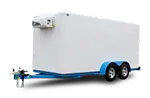


You’ve found the trailer. Maybe it’s a 22-foot Diamond C LPX equipment trailer in a 15,500 lb GVWR configuration, or a 7×16 enclosed cargo trailer. The advertised price is real, and now you’re wondering what the purchase will actually cost per month. That’s where a trailer loan calculator earns its keep.
Most people skip straight to the monthly payment and ignore the amount financed, APR, loan term, fees, and total finance charge underneath it. That’s a mistake. Understanding how the math works helps you negotiate smarter, compare offers on equal terms, choose an appropriate loan length, and avoid surprises when the final buyer’s order and financing documents are placed in front of you.
How Amortization Actually Works
A fully amortizing trailer loan is structured so that regular payments gradually repay both interest and principal. Early in the loan, a larger share of each payment generally goes toward interest because the outstanding balance is at its highest. As the balance drops, the interest charged for each period falls and more of the payment goes toward principal. On a low-rate or short-term loan, principal may still make up more than half of the first payment, so it is more accurate to say that the interest share is highest at the beginning, not that interest always consumes most of every early payment.
Three variables control the basic payment calculation:
- Principal, or the amount financed after adding any taxes, eligible fees, financed accessories, service products, or other charges and subtracting the down payment, trade credit, rebates, or other credits
- Interest rate, usually expressed in the contract as an annual rate, while the annual percentage rate (APR) may also reflect certain lender finance charges
- Term, or the number of months over which the loan is scheduled to be repaid
Change any one of those variables and the payment changes. Depending on the lender, borrower, trailer, loan amount, and whether the purchase is personal or commercial, available terms may include 36, 48, 60, 72, or 84 months. Longer terms reduce the required monthly payment but usually increase the total interest paid because the balance remains outstanding longer. Shorter terms require more cash each month but normally reduce the total borrowing cost.
Before relying on the formula, confirm that the proposed financing is a standard fixed-rate, fully amortizing loan. Some commercial equipment contracts may include a balloon payment, seasonal payment structure, variable rate, or other terms that a basic calculator will not model correctly.
The Payment Formula (Without the Math Degree)
The standard formula for estimating the payment on a fixed-rate, fully amortizing loan is:
Monthly Payment = P × [r(1+r)n] / [(1+r)n − 1]
In this formula, P is the amount financed, r is the monthly contract interest rate, and n is the number of scheduled payments. To convert an annual rate into a monthly decimal rate for a basic estimate, divide it by 12. For example, 7.5% becomes 0.075 divided by 12.
You don’t need to calculate this by hand. A standard online loan calculator or spreadsheet can do it instantly. It is still useful to understand what drives the result: the cost of a rate increase grows with the amount financed and the length of the term. A two-point increase on a $15,000 trailer loan costs less than the same increase on a $40,000 equipment trailer financed over the same number of months.
APR and the contract interest rate are not always identical. APR can account for certain finance charges in addition to interest, while the payment may be calculated using the contract rate and the stated amount financed. A calculator is therefore an estimate until you enter the exact figures from the lender’s disclosure. The examples below assume no lender fees, no balloon payment, and an APR equal to the contract interest rate.
A Worked Example
Say you’re looking at a tandem-axle dump trailer with a 10,000 lb GVWR and an illustrative selling price of $10,500. Remember that 10,000 lb GVWR is the maximum rated weight of the loaded trailer, not a 10,000 lb payload rating. Actual payload is found by subtracting the trailer’s empty weight and any installed equipment from its GVWR.
You put $2,500 down, leaving an $8,000 amount financed. To keep the example clean, assume that sales tax, title and registration charges, the dealer documentation fee, accessories, and any optional products are paid separately rather than added to the loan. (All rates and prices below are illustrative examples only. Actual approvals, rates, terms, down-payment requirements, and fees depend on the lender, your credit profile, the collateral, the intended use, and market conditions at the time of purchase.)
| Term | Illustrative APR | Monthly Payment | Total Interest Paid |
|---|---|---|---|
| 36 months | 7.5% | $248.85 | $958.59 |
| 48 months | 7.9% | $194.93 | $1,356.55 |
| 60 months | 8.4% | $163.75 | $1,824.82 |
The 60-month option lowers the scheduled payment by about $85.10 per month compared with the 36-month option. However, it adds approximately $866.23 in total interest over the full life of the loan. Minor differences of a few cents can occur because lenders round scheduled payments and may adjust the final payment.
Whether that trade-off makes sense depends on your cash flow, expected trailer use, emergency reserves, and how long you plan to keep the trailer. A contractor who needs to preserve working capital may make a different choice from a buyer who can comfortably handle the higher payment and wants to minimize interest.
Also notice that the illustration uses a slightly higher rate for each longer term. Some lenders price longer terms at higher rates because their money remains at risk for more time, but that is not an automatic rule. A lender could offer the same rate at multiple terms, restrict longer terms to larger loan amounts, or change the required down payment instead. Compare the actual offers rather than assuming that every 72-month loan must carry a higher APR than every 48-month loan.
What Changes the Numbers Most
Down Payment
A larger down payment immediately reduces the amount financed, which means less money is accruing interest. It also lowers the loan-to-value ratio, a factor lenders may consider when deciding whether to approve the transaction and what terms to offer. A larger down payment may improve the approval or rate, but it does not guarantee either result.
Consider a Diamond C LPX-GN low-profile gooseneck equipment trailer with a configured selling price of $25,000. Ten percent down is $2,500, while 20% down is $5,000. The second option reduces the amount financed by an additional $2,500. At an illustrative 8.0% rate for 48 months, with all other terms unchanged, that extra down payment lowers the monthly payment by about $61 and reduces total interest by approximately $430.
Use the actual out-the-door amount when running this comparison. Calculating the down payment from the advertised trailer price while ignoring taxes, accessories, a spare tire, upgraded ramps, a wireless controller, service products, or other financed items can make the estimated payment look lower than the final contract payment.
Credit Score
Your credit score can affect the rate, but it is not the only factor in a trailer-loan decision. Lenders may also consider payment history, debt-to-income ratio, income stability, requested term, loan amount, down payment, collateral value, trailer age, personal versus business use, and whether the borrower is applying individually or through a business entity.
There is no reliable rule that a particular score will always receive a rate exactly two or three percentage points below another score. Lender programs and underwriting standards differ. A more useful way to see the effect is to compare actual rates without tying them to a promised score range. On a $20,000 loan over 60 months, an illustrative 7.0% rate produces a payment of about $396.02 and total interest of about $3,761.44. At 10.0%, the payment is about $424.94 and total interest is about $5,496.45. That three-point difference adds roughly $28.92 per month and $1,735 in total interest.
That is real money that could otherwise pay for maintenance, tie-down equipment, a spare tire and mount, registration costs, or operating expenses. Obtaining a current prequalification from a bank, credit union, equipment lender, or other finance company gives you a better planning number than estimating a rate from your credit score alone.
New vs. Used Trailers
Lenders may offer different terms for new and used trailers because age and condition affect collateral value. A new trailer has a current invoice, a manufacturer’s statement of origin, and a configuration that is generally easier to document. A used trailer may require a title review, condition assessment, valuation, age limit, inspection, or additional down payment.
Quality pre-owned units, including H&H car haulers and Delco dump trailers, can still qualify for competitive financing. The result depends on the specific lender and trailer, not simply the brand name. A clean late-model trailer with a clear title and documented value may be easier to finance than an older unit with structural modifications, missing identification information, unresolved liens, or a price that is difficult to support.
Online Calculators Worth Using
You don’t need a specialized trailer-finance application. A few reliable tools can handle the standard amortization calculation:
- Bankrate Loan Calculator (bankrate.com), which provides payment estimates and an amortization schedule based on the amount, term, and rate entered
- Calculator.net Loan Calculator, which can model additional monthly payments and show how extra principal may change the payoff date and total interest
- Google Sheets or Microsoft Excel, where the PMT function can calculate a scheduled payment and a custom worksheet can compare multiple amounts, rates, down payments, and terms side by side
Calculator results are only as accurate as the numbers entered. Use the amount financed rather than the advertised price, make sure the annual rate is entered as a percentage rather than a whole number, and confirm that the term is expressed in months. Do not accidentally enter 7.5 as 750% or enter a 60-month loan as five payments.
Run the numbers at two or three term lengths before you enter any financing conversation. You should already know approximately what a 48-month and 60-month payment look like before someone recommends a 72-month term to make the purchase appear more affordable. Then compare the total of payments, not only the amount due each month.
A Quick Q&A on Common Confusion
Does the trailer type affect the loan rate?
It can, but there is no universal rate chart based only on trailer type. An enclosed cargo trailer, flatbed, utility trailer, dump trailer, equipment trailer, or gooseneck may be eligible for different lender programs depending on its price, age, GVWR, intended use, and title documentation. Larger high-GVWR trailers and trailers purchased primarily for business use are more likely to be considered for commercial or equipment financing, but GVWR alone does not automatically determine the loan category.
Can I pay off a trailer loan early?
Often, but the contract controls. Check the promissory note and financing agreement for a prepayment penalty, minimum finance charge, payoff fee, or precomputed-interest provision before signing. For a simple-interest loan with no penalty, paying principal earlier generally reduces future interest. Ask the lender how extra payments must be submitted and whether they are applied directly to principal rather than merely advancing the next due date. When you are ready to pay the balance in full, request an official payoff quote because the amount can include interest accrued through a specific date.
Is dealer financing the same as bank financing?
Dealer financing is commonly arranged through a third-party bank, credit union, finance company, or equipment lender. The dealer submits the application and presents an approved contract, while the third-party lender funds and services the loan. The rate initially quoted by a lender to a dealer may not be identical to the final contract rate offered to the customer, so compare the APR, amount financed, term, monthly payment, finance charge, total of payments, and any optional products included in the contract.
Getting a preapproval from your own bank or credit union gives you a useful comparison, but dealer-arranged financing may still be more convenient or competitive. Compare both using the same selling price, down payment, term, and financed products. A lower monthly payment is not a better offer if it is created by adding years to the term or rolling unnecessary products into the principal.
What GVWR threshold changes financing options?
There is no single 10,000 lb or 14,000 lb GVWR threshold that every lender uses. One lender may finance a 9,990 lb GVWR enclosed trailer through a consumer program and route a 14,000 lb GVWR unit through equipment financing, while another lender may base the decision primarily on business use, borrower type, loan amount, age, or collateral value. Ask the lender where its current program boundaries are rather than assuming the number printed on the VIN label automatically determines the loan.
Financing classifications should not be confused with towing and licensing laws. In Indiana, a trailer or semitrailer with a gross weight of at least 3,000 lb must have brakes that can be controlled from the towing vehicle and that apply automatically in a breakaway. For commercial-driver licensing, a trailer over 10,000 lb GVWR does not by itself create a federal Class A CDL requirement. The standard Class A threshold applies when the combination has a GCWR of at least 26,001 lb and the towed unit has a GVWR over 10,000 lb, subject to the applicable commercial-use rules and any exemptions. Always verify the tow vehicle ratings, hitch ratings, state requirements, and the rules that apply to your specific use.
Running Your Own Numbers Before You Shop
Start by setting a monthly payment that fits comfortably within your normal budget, not the maximum you could squeeze out during a good month. Leave room for insurance if applicable, registration, tires, bearings, brakes, hydraulic-system maintenance, tie-down equipment, truck operating costs, and unexpected repairs. A trailer that technically fits the loan-payment budget can still strain cash flow when those ownership expenses are ignored.
Next, build a realistic out-the-door figure. Start with the negotiated selling price, then add accessories and options, applicable sales or use tax, title and registration charges, the dealer documentation fee, and any optional products you deliberately choose to finance. Subtract your cash down payment, trade credit, rebates, or other credits. For an Indiana retail transaction, sales or use tax is generally 7% unless a valid exemption or different interstate treatment applies. Indiana also limits dealer document-preparation fees under state law, so review the itemized buyer’s order rather than accepting a single unexplained total.
Indiana residents generally must apply for title and register a newly acquired, unregistered trailer within 45 days of purchase to avoid an administrative penalty. Those deadlines do not change the amortization formula, but title and registration costs still belong in your purchase budget, and delaying the paperwork can create additional expense.
Use a current lender prequalification or written quote as your rate assumption whenever possible. If you do not have one yet, run several scenarios instead of treating one guessed APR as a promise. Test the payment at your expected rate, then test it again two or three percentage points higher. That stress test shows whether the purchase remains manageable if the final approval is less favorable than expected.
Once you have a realistic payment, rate range, and term, work backward to the principal that your budget supports. Run the calculation at 48 months and again at 60 months. That gives you a practical shopping range rather than a vague idea of what you might be able to afford.
When you browse inventory with that range in mind, you stop getting distracted by trailers that are thousands of dollars above your workable budget, and you can make faster decisions on the units that fit your towing needs, payload requirements, and finances.
The calculation also shows exactly what a larger down payment can accomplish. If the proposed payment is above your target because the amount financed is roughly $3,000 too high, additional cash down may close some or all of that gap without stretching the loan for another year or two. The calculator can show whether that approach produces a meaningful payment reduction before you commit the cash.
For a legitimate business purchase, possible tax deductions should be evaluated separately from the loan payment. Federal law restored 100% bonus depreciation for eligible qualified property acquired and placed in service after January 19, 2025, but eligibility depends on ownership, business use, acquisition details, property classification, and the taxpayer’s circumstances. A deduction does not reduce the contractual monthly payment, and it should not be treated as guaranteed cash back. Discuss Section 179, bonus depreciation, state treatment, and business-use documentation with a qualified tax professional.
If you want to talk through financing options on a specific trailer, reach out to the team at Spencer Trailers. We work with buyers on Diamond C, H&H, Liberty, Delco, and other brands every week, and we can help you review available lender options for different trailer types and credit situations. Approval, rates, and terms remain subject to each lender’s current underwriting requirements. The phone is (812) 829-0226.
The sticker price matters, but it is only the starting point. The figures that determine affordability are the out-the-door price, down payment, amount financed, APR, term, monthly payment, finance charge, and total of payments. Run those numbers before you’re sitting across from someone handing you paperwork, and you will be in a much better position to recognize a loan that fits your budget.


