












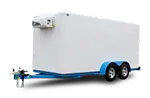


You’ve got a job lined up. Maybe two. You’re hauling equipment in borrowed pickups, renting trailers on weekends, making multiple trips with an undersized setup, or turning down work because you do not have the capacity. The trailer you need may cost anywhere from roughly $6,000 for a premium tandem-axle utility trailer to well over $15,000 for heavier equipment or dump configurations. The useful question is not simply whether you can make the payment. It is whether the trailer produces enough additional contribution margin to justify its full cost.
This post runs the actual numbers. It covers incremental revenue per job, direct operating expenses, monthly payments, upfront costs, cash-flow break-even, full-cost payback, and the month when the trailer begins producing more cash than it consumes. The figures are worked examples, not promises about what your business will earn. Replace them with your own invoices, job calendar, lender quote, insurance quote, fuel use, and out-the-door purchase price.
Start With the Payment
Begin with the exact trailer and its out-the-door price, not a broad category estimate. At the time of this update, Spencer Trailers has listed a Diamond C GTU235 83-inch-by-16-foot premium tandem-axle utility trailer at about $6,100. The GTU carries a 7,000 lb GVWR, uses dual 3,500 lb Lippert axles, and is built on a 4-inch channel frame. A current 20-foot Diamond C HDT207 split-deck tilt has been listed around $12,500. The HDT is a substantially heavier hydraulically dampened tilt equipment trailer with a 15,500 lb GVWR and dual 7,000 lb Lippert axles. Pricing changes with model year, length, GVWR package, tires, ramps, deck configuration, accessories, availability, and dealer discounts, so live inventory is the proper source for a current quote. :contentReference[oaicite:0]{index=0}
For this worked example, assume the signed retail installment contract shows an amount financed of $9,000. That could fit a 7×16 enclosed cargo trailer, a car-hauler-style open trailer, or another mid-size work trailer after the buyer’s down payment and trade allowance are applied. The amount financed should come from the final buyer’s order after the selling price, taxable charges, Indiana sales tax, title and registration costs, document-preparation fee, down payment, and any financed accessories have been accounted for. Indiana generally applies its 7% sales tax to trailer sales unless a specific exemption applies. :contentReference[oaicite:1]{index=1}
Use an illustrative 8.9% APR over 60 months. That is a math assumption, not a current financing offer and not a prediction of the rate any buyer will receive. On $9,000 financed, the payment is approximately $186.39 per month. Sixty scheduled payments total approximately $11,183.32, including about $2,183.32 in interest. A lender may also have late fees, returned-payment fees, optional products, or prepayment terms that are not included in this basic amortization example.
That $186.39 payment is only the debt-service portion of the monthly cost. A realistic ROI calculation also includes insurance, annual registration, tires, wheel bearings, brakes, breakaway-system maintenance, hydraulic-system maintenance where applicable, deck repairs, and any additional fuel caused by towing.
Revenue Per Job: What Are You Actually Bringing In?
This varies widely by trade, market, crew size, season, disposal cost, equipment mix, and the scope of each job. The figures below are illustrative planning inputs, not published Indiana rate averages. Use your own recent invoices whenever possible. A trailer does not create the entire invoice by itself, so the final column should reflect a conservative workload you can actually service.
| Trade / Use Case | Trailer Needed | Illustrative Gross Billing | Jobs/Month (Conservative) |
|---|---|---|---|
| Lawn care / landscaping | 16-ft Diamond C GTU utility trailer or properly rated equipment trailer | $150 to $400 per service day | 12 to 20 |
| Small contractor (tools + materials) | 7×16 enclosed cargo trailer | $400 to $1,200 per completed job | 4 to 8 |
| Equipment rental / delivery | 20-ft equipment trailer or tilt deck sized to the machine | $200 to $600 per billed delivery or haul | 6 to 10 |
| Demo / debris hauling | Diamond C LPT, MDT, or DOD dump trailer selected for the load | $300 to $700 per billed load | 8 to 15 |
For the worked example, use a landscaper running a single crew with a 16-ft open utility trailer. The business bills an average of $250 per service day and completes 14 service days per month during its working season. Monthly trailer-enabled gross billings are therefore $3,500.
That is gross revenue, not trailer profit. It still includes labor, fuel, fertilizer, mulch, disposal charges, equipment wear, card-processing fees, and other job costs. It may also include work the company could have completed without owning this particular trailer. Counting the entire $3,500 as trailer profit would produce a misleadingly fast payback period.
The Right Way to Think About “Trailer Revenue”
There are two scenarios worth separating:
Scenario A: You already perform some work, but the trailer allows you to accept larger jobs, combine equipment into one trip, reduce rental days, add a crew, or complete additional jobs you would otherwise decline. In this situation, count only the incremental revenue and savings made possible by ownership.
Scenario B: You are starting a business and the trailer is day-one infrastructure. A larger share of revenue may depend on the trailer, but you still should not call all business revenue trailer profit. Labor, materials, equipment, marketing, licensing, insurance, and the tow vehicle are also required to earn that money.
Most buyers are somewhere in between. They are already working but are limited by trailer capacity, rental availability, loading time, security, or the number of trips required. The trailer removes part of that limitation.
A conservative planning method is to attribute 60% of the trailer-enabled gross billings to trailer ownership. For the landscaper, $3,500 multiplied by 60% equals $2,100 per month in incremental trailer-attributed revenue. The 60% figure is only a modeling assumption. A buyer with reliable records may find that the correct attribution is 25%, 80%, or another percentage.
Next, subtract the direct expenses required to produce that incremental revenue. Assume direct costs equal 35% of the $2,100, or $735 per month. That leaves $1,365 per month in contribution margin before the trailer’s payment and other fixed carrying costs. This step matters because revenue cannot repay a trailer if most of that revenue is consumed by labor, materials, disposal, subcontractors, or additional equipment expenses.
The Break-Even Calculation
There are two useful break-even measures. Cash-flow break-even is the point when cumulative after-expense cash generated by the trailer covers the cash you paid at purchase. Full-cost payback is the point when the trailer has generated enough contribution to recover the down payment, the entire scheduled principal and interest cost, and setup expenses. These numbers are different, and both are more useful than dividing the sticker price by gross revenue.
Upfront costs to account for in this example include:
- Down payment: $1,000
- Indiana title fee: $15
- Indiana registration fee for a trailer rated at no more than 9,000 lb: $25.35 before any other applicable taxes or fees
- Rated hitch hardware, brake-controller work, wiring, or other towing setup: $250 planning allowance
- Sales tax and any dealer charges not already included in the stated amount financed
The Indiana BMV fee chart lists a $15 title fee, a $25.35 registration fee for a trailer of 9,000 lb or less, and different treatment for other trailer classes. Additional taxes and fees may apply. An Indiana buyer generally must apply for the certificate of title within 45 days after purchase to avoid the administrative penalty. As of July 1, 2026, the Indiana Auto Dealer Services Division states that it will not take enforcement action on document-preparation fees at or below $261.72; the fee must be disclosed, shown as a separate line item, and handled in accordance with Indiana advertising requirements. :contentReference[oaicite:2]{index=2}
Using the figures above, the example has $1,290.35 in upfront cash. That consists of the $1,000 down payment, $15 title fee, $25.35 base registration fee, and the $250 setup allowance. The example assumes sales tax and any applicable dealer charge have already been included when arriving at the $9,000 amount financed. Never assume that is true without checking the buyer’s order.
Now add recurring costs. Use the $186.39 payment, an illustrative $25 monthly insurance cost, and a $35 monthly maintenance and registration reserve. Actual commercial trailer insurance can vary substantially based on trailer value, use, storage, claims history, coverage limits, and whether physical-damage coverage is purchased. The $35 reserve is not a bill due every month; it is money set aside for tires, brakes, bearings, deck repairs, annual registration, breakaway components, and other ownership expenses.
Total modeled monthly fixed cost is therefore $246.39. Monthly contribution after direct job expenses and trailer fixed costs is $1,365 minus $246.39, or approximately $1,118.61.
Cash-flow break-even on the upfront money is $1,290.35 divided by $1,118.61, which equals approximately 1.15 months. Under these assumptions, the business recovers its initial cash investment shortly after the first full month of operation. The loan, however, is still outstanding, so this is not the same as recovering the trailer’s complete financed cost.
For full-cost payback, add the $1,290.35 upfront amount to the $11,183.32 in scheduled loan payments. Total modeled acquisition cost becomes $12,473.67. Because the full loan payments are already included in that total, do not subtract the monthly payment again from the payback denominator. Instead, use the $1,365 contribution before debt service and subtract only the $25 insurance assumption and $35 ownership reserve. That leaves $1,305 per month available to recover the acquisition cost.
$12,473.67 divided by $1,305 produces a full-cost payback period of approximately 9.6 months. That is a much more defensible ROI estimate than treating every dollar of trailer-enabled billing as profit. After the full-cost payback point, the trailer can continue contributing cash, but it will still incur insurance, maintenance, registration, fuel, repair, and eventual replacement costs.
What Changes the Math
That 9.6-month result can move dramatically based on three levers:
1. How Much Work the Trailer Enables
A landscaper running 14 service days per month at $250 per day looks very different from one running eight days at $180. At eight days and $180, gross trailer-enabled billing is $1,440. Applying the same 60% attribution produces $864 in incremental trailer revenue. Subtracting the same assumed 35% direct-cost ratio leaves $561.60 before trailer fixed costs.
After the $246.39 monthly fixed cost, the lower-volume scenario produces approximately $315.21 in monthly after-debt cash contribution. Upfront cash break-even extends to approximately 4.1 months. Full-cost payback, using the entire $12,473.67 acquisition cost and subtracting the $60 in non-finance carrying costs from the $561.60 contribution, extends to approximately 24.9 months.
The lesson is simple: before financing, map your realistic job calendar. Use your conservative calendar, not your best-ever month multiplied by 12. Include rain days, cancellations, winter slowdown, equipment downtime, unpaid invoices, disposal costs, and the possibility that some customers will not accept your target price.
2. The Interest Rate
Compare the complete dealer financing offer with quotes from your bank, credit union, and other legitimate lenders. Dealer-arranged financing may be competitive because the participating lenders understand trailer collateral, but it is not automatically cheaper than every outside option. Compare APR, term, total of payments, down payment, required insurance, prepayment terms, collateral requirements, and optional products rather than comparing only the monthly payment.
On the same $9,000 amount financed for 60 months, a 7.9% APR produces a payment of approximately $182.06, while an 11.9% APR produces a payment of approximately $199.75. The difference is about $17.69 per month and approximately $1,061.30 in total interest over the full term. That matters, but a lack of profitable work can damage ROI much faster than a four-percentage-point rate difference.
3. Whether You Rent vs. Buy
Do not use a generic internet rental rate. Call the rental companies you would actually use and price the exact trailer class, reservation period, mileage policy, damage waiver, deposit, taxes, after-hours return rules, and availability during your busiest months. Then multiply the real out-the-door daily cost by the number of rental days you expect.
For example, if your actual rental quote is $100 per day and you need the trailer eight days each month, rental expense is $800 per month before pickup time, return time, deposits, and scheduling risk. In the ownership example, modeled monthly fixed cost is $246.39, although ownership also commits you to repairs, storage, insurance, and long-term debt. If you need the trailer only six times per year, rental may still be the financially safer option. The correct comparison is annual rental cost versus annual ownership cost, not rental price versus loan payment alone.
Cargo Trailers: A Slightly Different Calculation
An enclosed cargo trailer has a different ROI profile because it can enable work while also protecting tools, reducing loading time, improving organization, and providing an advertising surface. At the time of this update, Spencer Trailers has listed a 2026 Darkhorse 7×16 enclosed cargo trailer with a 7,000 lb GVWR, dual 3,500 lb axles, electric brakes, a rear ramp door, and a 7-foot interior height at approximately $8,300. Comparable prices vary with manufacturer, construction, interior height, axle package, wall and floor spacing, roof design, door configuration, spare tire, electrical equipment, and interior finish. :contentReference[oaicite:3]{index=3}
The ROI for an enclosed trailer can include:
- Reduced weather exposure for tools, materials, and finished components
- Improved theft deterrence when the trailer has suitable locks, secure parking, and appropriate insurance
- Less crew time spent loading and unloading tools at the beginning and end of each day
- A mobile, branded advertising surface when professionally lettered or wrapped
- Fewer trips or reduced need for an additional truck when the load remains within every applicable rating
Do not assign an arbitrary dollar value to the wrap. Use a dedicated phone number, landing page, QR code, or lead-source field so you can track inquiries generated by the trailer. Then calculate advertising contribution as qualified leads multiplied by close rate multiplied by contribution margin per completed job. A $400 invoice is not $400 of advertising profit if labor and materials consume half of it.
Security savings also need to be handled carefully. An enclosed trailer can reduce weather exposure and casual access, but it does not guarantee that tools will not be stolen. Confirm whether the trailer itself has comprehensive and collision coverage, whether permanently installed equipment is covered, and whether loose tools and customer property require inland marine, contractor’s equipment, or another separate policy.
Browse the current Spencer Trailers inventory to see what is in stock now across Diamond C, H&H, Darkhorse Cargo, Legend, Liberty, United, and other available lines. Inventory, prices, model years, discounts, and option packages change regularly. :contentReference[oaicite:4]{index=4}
A Quick Q&A on the Numbers People Actually Ask
Do I need to count fuel as a trailer cost? Yes. Use your actual solo and towing fuel economy rather than a universal percentage. The formula for additional fuel on miles you would have driven anyway is: towing miles multiplied by the difference between one divided by towing MPG and one divided by solo MPG, then multiplied by fuel price. At 50 miles, 18 MPG without the trailer, 13 MPG while towing, and $3.50 per gallon, the incremental fuel cost is approximately $3.74, not $6 to $8. If the trailer causes an entirely new trip, count all fuel used on that trip rather than only the mileage-efficiency difference.
What about depreciation? Separate market depreciation from tax depreciation. Market value depends on age, condition, maintenance records, tires, brakes, deck condition, corrosion, modifications, accident history, model demand, and the local used-trailer market. Do not assume every trailer will retain a fixed percentage of its purchase price. Estimate future resale using comparable used listings and use a conservative number in the ROI model.
Tax depreciation is different. IRS guidance states that qualifying business property acquired and placed in service after January 19, 2025 may be eligible for 100% additional first-year bonus depreciation. Eligibility depends on the property, acquisition date, placed-in-service date, business use, ownership structure, related-party rules, elections, and the taxpayer’s circumstances. A deduction reduces taxable income; it is not a dollar-for-dollar rebate and should not be entered as operating revenue. Review the purchase with a qualified tax professional before relying on Section 179 or bonus depreciation in the decision. :contentReference[oaicite:5]{index=5}
What if I cannot fill the payment some months? Seasonal trades should model annual cash flow rather than expecting every month to carry itself. At $186.39 per month, annual debt service is approximately $2,236.68. Including the example insurance and maintenance reserves raises annual modeled fixed cost to approximately $2,956.68. Make sure the cash surplus from the busy season covers all 12 payments, insurance, maintenance, taxes, and slower months.
A 60-month term lowers the required payment compared with a shorter term, but it normally increases total interest and leaves the debt outstanding longer. The right term is the shortest payment schedule the business can handle comfortably under conservative revenue assumptions, while still maintaining an emergency reserve.
Does the tow vehicle change ROI? Absolutely. Check the truck’s receiver rating, payload sticker, rear-axle rating, gross vehicle weight rating, gross combination weight rating, tire ratings, hitch rating, and the loaded trailer’s actual tongue or pin weight. Payload is often the limiting number, especially once passengers, tools, fuel, bed equipment, and hitch hardware are added. If the trailer requires a different truck, gooseneck installation, weight-distribution equipment, brake controller, suspension work, or commercial registration, those costs belong in the ROI model.
What legal thresholds should an Indiana contractor consider? Indiana requires a trailer or semitrailer with a gross weight of at least 3,000 lb to have brakes that the driver can apply from the tow vehicle, along with automatic brake application in a breakaway. For CDL classification, the important Class A threshold is generally a combination GCWR or actual combination weight of at least 26,001 lb, with the towed unit having a GVWR or actual weight greater than 10,000 lb. A trailer rating over 10,000 lb does not by itself create that Class A threshold when the complete combination remains below 26,001 lb, although other commercial-motor-vehicle rules may still apply. :contentReference[oaicite:6]{index=6}
The Actual Decision Point
Run your own numbers before you walk onto a lot. You need three groups of figures:
- Your realistic monthly incremental revenue or rental savings enabled by owning the trailer, using documented invoices and a conservative attribution percentage
- Your incremental job expenses and monthly ownership costs, including labor, materials, disposal, fuel, payment, insurance, registration reserve, maintenance, tires, brakes, storage, and expected repairs
- Your upfront cash and total acquisition cost, including down payment, sales tax, title, registration, disclosed dealer charges, hitch or brake-controller work, accessories, and total scheduled loan interest
Calculate monthly contribution before the trailer’s fixed costs, then subtract the payment and recurring ownership expenses. If that result is negative in the conservative scenario, the trailer does not support its own monthly cash flow. If it is positive but small, determine whether the business has enough reserves to handle winter, repairs, delayed customer payments, and an unexpected truck expense.
There is no honest universal three-to-eight-month payoff window for every contractor in Owen County or the surrounding area. In the stronger worked scenario above, upfront cash break-even occurs in about 1.15 months and full-cost payback occurs in about 9.6 months. In the lower-volume scenario, those figures extend to about 4.1 months and 24.9 months. A buyer with higher direct costs, fewer jobs, a larger trailer, or a tow-vehicle upgrade could take considerably longer.
Choose the trailer by the actual load, not by the payment alone. A 7,000 lb Diamond C GTU can be a practical fit for mowers, compact equipment, ATVs, and general landscaping work when payload and dimensions are sufficient. A 15,500 lb Diamond C HDT is a different class of trailer intended for heavier equipment, with a hydraulically dampened tilt system and substantially different tow-vehicle, hitch, registration, operating, and potentially CDL considerations. The trailer’s GVWR is not its payload; subtract the trailer’s actual empty weight and account for tongue weight, installed options, tools, attachments, fuel, and securement equipment.
If you want to discuss the numbers for a specific setup, whether that is a 7,000 lb utility trailer for a landscaping crew, a 7×16 enclosed cargo trailer for tools, or a 15,500 lb HDT for machinery hauling, the team at Spencer Trailers can provide current inventory details and payment estimates based on an actual application. Reach out here or call (812) 829-0226. Bring the machine weights, dimensions, tow-vehicle ratings, expected down payment, and conservative monthly job volume so the conversation begins with the complete operating picture rather than the payment alone.


