





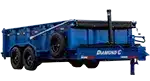

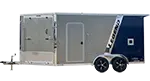
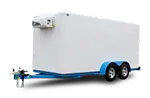
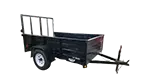

You found the trailer. The price looks fair. The financing offer is sitting right there. And the question nagging you is the one many buyers skip until they are standing at the desk: how much should I put down?
It is a real decision with real consequences, not just a formality. The wrong down payment can increase your monthly obligation, add unnecessary interest, or leave you cash-poor heading into your first hauling season. The right amount depends on the lender’s approval, the total amount financed, your credit profile, the type and age of the trailer, whether it will be used personally or commercially, and how much cash you need to keep available after the purchase.
Remember that the down payment is not always the entire amount due at signing. Sales tax, title and registration charges, an applicable documentation fee, optional accessories, delivery, insurance, service contracts, and other approved products may affect either the cash required at closing or the final amount financed. Start with a complete buyer’s order rather than calculating from an advertised trailer price alone.
What’s a Typical Down Payment on a Trailer?
There is no universal down payment requirement for trailer financing. As a practical planning range, many buyers start by calculating 10% to 20% of the trailer’s selling price. That is a useful savings target, but it is not a promise of approval or an industry-wide lender rule. A well-qualified borrower may be offered a lower down payment, including a qualifying zero-down program, while another borrower may need 20%, 30%, or more.
For example, 10% to 20% down on a trailer with a hypothetical $12,000 selling price would be $1,200 to $2,400. On a 7×14 enclosed cargo trailer with a hypothetical selling price of $7,500, the same planning range would be $750 to $1,500. Those calculations are based on the trailer price only. Your actual transaction may include taxes, registration, accessories, a spare tire, a weight-distribution hitch, a brake controller, delivery, or other items.
Do not assume that one credit-score cutoff automatically determines the required down payment. Lenders may evaluate payment history, debt obligations, income, housing history, recent credit inquiries, the requested term, the amount financed, the trailer’s value, and whether the application is personal or commercial. Business applications may also require information about time in business, cash flow, bank statements, ownership, and a personal guarantor.
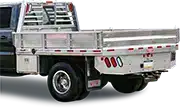
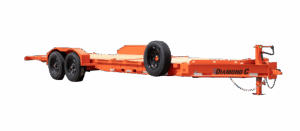
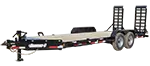
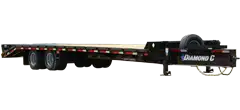
Commercial and heavy-haul trailers are often underwritten differently from smaller personal-use trailers. A Diamond C FMAX gooseneck flatbed, LPT telescopic dump, LPX equipment trailer, or HDT hydraulically dampened tilt trailer may involve a substantially larger amount financed than a light utility trailer. Depending on the borrower, use, configuration, and lender program, the application may require additional documentation, a larger equity contribution, or proof of appropriate insurance.
The most accurate answer is therefore not, “Every trailer requires 10% down.” It is, “Use 10% to 20% as an initial planning range, then obtain an actual approval and written buyer’s order.” The approved down payment can change when the lender receives the final trailer VIN, purchase price, accessories, trade information, and amount requested.
How Your Down Payment Changes the Numbers
The most obvious effect is on your loan balance. More money down means less money financed, which normally produces a lower monthly payment and less interest over the same loan term. That part is automatic as long as the other loan assumptions remain unchanged.
A larger down payment can also improve the transaction’s loan-to-value ratio. Loan-to-value compares the amount being financed with the lender’s recognized value of the collateral. A lower ratio may help with approval and may qualify a borrower for different terms, but a larger down payment does not automatically guarantee a lower annual percentage rate. Each lender uses its own credit and pricing criteria.
When comparing offers, pay attention to the annual percentage rate, or APR, rather than looking only at the advertised interest rate or monthly payment. APR is designed to reflect the cost of credit more completely when certain finance charges apply. Also compare the term, total of payments, total finance charge, amount due at signing, lender fees, and any prepayment provisions.
Run the actual math. The following example assumes a trailer selling price of $15,000, a 60-month loan, a fixed 8.5% APR, no taxes or additional fees financed, and no change in APR between down payment levels. It is an illustration only, not a current lender quote:
| Down Payment | Loan Amount | APR (illustrative) | Monthly Payment | Total Interest Paid |
|---|---|---|---|---|
| 5% ($750) | $14,250 | 8.5% | About $292 | About $3,292 |
| 15% ($2,250) | $12,750 | 8.5% | About $262 | About $2,945 |
| 25% ($3,750) | $11,250 | 8.5% | About $231 | About $2,599 |
Going from 5% to 25% down in this example requires another $3,000 at signing. In exchange, it reduces the scheduled payment by approximately $61 per month and saves approximately $693 in interest over five years. If the larger down payment also qualifies the borrower for a lower APR, the potential savings would be greater. If the lender offers the same APR at every down payment level, the savings come entirely from borrowing less.
That does not automatically make the largest down payment the best choice. You are exchanging liquid cash today for a lower payment and lower future interest. The correct comparison is not simply “Which payment is lowest?” It is “Is the interest saved worth tying up this amount of cash?”
Use the lender’s actual figures when making the final decision. Online payment calculators are useful for planning, but they may not include taxes, finance charges, optional products, irregular first-payment dates, or lender-specific rounding. The contract and federal lending disclosures control the transaction.
Using a Trade-In as Your Down Payment
A lot of buyers overlook their trade-in as a down payment tool. If you have an older trailer that you are replacing, its net trade equity can be applied toward the new purchase. Dealers such as Spencer Trailers regularly evaluate trades, but the usable equity is not always the same as the trade allowance shown on the buyer’s order.
Net trade equity is generally the agreed trade value minus any outstanding loan payoff. If your trailer receives a $2,500 trade allowance and has no lien, the full $2,500 may be available as equity. If the same trailer has a $1,000 payoff, the net equity is $1,500. A trade with a payoff greater than its appraised value has negative equity, which can increase the requested amount financed if the lender permits it.
For example, a lien-free trade valued at $2,500 against a trailer with a $16,000 selling price represents 15.6% of that selling price before considering taxes, fees, accessories, or other charges. If the lender requires 20% equity, adding $700 in cash would bring the combined cash-and-trade contribution to $3,200, or 20% of the $16,000 selling price.
The lender may calculate the transaction using the full out-the-door amount rather than the trailer price by itself. That is why a nominal 20% contribution based on the advertised price may produce a lower effective percentage after taxes, registration, accessories, and other approved charges are added.
Trade value depends on more than the trailer’s size and age. Appraisers may consider the title and VIN, frame condition, corrosion, tires, wheels, bearings, suspension, coupler, jack, lights, wiring, brakes, breakaway system, floor, roof and wall condition on enclosed trailers, hydraulic system condition on dump or tilt trailers, previous repairs, and local resale demand. Clean ownership documents and maintenance records can make the evaluation easier.
Before spending heavily on trade-in repairs, ask whether the work is likely to improve the appraisal enough to justify its cost. Cleaning the trailer, removing personal equipment, repairing inexpensive lights, locating the title, and gathering service records may help. New tires, major flooring work, hydraulic repairs, or body repairs may not return their full cost in trade value.
One thing to confirm is how the lender treats trade equity. Some programs accept the net trade amount as the entire required equity contribution. Others may limit the transaction’s loan-to-value ratio, require additional cash, or decline to finance negative equity. Ask the dealer to show the trade allowance, lien payoff, net equity, cash down payment, and final amount financed as separate line items.
Saving Toward a Down Payment: Practical Approaches
If you are not ready to buy yet, the time between now and signing is your best tool. Begin by identifying the type of trailer you need, verifying the tow vehicle’s ratings, and requesting a realistic purchase estimate. Saving toward an arbitrary number is much harder than saving toward a written target.
- Set a complete target. Pick the trailer category and obtain a current price or buyer’s-order estimate. Calculate several down payment options, such as 10%, 15%, 20%, and 25%. Include a separate estimate for taxes, title, registration, accessories, insurance, and any equipment needed to tow safely. If the trailer price is $10,000, a 20% price-based target is $2,000, but that may not represent the entire amount due at signing.
- Separate the savings. Keep the down payment fund separate from routine checking-account money. An insured savings account can preserve access while reducing the temptation to spend it. A short-term certificate of deposit may be appropriate when the purchase date is predictable, but check the maturity date and early-withdrawal terms before locking up the money.
- Protect your trade value. If you plan to trade an existing trailer, address routine maintenance and safety issues before neglect causes larger damage. Keep the title, registration, receipts, and lien information organized. Do not assume every major repair will add an equal amount to the appraisal.
- Watch actual inventory and promotions. Trailer discounts are tied to inventory age, manufacturer programs, configuration, demand, and dealership strategy. Some dealers discount specific prior-model-year units, but there is no guaranteed fall clearance cycle for every trailer. Follow the actual unit, stock number, and written price rather than waiting for a seasonal discount that may never appear.
Build a separate post-purchase reserve as well. Depending on the trailer and tow vehicle, you may need a brake controller, hitch components, gooseneck equipment, safety chains, cargo securement, a spare tire, wheel chocks, locks, insurance, bearing service, hydraulic maintenance, or replacement tires. A down payment that empties your account can leave you owning the trailer but unable to put it to work properly.
It can also help to prequalify before your savings period ends. Some lenders offer prequalification using a soft credit inquiry, while a complete application may involve a hard inquiry. Read the authorization carefully so you know which type of credit review is being performed. Prequalification is an estimate of potential buying power, not a final approval.
When to Put More Down
A larger down payment makes sense when it materially improves approval, lowers the amount financed, keeps the payment within a comfortable budget, or reduces the risk of owing more than the trailer is worth. It may be particularly useful when choosing a long loan term, purchasing a used or highly customized trailer, financing taxes and accessories, or buying a unit with a narrower resale market.
More down may also help when the credit application is marginal. A lender that is uncomfortable financing the full requested amount may approve a smaller balance after the buyer contributes additional equity. There is no single credit score at which a particular down payment guarantees approval, however. A larger down payment cannot correct unverifiable income, excessive monthly obligations, serious unresolved credit problems, or a payment that remains unaffordable.
Look at how long you expect to own the trailer. If you may sell or trade it within a year or two, a larger down payment can reduce the chance that the payoff exceeds the trailer’s trade or private-sale value. This is especially important when the transaction includes taxes, optional equipment, negative trade equity, service products, or other charges that may not add equivalent resale value.
A larger down payment can also be appropriate for a personal-use purchase when you have a fully funded emergency reserve and no higher-cost debt competing for the money. On a lower-priced utility trailer, compare the total finance charge and any minimum loan amount with the return you receive from keeping the cash. Financing a small balance over a long term may produce a convenient payment but an inefficient overall transaction.
Do not confuse a large down payment with safe towing capacity. Paying 25% or 50% down does not change the trailer’s GVWR, axle ratings, payload capacity, hitch requirements, brake requirements, or the tow vehicle’s ratings. Those limits are established by the equipment and applicable law, not by the loan balance.
When to Put Less Down
Cash has value beyond reducing a loan. If you are buying a trailer for a business and need working capital, tying up several thousand dollars in the down payment may not make sense. The trailer may help generate revenue, but the business still needs money for insurance, registration, fuel, materials, labor, advertising, maintenance, repairs, and the time between completing a job and receiving payment.
Suppose a contractor is considering a $4,000 down payment on an enclosed cargo trailer. Using $2,000 instead may create a higher monthly payment and more interest, but it also leaves $2,000 available for shelving, tools, materials, and operating expenses. That can be reasonable when the payment remains affordable and the retained cash has a defined business purpose. Keeping cash without a plan while carrying unnecessary debt is a different decision.
The same logic can apply when you have substantially higher-interest debt. For example, directing extra cash toward a credit-card balance charging a hypothetical 22% APR may save more interest than using the same cash to reduce a secured trailer loan charging a hypothetical 7% APR. Compare actual APRs, fees, tax effects, repayment terms, and cash-flow needs before deciding.
There is also an opportunity-cost question. If retained business cash can produce a reliable after-tax return greater than the trailer loan’s after-tax cost, financing more of the purchase may make financial sense. Use realistic results rather than an optimistic revenue estimate, and account for the risk that work may slow down while the loan payment continues.
Business buyers should also discuss depreciation with a qualified tax professional. Under current federal law, qualified property acquired and placed in service after January 19, 2025, may be eligible for 100% bonus depreciation. Section 179 may also be available when its separate requirements are met. A qualifying trailer’s tax treatment generally depends on factors such as business use, tax basis, placed-in-service date, eligibility, taxable income, and later recapture rules, not simply on how large the down payment was.
A tax deduction does not make the trailer free, and it does not create cash when a payment is due. Do not borrow more solely to obtain a deduction. The financing decision should work without assuming a particular tax result, and your accountant should confirm the treatment based on your business and the exact trailer purchase.
A Quick Q&A
Can I finance a trailer with no down payment?
Some lender programs offer zero-down financing to qualified borrowers. Approval depends on the lender, credit profile, collateral, purchase amount, term, and intended use. Zero down may refer only to the trailer price; taxes, registration, fees, insurance, or accessories may still be due or added to the amount financed. Review the written approval rather than assuming “zero down” means zero cash required.
Does a bigger down payment shorten my loan term?
Not automatically. The down payment and loan term are separate parts of the transaction. A larger down payment reduces the balance, but the loan can still be written for the same number of months. It may give you the flexibility to select a shorter term while keeping the payment manageable. Compare both options because a shorter term usually reduces total interest but increases the required monthly payment.
What if I put down more than the dealer requires?
You can often contribute more than the required amount, subject to the lender’s minimum amount-financed rules and program limits. Some buyers put 30%, 40%, or 50% down to reduce the payment or avoid financing taxes and accessories. Ask whether the lender has a minimum loan balance and whether reducing the amount financed changes the available term or promotional rate.
Is a large down payment the same as making an early loan payment?
No. The down payment is applied before the loan is created and reduces the original amount financed. An extra payment is made after the loan begins. If you plan to pay the loan off early or make additional principal payments, read the contract and confirm how extra payments are applied. Prepayment policies vary by lender and loan program.
Can my trade-in cover the entire down payment?
It may, provided the trailer has sufficient net equity and the lender accepts that equity under its program. The relevant figure is the trade allowance minus any loan payoff. The lender may still require cash if the final loan-to-value ratio, amount financed, or approval conditions call for it.
Should I use every dollar of available savings?
Usually not without first accounting for emergencies and ownership costs. Keep enough cash for household or business reserves, insurance, towing equipment, securement gear, maintenance, and unexpected repairs. A lower payment is helpful, but not when it leaves you unable to handle the first surprise expense.
Does the down payment affect GVWR, brakes, or CDL requirements?
No. Financing has no effect on legal weight ratings or equipment requirements. In Indiana, a trailer with a GVWR over 3,000 pounds is generally required to have brakes. For commercial licensing, a Class A CDL is generally implicated when the combination has a GCWR of 26,001 pounds or more and the trailer has a GVWR over 10,000 pounds, subject to the operation involved and any applicable exemptions. Check the tow vehicle, trailer ratings, registration, insurance, and licensing requirements separately from the financing decision.
Can I deduct the down payment as a business expense?
The down payment itself is not normally treated as a separate immediate operating expense simply because cash changed hands. A business-use trailer may be depreciated under the rules that apply to the asset, and qualifying interest may receive separate tax treatment. Have a tax professional determine the trailer’s basis, depreciation method, business-use percentage, interest treatment, and any future recapture.
Make the Decision Before You’re at the Desk
The best time to think through your down payment is before you are sitting in the finance office with paperwork in front of you. Identify the exact trailer, request a written price, estimate the complete out-the-door amount, and run the numbers at several down payment levels. Ten percent, 15%, 20%, and 25% are useful comparison points even when the lender ultimately approves a different structure.
For every scenario, write down the cash due at signing, amount financed, APR, term, monthly payment, total finance charge, total of payments, insurance requirement, and prepayment terms. Then ask three practical questions: Does the payment fit comfortably? Will I still have an adequate cash reserve? Is the interest saved by putting more down worth the loss of liquidity?
Do not choose a down payment only to reach a target monthly payment. A lender can also lower the payment by extending the term, which may increase total interest and leave the balance declining more slowly. Compare the total cost, not just the monthly number printed in the largest type.
If you’re shopping Spencer Trailers’ current inventory and want to talk through financing before you come in, reach out to the team at (812) 829-0226. Financing programs, rates, terms, and down payment requirements are subject to lender approval and can change. The right down payment for a Diamond C FMAX gooseneck flatbed is different from the right amount for a lower-cost tandem utility trailer such as the 7,000 lb GVWR Diamond C GTU. Get specific numbers for the actual trailer before you commit.


