







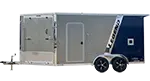
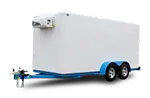


A full cord of green oak can weigh roughly 5,000 to 5,500 pounds, depending on the oak species, moisture content, how the wood is cut, and how tightly it is stacked. A cord of properly seasoned oak at about 20 percent moisture content may still weigh around 3,600 to 3,700 pounds. Those numbers stop sounding abstract when you remember that a trailer’s payload is not the same as its GVWR. On many 7,000-lb GVWR utility trailers, one cord of green oak can use all the available payload or put the trailer over its rating.
Firewood hauling trips up trailer owners because a pile of split wood can look manageable while carrying far more weight than expected. The deck may have enough physical space, the tires may not look flat, and the truck may still move the load. None of those observations proves that the trailer is within its GVWR, axle ratings, tire ratings, hitch rating, or the truck’s limits. A certified scale is the most reliable way to know what the combination actually weighs.
Green vs. Seasoned: The Weight Math Actually Matters
A standard full cord is a stacked volume of 128 cubic feet, traditionally measured as a pile 4 feet high, 4 feet deep, and 8 feet long. The weight of that cord varies substantially. Species density, moisture content, split size, bark, dirt, ice, stacking gaps, and the percentage of solid wood inside the measured volume all affect the final number.
Green hardwood contains a large amount of water and can be dramatically heavier than the same wood after drying. As a practical planning range, green oak can approach approximately 5,000 to 5,500 pounds per cord. Some mixed hardwood loads will be lighter, while exceptionally dense or wet loads may be heavier. Green pine is generally lighter than green oak, but a full cord can still weigh several thousand pounds. Pine should not automatically be treated as a light load merely because it is a softwood.
Properly seasoned hardwood is lighter, but it is not lightweight cargo. Oak near 20 percent moisture content may weigh approximately 3,600 to 3,700 pounds per cord, with meaningful variation from one load to another. Drying time by itself does not establish that firewood is seasoned. Wood cut and stacked for 12 months may still be wet if it was stored in shade, covered incorrectly, left in long rounds, or exposed to poor airflow. A moisture meter used on a freshly split face gives you better information than the calendar alone.
A “face cord” also needs clarification before you calculate weight. The term is not a universally fixed volume. It is often used for a stack 4 feet high and 8 feet long with pieces approximately 16 inches deep, which would equal about one-third of a full cord. If the pieces are 12, 18, 20, or 24 inches long, the actual volume changes. Ask for the stack dimensions instead of relying only on the name.
So if you are buying freshly cut oak from a logger in Owen County and loading it directly onto your trailer, using 5,000 pounds per full cord as a starting estimate is reasonable, but it is not a substitute for weighing the load. Planning around the upper end of the likely range gives you a safer margin for wet wood, bark, tools, tarps, and other cargo.
Know Your GVWR Before You Stack a Single Piece
GVWR, or Gross Vehicle Weight Rating, is the maximum total loaded weight assigned to the trailer by its manufacturer. It includes the trailer itself, the firewood, ramps, tools, mounted accessories, spare equipment, and every other item carried by or added to the trailer. The rating is shown on the trailer’s certification or VIN label and should never be treated as a suggested target that can be exceeded when the trip is short.
Available payload is calculated by subtracting the trailer’s actual empty weight from its GVWR. Published empty weights are useful for planning, but optional ramps, taller sides, tarps, spare tires, upgraded flooring, toolboxes, batteries, hydraulic equipment, and other options can change the finished weight. For the most accurate calculation, weigh the specific trailer as equipped.
Here are current examples that show how much payload different configurations may provide:
| Trailer Type | GVWR | Approx. Empty Weight | Usable Payload |
|---|---|---|---|
| 2026 Liberty LU 83×14 tandem-axle utility | 7,000 lb | 1,850 lb | ~5,150 lb |
| Diamond C LPT207 14-ft dump with 24-in sides | 15,500 lb | ~4,610 lb | ~10,890 lb |
| H&H 83×14 Telescopic I-Beam Dump | 14,000 lb | 4,250 lb | 9,750 lb |
| Diamond C LPT208 14-ft dump with 24-in sides | 18,000 lb | ~5,200 lb | ~12,800 lb |
These figures are configuration examples, not guaranteed weights for every trailer carrying the same model name. Diamond C’s estimated LPT weights are based on specified body lengths, side heights, steel thicknesses, axle packages, and limited options. H&H and Liberty weights also change with the exact model and installed equipment. Always use the VIN label, manufacturer documentation, and the weight of the actual trailer you are loading.
On the 7,000-lb Liberty example, the listed payload is approximately 5,150 pounds. A green oak cord near 5,000 pounds would leave almost no margin, while a 5,500-lb cord would exceed the available payload. That is before adding a chainsaw, fuel, wedges, tarps, or other equipment that is not already included in the trailer’s empty weight.
Also remember that payload is not determined by GVWR alone. The loaded trailer must remain within its Gross Axle Weight Ratings, tire capacities, wheel ratings, coupler rating, safety-chain ratings, and other component limits. Poor load placement can overload one axle or one side of the trailer even when the trailer’s total weight remains below GVWR.
Tongue weight does not create extra payload capacity. Some of the trailer’s weight is carried through the hitch and the remainder is carried by the trailer axles, but the entire loaded trailer still has to remain within its GVWR. To understand the complete setup, weigh the truck and trailer in a way that identifies the truck axles, trailer axles, and total combination weight.
Dump Trailers Change the Equation
If you buy, process, or sell firewood regularly, a dump trailer can turn unloading from a long manual job into a controlled hydraulic operation. The exact cycle time depends on the trailer, battery condition, hydraulic pump, oil temperature, bed angle, load distribution, and cargo. A properly maintained dump system can unload a firewood load in a few minutes, but it should not be rushed or operated on unsuitable ground.
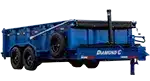
The current Diamond C LPT is a heavy-duty low-profile telescopic dump trailer offered in GVWR packages from approximately 15,500 to 24,000 pounds, depending on model and configuration. It uses a three-stage telescopic cylinder and offers bed lengths from 12 to 16 feet. The LPT207 package uses tandem 7,000-lb Lippert axles, while higher-capacity LPT packages use heavier axle and frame configurations. Actual payload depends on the selected length, side height, body thickness, axle package, ramps, tarp, and other options.
The H&H 83×14 Telescopic I-Beam Dump rated at 14,000 pounds has a published curb weight of 4,250 pounds and a payload rating of 9,750 pounds. By weight alone, that may be enough for two approximately 3,600- to 3,700-lb cords of seasoned oak. That does not automatically mean two measured cords will fit safely inside every body configuration. Side height, usable bed volume, how loosely the wood is thrown, axle distribution, tongue weight, and the weight of any additional equipment still have to be considered.
A log splitter should not simply be placed at the front of a loaded dump body because the trailer appears to have unused space. Concentrated weight near the coupler can overload the hitch, receiver, truck payload, or rear axle. A splitter also needs to be secured against movement. Weigh the completed setup before assuming that the trailer has room for both the wood and the machine.
Diamond C and H&H dump trailers are among the options Spencer Trailers carries or may be able to order, depending on current availability and configuration. You can review available units through our Spencer Trailers inventory.
Safe dumping begins before the bed moves. Park on firm, level ground with adequate overhead clearance. Keep the tow vehicle and trailer aligned, apply the parking brake, and use wheel chocks when appropriate. Open or secure the rear gate according to the manufacturer’s instructions, confirm that no person is behind or beside the discharge area, and watch for wood that may bind against the sides or gate.
Keep the trailer correctly coupled to the tow vehicle throughout the dumping cycle unless the manufacturer provides a different approved procedure. Do not partially disconnect the coupler, remove the safety chains, or attempt to use the raised bed to shift the trailer. Lower the bed completely before moving or uncoupling. Never work beneath a raised body unless the manufacturer-approved body-prop system is correctly engaged and the service procedure is being followed.
Trailer Sides: What to Add and Why
Open utility and flat-deck trailers need an appropriate containment system before carrying loose split wood or rounds. Stake pockets, correctly built side panels, rated mesh extensions, secure gates, and load-rated tie-downs can help keep the cargo on the trailer. The sides still do not replace proper securement, and adding taller walls does not increase the trailer’s legal payload.
Options from what we carry:
- Diamond C LPT dump: the current LPT uses an integrated steel dump body with 24-inch sides as a common standard configuration and taller 32-inch or 44-inch side options available on applicable builds. A 10-gauge body is standard on many configurations, with heavier 7-gauge construction available. Its low-profile design, telescopic hoist, three-way gate, and available tarp systems make it well suited to loose firewood when the load remains within every rating. Diamond C finishes current trailers with its DM Difference Maker multi-stage coating process.
- H&H utility trailers with compatible side systems: rail design, stake-pocket spacing, gate style, and available side kits vary by model. Removable wood sides can be practical for occasional firewood hauling, but they need to be securely built and attached so the load cannot force them outward during braking or cornering.
- Delco Equipment dump trailer with an integrated dump body: the steel body provides containment without relying on a separate utility-trailer side kit. Side height, GVWR, axle package, body length, hoist design, and payload vary by model, so verify the specifications of the exact trailer before calculating cord capacity.
- Liberty tandem utility or dump trailer: current configurations vary in side height, gate design, axle rating, and body style. A tandem utility may be appropriate for smaller or carefully stacked seasoned loads, while an appropriately rated dump trailer can simplify unloading. Spencer Trailers can verify the installed sides, gate, GVWR, and payload of the specific unit being considered.
A 24-inch side can provide useful containment for split firewood, while a taller body may allow more loose wood to fit by volume. That extra volume can make overloading easier. Firewood can reach the trailer’s weight limit well before a high-sided body looks full, especially when the load contains green oak or wet rounds.
Do not stack wood above the sides merely because the pieces seem wedged together. Braking, potholes, and cornering can settle the pile and release pieces from the top. Use an appropriate cargo net, tarp, or other securement system rated for the load and arranged so nothing can leave the trailer. Stop after the first few miles to inspect the load because split wood commonly settles after the trailer begins moving.
Matching Your Truck to the Load
The trailer’s GVWR tells only one part of the towing story. The tow vehicle must also remain within its tow rating, Gross Combined Weight Rating, Gross Vehicle Weight Rating, front and rear Gross Axle Weight Ratings, tire capacities, payload allowance, receiver rating, hitch-ball rating, and any limits stated by the vehicle manufacturer.
Suppose a half-ton pickup is rated to tow 8,500 pounds and is connected to a 7,000-lb GVWR trailer. The 8,500-lb tow rating does not prove that every 7,000-lb trailer load is acceptable. Passengers, tools, fuel, accessories, cargo in the bed, and trailer tongue weight all consume the truck’s available payload. The rear axle or receiver can reach its limit before the published maximum tow rating is reached.
For a conventional bumper-pull trailer, tongue weight is commonly planned at approximately 10 to 15 percent of the loaded trailer weight, unless the truck, hitch, or trailer manufacturer specifies otherwise. A 7,000-lb loaded trailer could therefore place approximately 700 to 1,050 pounds on the hitch. That load is carried by the truck and must fit within the receiver, hitch, payload, tire, GVWR, and rear-axle limits.
Load placement matters. Stacking too much firewood in front of the trailer axles can create excessive tongue weight. Stacking too much behind the axles can reduce tongue weight and encourage dangerous sway. Keep the load centered side to side and distributed according to the trailer manufacturer’s loading guidance. Do not move heavy pieces rearward merely to make the truck sit more level.
A weight-distributing hitch may be required or permitted for certain bumper-pull combinations, but it must be compatible with the truck, receiver, coupler, trailer frame, and any dump-trailer limitations. It does not increase the trailer’s GVWR, the truck’s GVWR, the receiver’s maximum rating, or the combination’s GCWR. Brake type is not what determines whether a weight-distributing hitch is appropriate.
Two cords of green oak can weigh approximately 10,000 to 11,000 pounds before adding the trailer. On the estimated 14-ft LPT207 example weighing about 4,610 pounds, the loaded trailer could total approximately 14,610 to 15,610 pounds. The lower estimate leaves limited margin under a 15,500-lb GVWR, while the upper estimate exceeds it. A higher-GVWR LPT configuration, a smaller load, or multiple trips may be necessary.
A three-quarter-ton or one-ton truck may provide more suitable ratings for heavier dump trailers, but the badge on the fender is not enough. Ratings vary by engine, cab, wheelbase, drivetrain, axle ratio, suspension, tire package, hitch equipment, and installed options. Use the certification labels and towing information for the exact truck, then confirm the loaded combination on a scale.
Towing Safety on Rural Roads
Owen County has narrow state highways, hilly routes, gravel township roads, soft shoulders, and driveways with limited sight distance. A loaded firewood trailer reacts more slowly than an empty one. Acceleration decreases, braking distance grows, tires build more heat, and abrupt steering inputs can produce a much larger response from the trailer.
Indiana law requires a trailer or semitrailer with a gross weight of at least 3,000 pounds while operated on a highway to have brakes adequate to control, stop, and hold the vehicle. The brakes must be operable from the tow vehicle, and the required system must apply automatically if the trailer breaks away. A compliant breakaway system, charged battery, correctly adjusted brakes, functioning wiring, and a properly set brake controller are essential parts of the setup.
Most tandem-axle utility and dump trailers in these weight classes are equipped with electric brakes, but equipment varies by model and build. Confirm that the brakes operate on the wheels required for the trailer, inspect wiring and connectors, test the breakaway switch, and adjust the controller for the loaded trailer. A controller setting that felt adequate when the trailer was empty may not provide balanced braking with several thousand pounds of firewood aboard.
Perform a loaded brake test at low speed in a safe area before entering traffic. The trailer should assist the truck without locking its wheels or pushing the tow vehicle. If braking is weak, erratic, or delayed, stop and correct the problem rather than compensating by driving more slowly.
Check cold tire pressure before loading and use the pressure specified for the trailer and tire application. Inspect tread, sidewalls, valve stems, wheel condition, lug-nut torque, and signs of bearing or hub problems. Every tire must have sufficient capacity for the load it carries. Replacing a trailer tire with one that physically fits but has a lower load rating can reduce the safe capacity of the entire setup.
Firewood should be distributed evenly from side to side. A pile concentrated on one side can overload individual tires, bearings, springs, or axles and can make the trailer lean or react unpredictably. The trailer should be level or positioned within the towing recommendations of its manufacturer when connected to the loaded truck.
If sway begins, hold the steering wheel steady, ease off the accelerator, and avoid abrupt steering or hard tow-vehicle braking. When appropriate, use the trailer-brake controller’s manual control to help bring the trailer back in line without applying more power. Reduce speed smoothly, pull over in a safe location, and correct the load distribution, tire issue, hitch problem, or excessive speed that caused the instability. Do not continue merely because the sway temporarily disappears.
A Quick Q&A
Can I haul a cord of green firewood on a 5,000-lb GVWR single-axle trailer?
Usually not if the load is a full cord of green oak. Payload depends on the trailer’s actual empty weight. For example, a 5,000-lb GVWR trailer weighing 1,200 pounds has approximately 3,800 pounds of payload before accessories or tools are added. A green oak cord near 5,000 to 5,500 pounds would exceed that payload by a substantial amount. Even some lighter species may be too heavy. Check the VIN label, determine the trailer’s actual empty weight, and weigh the firewood rather than estimating from how much deck space it occupies.
Do I need a CDL to haul firewood?
A trailer over 10,000-lb GVWR does not automatically require a Class A CDL by itself. The Class A threshold generally applies when the combination has a GCWR or actual combined gross weight of 26,001 pounds or more and the towed unit has a GVWR or actual gross weight over 10,000 pounds. The ratings and actual weights used in the determination can matter. Commercial firewood businesses may also be subject to motor-carrier, vehicle-marking, medical qualification, inspection, insurance, hours-of-service, or USDOT requirements at thresholds below the CDL limit, particularly in interstate commerce. Verify the requirements for the exact truck, trailer, operating area, and business use with Indiana and federal authorities.
What’s the best dump trailer for a one-person firewood operation?
There is no single best model for every operation. The H&H 83×14 Telescopic I-Beam Dump rated at 14,000 pounds provides a published 9,750-lb payload in its listed configuration and can be a practical option for seasoned firewood. A Diamond C LPT provides a low-profile body, three-stage telescopic hoist, current Lippert axle packages, multiple side-height choices, and GVWR options from approximately 15,500 to 24,000 pounds. The right choice depends on the weight and volume of each load, whether the wood is green or seasoned, the tow vehicle’s ratings, the unloading location, the desired side height, and how much payload margin the operator wants. Select the trailer from measured loads rather than simply choosing the largest body.
Get the Right Trailer Before the Cutting Season Starts
Indiana firewood demand rises as colder weather approaches, but the trailer planning should happen before the fall rush. Spring and summer are the time to inspect brakes and tires, service hydraulic systems, repair gates, confirm truck ratings, and weigh representative loads. Waiting until the first large green-wood pickup to calculate payload can leave you choosing between reducing the load and operating an overweight combination.
Start with the heaviest wood you realistically expect to haul. Determine whether customers and suppliers are selling by full cord, face cord, thrown volume, weight, or another measurement. Then calculate payload from the exact trailer, not a generic model description. Leave a practical margin instead of building every load to the last pound of the published rating.
When purchasing a trailer, review the certification label and build specifications for the individual unit. Confirm GVWR, GAWR, tire and wheel ratings, coupler size and capacity, brake equipment, breakaway system, body dimensions, side height, hoist type, empty weight, payload, and required truck and hitch equipment. Optional equipment can change both the trailer’s weight and the way it should be used.
Indiana residents generally have 45 days to title and register a newly acquired vehicle or trailer without a late penalty, so complete the paperwork promptly rather than waiting for the first hauling job. Commercial buyers should also discuss current tax treatment with a qualified tax professional. Eligibility for depreciation deductions depends on ownership, business use, placed-in-service timing, taxable income, and other facts specific to the purchaser.
Stop by 291 West State Hwy 46 in Spencer or call us at (812) 829-0226. We will walk you through GVWR, actual payload, axle packages, dump systems, side configurations, brakes, ramps, hitch requirements, and truck compatibility based on what you haul and how often you haul it. Or reach out online and our team will follow up. If you are still comparing configurations, browse current inventory to see the trailers presently available.
What’s heavier: the cord of wood or figuring out the right trailer after you’ve already bought the wrong one?


