








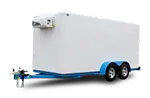


You just picked up a new trailer. You notice the tires look different from the ones on your truck. Someone at the lot mentions “ST tires,” and you nod, but later you start wondering: can you install an LT tire with similar dimensions and load numbers? It may fit the wheel, and it may be rated for heavy loads, but that does not automatically make it the correct replacement.
The practical answer is that your trailer tires do not need to match your truck’s tires. They do need to match the tire size, service type, load capacity, inflation specification, speed rating, wheel requirements, and axle ratings established by the trailer manufacturer. Many trailers are equipped with ST tires, while some heavy-duty trailers are factory-equipped with LT-designated or commercial all-steel radial tires. The trailer’s certification label, tire placard, and owner’s manual determine what belongs on it.
What the Letters Actually Mean
Tire designations help identify the service for which a tire was engineered. P generally identifies a passenger-car tire. LT identifies a light-truck tire. ST means Special Trailer and identifies a tire intended for trailer service rather than a powered or steering axle. Some commercial tires, including many 16-inch and 17.5-inch all-steel radials used on higher-capacity trailers, may use a different size format without an ST or LT prefix.
ST tires are designed around the demands of a free-rolling trailer axle. They must support substantial vertical load, tolerate the lateral scrub created when a tandem- or triple-axle trailer turns, and operate for long periods without the steering, acceleration, and traction duties expected of a truck tire. Depending on the product, an ST tire may use a casing, belt package, sidewall construction, tread depth, and load-and-inflation table developed specifically for trailer service.
That does not mean every trailer must use an ST tire. Some heavy equipment trailers, goosenecks, deck-over trailers, and commercial hauling configurations are built around high-capacity all-steel radial or commercial tire packages. Those tires are appropriate when they are part of the manufacturer’s approved configuration. The mistake is choosing a replacement solely because its outside dimensions look similar or because the same load-range letter appears on the sidewall.
Sidewall Stiffness Is the Real Story
Sidewall and casing behavior matter, but stiffness alone does not determine whether a tire is suitable for a trailer. The complete specification matters: tire type, construction, approved rim width, maximum load, required cold inflation pressure, speed capability, overall diameter, section width, and compatibility with the trailer’s axle and suspension system.
Many ST tires are engineered to control deflection and withstand the side-loading and scrubbing that occur during tight turns. An LT tire with similar nominal dimensions may use a different load table and may carry less weight at the same pressure. It may also have a different overall diameter or section width, creating clearance problems between tandem tires, fenders, suspension components, or the trailer frame.
However, it is not accurate to assume that every LT tire is too flexible for trailer use. LT and commercial tires are used successfully on trailers that were engineered and labeled for them. Trailer sway is also influenced much more broadly by loading, tongue or pin weight, tow-vehicle capacity, hitch setup, speed, suspension condition, tire pressure, crosswinds, and cargo placement. Installing a different tire type without approval can change handling, but tires are only one part of the complete towing system.
P-metric tires require even more caution. Federal tire-selection rules apply a capacity reduction when a passenger-car tire is installed on a trailer, truck, bus, or multipurpose passenger vehicle. The tire’s stated load rating is divided by 1.10 before its usable capacity is evaluated for that application. For that reason, a P215/75R15 cannot be compared directly with an ST or LT tire by reading only the maximum-load number molded into the sidewall. Unless the trailer manufacturer specifically approved a P-metric tire and accounted for that reduction, it should not be used as a substitute on a work trailer.
Load Range: What It Actually Tells You
Load range is an alphabetic designation that identifies the load and inflation limits of a particular tire size. It is related to the older ply-rating system, but it does not necessarily tell you how many physical body plies are inside a modern tire. Advanced materials allow a tire marked with a particular ply rating to achieve that capacity without containing the historical number of cotton cord plies.
- Load Range B traditionally corresponds to a 4-ply rating and appears in some lower-capacity tire sizes
- Load Range C traditionally corresponds to a 6-ply rating and is common in many light- and medium-duty trailer sizes
- Load Range D traditionally corresponds to an 8-ply rating and provides greater load-and-inflation capability in the same applicable size
- Load Range E traditionally corresponds to a 10-ply rating and is common on many higher-capacity 15- and 16-inch trailer tires
Heavier trailer packages may use Load Range F, G, H, J, or another commercial designation. The letter by itself is not a universal capacity number. A Load Range E tire in one size can carry substantially more or less than a Load Range E tire in another size. Always read the maximum load, inflation pressure, and service description for the exact tire being installed.
The correct capacity comparison is based primarily on the trailer’s gross axle weight rating, or GAWR. Federal requirements generally provide that the combined maximum load ratings of the tires installed on an axle must be at least equal to that axle’s GAWR. The tires must also be capable of supporting the trailer’s actual loaded axle weight without overloading an individual tire or wheel position.
For example, a 7,000 lb tandem-axle trailer commonly has two axles rated at 3,500 lbs each. Each pair of tires must therefore provide at least 3,500 lbs of capacity, which normally means at least 1,750 lbs per tire when all four tires are equally rated. A common ST205/75R15 Load Range C tire may be rated for approximately 1,820 lbs at 50 psi, but the exact number must be confirmed on the tire and in the tire manufacturer’s data. That example would provide 3,640 lbs of rated capacity per axle.
Do not rely only on the trailer’s GVWR when doing tire math. A bumper-pull trailer transfers part of its loaded weight to the tow vehicle through the tongue, and a gooseneck transfers pin weight into the truck bed. As a result, the combined tire capacity may not always equal the full trailer GVWR. The certification label’s GAWR values, the specified tire package, and actual scale weights provide the more useful comparison.
Dual-wheel trailers require another check. Many commercial tires list separate maximum-load ratings for single and dual installation. When a tire is used in a dual assembly, use the dual-load rating rather than the higher single-tire number.
Always check the trailer’s certification label or tire placard and match the approved size, type, load capacity, and cold inflation pressure. Moving to a higher load range may be possible, but only when the wheel, valve stem, hub, available clearance, and manufacturer’s recommendations support it. A wheel rated for 80 psi should not be subjected to a 110- or 125-psi tire package, and installing stronger tires does not increase the trailer’s axle rating, GVWR, payload, coupler rating, or braking capacity.
Speed Rating: The Number Nobody Checks Until It’s Too Late
The idea that nearly every ST tire is limited to 65 mph is outdated. Some older trailer tires and certain specialty sizes do have ratings near that range, but many current radial ST tires carry recognized speed symbols such as L, M, or N. An L rating corresponds to 75 mph, M to 81 mph, and N to 87 mph. Other trailer and commercial tires may have lower or different ratings, so the exact sidewall marking and manufacturer’s specifications must be checked.
A speed rating is the maximum speed capability demonstrated under specified test conditions while the tire is correctly inflated and loaded. It is not a recommended cruising speed, permission to exceed the speed limit, or proof that the truck-and-trailer combination is stable at that speed. The safe towing speed may be considerably lower because of road conditions, traffic, weather, trailer design, cargo, tow-vehicle limits, or state law.
Heat increases as speed, load, ambient temperature, and casing flex increase. Underinflation is especially dangerous because it creates excessive flex and internal heat while also reducing the tire’s effective load-carrying ability. Overloading, impact damage, aged rubber, punctures, improper repairs, wheel misalignment, bearing problems, and tire-to-tire contact can also contribute to tread separation or sudden pressure loss. Trailer blowouts should not automatically be blamed on one cause.
If you regularly tow on interstates where posted limits and traffic speeds are high, select a manufacturer-approved tire with adequate load capacity and a clearly stated speed rating. Then operate below the lowest applicable limit among the tire, trailer, tow vehicle, hitch, roadway, and prevailing conditions. Increasing the tire’s speed rating does not correct improper loading or make an unstable trailer safe.
Why You Can’t Just Use What’s on Your Truck
LT tires are excellent when used in the applications for which they were selected. A set of LT285/70R17 Load Range E tires may be appropriate for an F-250 or Ram 2500 because the truck manufacturer accounted for their load index, inflation requirements, steering response, braking, traction, wheel width, suspension geometry, and overall diameter.
Those same specifications do not automatically transfer to a trailer. Even when the rim diameter appears compatible, the tire may be too wide, too tall, unsuitable for the wheel’s approved width, or incapable of carrying the trailer axle’s rated load at the specified pressure. A wider tire can contact a neighboring tire in a dual or tandem configuration, and a taller tire can reduce fender or deck clearance when the suspension compresses.
The reverse is also important: an LT or commercial tire is not inherently incorrect simply because it lacks an ST prefix. Some trailers are factory-built around LT tires, 14-ply all-steel radials, or 17.5-inch commercial tire packages. Higher-capacity Diamond C equipment, dump, and gooseneck configurations are examples of trailers that may use heavy all-steel radial packages selected for their axle ratings. The manufacturer-approved configuration is what makes the tire suitable.
There is also a warranty and documentation issue. Installing a tire that conflicts with the trailer placard, owner’s manual, or tire manufacturer’s application guidance may complicate a warranty claim and can become relevant during a post-incident inspection. It does not automatically cancel an insurance policy, because insurance coverage depends on the policy language and circumstances, but knowingly operating with under-capacity or unapproved tires can create avoidable safety and liability questions.
A Quick Comparison
| Tire Type | Sidewall Stiffness | Typical Speed Rating | Designed For | OK on Trailer? |
|---|---|---|---|---|
| ST (Special Trailer) | Trailer-specific construction; varies by model | Often 75-87 mph on current radial products; verify each tire | Free-rolling trailer axles | Yes, when specified |
| LT (Light Truck) | Varies by size, load range, and construction | Varies widely and is often higher than basic trailer ratings | Light trucks and certain manufacturer-approved trailer applications | Only when specified or approved |
| P (Passenger) | Designed primarily around passenger-vehicle requirements | Varies widely by product | Passenger cars and light-duty vehicle applications | Only when explicitly specified and properly derated |
| Commercial All-Steel Radial | High-capacity commercial construction | Varies by tire and service description | Commercial, heavy-trailer, and specialty axle applications | Yes, when specified |
Don’t Mix Tire Types on the Same Trailer
This comes up more often than it should. A tire is damaged on the road, the exact replacement is not immediately available, and someone considers installing any tire that will hold air and fit the wheel. That may get the trailer off the shoulder in a genuine emergency, but an improvised tire should not be treated as a normal replacement unless it meets the trailer and tire manufacturers’ requirements.
At a minimum, tires on the same axle should match in size designation, construction type, load capacity, speed capability, overall diameter, and inflation specification. Mixing radial and bias-ply tires, substantially different tread depths, different load ranges, or tires with unequal diameters can change how the axle shares load and how the trailer responds during braking and cornering.
Matching also matters across closely spaced tandem or triple axles. Those tires scrub laterally whenever the trailer turns. If one tire is taller because of a different size, construction, inflation pressure, or tread depth, it can carry more than its intended share of the load. On dual-wheel assemblies, mismatched diameters can overload the larger tire and allow the smaller tire to contribute less support.
Brand names do not always have to match, but tire dimensions and service characteristics must. When possible, use the same make, model, size, load range, and tread design across an axle. If the existing tires have significant wear or age, replacing an axle pair or the full trailer set may be more appropriate than adding one new tire with a noticeably larger rolling diameter.
The spare deserves the same attention. It should have the correct service designation, size, capacity, and inflation pressure for the trailer. Check it before every long trip; a perfectly matched spare is not useful if it has been sitting at half its required pressure for two years.
What to Look for When Buying a Used Trailer
If you are shopping for a used trailer, the tires are one of the first items to inspect. Compare the sidewall markings with the trailer’s certification label. Look for the size designation, ST, LT, or commercial service type, load range or load index, maximum load, required inflation pressure, speed symbol, and radial or bias construction. Also confirm that the wheel appears suitable for the tire’s pressure and that there is adequate clearance around neighboring tires, fenders, brakes, and suspension components.
Find the DOT Tire Identification Number and read its final four digits. The first two digits identify the week of manufacture, and the final two identify the year. A code ending in 1824, for example, indicates production during the eighteenth week of 2024. The complete date code may appear on only one side of the tire, so you may need to inspect the inward-facing side.
There is no single federal rule requiring every tire to be replaced at exactly five or six years. Tire service life depends on the tire manufacturer’s recommendation, the trailer manufacturer’s guidance, storage, climate, inflation history, loading, speed, maintenance, and physical condition. Some manufacturers recommend replacement around six years, while others call for regular professional inspections after five years and removal by ten years at the latest.
Age is only one factor. Replace a tire sooner if it has exposed cords, bulges, deep cracking, belt or tread separation, bead damage, repeated pressure loss, an improper repair, severe flat spotting, sidewall punctures, or evidence that it was driven while underinflated. Trailer tires often age out before wearing out because trailers can sit outdoors for months while supporting weight in the same position.
A used trailer with a matching set of properly rated ST235/80R16 Load Range E tires in good condition is a different purchase from one carrying mixed sizes, incorrect service types, uneven tread depths, unknown repairs, or tires manufactured in 2017. In 2026, a 2017 tire is already approximately nine years old and should be evaluated against the tire manufacturer’s maximum service-life guidance even if the tread still looks deep.
Replacement cost varies much more widely than a single price range suggests. A set of four common 14- or 15-inch ST tires may cost several hundred dollars before mounting, balancing, disposal, and new valve stems. High-capacity 16-inch all-steel radials, dual-wheel packages, and 17.5-inch commercial tires can push a complete replacement well beyond $1,000. A matching spare, pressure-rated metal valve stems, wheel replacement, and roadside installation can increase the total further.
We carry a range of trailers at Spencer Trailers from brands like Diamond C, H&H, Liberty, and Wells Cargo. Their tire and wheel packages are selected around the trailer’s configuration and axle ratings. Many light- and medium-duty trailers use ST radials, while certain higher-capacity equipment, dump, deck-over, and gooseneck trailers use all-steel or commercial radial packages. If you are buying new, verify the placard and included spare before delivery. If you are considering a used unit, ask about the tires before signing anything.
What Counts When Matching Trailer Tires
Your truck tires and trailer tires perform different jobs. The trailer does not need tires that match the truck’s brand, tread pattern, wheel diameter, or appearance. It needs tires selected for its own axles, wheels, weight ratings, operating pressure, speed requirements, and intended service.
If the trailer placard specifies ST tires, stay with the listed ST size and load specification unless the trailer manufacturer approves an alternative. If the trailer was designed around LT-designated or commercial all-steel radial tires, use replacements that meet that approved specification rather than changing to ST tires simply because they are marketed for trailers.
Do not judge compatibility by load range alone. Confirm the complete size designation, maximum load at the required pressure, single or dual rating where applicable, speed symbol, radial or bias construction, wheel-pressure capacity, rim width, overall diameter, section width, and available clearance. Make sure the tire capacity meets or exceeds the GAWR for each axle, and never treat stronger tires as permission to exceed the trailer’s GVWR.
Inflate the tires cold to the pressure specified by the trailer manufacturer unless an approved load-and-inflation program for that exact tire calls for a different setting. The maximum pressure molded into the tire sidewall identifies the pressure associated with its stated maximum load; it is not automatically the correct operating pressure for every trailer. Check all tires with an accurate gauge before trips and do not bleed pressure from a hot tire.
If you are not sure what your trailer requires, start with the certification label or tire placard attached to the tongue, frame, body, or VIN area. Then check the owner’s manual and tire manufacturer’s data. You can also reach out to us with the trailer’s VIN, axle ratings, current tire size, wheel size, and intended load, and we will help you identify a tire package that actually matches the trailer rather than merely matching the truck parked in front of it.


