












You’ve got a trailer hitched and a load to move. It can be tempting to place everything wherever it fits, tighten a few straps, and call it good. That approach works only until an unbalanced load begins to sway, overloaded components overheat, or unsecured cargo moves during a sudden stop. Once severe trailer sway develops at highway speed, steering or braking aggressively can make the situation worse. Loading a trailer correctly is not complicated, but it does require checking weights, ratings, cargo position, and securement before you start driving.
The 60/40 Rule: Where Your Cargo Goes
A useful starting point for many bumper-pull utility and equipment trailers is to place approximately 60% of the cargo weight in the front half of the trailer deck and 40% in the rear half. This is a loading guideline, not a substitute for measuring the completed trailer’s tongue weight. Cargo dimensions, axle placement, trailer design, and the location of concentrated loads can all change the final result.
Think of the trailer’s axle group as a fulcrum. Cargo placed ahead of the axle centerline generally increases downward force at the coupler. Cargo placed behind the axle centerline reduces that force and can eventually create an unstable, tail-heavy condition. Insufficient tongue weight is a major cause of trailer sway because the trailer has less stabilizing force at the hitch. Excessive tongue weight is also unsafe because it can overload the hitch, receiver, rear axle, suspension, or tires of the tow vehicle while removing useful weight from the steering axle.
For a 16-foot utility trailer, a 60/40 division would place the dividing point at approximately 9.6 feet from the front of the usable deck. That does not mean every dense object belongs at the very front. Heavy equipment, generators, pallets, and stacked steel should generally be positioned over or slightly forward of the axle group, then moved as needed to achieve the correct tongue weight without exceeding any component rating. Light items such as empty containers and tarps can occupy less critical areas, but they still must be secured against movement and loss.
Tongue Weight: The Number You Need to Know
Tongue weight (TW) is the downward force a bumper-pull trailer’s coupler applies to the hitch ball. For many conventional bumper-pull trailers, a common target is approximately 10% to 15% of the trailer’s actual loaded weight. If a loaded trailer weighs 6,000 lbs, that produces a general target range of 600 to 900 lbs. Always follow the trailer and tow-vehicle manufacturers’ instructions when they specify a different range.
Gooseneck and fifth-wheel trailers commonly place a larger percentage of their loaded weight on the truck than bumper-pull trailers do, often roughly 15% to 25%, depending on the trailer and load. That pin or gooseneck weight must remain within the truck’s payload, rear gross axle weight rating, tire ratings, hitch rating, and any body or bed limitations.
Too little tongue weight can make a bumper-pull trailer unstable. Too much can overload the rear of the tow vehicle and reduce weight on the front axle, affecting steering, braking, headlight aim, and handling. The hitch ball, ball mount, receiver, coupler, and weight-distribution equipment must each be rated for the actual trailer and tongue weights.
You can measure moderate bumper-pull tongue weights with a properly rated tongue-weight scale while the loaded trailer is level and supported safely. Commercial scales can provide the most useful information for heavier combinations because separate axle-platform readings help identify the truck’s front-axle, rear-axle, and trailer-axle loads. Lever arrangements using a household scale require careful setup and calculation and should never be used where the expected load could exceed the scale, blocking, or supporting components. Do not rely on appearance or suspension squat alone.
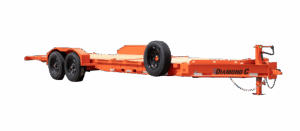
Your trailer’s Gross Vehicle Weight Rating (GVWR) is the maximum allowable loaded weight assigned by its manufacturer. Payload is not automatically equal to the combined axle ratings; it is generally determined by subtracting the trailer’s actual empty weight from its GVWR, while also respecting the Gross Axle Weight Rating (GAWR), tire ratings, coupler rating, and other limits shown on the certification label. A Diamond C LPX, for example, is a low-profile heavy-duty equipment trailer offered in configurations from 15,500 to 24,000 lbs GVWR. Current tandem-axle configurations use Lippert axles, with ratings and available upgrades varying by build. Because trailer weight changes with length and options, use the certification label and a scale ticket to determine the payload of the specific unit rather than relying on a generic advertised figure.
Side-to-Side Balance Matters Too
Front-to-rear weight distribution gets most of the attention, but side-to-side balance is also important. A heavily unbalanced trailer can lean, overload a tire, wheel, spring, hub, or one side of an axle, and respond unpredictably during braking or cornering. Tandem and triple axles do not eliminate this problem.
Aim for approximately equal weight on each side of the trailer’s centerline. When loading odd-shaped items such as ATVs, skid steers, excavators, or zero-turn mowers, account for where their engines, counterweights, attachments, fuel tanks, and batteries are located. Position the machine so its center of gravity is near the trailer’s centerline and its fore-and-aft position produces the proper hitch weight. Do not intentionally favor the driver’s or passenger’s side unless the measured axle and tire loads remain within their ratings and the trailer or cargo manufacturer specifically requires that placement.
On an enclosed trailer such as a Wells Cargo Road Force or a Darkhorse Cargo unit, distribute cargo across the floor and use only factory-installed or properly engineered tie-down anchors. E-track, D-rings, floor rings, and other anchor systems differ in rating and availability by model and option package. An anchor is only as strong as its attachment to the trailer structure, so do not assume that wall trim, interior plywood, or an unmarked track can carry a heavy securement load.
Securing the Load
Straps, chains, binders, blocking, and chocks each serve different purposes. Select the securement system according to the cargo’s weight, shape, attachment points, tendency to roll or shift, and the ratings of both the tiedowns and trailer anchors. Commercial carriers must comply with the cargo-securement requirements in 49 CFR Part 393, Subpart I. Those federal rules are also a useful safety benchmark for noncommercial hauling, although the exact legal requirements can depend on how and where the combination is operated.
Choosing the Right Tie-Down
- Ratchet straps: Suitable for many forms of general cargo and for certain vehicles or equipment when the webbing, hooks, anchors, and attachment method are rated for the load. Width alone does not establish capacity. A 2-inch strap may carry a labeled working load limit around 3,333 lbs, but ratings vary substantially by webbing, hardware, construction, and manufacturer. Use the WLL printed on the intact tag and remove cut, burned, chemically damaged, knotted, or severely abraded straps from service.
- Transport chains with binders: Commonly used for construction equipment and other heavy cargo because properly graded transport chain tolerates demanding service. Match the chain, hooks, binders, and anchors by grade and WLL; the lowest-rated component limits the assembly. Federal rules do not make chain the only acceptable material solely because a machine exceeds 10,000 lbs, but heavy vehicles, equipment, and machinery weighing 10,000 lbs or more require at least four properly rated tiedowns in covered commercial operations, with additional securement for certain attachments and articulating components.
- Cargo nets and tarps: Useful for containing light or loose material, but ordinary covers are not substitutes for structural tiedowns, blocking, or rated containment. Use a tarp or net rated for its intended purpose and fasten it so air cannot lift it or allow material to escape.
- Wheel chocks, cradles, and wheel restraints: Useful for controlling rolling cargo when correctly sized and secured. Chocks by themselves do not necessarily restrain lifting, bouncing, or lateral movement. Vehicles and machinery must be secured with a complete system appropriate to their weight and manufacturer-approved attachment points.
Under the federal commercial-cargo rules, the aggregate working load limit of the securement system must be at least one-half the weight of the article or group of articles being secured. How each tiedown contributes to that aggregate depends on whether it runs directly between the trailer and cargo or passes over, through, or around the cargo. Meeting the aggregate WLL requirement does not replace the rules for the minimum number and placement of tiedowns.
The Four-Point Rule
Four-point securement is a sound practice for vehicles, machinery, and other large concentrated loads, and it is required by federal rules for many pieces of heavy equipment weighing 10,000 lbs or more in commercial transportation. Use independent tiedowns positioned to resist forward, rearward, and lateral movement. Secure accessory equipment such as hydraulic booms, buckets, blades, and articulated components when required to prevent movement during transit.
Four tiedowns are not automatically required for every individual box or short article. Under federal commercial rules, the minimum number for general cargo also depends on cargo length, weight, whether it is blocked against forward movement, and whether a tiedown is placed in a way that prevents tipping or shifting. Long articles generally need additional tiedowns as their length increases. Whatever method is used, cargo must remain immobilized or secured for normal acceleration, braking, turning, and road vibration.
Strap placement matters. Connect tiedowns to manufacturer-approved points on the cargo and to properly rated trailer anchors. Keep webbing away from sharp edges or use suitable edge protection. Do not attach heavy cargo to deck boards, thin sheet metal, side-wall plywood, light railings, or any unverified point. Diamond C tie-down provisions vary by trailer model and selected options and may include stake pockets, rub rail, D-rings, or engineered attachment points. Confirm the rating and intended use of the anchors on the specific trailer before loading.
Load Types That Need Special Attention
Round or Cylindrical Loads
Pipe, round bales, cable reels, and logs can roll even when downward pressure appears substantial. Use bunks, cradles, wedges, chocks, stakes, bolsters, or other blocking designed for the cargo and secure those components so they cannot work loose. Arrange tiedowns to resist forward, rearward, lateral, and rolling movement. A strap placed only over the top may create downward force without adequately preventing a cylindrical object from rolling along the trailer during hard braking or acceleration.
Special federal securement rules apply to commodities such as logs, dressed lumber, metal coils, paper rolls, concrete pipe, and large boulders in commercial transportation. Operators carrying those materials should follow the commodity-specific provisions rather than relying only on general tiedown practices.
Sheet Materials and Lumber
Plywood, sheet goods, and long lumber can slide, separate, or catch air. Stack compatible materials evenly on stable support, keep the stack within the trailer’s rated dimensions, and block or bundle it as necessary. Place tiedowns across the load at intervals sufficient for its length, weight, and rigidity, adding more securement where individual pieces could escape. Protect straps from sharp sheet-metal edges and avoid routing them where vibration can cut the webbing.
Do not use a fixed “one strap every 4 to 6 feet” rule as a substitute for the applicable securement requirements. Under the federal general-cargo rules, an article longer than 10 feet that is not blocked against forward movement generally requires two tiedowns for the first 10 feet and an additional tiedown for each additional 10 feet or fraction. Cargo length, weight, blocking, and the way the tiedown contacts the cargo can change the required arrangement.
Rear overhang must comply with every applicable state and federal marking rule. In Indiana, a load extending more than four feet beyond the rear of a vehicle must be marked as required by state law, including a red flag during daylight and specified red lighting and reflectors during the legally defined nighttime period. Federal commercial-vehicle rules also address marking projected loads. Overhang cannot obscure the trailer’s lamps, license plate, or required reflective devices, and it must not cause the combination to exceed an applicable length or dimensional limit.
Loose Aggregate and Bulk Materials
Gravel, mulch, demolition debris, soil, and similar materials should be carried in a dump trailer or other body engineered to contain the load. Confirm the material’s weight rather than estimating by volume alone: wet soil, rock, concrete, and gravel can exceed a trailer’s payload well before the bed appears full. Sidewall height does not determine weight capacity, and the trailer’s GVWR, GAWR, tires, wheels, coupler, hoist, and tow vehicle still establish the limits.
A properly configured H&H dump trailer can be suitable for aggregate and bulk materials, but dimensions, side height, GVWR, axle ratings, payload, hoist design, and tarp equipment vary by model and build. Use the certification label and current manufacturer documentation for the exact trailer. Do not carry loose aggregate on an open utility or flatbed trailer unless a purpose-designed, adequately rated containment system prevents leakage and escape. A light-duty cargo net draped over an otherwise uncontained pile is not adequate.
Weight Distribution Hitches and Sway Control
A weight-distribution hitch uses spring bars to transfer part of the hitch load through the tow vehicle and trailer structure, helping restore front-axle loading and maintain the combination’s intended attitude. There is no universal 750-lb tongue-weight threshold at which every vehicle requires one. The tow vehicle’s owner’s manual, receiver label, hitch instructions, trailer design, and actual measured weights determine whether weight distribution is permitted, recommended, or required.
Do not assume every weight-distribution hitch is rated to 17,000 lbs or that one model fits every trailer. Systems are offered in different gross trailer weight and tongue-weight ranges, and the selected system must match the loaded combination. Some tow vehicles, receivers, trailer couplers, surge-brake systems, and aluminum or specialized trailer frames impose restrictions. Weight distribution also does not increase the tow vehicle’s GCWR, GVWR, GAWR, payload, receiver rating, tire capacity, or the trailer’s GVWR.
Sway control and trailer braking are related safety systems, but they are not the same device. Friction or cam-style sway-control equipment resists articulation at the hitch. Some properly matched weight-distribution hitches incorporate sway-control features. A conventional in-cab electric brake controller applies the trailer’s electric brakes in response to the driver’s braking; it should not be described as active sway control unless that specific controller or tow vehicle has a manufacturer-documented sway-mitigation function.
Indiana law requires brakes adequate to control and stop a trailer or semitrailer with a gross weight of at least 3,000 lbs, subject to the provisions of IC 9-19-3-3. The trailer’s brake system and controller must be compatible and correctly adjusted. Electric trailer brakes typically require a suitable brake controller, while electric-over-hydraulic and surge systems have their own compatibility requirements. A breakaway system is an emergency device for applying the trailer brakes after an accidental separation; it is not a parking brake and does not replace the regular controller.
When sway begins, avoid abrupt steering inputs. Hold the steering wheel steady, ease off the accelerator, and follow the tow vehicle and brake-controller manufacturers’ instructions. If conditions allow and the controller manufacturer permits it, careful manual application of the trailer brakes may help straighten the combination. Do not accelerate to “pull out” of sway as a general rule, and do not continue driving until the cause—often loading, speed, tire condition, wind, hitch setup, or mechanical wear—has been identified and corrected.
| Loaded Trailer Weight | Typical Bumper-Pull Tongue-Weight Target | Weight-Distribution Decision |
|---|---|---|
| Under 3,500 lbs | Approximately 10–15%, subject to manufacturer instructions | Check the tow vehicle, receiver, and trailer manuals; often not needed, but weight alone does not decide |
| 3,500 to 6,000 lbs | Approximately 350 to 900 lbs across this range | Use if required or recommended for the specific tow vehicle, receiver, hitch weight, and trailer |
| 6,000 to 10,000 lbs | Approximately 600 to 1,500 lbs across this range | Commonly beneficial or required on compatible bumper-pull combinations; verify every rating |
| Over 10,000 lbs | Approximately 10–15% for many bumper-pull trailers; follow the manufacturer’s specified range | Vehicle- and hitch-specific; never assume it is permitted or that it increases rated capacity |
The ranges above apply to conventional bumper-pull trailers as general planning guidance. Gooseneck trailers use a ball mounted over or slightly ahead of the truck’s rear axle and normally carry a higher percentage of loaded weight on the truck. They do not use a conventional bumper-pull weight-distribution hitch.
Pre-Trip Loading Checklist
- Read the trailer certification label and confirm its GVWR, GAWR, tire specifications, and cold inflation pressures. Also verify the tow vehicle’s GVWR, front and rear GAWR, GCWR, payload, hitch, and towing limits.
- Calculate an initial payload estimate by subtracting the trailer’s actual empty weight from its GVWR. Remember that installed options, spare tires, batteries, tarps, fuel, tools, and accessories consume payload.
- Determine the cargo’s real weight from equipment data plates, shipping documents, supplier tickets, or a certified scale. Do not estimate dense bulk material solely by bed volume.
- Position the heaviest items low, close to the centerline, and over or slightly forward of the axle centerline. Adjust their position to achieve the required hitch weight.
- Measure or verify bumper-pull tongue weight, or obtain separate truck and trailer axle weights at a suitable scale. Keep every axle, tire, hitch, and vehicle within its individual rating.
- Check side-to-side balance. The trailer should not lean, but visual inspection does not replace weighing when the load is heavy or unevenly shaped.
- Select tiedowns and anchors with adequate working load limits. Use the number, placement, blocking, and attachment method required for the cargo rather than assuming four straps will secure every load.
- Inspect straps, chains, hooks, binders, chocks, D-rings, and anchor structures. Protect webbing from edges and secure loose strap tails, binder handles, doors, ramps, gates, and attachments.
- Confirm that the coupler or gooseneck latch is fully engaged, the correct hitch components are used, the jack is raised, safety chains are crossed and attached to proper vehicle points, and the breakaway cable is connected independently of the chains.
- Test running lights, turn signals, brake lamps, trailer brakes, and the breakaway battery according to the manufacturers’ procedures. Confirm tires are cold-inflated correctly and inspect wheels, lug nuts, bearings, suspension, and visible brake wiring.
- Stop in a safe location shortly after departure to inspect the load and securement because cargo can settle and tiedowns can lose tension. Commercial drivers must also follow the inspection intervals in 49 CFR 392.9, including checks within the first 50 miles and again when required by distance, time, or a change of duty status.
- Repeat the inspection after rough roads, abrupt maneuvers, weather changes, or any sign of load movement. Never climb onto an unsecured or unstable load to tighten a tiedown.
A Common Mistake Worth Avoiding
One of the most frequent loading errors is treating the trailer’s rated capacity as a target rather than an absolute ceiling. A trailer with a 7,000-lb GVWR and an actual empty weight of 1,540 lbs would have no more than approximately 5,460 lbs available before reaching GVWR. The usable cargo capacity may be lower after accounting for permanently or temporarily added equipment, unequal axle loading, tongue weight, tire capacity, or another component rating.
Operating at or below GVWR is essential, but simply staying a few pounds below that number does not guarantee a safe combination. The trailer axles can be overloaded while total trailer weight remains under GVWR, and the truck’s rear axle or payload can be exceeded by tongue or gooseneck weight. Heat, speed, low tire pressure, worn bearings, degraded brakes, improper hitch height, and poor load distribution can create failures even without a nominal GVWR violation.
Consistent overloading accelerates tire, bearing, suspension, brake, coupler, and frame wear. It increases stopping distance and leaves less reserve capacity for potholes, heat, evasive maneuvers, and shifting cargo. Load for the task, leave a practical operating margin, and choose a larger trailer when your normal cargo repeatedly puts the combination near one or more ratings.
If you’re not sure which trailer configuration fits your typical loads, our team at Spencer Trailers can walk you through the options. We stock Diamond C, Liberty, H&H, Delco, and other lines in a range of axle, GVWR, deck-width, ramp, dump, and hitch configurations. Current Diamond C choices include models such as the GTU utility trailer, LPX equipment trailer, HDT hydraulically dampened tilt trailer, LPT telescopic dump trailer, DOD deck-over dump, and FMAX gooseneck flatbed. Diamond C’s premium FMAX, HDT, LPT, LPX, WDT, and DEC lines use Lippert axles as standard, with exact axle count and rating determined by model and configuration.
Whether you need a compact utility trailer, an approximately 82-inch-wide low-profile equipment deck, or a 102-inch-wide deck-over platform, the correct choice depends on more than deck dimensions. Bring the cargo weight, equipment dimensions, tow-vehicle ratings, intended hitch type, and typical operating conditions when comparing trailers. Getting the right trailer under the load is the first step. Keeping the truck, hitch, trailer, axles, tires, and securement system within their ratings is what gets the load home safely.
Have a load you’re not sure how to secure? Call us at (812) 829-0226 or stop by 291 West State Hwy 46 in Spencer. Bring the equipment weight, dimensions, attachment-point information, and tow-vehicle specifications if possible. We can help you identify an appropriate trailer and loading approach before you roll out.


