







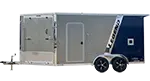

You’ve got a truck sitting several inches taller than stock, with 37-inch tires and aftermarket fender flares, and now you need to move it. Maybe it’s headed to a show, a shop across the state, or a new owner. The challenge is finding a trailer that can carry the truck’s actual weight, accommodate its tire track and overall width, provide a workable loading angle, and give you suitable locations for properly rated tie-downs.
Hauling a lifted truck is a specific job. Get the setup right and the trip should be uneventful. Get it wrong and you can damage the truck while loading, overload the trailer, reduce tow-vehicle stability, or allow an expensive build to move on the deck. Here’s what matters.
Why Lifted Trucks Break the Standard Assumptions
A stock half-ton truck loaded on a properly rated equipment trailer is usually straightforward. A lifted truck changes several parts of the equation: overall height, center of gravity, curb weight, tire track, body width, ground clearance, and the location of usable securement points. Each factor can affect which trailer you need and how the truck must be loaded.
Height. Suspension lifts, body lifts, and taller tires can raise the truck’s cab, bed, bumpers, and center of gravity. The total increase is not always equal to the advertised lift-kit height. Tire diameter contributes approximately half of the diameter increase at the axle, while suspension and body modifications affect different parts of the vehicle. Measure the finished truck from the ground to its highest fixed point instead of calculating its height from the parts list.
A higher center of gravity makes correct trailer loading and hitch setup especially important. The trailer should run approximately level when coupled and loaded, the tow vehicle must have sufficient payload and axle capacity for the imposed hitch weight, and the truck must be positioned to produce stable tongue or pin weight. Suspension squat, an improperly adjusted ball mount, underinflated tires, or excessive rearward load placement can all reduce stability.
Approach angle. A suspension lift and taller tires generally improve ground clearance and approach angle, but aftermarket parts can give that clearance back. A low winch mount, front receiver, air dam, drop-style running board, long rear bumper, hitch attachment, or rock slider can become the first point to contact the trailer. The critical measurements are the height and forward or rearward projection of the truck’s lowest components, not simply the advertised lift height.
Wheel and tire size. Full-size pickups are offered with many factory tire sizes, while modified trucks commonly run nominal 35-inch or 37-inch tires. The marked size does not always equal the tire’s mounted, loaded diameter, and actual section width varies with the tire and wheel. Wider wheels, spacers, aggressive offsets, flares, and dual rear wheels can make overall width just as important as tire diameter. These changes also affect where tire nets can sit and whether the truck can pass between conventional trailer fenders.
Heavier wheels, tires, bumpers, skid plates, winches, toolboxes, auxiliary tanks, and bed-mounted gear add to the truck’s actual transport weight. The only reliable number is a scale weight in the condition in which the truck will be hauled, including fuel, tools, spare parts, and cargo that will remain inside it.
Deck Length: Don’t Shortchange This
The most common mistake is choosing a deck that’s only barely long enough. Current full-size crew-cab pickups can exceed 20 feet bumper to bumper before modifications. For example, a crew-cab half-ton with a 6.5-foot bed can be approximately 244 inches long, while certain crew-cab long-bed heavy-duty pickups extend beyond 260 inches. Aftermarket front and rear bumpers, spare-tire carriers, and hitch-mounted equipment can add still more length.
A 20-foot deck can handle many short-bed full-size pickups, provided the truck physically fits and can be positioned for proper hitch weight. It is not a universal minimum for every lifted pickup. A crew-cab truck with a longer bed often fits and balances more comfortably on a 22-foot, 24-foot, or longer deck. The extra room is not merely about keeping the bumpers over the wood or steel. It allows you to move the truck forward or rearward until the loaded trailer produces the correct tongue or gooseneck pin weight without exceeding any axle, tire, coupler, hitch, trailer, or tow-vehicle rating.
Usable deck length must also be distinguished from advertised overall length. On some trailers, the listed bed length includes a dovetail; on a stationary-deck tilt trailer, part of the bed may remain fixed while the rear section tilts. Confirm the length of the actual tire-supporting surface, the location of the tilt pivot, and whether the truck’s wheelbase and overhangs work with that layout.
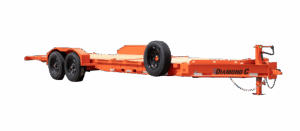
Width requires the same care. A conventional low-profile equipment trailer commonly has an approximately 80- to 82-inch bed between the fenders, not a flat 102-inch driving surface. Diamond C’s HDT, for example, is an 80- to 82-inch-bed hydraulically dampened tilt trailer, depending on configuration. Diamond C also offers configurations intended for wider loads, including the 102-inch-wide HXD tilt trailer and a 102-inch max-width LPX setup with drive-over fenders and the compatible X-Ramp system. A Diamond C DEC provides a 102-inch deck-over bed when a full-width deck and fixed equipment-trailer layout are preferred.
H&H also offers 102-inch full-width designs, including car-hauler, equipment, tilt, and deck-over configurations, but specifications and capacities vary by series. Before choosing either brand, measure the truck’s outside tire width, overall body or flare width, wheelbase, and overall length. Then compare those measurements with the exact trailer’s usable deck, fender clearance, ramp width, and rated capacity. Browse current trailer inventory here.
Ramp Angle and Approach: The Math Matters
There is no single loading angle that applies to every tilt or ramp-equipped trailer. The angle changes with deck height, deck length, dovetail length, ramp length, tilt geometry, suspension position, tire sink on soft ground, and whether the trailer and tow vehicle are sitting on level pavement. Manufacturer drawings or a measurement of the exact trailer are more useful than a generic angle estimate.
A longer transition and lower deck generally reduce the chance of contact, but lifted trucks can present unusual clearance problems. Front clearance matters as the truck begins climbing. Breakover clearance matters as the front axle reaches the deck while the rear axle remains on the incline. Rear departure clearance matters near the end of loading, particularly with long beds, extended bumpers, drop hitches, or rear-mounted spare tires.
Ramp-equipped trailers can reduce the transition angle through a dovetail and longer ramps. Diamond C’s current LPX is available with loading systems such as spring-assisted MAX Ramps. On compatible 102-inch max-width LPX configurations, the full-width X-Ramp works with frame extensions and drive-over fenders to create a broad loading path. The correct option depends on the truck’s tire track and the trailer’s configuration.
A Diamond C HDT uses a gravity-fed, hydraulically dampened tilt bed. The hydraulic dampening controls deck movement; it is not the same thing as a powered hydraulic cylinder that raises and lowers the deck on command. The HDT is available in multiple lengths, but the precise approach angle and the relationship between its stationary and tilting sections must be checked for the selected build. Diamond C’s 102-inch HXD provides a full-width tilt alternative for trucks that cannot fit safely between conventional fenders. H&H offers both hydraulic tilt car-hauler designs and powered tilt deck-over configurations, so operation should be verified model by model.
Before loading, park the tow vehicle and trailer in a straight line on firm, level ground whenever possible. Measure the truck’s lowest front, center, and rear components and inspect the entire path through the loading transition. Do not improvise with loose lumber or unsecured blocks. If additional approach aids are needed, use properly rated, purpose-built extensions or a manufacturer-approved loading solution that cannot slip, collapse, or overload the trailer’s ramp structure.
Tie-Down Points: Raised Suspension Changes Everything
This is where careful equipment selection matters most. Do not hook a strap to a bumper, running board, sway bar, steering component, suspension link, brake line, or any point that the vehicle or tie-down manufacturer has not approved for securement. Never route webbing across a sharp edge, hot exhaust part, or moving component.
A lifted truck can place frame and axle components farther above the trailer deck, changing tie-down angles and making some factory transport points harder to reach. A body lift may alter access around the body without moving the chassis by the same amount. Long-travel suspension, aftermarket control arms, remote-reservoir shocks, rock sliders, and skid plates can further limit safe routing.
Wheel-based securement is often practical because properly fitted wheel nets or over-the-tire straps restrain the tires without relying on a high frame rail. The restraint must be designed for the tire’s actual diameter and width, positioned so it cannot walk off the tread, and connected only to compatible anchor points. Axle straps or chains may also be appropriate when attached and routed according to the vehicle, trailer, and securement-equipment manufacturers’ instructions. Frame securement compresses the suspension and must use designated structural points; wheel or axle securement allows the body and suspension to move while the running gear remains restrained.
Use a four-corner securement arrangement for this kind of transport: two restraints controlling the front and two controlling the rear, arranged to resist forward, rearward, lateral, and vertical movement. Federal commercial cargo-securement rules for automobiles and light trucks weighing 10,000 pounds or less require restraint at both the front and rear with at least two tiedowns, but a properly designed four-point system provides redundancy and directional control suited to transporting a pickup. Vehicles exceeding 10,000 pounds are subject to the heavy-vehicle securement provisions in commercial operation. State rules and noncommercial requirements may also apply.
The trailer needs anchor locations that permit effective angles without contacting tires, bodywork, or suspension components. Some equipment trailers provide stake pockets, rub rails, or selected D-rings rather than D-rings at a fixed 24-inch interval. Do not assume every stake pocket or rail location has the same rating. Confirm the working load limit of the anchor, its attachment to the trailer structure, and whether the manufacturer approves it for vehicle securement.
Choose the system by its working load limit, not its advertised break strength. Under federal commercial securement rules, the aggregate working load limit of the tiedowns must be at least one-half the cargo’s weight, and the value contributed by each tiedown depends on how it is attached and routed. The effective rating of a securement assembly is limited by its lowest-rated component, including the strap or chain, hook, ratchet or binder, axle strap, connector, and trailer anchor point.
A common 2-inch transport strap may be marked with a 3,333-pound working load limit, but products differ and that number cannot be assumed. Read every label, reject cut or chemically damaged webbing, protect straps from abrasion, and use hardware intended for the selected anchor. Apply the parking brake and place the transmission in Park or in gear as appropriate, but never treat the transmission or parking brake as a substitute for external securement. Stop after the first few miles to inspect tension and routing, then recheck the load periodically during the trip.
GVWR and Trailer Rating: The Numbers That Protect You
Pickup weights vary widely by cab, bed, engine, drivetrain, trim, and equipment. A half-ton may weigh well under 5,000 pounds in a light configuration or approach and exceed 6,000 pounds in a heavily equipped performance or modified build. A diesel crew-cab one-ton can be substantially heavier. The registration, brochure, or internet estimate is not precise enough for a truck with extensive modifications.
Trailer payload capacity is not the same as trailer GVWR. A useful starting calculation is the trailer’s certified GVWR minus its actual empty weight, but the resulting number does not override axle, tire, wheel, hitch, coupler, or loading limits. Options such as steel flooring, spare tires, winches, toolboxes, batteries, hydraulic equipment, and upgraded ramps add empty weight and reduce available payload. The VIN certification label and an actual scale ticket should control the decision.
For example, a trailer certified at 14,000 pounds that weighs 4,200 pounds in its ready-to-tow condition has a theoretical 9,800-pound payload by subtraction. That does not automatically make it suitable for every 9,800-pound vehicle. The load must still fit physically, be positioned without overloading either trailer axle, and remain within the ratings of the tires, wheels, hitch system, and tow vehicle. The scale should be used to verify loaded axle and combination weights.
Diamond C’s current heavy-duty equipment range includes several appropriate starting points. The LPX low-profile equipment trailer and HDT hydraulically dampened tilt trailer are offered in GVWR configurations from 15,500 to 24,000 pounds. Standard axle equipment on these premium Diamond C lines is Lippert, with axle count and rating varying by selected GVWR package. The HXD full-width tilt is available with a 102-inch bed and GVWR choices in the heavy-equipment range. The 102-inch DEC deck-over equipment trailer is available in GVWR configurations from 15,500 to 23,000 pounds. Exact empty weight and payload change with length and options.
For substantially heavier trucks or frequent commercial use, Diamond C’s FMAX gooseneck flatbed family provides 102-inch deck-over configurations across a broad range of lengths and GVWRs, reaching approximately 40,000 pounds on applicable models. A gooseneck does not create capacity by itself; the tow vehicle must be equipped for the trailer’s loaded weight and pin weight, and the particular FMAX model must match the load.
H&H equipment, car-hauler, tilt, and deck-over trailers cover several capacities and deck layouts as well. Do not compare two trailers by axle labels alone. Compare certified GVWR, actual empty weight, payload, bed dimensions, ramp capacity, anchor ratings, tire ratings, and hitch requirements. If you’re not sure which rating you need, call the team at (812) 829-0226 with the truck’s scale weight, dimensions, tire track, and intended tow vehicle.
A Few Specific Scenarios Worth Addressing
Tall tires and enclosed trailers
If you’re considering an enclosed trailer for a lifted truck, confirm more than the brochure’s nominal interior height. Measure the truck from the ground to its highest fixed point in transport condition, including roof racks, antennas that cannot be removed, cab lights, and bed-mounted equipment. Then confirm the trailer’s clear rear-door opening, ramp-door opening, interior roof-bow clearance, roof-vent clearance, wheel-box spacing, ramp capacity, and transition angle.
A nominal 6-inch suspension lift does not necessarily add exactly 6 inches to total height, and changing from a 31-inch tire to a 37-inch tire contributes roughly 3 inches of theoretical axle-height increase before tire deflection. The combined result could approach 9 inches, but suspension geometry, tire dimensions, vehicle loading, and modifications make direct measurement essential. A stock 4×4 half-ton may already stand roughly 77 inches tall depending on configuration, and a modified truck can readily exceed a typical car hauler’s door opening even when the published interior height appears sufficient.
The cab, roof rack, or antenna is normally the highest point, not the tire. Also remember that the entrance can be lower than the interior because of the rear header and door hardware. Leave a practical safety margin rather than planning around an exact zero-clearance fit.
Loading alone vs. with a spotter
A lifted truck with wide tires can be difficult to center on a conventional equipment trailer. From the driver’s seat, the front corners may be visible while the tire-to-fender clearance is not. Use a spotter standing where the driver can see them and away from the truck’s travel path, trailer pinch points, and the area behind the vehicle. Agree on clear hand signals before moving.
Do not calculate available deck clearance by subtracting tire widths from the trailer’s overall width. What matters is the truck’s outside-to-outside tire measurement and the trailer’s clear driving width at its narrowest point. A 102-inch-wide trailer may still have fenders, rails, ramp channels, or hardware that reduce usable tire space unless it is specifically configured as a full-width driving surface. Folded mirrors may still extend beyond the body, so verify both mirror and flare clearance before loading.
Use slow, straight steering inputs and stop immediately if the spotter disappears from view. A winch can provide more controlled loading for a disabled or unfamiliar truck, but the winch, cable or synthetic line, attachment point, battery system, and trailer structure must all be rated for the pull. No person should stand in line with a tensioned winch line.
Tongue weight and balance
Do not use a rule that places a fixed percentage of the truck’s weight ahead of the trailer axles. The goal is to produce the correct loaded hitch weight while staying within every rating. For many bumper-pull trailers, a common stability target is approximately 10 to 15 percent of the loaded trailer weight on the hitch. Gooseneck trailers commonly impose a higher percentage on the truck, often approximately 15 to 25 percent. The trailer manufacturer and tow-vehicle manufacturer should determine the acceptable range for the actual combination.
Move the hauled truck in small increments and verify the result with a suitable scale. Keep the loaded trailer approximately level and confirm the tow vehicle’s front and rear axle weights, receiver or gooseneck rating, hitch components, payload capacity, gross vehicle weight rating, and gross combination weight rating. Weight-distributing equipment should be used only when approved and correctly selected for the tow vehicle, receiver, and trailer.
Too little tongue weight can promote sway. Excessive tongue or pin weight can overload the tow vehicle’s rear axle, tires, suspension, receiver, or frame while unloading the steering axle. A lifted truck with a rear-mounted spare, bed toolbox, auxiliary tank, or overland equipment may have more weight concentrated near its rear axle, so its final trailer position can differ from an otherwise similar stock truck.
What to Look for When You’re Shopping a Trailer for This Job
- A usable deck length matched to the truck’s measured overall length, wheelbase, overhangs, and required balance position; 22, 24, or more feet may be preferable for long crew-cab builds
- A verified loading transition that clears the truck’s front bumper, center breakover points, steps, skid plates, rear bumper, and hitch hardware
- Ramps, a dovetail, or a tilt system rated for the truck’s axle loads and tire contact pattern
- Properly rated D-rings, stake pockets, rub rails, or manufacturer-approved vehicle-securement anchors in locations that allow safe four-corner restraint
- GVWR and actual payload capacity that exceed the truck’s measured transport weight with an appropriate operating margin
- A clear driving width matched to the truck’s outside tire width, flares, steps, and body; use a compatible drive-over-fender or 102-inch deck design when an 80- to 82-inch fendered bed is insufficient
- An actual empty-weight figure for the selected trailer, including ramps, winch, spare tire, steel floor, batteries, toolboxes, and other installed options
- Electric brakes on all required axles, a functioning breakaway system, properly rated tires, and a tow vehicle with a compatible brake controller
A tilt deck can be an excellent loading option because the deck itself forms the loading surface and there are no separate ramps to position. Operation varies by model. Diamond C’s HDT uses a gravity-fed, hydraulically dampened system, while its HXD provides a 102-inch full-width tilt platform. H&H offers hydraulic tilt designs, including full-width configurations. Inspect the exact tilt length, stationary-deck section, operating procedure, approach angle, deck width, and rated capacity rather than assuming all tilt trailers work alike.
If you’re hauling a lifted truck on a one-time basis, rental may be an option, but obtain the rental trailer’s VIN-label ratings and actual specifications before pickup. A nominal 7,000-pound-GVWR car hauler cannot legally or safely carry a truck weighing close to 7,000 pounds because the trailer’s own weight is part of its GVWR. The tow vehicle, hitch, ball or gooseneck coupler, safety chains, tires, brake controller, and electrical connection must also be compatible.
Indiana requires qualifying trailers with a gross weight of at least 3,000 pounds to have brakes adequate to control and stop the vehicle. That requirement is only one part of a safe combination; a heavy equipment trailer should have all required brakes maintained and correctly controlled. Depending on whether the trip is personal or commercial, vehicle ratings, use, and route can also affect registration, licensing, insurance, and federal motor-carrier requirements.
Start with four verified numbers: the truck’s scale weight, overall length, maximum width, and overall height. Add its outside tire width, wheelbase, lowest clearance points, and approved securement locations. Those measurements, combined with the tow vehicle’s ratings and the trailer’s certified payload, loading geometry, and anchor system, point directly to the right trailer for the job. If you want help matching the two, start with the current inventory at Spencer Trailers and go from there.


