










You feel it before you see it. A gentle push from the back of your truck, then another, and suddenly the trailer is moving side to side with each swing becoming harder to settle. Trailer sway is one of the most disorienting situations a driver can experience while towing, and an unchecked oscillation can quickly lead to a lane departure, jackknife, rollover, or collision.
The good news is that most sway problems have an identifiable cause. Incorrect load placement is common, but hitch height, tire condition, brake setup, speed, wind, worn suspension parts, axle alignment, and an undersized tow vehicle can all contribute. The important part is finding the cause instead of treating sway as a normal part of towing.
What Actually Causes Trailer Sway?
Sway does not come out of nowhere. The tow vehicle and trailer form a coupled system with an articulation point at the hitch. Once the trailer begins rotating from side to side, steering inputs, wind, road irregularities, tire flex, and changes in hitch load can either damp that motion or feed more energy into it. A properly matched and loaded combination should naturally settle after a small disturbance rather than continuing to swing.
Low Tongue Weight
This is one of the most common causes of bumper-pull trailer instability. Tongue weight is the downward load the trailer places on the hitch. A widely used starting range for a conventional bumper-pull trailer is approximately 10 to 15 percent of the trailer’s actual loaded weight, unless the trailer or tow-vehicle manufacturer specifies something different. For a trailer that actually weighs 7,000 lbs loaded, that range would be about 700 to 1,050 lbs.
That percentage is only useful when the trailer’s real loaded weight is known. Tongue weight must also remain within the ratings of the coupler, ball, ball mount, receiver, weight-distribution system, tow vehicle, rear axle, and tires. Gooseneck and fifth-wheel combinations generally carry a higher percentage of their loaded weight at the hitch, often around 15 percent or more, but the correct figure must come from the applicable manuals and ratings.
Too little tongue weight reduces the stabilizing force at the front of the trailer and can make the trailer more willing to rotate around its axle group. It may also leave less load on the tow vehicle’s rear axle than the combination was designed to carry. Excessive tongue weight creates a different problem: it can overload the receiver or rear axle, push the back of the tow vehicle down, and remove enough load from the front axle to reduce steering and braking response. There is no universal percentage at which every trailer suddenly becomes unstable, so measure the load rather than relying on a guess.
Rear-Loaded Cargo
Tongue weight is directly affected by cargo placement. Moving a heavy machine, pallet, vehicle, or attachment behind the axle group transfers weight away from the hitch. A change of only a few inches can make a meaningful difference when the item weighs several thousand pounds.
Heavy cargo should normally be positioned low, centered from side to side, and far enough forward to produce the manufacturer-recommended tongue weight. That does not mean pushing everything against the front rail. Too much forward load can exceed the trailer’s coupler rating or the tow vehicle’s payload, GVWR, or rear GAWR. Approximately 60 percent of cargo in the front half and 40 percent in the rear half can be a useful starting point for many conventional trailers, but the final position must be verified by weighing.
The load also has to stay where it was placed. A skid steer that rolls backward, a water tank that allows liquid to surge, unsecured lumber, livestock movement, or a vehicle with loose tie-downs can change tongue weight while the combination is moving. Use properly rated securement equipment, follow applicable cargo-securement requirements, and recheck straps and chains after the first few miles.
Speed
Speed amplifies an unstable setup. Aerodynamic forces increase rapidly as speed rises, tires and suspension components have less time to settle after a disturbance, and the driver has less time to respond. A combination that appears acceptable at 50 or 55 mph may begin oscillating at a higher speed, especially after a steering correction, crosswind, downhill run, or pass by a large truck.
There is no blanket 65 mph limit that applies to every utility, equipment, dump, or cargo trailer. The maximum safe speed is the lowest limit established by the road, tow-vehicle manufacturer, trailer manufacturer, hitch equipment, and tires. Modern ST tires are available with different speed ratings, load ranges, and pressure requirements. A higher tire speed rating also does not make it safe to exceed the trailer’s instructions or drive faster than conditions allow.
If a trailer feels nervous at a particular speed, slowing down is the immediate answer, but it is not the complete repair. A combination that repeatedly begins swaying at highway speed needs to be weighed and inspected before the next trip.
Wind and Passing Trucks
A fully enclosed cargo trailer presents a large surface to the wind. The flat sides of a 7-by-16 or 8.5-by-24 Wells Cargo or United trailer can be pushed by crosswinds, especially when the trailer is lightly loaded. When a semi overtakes you, its bow wave may first push the trailer away and the low-pressure area beside the truck may then pull it toward the passing vehicle. That rapid change can initiate sway in a marginal setup.
Open trailers are not immune. A flatbed or equipment trailer carrying a tall tractor, stacked materials, a large tank, or another high-profile load can have as much exposed area as an enclosed trailer. Strong gusts, bridge approaches, gaps in tree lines, and exposed sections of highway deserve a lower speed and more following distance. If the wind is moving the trailer across the lane, the safe decision may be to stop and wait for conditions to improve.
Tire Pressure
Underinflated trailer tires generate excess heat and allow more sidewall deflection. That can make the trailer feel vague, increase rolling resistance, reduce load capacity, and eventually cause tire failure. Overinflation beyond the approved pressure can also reduce the tire’s contact patch and compromise ride, traction, and durability.
Check pressure when the tires are cold and inflate them according to the trailer certification label, owner’s manual, and tire manufacturer’s load-and-inflation information. Do not assume every trailer tire should be set to 65 or 80 psi. Depending on tire size and load range, the specified cold pressure may be 50, 65, 80, 110, 125 psi, or another value. The maximum cold pressure molded into a sidewall is not automatically the correct target for every trailer installation.
All tires on an axle should be compatible in size, construction, load capacity, and approved pressure. Inspect the tread and sidewalls for cuts, cracking, bulges, exposed cords, uneven wear, impact damage, and evidence of separation. Check the DOT date code as well; trailer tires age even when tread remains. A trailer that has been parked for months may also have low pressure, corrosion at the valve or wheel, or temporary flat spotting. Carry a properly rated spare and verify wheel-lug torque using the trailer or wheel manufacturer’s procedure.
Improper Hitch Setup
A weight-distribution hitch is not selected by comparing trailer weight with an arbitrary percentage of the tow vehicle’s curb weight. Whether one is required depends on the tow vehicle, receiver, hitch, and trailer instructions. Many conventional combinations over 5,000 lbs call for weight distribution, but that is not a universal rule, and some tow vehicles or trailer brake systems have specific restrictions.
The first step is making sure every component is properly rated: receiver, ball mount, hitch ball, coupler, pins, safety chains, and breakaway equipment. The hitch ball must be the correct diameter, and the ball mount must place a conventional trailer level or at the attitude specified by its manufacturer. A trailer that is noticeably nose-high or nose-low can distribute axle loads incorrectly, particularly on tandem and triple-axle models.
A correctly adjusted weight-distribution hitch transfers part of the tongue load from the tow vehicle’s rear axle to its front axle and the trailer axles. It should be set according to the tow-vehicle and hitch manufacturer’s measurements, not tightened until the truck merely “looks level.” Friction sway controls and integrated weight-distribution systems can add resistance to articulation, but they cannot correct insufficient tongue weight, an overloaded trailer, damaged tires, worn suspension, or a mismatched tow vehicle.
Trailer brakes matter too. Indiana requires a trailer or semitrailer with a gross weight of at least 3,000 lbs, when operated on a highway, to have brakes adequate to control, stop, and hold it. The driver must be able to apply those brakes from the tow vehicle, and the system must apply automatically if the trailer breaks away. Electric and electric-over-hydraulic systems also need a compatible, properly adjusted brake controller. Brake gain that is far too low leaves the trailer pushing the truck; gain that is too high can lock the trailer wheels and reduce stability.
Q&A: Common Questions We Hear at the Lot
Q: My trailer swayed badly on the way home from buying it. I had nothing in it. Why?
An empty trailer is not automatically unsafe, and its tongue-weight percentage is not necessarily lower simply because no cargo is present. A properly engineered trailer should tow predictably in its unloaded condition when it is correctly coupled and maintained. However, an empty trailer has less total mass and may react more sharply to wind, potholes, pavement joints, and abrupt steering. Its suspension may also bounce more because it is carrying far less than its working load.
Severe unloaded sway should not be dismissed as normal. Possible causes include inadequate empty tongue weight, wrong ball height, low or mismatched tires, loose wheel bearings, worn suspension components, incorrect axle alignment, brake drag, a bent frame, or excessive speed for conditions. Stop and inspect the setup rather than adding random ballast. Any ballast used to correct loading must be securely fastened, within the trailer’s capacity, and positioned using measured tongue weight.
Q: If I feel sway starting, should I hit the brakes?
Do not stomp the tow vehicle’s brakes and do not try to steer back and forth against the trailer. Hold the steering wheel as steadily as possible, keep the combination pointed straight, and ease off the accelerator. If the trailer has functioning electric or electric-over-hydraulic brakes and the brake controller’s instructions permit it, apply the controller’s manual override smoothly. Applying the trailer brakes without abruptly braking the tow vehicle can pull the trailer back into line.
Continue reducing speed in a controlled manner. Do not accelerate in an attempt to “pull out” of the sway, and avoid sudden lane changes. After the oscillation stops, move to a safe location and inspect the load, coupler, hitch, tires, wheels, suspension, brakes, and tie-downs. There is no specific speed, such as 45 mph, at which every sway event will automatically stop. Do not resume highway travel until the cause has been identified or the combination can be transported safely for inspection.
Q: Does a tandem-axle trailer sway less than a single-axle?
Often, but not automatically. A tandem-axle trailer generally feels more settled over bumps, carries its load across more tires, and may resist quick changes in direction better than a small single-axle trailer. It also provides additional tire capacity and can be better suited to longer decks and heavier cargo. Those advantages do not overcome poor tongue weight, overloading, bad tires, incorrect hitch height, or loose cargo.
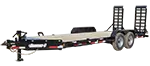
A properly designed and loaded single-axle utility trailer can tow safely, while a poorly loaded tandem can sway violently. Axle placement, wheelbase, deck length, suspension geometry, load height, frame condition, and tow-vehicle compatibility matter more than axle count by itself. Current Diamond C LPX and HDT bumper-pull equipment trailers are offered in heavy-duty GVWR configurations from approximately 15,500 through 24,000 lbs, with Lippert axles standard and axle packages varying by the selected rating. Those trailers are designed for substantial equipment loads, but they still require correct positioning, securement, hitch setup, and tow-vehicle capacity.
Q: Can a brake controller prevent sway even without me doing anything?
An ordinary proportional brake controller should not be assumed to detect trailer sway. Its primary job is to apply the trailer brakes in response to tow-vehicle braking or deceleration, and to give the driver a manual control. That is different from an active stability system.
Some newer tow vehicles have trailer-sway control that monitors yaw and may reduce engine power or apply selected vehicle brakes. Certain trailer-mounted ABS systems can also provide active sway-mitigation functions. For 2026, Diamond C introduced Lippert ABS as standard on configurations using 8,000-lb and larger axle packages and optional on 7,000-lb axle configurations. That system includes trailer-side stability features, but it remains supplemental technology. It cannot make an overloaded, rear-heavy, mechanically damaged, or incorrectly matched combination safe.
How to Fix It Before You Pull Out
- Weigh your tongue weight. Use a properly rated tongue-weight scale or a commercial platform scale, and measure the trailer in its actual travel condition with fuel, tools, equipment, attachments, and cargo aboard. Keep the coupler at normal towing height. Compare the result with the loaded trailer weight and every applicable hitch and vehicle rating.
- Load heavy items forward, but verify the result. Approximately 60 percent of the cargo in the front half is a useful starting point for many conventional trailers, not a substitute for weighing. Center the cargo from side to side, keep its center of gravity low, and secure it so it cannot move under braking, acceleration, or cornering.
- Check tire pressure cold. Use the pressure specified for that trailer and tire installation. Inspect every tire, including the spare, and confirm that the tires have adequate load capacity for the heaviest-loaded axle. Do not compensate for an overloaded trailer by adding pressure beyond the tire or wheel rating.
- Set the tow vehicle’s tires and loading correctly too. Follow the vehicle’s tire-information label and owner’s manual, including any towing guidance. Account for passengers, tools, fuel, bed cargo, the hitch, and tongue or pin weight. Do not exceed the tow vehicle’s payload, GVWR, front GAWR, rear GAWR, GCWR, receiver rating, or tire capacities.
- Use the correct hitch equipment. Install and adjust a weight-distribution hitch only when the tow-vehicle, receiver, and trailer manufacturers approve or require it. Confirm ball size, ball-mount rise or drop, coupler engagement, safety-chain attachment, breakaway-cable routing, brake-controller operation, and a level trailer attitude before leaving.
- Respect the lowest speed limit in the system. Stay within the posted limit, tire speed rating, and tow-vehicle, trailer, and hitch instructions. Reduce speed further for wind, rain, rough pavement, hills, traffic, tall loads, or unfamiliar equipment. A rating is a maximum under approved conditions, not a promise that every loaded combination will remain stable at that speed.
What Trailer Design Has to Do With It
Not all trailers respond the same way. Axle position, axle alignment, hitch geometry, deck height, frame rigidity, suspension condition, tire selection, brake balance, and the distance between the hitch and axle group all influence towing behavior. The manufacturer must locate the axle group so the trailer develops appropriate hitch load across its intended loading range, but the operator is still responsible for staying within that range.
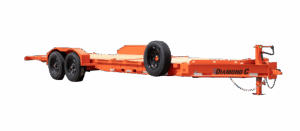
A Diamond C trailer, for instance, must be evaluated by its actual model and configuration rather than by the brand name alone. The LPX is a low-profile, extreme-duty bumper-pull equipment trailer, while the HDT is a low-profile, hydraulically dampened tilt equipment trailer. Current versions span roughly 15,500 to 24,000 lbs GVWR, depending on axle package and any selected derating. Their lower deck height can help keep properly positioned equipment closer to the road, reducing the load’s center of gravity compared with a taller deck-over arrangement.
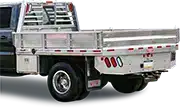
The FMAX is Diamond C’s gooseneck flatbed family, with model-specific ratings extending from approximately 15,500 lbs to 40,000 lbs GVWR. A gooseneck transfers pin weight into the truck bed near the rear axle rather than applying it behind the bumper, which generally gives a heavy combination more favorable towing geometry. Diamond C’s premium FMAX, HDT, LPT, LPX, WDT, and DEC lines use Lippert axles as standard. Axle capacity and advanced features help the trailer carry and control an appropriate load, but neither the axle brand nor the frame design eliminates the need to weigh the combination.
Liberty and Delco trailers, both of which we carry, cover several different sizes, axle arrangements, deck styles, and GVWR classes. The correct choice depends on the dimensions and actual weight of the cargo, where its center of gravity sits, how it can be secured, and what the tow vehicle can legally and safely handle. A compact single-axle utility trailer may be perfect for a mower or light household load, but it should not be pressed into service for cargo that exceeds its GVWR, axle rating, tire capacity, deck space, or securement provisions.
If you are not sure whether your current trailer is sized correctly for what you are hauling, that is a conversation worth having before something goes sideways on State Road 46. Reach out to us with the trailer VIN or model, tow-vehicle details, cargo weight, cargo dimensions, and intended loading position. We can help you compare actual payload, tongue or pin weight, GVWR, axle ratings, tire capacities, hitch requirements, and brake equipment.
The Short Version
Sway comes from factors you can usually identify and control: tongue weight, cargo placement, cargo securement, speed, wind exposure, tire condition, hitch geometry, brake setup, tow-vehicle loading, and mechanical condition. Get those items right on every haul and the combination should settle naturally after normal road disturbances instead of building into a recurring oscillation.
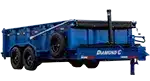
The trailers in our current inventory range from compact single-axle utilities through tandem equipment trailers, dump trailers, enclosed cargo trailers, and heavy-duty gooseneck haulers. Inventory and specifications change as units arrive and sell, so the VIN-specific certification label and build information are more reliable than a general model description. Every trailer still has to be matched to the cargo and tow vehicle, loaded within all ratings, coupled correctly, and maintained.
If you have experienced a sway event, do not solve it by automatically adding a sway-control bar, increasing tire pressure, or moving the load forward without measurements. Bring us the trailer and the details of how it was loaded. We will look at the hitch height, tongue or pin weight, tires, wheels, suspension, brakes, axle alignment, cargo position, and tow-vehicle ratings and give you a straight answer about what needs to change.


