


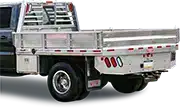
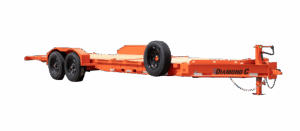


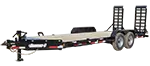


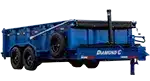


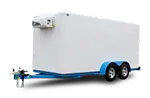


You found the trailer. It checks every box. Then someone asks what you’re towing it with, and suddenly you’re second-guessing whether your half-ton can handle it. This is one of the most common mistakes people make when buying a trailer, and it can leave them with a truck that is over one or more ratings or with far more truck than the job actually requires.
Here’s the practical answer: your truck’s VIN-specific maximum loaded trailer rating must exceed the trailer’s actual loaded weight, the combination must remain within the truck’s Gross Combination Weight Rating, and the truck must have enough payload and rear-axle capacity for the trailer’s tongue or pin weight. The receiver, ball mount, hitch ball, coupler, tires, wheels, and any weight-distributing or gooseneck hardware must also remain within their individual ratings. When you’re buying a truck for a trailer that may eventually be loaded to capacity, planning around the trailer’s full GVWR is the safest and simplest approach. :contentReference[oaicite:0]{index=0}
Start With GVWR, Not Empty Weight
The first number to identify is the trailer’s Gross Vehicle Weight Rating, not only what the trailer weighs sitting empty in our lot. GVWR is the maximum permitted weight of the trailer and everything loaded on it. It includes the frame, axles, deck, ramps, spare tire, toolbox, batteries, hydraulic equipment, attachments, cargo, and any other items carried by the trailer. Payload capacity is calculated by subtracting the trailer’s actual empty weight from its GVWR, so GVWR and payload are not the same number.
For example, the current Diamond C GTU premium tandem-axle utility trailer has a 7,000 lb GVWR and two 3,500 lb Lippert brake axles. Move into a Diamond C LPX equipment trailer and the current manufacturer range runs from 15,500 to 24,000 lb GVWR, with some dealer-stock configurations certified at 14,900 lb. Those trailers may have similar deck lengths, but they require very different tow-vehicle, hitch, payload, brake, tire, and licensing calculations. :contentReference[oaicite:1]{index=1}
Your truck does not necessarily have to be rated for the trailer’s entire GVWR when the trailer will never be loaded that heavily and its real loaded weight is known. The truck must be rated for the trailer’s actual loaded weight. However, relying on an assumed light load creates little room for heavier equipment, attachments, extra material, fuel, tools, or future changes. For a truck and trailer combination you plan to own for years, matching the truck to the trailer’s full GVWR provides a more useful operating margin.
GVWR is a certified maximum, not a suggested target that can be exceeded because the axles appear capable of carrying more. The trailer’s frame, coupler, suspension, tires, wheels, brakes, safety equipment, and certification are evaluated as a complete system. Never substitute the combined axle ratings for the trailer’s stated GVWR, and never calculate payload from an estimated empty weight when the trailer’s certification label or an actual scale weight is available.
The Three Classes: What Half, Three-Quarter, and One-Ton Actually Mean
The “half-ton / three-quarter-ton / one-ton” language is traditional truck terminology, not a guarantee of modern payload or towing capacity. Two trucks wearing the same model badge can have dramatically different ratings because of cab style, bed length, engine, drivetrain, axle ratio, suspension package, tires, wheels, trim level, factory options, and installed equipment. Always verify the exact truck rather than relying on its general class.
Half-Ton (F-150, Ram 1500, Silverado 1500)
Modern half-ton tow ratings vary widely. For 2026, a properly configured Ford F-150 can tow up to 13,500 lbs with the 3.5L EcoBoost, while the PowerBoost hybrid tops out at 12,400 lbs. The 2026 Chevrolet Silverado 1500 reaches 13,300 lbs in specific configurations, and the 2026 Ram 1500 reaches 11,610 lbs. Maximum advertised payloads also exceed 2,000 lbs on certain builds, but the maximum towing and maximum payload figures usually represent different configurations and should not be treated as though one truck automatically has both. :contentReference[oaicite:2]{index=2}
For a 7,000 lb loaded conventional trailer, a properly balanced tongue weight will commonly fall between about 700 and 1,050 lbs. At 9,890 lbs loaded, the same 10 to 15 percent range becomes approximately 989 to 1,484 lbs. At 13,000 lbs, it becomes approximately 1,300 to 1,950 lbs. That weight rests on the truck and uses payload capacity, rear-axle capacity, and hitch capacity even though most of the trailer’s weight remains on its own axles. Ford and GMC both direct conventional-trailer owners to maintain tongue weight in approximately this 10 to 15 percent range. :contentReference[oaicite:3]{index=3}
A properly equipped half-ton is usually a sensible match for 2,990 to 7,000 lb utility trailers, many 7,000 lb car haulers, and selected cargo or equipment trailers approaching 9,890 lbs. Once you get near the top of the half-ton’s trailer rating, payload, rear GAWR, receiver limits, frontal area, crosswind behavior, and frequency of use become increasingly important. An enclosed trailer can also be more demanding than an open trailer of the same weight because of its larger frontal area and wind resistance.
Half-tons are not automatically unsafe near 9,000 or 10,000 lbs, but the truck must be the correct configuration and the trailer must be loaded properly. A lightly optioned regular-cab work truck may have substantially more payload than a crew-cab luxury model with four-wheel drive, large wheels, a panoramic roof, and other equipment. The model name alone does not answer the question.
Three-Quarter-Ton (F-250, Ram 2500, Silverado 2500HD)
This is the workhorse class for frequent equipment and commercial-style hauling. Depending on configuration, current three-quarter-ton pickups can offer conventional trailer ratings from the mid-teens to approximately 20,000 or 22,000 lbs. The 2026 Ram 2500 is rated for up to 20,000 lbs of towing, while selected 2026 Ford F-250 configurations reach 22,000 lbs conventionally. A properly equipped 2026 Silverado 2500HD can reach 20,000 lbs of conventional trailering. :contentReference[oaicite:4]{index=4}
Three-quarter-ton payload ratings commonly fall somewhere around 2,000 to 4,000 lbs, but diesel engines, four-wheel drive, crew cabs, high trim levels, and heavy accessories can reduce the available payload. For the 2026 Ram 2500, maximum published payload is 3,930 lbs with the gas engine and 3,600 lbs with the diesel, but those are maximum configurations rather than ratings that apply to every Ram 2500. :contentReference[oaicite:5]{index=5}
Three-quarter-ton trucks often pair well with equipment trailers in the 9,890 to 15,500 lb range, heavy enclosed trailers, dump trailers, and some lighter goosenecks. A Diamond C LPX or HDT may be certified at 14,900 or 15,500 lbs in common dealer configurations, while the current manufacturer lineup extends to 24,000 lbs with higher-capacity axle packages. A three-quarter-ton may handle one of the lower-GVWR versions, but it is not an automatic match for every LPX or HDT simply because its brochure tow rating is high enough. :contentReference[oaicite:6]{index=6}
At 15,500 lbs, a conventional trailer carrying 12 percent tongue weight places approximately 1,860 lbs on the truck. At 15 percent, that becomes 2,325 lbs. Add occupants, tools, a toolbox, auxiliary fuel, a weight-distributing hitch, and other bed cargo, and some diesel three-quarter-ton trucks can run out of payload or rear-axle capacity before reaching their published maximum trailer rating. That is why the truck’s door labels and towing guide matter more than the badge on the fender.
One-Ton (F-350, Ram 3500, Silverado 3500HD)
One-ton trucks provide higher GVWR, rear-axle capacity, payload, and gooseneck or fifth-wheel capability. Current one-tons can tow roughly 18,000 to 22,000 lbs through a conventional receiver in selected configurations and substantially more through an approved gooseneck or fifth-wheel system. The 2026 Ram 3500 is rated for up to 36,610 lbs of diesel towing and up to 7,590 lbs of payload in separate maximum configurations. Properly equipped 2026 Ford Super Duty trucks can reach 40,000 lbs of gooseneck capacity. :contentReference[oaicite:7]{index=7}
This is the natural starting class for many heavy gooseneck flatbeds and high-capacity equipment trailers. Diamond C FMAX gooseneck flatbeds currently begin with the 15,500 lb GVWR FMAX207 and extend through tandem-dual and triple-dual configurations available at up to 40,000 lb GVWR. The lower end may work with an appropriately configured single-rear-wheel one-ton, while the highest-GVWR combinations require careful evaluation of the truck’s exact gooseneck rating, payload, rear GAWR, tire ratings, hitch rating, GCWR, and applicable commercial requirements. :contentReference[oaicite:8]{index=8}
A dual-rear-wheel truck is not automatically required just because a trailer exceeds 16,000 lbs, but dual rear wheels provide additional rear tire capacity, axle-load margin, and lateral stability. Those advantages become especially important with high gooseneck pin weight, tall enclosed trailers, frequent highway hauling, or equipment that cannot always be positioned for an ideal load balance. Some single-rear-wheel one-tons have excellent ratings, while some heavily optioned one-tons have less payload than buyers expect.
Moving to a one-ton does not increase the trailer’s legal payload or excuse an overloaded hitch. It simply gives you access to truck configurations with greater capacity and, often, more operating margin. The exact combination still has to comply with the truck GVWR, front and rear GAWR, GCWR, trailer rating, hitch limits, and tire ratings.
Tongue Weight and Why Payload Limits Bites People
This is where capable trucks get maxed out by owners who only check the advertised tow rating. Payload is the weight that can be added to the truck as it was manufactured. The Tire and Loading Information label states the maximum combined weight of occupants and cargo for that specific vehicle. Passengers, tools, bed cargo, aftermarket bumpers, auxiliary tanks, aftermarket hitch equipment, and the trailer’s tongue or pin weight all use that capacity. Factory-installed equipment is already reflected in the truck’s as-built rating, while equipment added later must be accounted for.
A common scenario is a half-ton with a 1,800 lb payload label. Two occupants weigh 400 lbs, tools and personal gear add 100 lbs, an aftermarket weight-distributing hitch adds 75 lbs, and the trailer places 1,300 lbs on the ball. The total is 1,875 lbs, so the truck is already 75 lbs over its payload allowance even though the trailer itself may remain below the published tow rating.
Payload is not the only truck-side limit. The rear axle and rear tires carry much of the tongue or pin weight, so the loaded truck must also remain under its rear GAWR and individual tire capacities. A truck can be under its total GVWR but still overload the rear axle, particularly with a heavy gooseneck, a toolbox, an auxiliary fuel tank, or cargo positioned behind the rear axle.
Check the yellow Tire and Loading Information label inside the driver door for the specific payload allowance. Check the Safety Compliance Certification label for truck GVWR and front and rear GAWR. Then use the owner’s manual, manufacturer towing guide, or VIN-based towing tool to identify the truck’s exact maximum trailer weight and GCWR. The brochure’s highest advertised number is not the rating for every truck. Ford and Chevrolet both state that passengers, cargo, accessories, and vehicle configuration can reduce available towing capacity. :contentReference[oaicite:9]{index=9}
A weight-distributing hitch does not erase tongue weight or create additional payload. It redistributes part of the load among the truck’s front axle, rear axle, and trailer axles when properly selected and adjusted. The tongue weight still counts against the truck, and the system must be used only where the truck, receiver, trailer frame, and hitch manufacturer permit it.
Gooseneck and fifth-wheel trailers require a separate calculation because pin weight is commonly higher than conventional tongue weight. Depending on trailer design and loading, approximately 15 to 25 percent of the loaded trailer weight may be carried in the truck bed. A 20,000 lb gooseneck at 20 percent pin weight places about 4,000 lbs on the truck before occupants, hitch hardware, or bed cargo are added. :contentReference[oaicite:10]{index=10}
A Quick Reference by Trailer Type
| Trailer Type | Typical GVWR Range | Recommended Minimum Truck Class |
|---|---|---|
| Utility / landscape trailer (5×10 to 6×12) | 2,990 to 7,000 lbs | Properly rated midsize truck, full-size SUV, or half-ton |
| Cargo / enclosed trailer (7×16 to 7×20) | 7,000 to 9,990 lbs | Properly equipped half-ton or three-quarter-ton |
| Equipment / flatbed bumper-pull (16 to 24 ft) | 9,890 to 15,500+ lbs | Three-quarter-ton or one-ton after payload and hitch calculations |
| Heavy equipment / gooseneck (20+ ft) | 15,500 to 40,000 lbs | Properly configured one-ton SRW, one-ton dually, or higher-capacity truck |
These ranges are starting points, not guarantees. Trailer length alone does not determine truck size, and the word “half-ton” or “one-ton” does not establish a specific rating. A 9,890 lb trailer may fit a carefully configured half-ton when it is lightly loaded and properly balanced, but the same trailer loaded near GVWR may require a three-quarter-ton because of tongue weight. A 15,500 lb bumper-pull may fall within a three-quarter-ton’s trailer rating yet exceed that truck’s available payload or receiver tongue-weight rating.
Frequency and operating conditions also matter. A combination used twice a year on flat local roads presents a different ownership decision from one used every day on interstates, construction sites, gravel roads, steep grades, or in winter weather. Ratings are still the legal and mechanical ceiling in either case, but buyers who tow frequently usually benefit from more payload, cooling capacity, braking reserve, wheelbase, and stability than the minimum calculation requires.
The Hitch Rating Is a Third Number You Can’t Ignore
Even when the truck has enough trailer and payload capacity, the hitch system may establish a lower limit. Do not rely only on terms such as Class III, Class IV, or Class V. Read the actual label or stamping on the receiver and determine whether the listed capacity applies in weight-carrying mode, weight-distributing mode, or both. Factory and aftermarket receivers within the same general class can have different maximum trailer and tongue-weight ratings.
The receiver is only one component. The drawbar or adjustable ball mount, hitch ball, coupler, locking mechanism, hitch pin, safety chains, weight-distributing system, and trailer frame attachment must all be rated appropriately. The lowest-rated component controls the combination. A 20,000 lb receiver does not make a 10,000 lb ball mount or coupler capable of carrying 20,000 lbs.
Ball size must match the coupler exactly, but ball diameter does not establish one universal weight capacity. A 2-inch ball can be manufactured with different ratings, just as 2-5/16-inch balls, couplers, and mounts are available in different capacities. Use the capacity stamped on the actual component and confirm that the shank diameter, shank length, mounting-hole size, and torque specifications are correct. Current Diamond C GTU inventory, for example, includes configurations with differently rated couplers even within the same 7,000 lb trailer family, which is why reading the component label is more reliable than assuming capacity from ball size alone. :contentReference[oaicite:11]{index=11}
For gooseneck towing, verify the truck’s under-bed or above-bed hitch rating, the ball rating, the safety-chain attachment rating, and the manufacturer’s installation requirements. The truck may also have a separate maximum gooseneck or fifth-wheel rating that differs from its conventional receiver rating. Never assume that installing a higher-rated aftermarket hitch increases the truck manufacturer’s towing, GVWR, GAWR, payload, or GCWR limits.
A Practical Example: Trailer Shopping at Spencer Trailers
Say you’re looking at a trailer in our current inventory, such as a 20-foot Diamond C GTF car hauler rated near 9,890 lbs GVWR. If it leaves the scale at 9,000 lbs loaded and carries 12 percent on the ball, the tongue weight is approximately 1,080 lbs. If loading pushes tongue weight to 15 percent, it becomes 1,350 lbs. Current Spencer Trailers inventory includes GTF configurations in this 9.8K GVWR class. :contentReference[oaicite:12]{index=12}
Now assume your half-ton’s VIN-specific towing guide allows an 11,000 lb loaded trailer and the door label provides 1,650 lbs of payload. The trailer clears the maximum trailer-weight rating. However, two adults weighing 350 lbs, 150 lbs of tools and cargo, and 75 lbs of aftermarket hitch hardware leave only 1,075 lbs for tongue weight. A 1,200 lb measured tongue weight would put that truck 125 lbs over its payload allowance even though it remains under the advertised tow rating.
A properly configured three-quarter-ton with a 2,800 lb door-sticker payload, an adequate receiver, and a trailer rating above 9,890 lbs changes the calculation. Using the same 350 lbs of occupants, 150 lbs of cargo, 75 lbs of hitch equipment, and 1,200 lbs of tongue weight produces 1,775 lbs of added load. That leaves considerably more payload and rear-axle margin, but the exact truck labels and hitch ratings still have to be checked.
The same reasoning applies at the other end. If you’re towing a 5×10 utility trailer with a 2,990 lb GVWR, a one-ton truck is not automatically necessary. A properly rated midsize pickup, full-size SUV, or half-ton may handle it comfortably, provided the vehicle has enough trailer capacity, payload, hitch capacity, wiring, tire capacity, and stability for the actual load. Buying more truck than the job requires can increase purchase and operating costs without providing a useful benefit for that particular trailer.
The best practical check is a certified scale. Weigh the loaded truck and trailer together, the truck by itself while hitched, and the individual truck axles where possible. Those measurements let you calculate actual trailer weight, tongue or pin weight, truck GVW, rear-axle load, and combined weight instead of relying entirely on estimates.
One More Thing: Brake Controllers and State Requirements
Indiana Code 9-19-3-3 requires a trailer or semitrailer with a gross weight of at least 3,000 lbs, when operated on a highway, to have brakes adequate to control, stop, and hold the vehicle. The brakes must be controllable by the driver from the tow-vehicle cab and must apply automatically if the trailer accidentally breaks away. For practical trailer shopping, any trailer rated above 3,000 lbs should be matched with a tow vehicle and control system capable of properly operating its brakes. :contentReference[oaicite:13]{index=13}
Many utility, car-hauler, cargo, equipment, and dump trailers use electric drum brakes, which require a compatible brake controller in the truck. Heavier trailers may use electric-over-hydraulic disc brakes and require a controller confirmed to work with that system. Current Diamond C GTU trailers use Lippert brake axles, while heavier FMAX configurations can be equipped with hydraulic disc-brake systems. :contentReference[oaicite:14]{index=14}
Many newer trucks offer factory-integrated brake controllers, but availability depends on trim and equipment. An aftermarket controller may also require the correct wiring harness, power circuit, ground, brake-light signal, trailer connector, mounting location, and calibration. Installation cost and complexity vary widely by truck, so this is not something to reduce to a universal parts-price estimate.
The breakaway switch and battery are part of the braking system, not optional accessories. The breakaway cable should be attached to the tow vehicle independently of the safety chains and positioned so it can activate the trailer brakes if the trailer separates. Before every trip, inspect the plug, wiring, breakaway cable, battery condition, brake operation, safety chains, coupler latch, and lighting.
Trailer brakes are designed to share the stopping work and help keep the combination stable. They do not increase the truck’s tow rating, and they do not make an overloaded combination acceptable. Set the controller gain according to the brake-controller and trailer instructions, then test the brakes at low speed before entering traffic. Too little gain leaves the truck doing excessive work; too much can lock the trailer wheels and reduce control.
The Honest Answer to “Can My Truck Handle It?”
Pull the truck’s VIN-specific maximum loaded trailer rating, payload label, GVWR, front and rear GAWR, GCWR, and hitch-component ratings before you buy any trailer. Compare the trailer’s actual loaded weight with the truck’s maximum trailer rating and compare the entire combination’s actual weight with GCWR. For a new trailer or an uncertain future load, use the trailer’s full GVWR as the planning number.
Next, compare the truck’s remaining payload and rear-axle capacity with the expected tongue or pin weight plus occupants, cargo, and aftermarket equipment. For a conventional trailer, begin with approximately 10 to 15 percent of loaded trailer weight unless the trailer or tow-vehicle manufacturer specifies otherwise. For a gooseneck or fifth-wheel, allow for the higher pin-weight percentage required by that design. Measure the finished combination on a scale whenever possible.
Truck capacity and driver licensing are separate questions. For commercial operation, a Class A CDL threshold generally involves a combination with a GCWR or actual GCW of at least 26,001 lbs and a towed unit with a GVWR or actual GVW over 10,000 lbs. A trailer exceeding 10,000 lbs does not by itself create the Class A threshold when the combination remains below 26,001 lbs, although hazardous-material, passenger, business-use, and state-specific rules may create other requirements. :contentReference[oaicite:15]{index=15}
Not sure where your rig lands? Call us at (812) 829-0226 before you buy. We’d rather spend ten minutes on the phone helping you match a trailer to your truck than have you drive two hours to Spencer and discover the fit isn’t right. Bring the truck’s door-label information, VIN-specific towing data, receiver label, and a realistic description of what you plan to haul. If you need to step up in truck class, change the trailer GVWR package, reduce the load, or choose a different hitch configuration, that’s a straight-up honest conversation we’re happy to have.
The right setup stays within every rating, carries an appropriate tongue or pin weight, controls the trailer brakes correctly, and has enough margin for the people and equipment you actually carry. It should tow cleanly, stop predictably, remain stable in wind and traffic, and avoid surprises when you reach a steep grade or a certified scale.
The trailer you need is probably already in our lot. The question is making sure your truck, hitch, brakes, ratings, and real-world load are the right match for it.


