


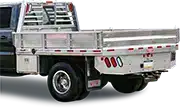
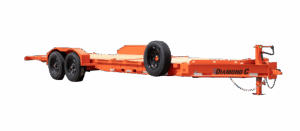






You’ve got a full day of stops lined up across Fishers, Carmel, Westfield, and Noblesville. The mowers need to be on-site by 7 a.m., the handheld equipment has to stay organized between stops, and everything you own may sit beside a busy residential street while your crew is working two yards away. The trailer you choose matters a lot more than many lawn care operators realize until a mower disappears, a ramp becomes a daily headache, or an overloaded trailer starts wearing out tires and brakes.
Here’s the honest breakdown of what actually works for hauling lawn equipment around Indianapolis and its suburbs.
Open Utility vs. Enclosed Cargo: Pick a Side
Most operators starting out buy an open utility trailer because it costs less upfront, weighs less than a comparable enclosed trailer, and makes it easy to see and reach the equipment. That’s not a bad decision. A current 83-inch-wide, 16-foot tandem-axle utility trailer with a 7,000 lb. GVWR can often carry two commercial zero-turns, handheld tools, fuel cans, and a small toolbox, provided the actual mower dimensions and loaded weight remain within the trailer’s payload rating.
Do not confuse GVWR with payload. A 7,000 lb. GVWR trailer cannot carry 7,000 pounds of equipment because the empty trailer, spare tire, racks, toolbox, ramps, and other permanently installed accessories all count toward that rating. Payload is the trailer’s GVWR minus its actual empty weight and installed equipment. The certification label and scale weight of the finished trailer are more useful than a generic brochure number.
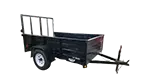
The Diamond C GTU Premium Tandem Axle Utility Trailer is a current example that fits many professional lawn care operations. It has a 7,000 lb. GVWR, an 83-inch bed, available lengths from 14 to 20 feet, two 3,500 lb. Lippert brake axles, and a 4-inch channel frame. Depending on the selected build, it can be equipped with an EZ Bi-Fold Gate or a heavier tractor-style gate, along with expanded-metal sides, integrated tie-downs, a dovetail, and either treated-lumber or available alternative flooring. Diamond C finishes the steel structure with its DM Difference Maker multi-stage coating system. :contentReference[oaicite:0]{index=0}
Open trailers do have one major weakness in an urban or suburban route environment: the equipment remains visible. A commercial zero-turn is not a minor purchase. Current manufacturer pricing places many 60-inch commercial machines well into five figures, while larger diesel and wide-deck configurations can cost far more. Leaving multiple mowers, blowers, trimmers, batteries, and handheld tools exposed while the crew works behind a house creates a real security problem, even when the stop is supposed to take only 20 minutes. :contentReference[oaicite:1]{index=1}
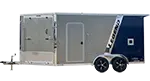
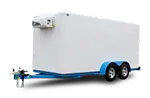
Enclosed trailers reduce that visibility and add useful protection from rain, road spray, salt, and direct sun. A current Darkhorse DHW 7′ x 16′ tandem-axle enclosed cargo trailer, for example, can be configured with a 7,000 lb. GVWR, two 3,500 lb. electric-brake axles, a rear ramp door with a transition flap, a curbside access door, recessed wall track, four floor D-rings, a one-piece aluminum roof, interior lighting, and a 7-foot interior height. Actual empty weight and payload vary by build, so the VIN-specific label should always control the loading decision. :contentReference[oaicite:2]{index=2}
The trade-offs are higher purchase price, more empty weight, more wind resistance, less visibility while backing, and more heat buildup. An enclosed trailer also requires deliberate ventilation and housekeeping. Wet mowers, grass clippings, fertilizer residue, and fuel vapors should not be sealed inside at the end of a hot Indiana workday. Use approved fuel containers, secure them upright in a purpose-built rack or compartment, keep ignition sources away, and never refuel equipment inside the trailer.
Neither trailer style is universally better. The right answer depends on the value of your equipment, how long it sits unattended, your route density, the towing capacity of the truck, where the trailer is stored overnight, and whether your crew needs the trailer to double as a locked mobile workshop.
What to Look for in a Lawn Care Trailer
Ramp Gates
This is where a lot of buyers make an expensive mistake. The ramp needs to do more than reach the ground. It must be wide enough for the mower’s actual outside dimensions, strong enough for the machine and operator, and long enough to create a usable loading angle.
A mower advertised with a 60-inch or 72-inch cutting deck may be wider than that once the discharge chute, deck guards, anti-scalp wheels, or collection system are included. Measure the machine in the exact configuration in which it will be loaded. Folding the chute does not help if another fixed component remains wider than the gate opening.
Many current utility trailers use a full-width mesh gate, a bi-fold gate, or a reinforced tractor gate. A bi-fold design can reduce the effort required to raise the gate and may reduce wind drag when folded according to the manufacturer’s design. A conventional upright mesh gate can create considerable aerodynamic drag at highway speed, so compare the gate styles available on the exact trailer rather than assuming every utility trailer comes with the same ramp.
The loading angle matters just as much as width. A short, steep ramp can cause a low mower deck, rear engine guard, or collection system to drag at the transition. A longer ramp, dovetail, transition flap, or beavertail can reduce the breakover angle. Test-load the lowest mower in your fleet before purchasing whenever possible. Do not rely only on the nominal trailer length or a salesperson’s estimate.
For enclosed trailers, inspect the clear rear-door opening, not just the advertised body width. Look at the ramp-door capacity, hinge construction, cable or spring-assist system, transition flap, rear stabilizer options, and the floor structure immediately inside the doorway. Legend’s current tandem-axle 7′ x 16′ enclosed models are offered in several lines and GVWR configurations, while Darkhorse and other brands can be ordered with different heights, floor structures, ramp details, and axle packages. The actual build sheet is more important than the brand name alone. :contentReference[oaicite:3]{index=3}
Rear stabilizer jacks are also worth considering on an enclosed lawn trailer. They can reduce rear-end movement while loading a heavy mower when the trailer is unhitched or lightly supported. They do not replace proper hitching, wheel chocks, or the manufacturer’s loading instructions.
Floor and Tie-Down Points
Treated-lumber floors are common on open utility trailers because they are durable, replaceable, and relatively easy to repair. They do not automatically rot after a few seasons, but repeated saturation, trapped grass, fertilizer, road salt, and careless pressure washing can shorten their life. Sweep the floor regularly, remove wet organic debris, let the trailer dry, and inspect boards around fasteners and wheel paths.
Aluminum plank flooring can reduce corrosion concerns and may reduce empty weight, but it costs more, can become slick when wet, and still needs proper support and maintenance. Steel tread plate is durable but adds weight and can become slippery with grass clippings, mud, or oil. On an enclosed trailer, high-performance engineered wood flooring is common and should be cleaned according to the manufacturer’s recommendations rather than soaked after every route.
Tie-down anchors should be attached to reinforced structural members or installed using the manufacturer’s approved backing system. A D-ring screwed only into a thin floor panel is not equivalent to a reinforced floor anchor. Likewise, wall-mounted track should not be used for a heavy mower unless the track, fasteners, backing structure, fittings, and straps are all rated for that load and direction of pull.
Look for a clearly marked working load limit on the straps, chains, hooks, ratchets, and anchors. The weakest component controls the securement system. Use separate securement for each mower, keep straps away from sharp deck edges and hot exhaust components, and attach to manufacturer-approved frame points rather than steering controls, sheet metal, or movable deck hardware. Wheel chocks can help position the machine, but they do not replace rated tie-downs.
Axle Rating and GVWR
A common undersizing mistake is buying a light single-axle trailer because the mower weights appear to fit when added together. That calculation leaves out the trailer’s own weight, fuel, racks, spare tire, blowers, trimmers, batteries, push mowers, spreaders, aerators, bagging systems, tools, and the material that accumulates during the workday.
Commercial zero-turns frequently weigh around or above 1,000 pounds before adding a grass-collection system or other attachments. Two machines can therefore consume a large part of a small trailer’s legal payload before a single fuel can or handheld tool is loaded. The safest method is to build a written equipment list, use the manufacturers’ published operating weights, add every permanent trailer accessory, and leave usable capacity for future equipment.
For many two-mower lawn rigs, a tandem-axle trailer with a 7,000 lb. GVWR is the practical starting point. A current H&H 82-inch by 16-foot steel rail-side tandem utility, for example, is rated at 7,000 lb. GVWR with two 3,500 lb. axles, while the Diamond C GTU uses two 3,500 lb. Lippert brake axles and is available from 14 to 20 feet. The final payload still depends on the finished trailer’s empty weight and options. :contentReference[oaicite:4]{index=4}
A 14,000 lb. equipment trailer is usually unnecessary for two ordinary zero-turns, but it can make sense for a landscaping company that also moves a compact track loader, mini excavator, heavy aerator, trencher, or palletized material. At that point, compare a purpose-built equipment trailer instead of trying to turn a lawn utility trailer into a skid-steer hauler. Diamond C’s LPX equipment line begins in a substantially heavier class than the GTU, and its HDT line uses a hydraulically dampened tilt deck for equipment loading. These premium Diamond C lines use Lippert axles as their standard axle platform.
A heavier trailer rating does not automatically mean the driver needs a CDL. For a Class A CDL, the general threshold is a combination with a GCWR or actual gross combination weight of at least 26,001 pounds, inclusive of a towed unit with a GVWR or actual gross weight over 10,000 pounds. Business use, interstate operation, hazardous materials, and other commercial-motor-vehicle rules can create additional obligations below the CDL threshold, so a growing fleet should review the complete operating combination instead of looking only at the number printed on the trailer. :contentReference[oaicite:5]{index=5}
Indiana braking requirements also matter. A 7,000 lb. GVWR lawn trailer is firmly in brake-equipped territory. Indiana requires a trailer or semitrailer with a gross weight of at least 3,000 pounds to have brakes adequate to control, stop, and hold it. The brakes must be controllable from the towing vehicle’s cab and must apply automatically if the trailer separates from the tow vehicle. That means the truck needs a compatible brake controller, the breakaway battery and switch need to work, and the 7-way electrical connection should be checked before the route begins. :contentReference[oaicite:6]{index=6}
Finally, confirm the truck’s receiver rating, hitch rating, ball size, payload rating, rear-axle rating, GCWR, and allowable tongue weight. A trailer that is legal by itself can still overload the truck. Bumper-pull trailers also need enough tongue weight for stable towing, generally within the trailer and tow-vehicle manufacturers’ specified range, without exceeding the truck’s available payload.
Theft Prevention on Indy Suburb Routes
Open-trailer operators do not have to accept theft as an unavoidable cost of business. The goal is to create several independent layers so defeating one lock does not release the trailer and every machine on it.
- Coupler, latch, and receiver locks. Use a coupler lock that fits the exact coupler design, plus a lock for the coupler latch when applicable. Lock the adjustable ball mount or receiver pin to the truck as well. A premium lock cannot make a trailer impossible to steal, but it can prevent a quick unhitch-and-go attempt.
- Wheel immobilizer or hardened chain. A properly fitted wheel boot adds a separate physical barrier. A hardened chain through a wheel or structural frame member can also help when attached to an authorized fixed point. Do not wrap a chain around brake wiring, suspension parts, hydraulic lines, or thin rail material.
- Independent mower securement. Lock the mower frames to structural trailer anchors in addition to using the transport tie-downs. A hardened chain is generally more resistant to hand tools than a light cable. Route it through substantial frame members without contacting fuel lines, wiring, controls, or hot components.
- Trailer-appropriate GPS tracking. Use a battery-powered, solar-powered, or properly hardwired asset tracker designed for trailers rather than a device that requires a vehicle’s OBD-II port. The LandAirSea 54 is one example of a compact battery-powered, magnetic, IP67-rated tracker, but it requires a cellular subscription and its battery life changes significantly with the reporting interval. Whatever tracker you choose, enable movement and geofence alerts, test it regularly, and hide it where it can still receive usable satellite and cellular signals. :contentReference[oaicite:7]{index=7}
- Serial-number and insurance records. Photograph every mower, handheld tool, trailer VIN label, and identifying mark. Keep model and serial numbers in cloud storage that can be reached without the stolen phone or truck. Confirm whether your commercial property, inland marine, or equipment policy covers tools while they are in transit and unattended.
Enclosed-trailer users still need coupler locks, wheel security, and strong locks on both the rear ramp and side door. A shrouded lock or puck-style lock can provide better resistance than an exposed long-shackle padlock when the trailer’s hasps are designed for it. Secure the mowers inside as well; a locked door does not prevent the entire trailer from being taken.
The advantage of an enclosed trailer is reduced visibility and slower access, not immunity from theft. Avoid leaving branded trailers full of equipment at an unsecured job site overnight, and do not store the keys, registration, spare locks, and tracker instructions together inside the trailer.
Fleet Considerations for Growing Lawn Care Operations
If you’re running more than one crew, trailer standardization can save real money, but the benefit is broader than simply buying the same model. Standardizing body width, interior height, coupler type, electrical connector, tire size, wheel bolt pattern, spare-tire location, tie-down method, mower placement, fire-extinguisher location, and lock system makes training and maintenance easier.
Do not assume ramps, gates, springs, hinges, or suspension parts are interchangeable merely because two trailers have the same advertised dimensions. Manufacturers can revise components during a model year, and optional ramp packages may use different hardware. Record the VIN, axle identification, bearing and seal numbers, tire specification, brake size, and gate components for every fleet unit.
A practical fleet pairing around Indianapolis can be a 7′ x 16′ enclosed cargo trailer for the crew carrying the most valuable equipment or making longer unattended stops, with 6.5′ x 14′, 7′ x 14′, or 83-inch-wide open utility trailers assigned to routes where fast access, lower empty weight, and easy cleanup matter more. The neighborhood name should not determine the security plan; the value of the load, parking visibility, stop duration, and overnight storage arrangement should.
Enclosed trailers also provide interior wall space for organized trimmer racks, blower racks, shelves, battery charging cabinets, first-aid supplies, and spare parts. Plan those additions before ordering because every rack, cabinet, spare tire, battery, and tool reduces payload. Keep heavy items low and near the axle area rather than loading all toolboxes and fuel at the front wall.
Open utility trailers can be standardized just as effectively. A fleet of similarly configured Diamond C GTUs, for example, can use the same load map, gate procedure, mower positions, tie-down method, inspection checklist, and spare-tire specification when the actual builds match. The GTU’s 7,000 lb. GVWR, 83-inch bed, 4-inch channel frame, and tandem Lippert brake axles place it in the useful middle ground for professional mowing and property-maintenance crews. :contentReference[oaicite:8]{index=8}
When you’re buying multiple units, dealers like Spencer Trailers can discuss fleet orders, matched builds, custom options, financing, and delivery. Ask for an itemized out-the-door quote on each trailer so you can compare the exact GVWR, empty weight, floor, gate, spare tire, locks, racks, taxes, title work, and dealer charges instead of comparing only an advertised starting price.
Trailer Width and Indianapolis Suburb Parking
Older Indianapolis neighborhoods such as Broad Ripple, Irvington, Fountain Square, and Meridian-Kessler can have narrow driveways, curbside parking, mature trees, alleys, and limited room to turn around. Newer subdivisions in Hamilton County may provide wider streets, but cul-de-sacs, landscaped islands, parked vehicles, and homeowners-association restrictions can still create problems.
The width printed in a trailer’s name is not always its total road width. An 83-inch open utility trailer usually has external fenders and wheels, so its overall width can approach the same 102-inch legal envelope used by many 8.5-foot enclosed trailers. A 7-foot enclosed trailer may also have external fenders that make it substantially wider than its body. Compare the manufacturer’s overall-width dimension, including fenders, hubs, lights, door hardware, and any racks, rather than judging by the deck or box width alone.
An 8.5-foot-wide enclosed body gives you more interior floor space and may place the wheel boxes inside the cargo area, but its body itself occupies nearly the full legal width. That can make curbside loading, mirror clearance, driveway entrances, and backing visibility more demanding. A narrower body may feel easier to place even when its external fenders bring the total width close to that of a wider trailer.
Length can create as many problems as width. A 16-foot body plus the V-nose or front wall, tongue, coupler, rear-door hardware, and tow vehicle creates a much longer combination than the floor-length label suggests. Measure the storage area, driveway approach, alley turn, gate opening, and curb space used on actual routes. Also confirm that the trailer can be parked without blocking sidewalks, mailboxes, fire hydrants, driveways, or sight lines.
Measure the routes you actually run before committing to a trailer. It sounds obvious. Most people skip it, then discover the problem with two mowers already loaded.
Open vs. Enclosed: A Direct Comparison
| Feature | Open Utility (Diamond C GTU 83″ x 16′ 7K) | Enclosed Cargo (Darkhorse DHW 7′ x 16′ 7K) |
|---|---|---|
| Typical GVWR | 7,000 lb.; two 3,500 lb. Lippert brake axles | 7,000 lb.; two 3,500 lb. electric-brake axles |
| Usable payload | GVWR minus actual trailer weight and installed options; verify the VIN label | GVWR minus actual trailer weight, interior build-out, racks, and installed options; verify the VIN label |
| Approx. current price range | Roughly $4,500 to $6,500 or more for comparable 16-foot steel 7K utilities, depending on brand, gate, floor, spare tire, and options | Roughly $8,000 to $10,000 or more for a current steel 7′ x 16′ 7K enclosed trailer; aluminum construction and upgrades can cost substantially more |
| Theft exposure | Equipment remains visible; independent mower locks, coupler security, and tracking are important | Lower visibility and slower access, but the doors, coupler, wheels, equipment, and complete trailer still need protection |
| Weather protection | Equipment is exposed to rain, sun, road spray, and salt unless separately covered | Good protection from direct weather when the roof, seams, and doors are maintained; ventilation and moisture control are still required |
| Load speed | Fast rear access; side access depends on the rail and optional gate design | Rear-ramp loading is orderly but more confined; the side personnel door is not an equipment ramp unless specifically designed as one |
| Ramp considerations | Bi-fold or tractor-gate options can suit mowers; verify clear width, gate rating, dovetail, and loading angle | Verify rear-door opening, ramp rating, transition flap, beavertail, and rear stabilizer configuration |
| Cleaning ease | Easy to sweep and carefully rinse; avoid directing high pressure at bearings, brakes, wiring, or wood-floor joints | Best swept or cleaned with controlled moisture, followed by thorough drying and ventilation |
| Braking equipment | Electric brakes and breakaway equipment; compatible in-cab brake controller required | Electric brakes and breakaway equipment; compatible in-cab brake controller required |
| Branding space | Limited to rails, mesh panels, fenders, mud shields, or added signs that do not obstruct lighting | Large exterior panels provide substantial wrap and fleet-branding space |
Those price ranges are planning figures, not permanent quotes. Current Spencer inventory has included 16-foot 7K steel utilities in the mid-$4,000 range, Diamond C GTU configurations around the low-$6,000 range, and Darkhorse 7′ x 16′ 7K enclosed trailers around the low-to-mid-$8,000 range. Inventory, model year, freight, manufacturer pricing, and installed options can change the final number. :contentReference[oaicite:9]{index=9}
What Spencer Trailers Carries for Lawn Care Rigs
At 291 West State Road 46 in Spencer, the rotating inventory includes utility, equipment, tilt, dump, and enclosed trailers from manufacturers such as Diamond C, Liberty, Delco, Darkhorse Cargo, H&H, Legend, United, and Wells Cargo, depending on current stock and incoming orders. Available ratings range from compact 2,990 lb. single-axle trailers through tandem 7,000 and 9,990 lb. lawn and cargo configurations and into substantially heavier equipment-hauling classes. :contentReference[oaicite:10]{index=10}
For a Diamond C lawn care rig, the GTU is the logical tandem-axle utility starting point. It is a genuine 7,000 lb. GVWR bumper-pull utility with an 83-inch bed, lengths from 14 to 20 feet, dual 3,500 lb. Lippert brake axles, and a 4-inch channel frame. Diamond C builds its trailers in Mt. Pleasant, Texas, where the company has operated since 1985, and its steel trailers receive the DM Difference Maker multi-stage coating process.
If your lawn business is adding a compact loader, mini excavator, trencher, or other dense equipment, move the discussion to an actual equipment trailer. Diamond C’s LPX low-profile equipment trailer and HDT hydraulically dampened tilt trailer are built for much heavier duty cycles than a 7K utility trailer. Ordering the correct trailer now is usually cheaper than replacing bent gates, overloaded tires, worn brakes, and an undersized frame later.
For enclosed rigs, current Darkhorse inventory has included 7′ x 14′ and 7′ x 16′ tandem models with 7,000 lb. GVWRs, electric brakes, rear ramp doors, 7-foot interior heights, floor D-rings, interior lighting, recessed wall track, and side access doors. Legend and United provide additional steel or all-aluminum enclosed choices when lower empty weight, corrosion resistance, or a specific interior configuration is the priority. :contentReference[oaicite:11]{index=11}
If you’re outfitting a new crew or replacing a beat-up trailer that’s been taking Indiana winters for five years, the current inventory page shows what’s listed on the lot. Stock turns quickly, and individual listings can differ in axle capacity, floor, interior height, gate style, spare tire, payload, and price, so calling ahead at (812) 829-0226 to confirm availability before driving over from Indianapolis is worth the 30 seconds.
And if you’ve got specific questions about axle ratings, payload, mower clearance, ramp configurations, brake controllers, equipment racks, custom orders, or fleet pricing, the contact page or a direct call gets you an answer tied to the actual trailer and equipment you’re considering.
One more thing worth knowing: Spencer is roughly 55 to 60 driving miles southwest of central Indianapolis, depending on your starting point and route. Spencer Trailers is located at 291 West State Road 46, and its listed sales hours are Monday through Friday from 8:30 a.m. to 5 p.m. and Saturday from 9 a.m. to 1 p.m. Confirm hours and inventory before leaving, especially when you need a specific floor length, gate, color, axle package, or enclosed-trailer height. :contentReference[oaicite:12]{index=12}
Do not compare trailers on price alone. Compare the finished payload, axle and brake package, tires, frame, floor, gate, ramp angle, clear opening, warranty, spare tire, locks, racks, dealer support, and out-the-door cost. A lower-priced trailer that cannot legally or safely carry the next machine you buy is not the cheaper trailer.
What’s the next piece of equipment you’re adding to the rig? That answer usually determines whether an open 7K utility still makes sense, whether a locked enclosed trailer would improve the operation, or whether the business has already grown into a purpose-built equipment trailer.


