








A lot of construction work in Owen and Monroe counties gets slowed down at the trailer end. The excavator runs, the crew arrives, the permit is approved, and then material sits in a stockpile because the trailer does not have enough legal payload, the tow vehicle cannot safely handle the loaded combination, or the complete rig cannot negotiate the job-site entrance. If you’re running excavation, concrete, landscaping, utility, demolition, or general site work around Bloomington or Spencer, that kind of mismatch costs real money in labor, fuel, schedule delays, and extra trips.
We see it regularly here at Spencer Trailers. Contractors come in after repeatedly overloading a lighter trailer, discovering that the advertised axle capacity is not the same thing as legal payload, or learning that a long truck-and-trailer combination will not work through a residential cut or restricted staging area. The fix is not complicated, but it does require matching the trailer to the truck, the actual loaded weight, the material or machine being hauled, the route, and the physical access at the destination.
What Bloomington-Area Construction Work Actually Demands
Monroe County has a mix of work that many rural counties do not: Indiana University renovation and construction, downtown infill, commercial redevelopment, residential additions, utility work, limestone-related operations, and subdivision growth around Bloomington and Ellettsville. Owen County adds rural excavation, farm and property improvement, driveway construction, land clearing, septic work, and material hauling along county roads and the State Road 46 corridor. Each category creates different loading, towing, turning, and site-access requirements.
Campus and downtown Bloomington jobs can mean narrow approaches, controlled staging areas, pedestrian traffic, delivery windows, temporary closures, and project-specific haul routes. A long gooseneck may be the right equipment-hauling tool but still be impractical for a particular alley, gate, or staging location. A shorter bumper-pull dump trailer can be easier to position, although the contractor must still check the complete combination’s width, height, turning radius, rear swing, and loaded weight. Owen County work often provides more room for a longer trailer, but soft shoulders, uneven entrances, steep grades, narrow bridges, and unpaved roads can become the limiting factors.
The common thread is this: the trailer has to match the tow vehicle, payload, route, loading method, and access conditions. Shopping only by the lowest price or by the largest number printed beside “GVWR” can leave you with a trailer that is either overloaded for the job or unnecessarily difficult to move through the sites you serve.
Diamond C Dump Trailers: The Core of the Lineup
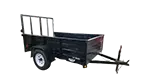
We stock Diamond C dump trailers at Spencer Trailers and carry configurations suited to Indiana contractors, landscapers, property-maintenance crews, and excavation companies. Diamond C has manufactured premium open-steel trailers since 1985 in Mt. Pleasant, Texas. Its current dump lineup ranges from the 6,000 lb. GVWR GST single-axle telescopic dump through the MDT and heavy-duty LPT bumper-pull models, along with DOD deck-over dumps and WDT gooseneck dump configurations for substantially heavier commercial work. Diamond C uses Lippert axles throughout its trailer lineup and protects the finished steel with its multi-stage DM Difference Maker coating system.
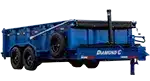
The Diamond C LPT Heavy Duty Low Profile Telescopic Dump is the model we recommend most often for contractors doing mixed residential and commercial material work. Current LPT configurations cover approximately 15,500 to 24,000 lb. GVWR, with 12-, 14-, and 16-foot bed lengths and an approximately 81- to 82-inch bed width, depending on the axle package. Standard LPT construction uses two 7,000 lb. Lippert axles, while available packages include heavier Lippert axle configurations. The trailer uses a three-stage telescopic cylinder and provides a 45-degree dump angle. Manufacturer-listed empty weights span roughly 4,440 to 6,930 lbs. across the model’s lengths and equipment packages, so rated payload must be calculated for the individual trailer rather than assumed from a generic advertisement. A 15,500 lb. LPT will often provide roughly 9,000 to 11,000 lbs. of payload, but body thickness, ramps, tarp equipment, hydraulic jack options, spare tires, taller sides, and other equipment all affect the final number. For crushed stone, soil, mulch, demolition debris, and similar materials around Spencer or Monroe County, it is a serious workhorse when properly matched to the tow vehicle.
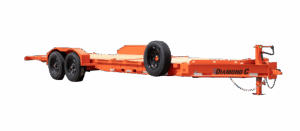
For heavier equipment transport, the Diamond C FMAX210 is a 25,000 lb. GVWR Flatbed Max gooseneck, not a dump trailer. Current configurations are available in lengths from 20 to 40 feet, with a 102-inch-wide deck, a 16-inch low-profile engineered-beam frame, and two 10,000 lb. Lippert axles. Depending on length and loading configuration, published trailer weights range from approximately 5,840 to 9,470 lbs., leaving roughly 15,500 to 19,000 lbs. of theoretical payload before considering the tow vehicle, hitch, axle distribution, and any added cargo. Loading options can include a straight deck, MAX Ramps, or a hydraulic dovetail configuration. If you’re moving a compact excavator, skid steer, attachments, and buckets between Owen and Monroe County jobs, add the machine’s complete operating weight, fuel, attachments, chains, binders, and other cargo before deciding whether a particular FMAX210 build has enough capacity.
Load Math: Stop Guessing, Start Calculating
The often-repeated 80,000 lb. figure is not a universal allowance for every truck-and-trailer combination. It is a common maximum gross weight for properly configured highway combinations operating without an overweight permit, but legal weight is also controlled by the number and spacing of axles, single- and tandem-axle limits, bridge-formula requirements, tire ratings, registered weight, and posted bridge or local-road restrictions. A pickup-and-trailer combination will normally reach the truck’s GVWR, GCWR, rear-axle rating, tire capacity, hitch rating, or trailer GVWR long before 80,000 lbs. becomes relevant. Indiana also requires a trailer or semitrailer with a gross weight of at least 3,000 lbs. to have brakes that the driver can apply from the cab, along with automatic application in a breakaway.
A properly equipped late-model F-350 dually can have a substantial gooseneck tow rating, but the highest number in a manufacturer’s brochure applies only to specific engines, axle ratios, cabs, drivetrains, wheelbases, hitch packages, and equipment combinations. The controlling numbers for your truck are its certification labels, published towing table, GCWR, rear GAWR, tire capacities, hitch rating, and available payload after passengers, tools, fuel, auxiliary tanks, and bed-mounted equipment are included. A 15,500 lb. LPT may fit within the capabilities of a correctly configured one-ton truck, but that cannot be assumed from the truck badge alone. Bumper-pull tongue weight loads the truck differently from gooseneck pin weight, and the rear axle or receiver rating can become the limit before the engine’s advertised tow rating does.
A loose cubic yard of limestone screenings or crushed limestone commonly weighs approximately 2,400 to 2,800 lbs., depending on gradation, moisture, and compaction. Topsoil can vary even more, with wet soil often falling somewhere around 1,800 to 2,400 lbs. per loose cubic yard. A trailer with 10,000 lbs. of available payload may therefore carry only about three and a half to four yards of dense limestone material, or roughly four to five yards of wet topsoil, before reaching its rating. The supplier’s scale ticket is more reliable than a volume estimate. Knowing the actual weight helps you quote projects without underloading and wasting trips, or overloading the trailer, truck, tires, hitch, or axles.
| Trailer | GVWR | Approx. Payload | Best Use |
|---|---|---|---|
| Diamond C LPT207 (12-16 ft.) | 15,500 lb. | Often ~9,000-11,000 lb.; verify equipped weight | Residential and commercial material hauling, cleanup, and demolition |
| Diamond C LPT208 (12-16 ft.) | 18,000 lb. | Often ~11,000-13,500 lb.; configuration-dependent | Heavier aggregate, soil, debris, and frequent contractor use |
| Diamond C FMAX210 (20-40 ft.) | 25,000 lb. | Approximately ~15,500-19,000 lb., depending on build | Excavator, skid steer, attachment, and equipment transport |
Site Access: The Detail That Kills Jobs
Monroe and Owen counties both have roads and structures where posted limits, temporary restrictions, narrow approaches, or pavement conditions matter more than the trailer’s rated capacity. Before committing a loaded rig to a project, confirm the intended route with the applicable county highway department, INDOT, municipality, or project manager. Check bridge postings, construction closures, seasonal conditions, legal width and weight, and whether an oversize or overweight permit is required. A route that is legal on a state highway may still encounter a lower posted limit after turning onto a county road, subdivision street, or privately maintained job-site entrance.
For Indiana University or other controlled commercial sites, the contract documents, site superintendent, project manager, and applicable transportation or facilities personnel determine staging and delivery requirements. A 10- or 12-foot dump body is generally easier to maneuver than a long equipment trailer, but bed length alone does not guarantee approval or access. Measure the complete trailer, tongue, truck wheelbase, overall combination length, turning path, rear overhang, gate opening, and overhead clearance. Confirm the route before arriving loaded rather than assuming that a shorter trailer will automatically fit the permitted staging area.
Residential subdivision and rural work may provide more room, but soft subgrade and unfinished entrances create their own risks. Legal axle weight does not mean the road base, shoulder, driveway, or builder’s grade can support that weight without damage. Shorter combinations can be easier to position, but the solution is not simply changing axle spacing. Reduce the load when conditions require it, stay on stabilized access, use ground protection when appropriate, avoid sharp turns that scrub tandem tires into soft material, and confirm that the truck can restart on the steepest loaded grade without losing traction.
Other Trailer Lines Worth Knowing
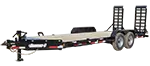
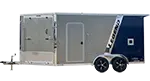
Diamond C is our primary premium dump and heavy-equipment brand for construction use, but we carry other lines that fill supporting roles. H&H Trailers offers utility, equipment, tilt, deck-over, and dump configurations across several weight classes. Current H&H equipment choices include 14,000 lb. industrial trailers, gravity-tilt models, full-width equipment designs, and heavier tilt configurations. For a compact loader, walk-behind trencher, mini skid steer, mower, or palletized material, an appropriately rated H&H utility or equipment trailer can be more efficient than pulling a heavy dump trailer. The correct choice depends on the specific trailer’s VIN label, empty weight, ramp rating, deck dimensions, tie-down locations, and the machine’s complete operating weight.
Delco Trailers and Liberty Trailers also fill out our utility and equipment inventory. Both can be practical choices for contractors who need a secondary trailer for tools, pipe, forms, compact equipment, or job-site supplies that do not justify using the main dump or heavy gooseneck on every trip. A gooseneck can improve load placement, stability, and maneuverability in the right truck, but hitch style does not create a CDL exemption. Licensing is determined by the applicable vehicle ratings, actual weights, commercial use, and trailer rating, not by whether the trailer connects to a bumper receiver or a ball in the bed.
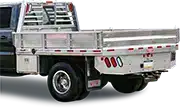
And we carry Zimmerman truck beds for contractors who want to consolidate their haul rig. Zimmerman steel and aluminum flatbeds and service-body configurations can provide deck space, tool storage, lighting, receiver-hitch capacity, and gooseneck capability without requiring a separate trailer for every visit. The body itself becomes part of the truck’s empty weight, however, so the completed truck’s payload, rear-axle load, tire capacity, hitch rating, and upfit certification must still be checked before adding tools, materials, fuel tanks, compressors, or trailer tongue weight.
A Few Questions We Hear Often
Do I need a CDL for a construction trailer in Indiana? A Class A CDL is generally required when a commercial combination has a gross combination weight rating or gross combination weight of 26,001 lbs. or more, whichever is greater, and the towed unit has a GVWR or actual gross weight of more than 10,000 lbs., whichever is greater. The 26,001 lb. threshold applies to the combination, not to the trailer by itself. A heavy straight truck rated at 26,001 lbs. or more with a trailer rated at 10,000 lbs. or less generally falls under Class B instead. Passenger and placarded hazardous-material operations have separate requirements. A contractor can also be subject to USDOT-number, inspection, vehicle-marking, medical-card, recordkeeping, or other commercial-motor-vehicle rules at weight levels below the CDL threshold. Check the truck’s rating, the trailer’s VIN plate, actual loaded weights, and the current Indiana BMV and Department of Revenue requirements before operating commercially.
What’s the lead time on Diamond C right now? We keep Diamond C dump, equipment, utility, and gooseneck units in stock at Spencer Trailers. A trailer that is physically on the lot can generally be purchased without waiting for a factory build, subject to payment or financing, required paperwork, and any installation work. Special-order timing varies by model, axle package, length, loading system, finish, and factory production schedule. Call us at (812) 829-0226 to verify the exact unit, current price, specifications, and availability before building a project schedule around a delivery date.
Can I use a dump trailer for equipment hauling? Sometimes, but only when the manufacturer has equipped and rated that specific trailer for the machine and loading method. Certain Diamond C LPT configurations can be ordered with heavy-duty ramps, stabilizer legs, D-rings, and other equipment-loading features. You must still verify ramp capacity, floor and body construction, concentrated track or tire loads, machine width, payload, tongue weight, tie-down ratings, and the trailer manufacturer’s loading instructions. The dump body should be fully lowered and secured during loading and transport, and rear stabilizers should be used as directed to prevent the loading machine from lifting or destabilizing the tongue. For contractors who haul machinery frequently, a purpose-built Diamond C LPX, HDT, or FMAX equipment trailer will normally provide a better deck, loading angle, tie-down layout, and weight distribution than using a dump body as an everyday equipment hauler.
Getting Set Up Before the Season Fills Up
Construction work in Monroe and Owen counties ramps up quickly in spring, while university, municipal, paving, landscaping, and subdivision schedules can keep equipment moving through summer and early fall. If you’re bidding work for those windows, trailer availability needs to match the bid schedule. It also helps to confirm the tow vehicle, brake controller, hitch, tires, safety chains, breakaway system, registration, insurance, and commercial compliance before the first loaded trip rather than discovering a limitation after the crew and equipment are already committed.
We’re located at 291 West State Hwy 46 in Spencer, roughly 25 to 30 minutes from central Bloomington depending on traffic and your starting point, and convenient to contractors throughout Owen County. You can browse available dump, equipment, utility, and gooseneck units at our full inventory page. If you’re not sure which configuration fits your truck and workload, bring the truck’s door-label information, hitch rating, machine weights, attachment list, expected material, and typical job-site access details. A short conversation with real numbers usually gets the choice narrowed down quickly.
What job is on your schedule that you haven’t squared the trailer away for yet?


