











You’ve got hay in the field and a narrow window to get it hauled. Nothing slows a farm operation down like a trailer that cannot handle the load, a strap that slips, or a bale that shifts on a county road at 55 mph. Hay hauling looks simple until something goes wrong, and when it goes wrong, it goes wrong fast.
Getting it right means knowing what the bales actually weigh, choosing a trailer with enough usable payload and deck space, matching that trailer to the tow vehicle, and securing the load correctly before you pull out of the field. Here’s a practical breakdown.
Round Bales vs. Square Bales: Know Your Weights Before You Load
The single biggest mistake people make when hauling hay is guessing at weight. Bale dimensions alone do not tell you the whole story. Crop type, bale density, moisture content, baler settings, storage conditions, and even the field being harvested can change bale weight substantially. Published averages are useful for planning, but a scale ticket or the weight of a representative bale is much better.
Round Bales
A 5×5 round bale of grass hay commonly falls in the neighborhood of 900 to 1,200 lbs. A lower-density bale may weigh less, while a tightly packed legume or mixed-hay bale may weigh more. A 5×6 bale often falls around 1,100 to 1,600 lbs, and a dense 6×6 bale can approach or exceed 1,800 lbs. Those are planning ranges, not guaranteed weights.
Moisture also adds weight, but extra moisture should never be treated as a normal way to increase bale density. Hay baled too wet can heat, mold, lose feed value, and create a fire hazard during storage. If the bale feels unusually heavy, verify both its weight and moisture before loading or stacking it.
If you’re hauling eight bales at 1,200 lbs each, that’s 9,600 lbs of hay alone. The trailer, spare tire, ramps, hay rack, toolboxes, chains, straps, and other installed equipment all count toward the total loaded trailer weight. Deck length and load geometry may limit the load before the trailer reaches its weight rating, especially with true 5-foot-wide bales.
Square Bales
Small two-string square bales generally run about 40 to 80 lbs each, depending on crop, size, density, and moisture. Larger three-string bales may weigh roughly 80 to 140 lbs. Large rectangular bales produced by commercial balers vary much more widely. Depending on whether they are 3×3, 3×4, 4×4, or another configuration, they may weigh anywhere from about 700 lbs to 1,500 lbs or more.
The point is to calculate actual payload before hitching up. Start with the number of bales and a realistic per-bale weight. Add any pallets, racks, tarps, loaders, tools, and other cargo carried on the trailer. Then compare that total with the trailer’s available payload.
Available payload is not simply the axle ratings added together. Use the trailer’s certified GVWR and subtract its actual empty weight with installed options. The result is the maximum theoretical cargo capacity, but every component still has to remain within its individual rating, including the axles, tires, wheels, suspension, frame, coupler, safety chains, hitch ball, and tow vehicle. A certified truck scale is the best way to confirm total trailer weight, axle-group weight, and hitch weight after loading.
Overloading a trailer does more than risk a roadside citation. It overheats tires and wheel bearings, reduces braking performance, increases stopping distance, stresses suspension components, fatigues the frame, and can cause a tire, axle, coupler, or structural failure at the worst possible moment.
Flatbed vs. Gooseneck: Which Trailer Fits Hay Hauling?
Both bumper-pull flatbeds and goosenecks can work for hay, but they are not interchangeable. The correct choice depends on bale dimensions, desired bale count, deck width, trailer payload, loading equipment, farm-lane access, and the ratings of the tow vehicle.
Bumper-Pull Flatbeds
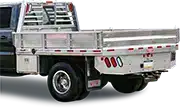
For 5-foot round bales or wide stacks of square bales, a 102-inch deckover is usually more practical than an equipment trailer with a narrower deck between the fenders. A full-width deck gives the loader operator a clear working surface and makes it easier to position large bales without interference from fenders.
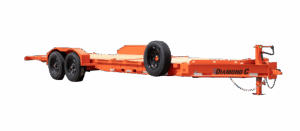
A current Diamond C DEC heavy-duty deckover equipment trailer is offered with a 102-inch-wide bed, lengths from approximately 20 to 30 feet, and GVWR packages ranging from about 15,500 to 23,000 lbs. Current Diamond C premium trailers use Lippert axles, with the exact axle configuration, brakes, tires, suspension, empty weight, and payload determined by the selected package and options. The standard treated-lumber deck also provides a practical surface for agricultural loads.
A Diamond C LPX can also move hay when its deck dimensions fit the intended load. The LPX is a low-profile equipment trailer with an approximately 80- to 82-inch bed between the fenders, lengths from about 16 to 30 feet, and current GVWR packages ranging from approximately 15,500 to 24,000 lbs. Its lower loading angle and equipment-oriented ramp systems are useful around tractors and skid steers, but the narrower deck changes how 5-foot bales can be arranged.
A 20-foot H&H Standard Duty Deckover in a 14,000-lb configuration is another practical hay platform when available. H&H offers current 102-inch-wide deckover configurations in multiple lengths and weight ratings. As with any trailer, confirm the exact model, VIN certification label, empty weight, tire ratings, and available payload rather than relying on a general model-family description.
Trailer length does not translate directly into an advertised bale capacity. A true 5×5 bale is approximately five feet wide and five feet in diameter, so only one normally fits across a 102-inch deck in the usual orientation. A 20-foot deck may accommodate approximately four 5×5 bales in a single lower row, subject to usable deck length, front stops, dovetail space, and securement. A properly planned second tier may increase the count, but it also raises the center of gravity and requires much more careful restraint.
Bumper-pull trailers can be easier to maneuver in tight lanes and may work well for short farm-to-barn trips. Their limitations include the tow vehicle’s receiver rating, hitch-ball rating, rear-axle capacity, payload, and allowable tongue weight. A heavy bumper-pull load must still have enough tongue weight for stability without overloading the truck.
Gooseneck Flatbeds
If you’re hauling large round bales commercially, moving hay between several fields, or trying to reduce the number of trips, a gooseneck flatbed often makes more sense. The hitch point is located over or slightly ahead of the truck’s rear axle, which generally improves control and reduces the leverage that a heavy bumper-pull trailer places behind the truck. That design advantage does not increase any legal rating, however. The truck, hitch, trailer, tires, axles, and brakes must all remain within their certified limits.
The current Diamond C FMAX family is the company’s Flatbed Max gooseneck line. It includes multiple legitimate configurations for different operating weights. For example, the FMAX207 is offered around a 15,500-lb GVWR with tandem 7,000-lb Lippert axles. The FMAX208 moves into an approximately 18,000-lb GVWR package with tandem 8,000-lb Lippert axles, while the FMAX210 is offered around 25,000 lbs with tandem 10,000-lb Lippert axles. Higher-capacity FMAX configurations can reach 30,000 or 40,000 lbs GVWR using appropriately rated tandem or triple-axle packages.
FMAX deck lengths vary by model and can extend from approximately 20 feet to more than 40 feet. Current loading configurations may include MAX Ramps, XDR Ramps, hydraulic dovetails, or straight-deck arrangements depending on the model. Ramp or dovetail space can reduce the portion of the deck that is practical for a particular bale layout, so use the trailer’s actual usable dimensions when planning the load.
A 22- to 25-foot 102-inch-wide gooseneck will generally hold about four or five true 5×5 bales in a single lower row. A carefully arranged and properly secured second tier may bring the planning range to approximately seven to nine bales. A 30- to 35-foot deck may hold approximately six or seven in the lower row and about 11 to 13 with a properly nested upper tier. These are geometric planning examples, not manufacturer-rated bale capacities.
Bale count can be higher with narrower 4-foot bales because some orientations allow two bales across a 102-inch deck. Counts can also change when a trailer has usable space above the gooseneck, but that area must be designed for cargo and the load must not interfere with truck-to-trailer clearance during turns or over uneven ground.
The heaviest Diamond C FMAX configurations should not automatically be matched to a pickup simply because the truck has a gooseneck ball. Some loads can be handled by a properly configured heavy-duty pickup, while higher trailer ratings and payloads may call for a one-ton dually or a medium-duty tow vehicle. The correct answer comes from the truck’s VIN-specific ratings and actual scale weights.
| Trailer Type | Typical GVWR | Approx. Round Bales (5×5) | Best For |
|---|---|---|---|
| Bumper-Pull Deckover (16 ft) | 10,000–14,000 lbs | About 3 single-layer; up to roughly 5 stacked | Small farms, local loads, tight lanes |
| Bumper-Pull Deckover (20 ft) | 14,000–18,000 lbs | About 4 single-layer; up to roughly 7 stacked | Mid-size operations and mixed farm use |
| Gooseneck Flatbed (22–25 ft) | 15,500–25,900 lbs | About 4–5 single-layer; roughly 7–9 stacked | Full-farm loads and custom hauling |
| Gooseneck Flatbed (30–35 ft) | 18,000–40,000 lbs by model | About 6–7 single-layer; roughly 11–13 stacked | High-volume and commercial operations |
These estimates assume true 5×5 bales and a 102-inch deck. They do not guarantee that the listed number will fit a particular trailer or remain within its payload. Bale dimensions, actual weight, deck hardware, dovetail length, legal height, axle loading, hitch weight, and securement may reduce the safe count.
Stacking: Keep the Load Low and Centered
Round bales should be arranged so they cannot roll, slide, or migrate as the trailer turns, brakes, or crosses uneven ground. For a single layer, placing bales on their flat circular faces may provide a stable footprint when deck space and loading equipment permit. Bales carried on their curved sides need effective chocks, cradles, blocking, or an arrangement that positively prevents rolling.
A two-tier load must be built as a stable system. The upper bales should nest securely between lower bales or be otherwise supported so they cannot roll off the stack. Lower bales must be tightly positioned and restrained before the upper tier is added. Do not depend on bale-to-bale friction, a loader’s final push, or loose square bales placed in gaps as the primary blocking system.
Small square bales should be stacked in interlocked courses, similar to brickwork, so the joints in one layer do not line up continuously with the joints below. Keep the outside faces square and avoid leaning columns. A front bulkhead, properly constructed hay rack, or side structure can help contain the stack, but the complete load still needs adequate tiedowns.
There is no universal safe rule that a small-square load can always be stacked six, seven, or eight courses high. Bale dimensions, deck height, rack strength, route, weather, and load securement all matter. Measure the finished height from the ground, not merely from the trailer deck. Indiana’s normal maximum vehicle height is generally 13 feet 6 inches without an oversize permit, and bridges, utility lines, tree limbs, barn openings, and local routes may provide less clearance.
Large rectangular bales should be placed on their most stable face with the broadest practical base. Depending on their dimensions, one or two may fit across a 102-inch deck. Staggering joints between tiers can improve stability, but every tier and outside bale still needs to be restrained. A 3×3 bale, a 3×4 bale, and a 4×4 bale create very different layouts, so calculate the arrangement from actual measurements rather than relying on a generic bale count.
Keep heavy bales low, but do not simply push all the weight as far forward as possible. The load should be distributed around the trailer’s axle group to produce the correct hitch or pin weight. Too little weight on the hitch can contribute to sway. Too much can overload the truck’s rear axle, suspension, tires, bed structure, or hitch.
After loading, check the tow vehicle’s front and rear axle weights, the trailer axle-group weight, and total combination weight on a scale. The truck should retain predictable steering and braking, the trailer should sit correctly, and every axle and tire should remain below its rating.
Securing the Load: Straps, Chains, and What Actually Holds
Indiana does not provide a blanket agricultural exemption that allows unsecured hay to be transported on public roads. Federal cargo-securement requirements apply to qualifying commercial motor vehicles, including applicable interstate operations, and Indiana enforces motor-carrier safety requirements for vehicles within their scope. Even when a local farm trip falls outside a particular federal provision, the same load-control principles are sound practice.
Under the general federal cargo-securement rule, the aggregate working load limit of the tiedowns used to secure an article or group of articles must be at least one-half of the cargo’s weight. That is only the starting point. The number and placement of tiedowns must also prevent forward, rearward, lateral, vertical, and rolling movement.
The effective working load limit is controlled by the weakest component in the system. A heavy strap or chain does not help if it is attached to an underrated anchor, damaged rub rail, light-duty stake pocket, worn binder, weak hook, or hitch point that was never designed for cargo securement.
Here’s what works in practice:
- Rated tiedowns for round bales: Use undamaged straps or chains with clearly marked working load limits. A 5-foot article weighing more than 1,100 lbs and not blocked against forward movement generally requires at least two tiedowns under the federal minimum-count rule for applicable commercial vehicles. Additional tiedowns or blocking may be needed because a round bale can roll. Bales may sometimes be secured as a touching, properly arranged group, but the complete group must remain stable and meet the required aggregate working load limit. Do not assume that one strap per row or two straps per bale is automatically correct for every layout.
- Correctly sized chains and binders: Grade 70 transport chain is commonly used for heavy agricultural cargo, but its working load limit depends on chain size. For example, a marked 5/16-inch Grade 70 chain is commonly rated around 4,700 lbs WLL, while a marked 3/8-inch Grade 70 chain is commonly rated around 6,600 lbs WLL. The binder, hooks, attachment points, and every other component must meet or exceed the required rating. Do not use an unmarked chain or guess its grade from its color.
- Side boards and hay racks: A properly designed front bulkhead or hay rack can help contain square bales and resist movement, but ordinary removable boards do not automatically replace tiedowns. Treat a rack as part of the primary securement system only when it is structurally designed, mounted, and rated for that purpose. Inspect welds, pins, pockets, fasteners, and uprights before every load.
- Net and tarp systems: A cargo net or mesh cover can contain loose leaves, twine, and light outer bales, but it is normally supplemental protection rather than primary securement. The load underneath still needs adequate straps, chains, blocking, or rated containment. Secure the net or tarp so it cannot inflate, flap loose, cover the trailer lights, or interfere with the wheels.
Two-inch ratchet straps are commonly used for hay, but not every 2-inch strap has the same working load limit. Read the sewn-in label and inspect the webbing, stitching, ratchet, hooks, and anchor points. Remove straps with cuts, melted fibers, chemical damage, severe abrasion, broken stitching, bent hardware, or unreadable rating labels. Use edge protection anywhere webbing crosses a sharp rail, bale spear mark, pallet edge, or metal corner.
Check every tiedown before leaving the field and stop again after the first few miles. Hay compresses and settles under tension, especially when it is freshly baled, and straps that were tight during loading can loosen quickly. Drivers of applicable commercial motor vehicles must inspect cargo and securement within the first 50 miles and recheck when duty status changes, after three hours of driving, or after 150 miles, whichever comes first. On rough farm and county roads, checking more frequently is a good idea.
Tarping: When You Need It and When You Don’t
Properly cured hay on a short trip in dry weather may not need a waterproof tarp, provided the bales are secured and no loose material is escaping. A tarp is not a substitute for tiedowns, and calm conditions in the field do not guarantee calm conditions at road speed.
If rain is expected, a tightly secured waterproof tarp can protect dry hay during transportation. It should cover the top and exposed weather side without loose fabric that can whip in the wind. Protect the tarp from sharp corners and tie it to suitable attachment points. Light bungee cords alone are not a dependable primary method for holding a large highway tarp.
Do not use an ordinary tarp as a cure for hay that was baled too wet. Covering damp hay can trap moisture and heat. Recommended moisture levels vary with bale size, density, storage method, and preservative use, but large dense bales generally need to be drier than small squares for safe storage. Hay around or above 20 percent moisture requires special management and should not simply be stacked under a tarp. Baleage is a different product that is normally baled at substantially higher moisture and sealed promptly in purpose-designed airtight plastic so it can ferment correctly.
On highway trips, loose hay and debris are both safety concerns and legal concerns. Indiana Code 9-21-8-48 generally prohibits driving a vehicle when its contents are dripping, sifting, leaking, or otherwise escaping. There is no general hay exemption that makes it acceptable for leaves, twine, or bales to fall onto the road.
A properly fitted mesh tarp or cargo net can help contain loose material from a tall stac


