








You call the landscape supply yard and order three cubic yards of topsoil. It sounds manageable because three yards does not look like an enormous pile. But you are hauling it in a nominal 6×10 tandem-axle dump trailer rated at 7,000 lb GVWR, and by the time the loader drops that third scoop, you may be thousands of pounds beyond the trailer’s allowable payload. Three yards of wet, dense topsoil can weigh approximately 8,400 lb when you use a conservative planning figure of 2,800 lb per cubic yard. That is cargo weight alone, before adding the weight of the trailer, tarp, ramps, spare tire, tools, battery, or anything else carried on it.
This happens constantly in Owen County and everywhere else people purchase landscape material. The confusion comes from ordering material by volume while trailers, axles, tires, hitches, and tow vehicles are constrained primarily by weight. A cubic yard tells you how much space a material occupies. It does not tell you whether your equipment can legally or safely carry it. Which limit you reach first depends on the material, its moisture content, the dimensions of the dump body, and the exact payload rating of the trailer as equipped.
Why Mulch and Topsoil Are Not Even Close to Equivalent
A cubic yard is always 27 cubic feet, regardless of what fills it. The pile occupies the same measured volume, but its weight can vary dramatically. Moist hardwood mulch may weigh only a fraction as much as dense, rain-soaked topsoil. That difference becomes significant after only one or two loader buckets.
Loose, dry wood mulch may weigh roughly 400 to 600 lb per cubic yard. Bulk shredded hardwood mulch from a landscape yard is normally denser than dry bagged material and may contain substantial moisture. Depending on the wood species, particle size, decomposition, compaction, and recent rainfall, bulk mulch may fall in the range of approximately 600 to 900 lb per cubic yard. Using 800 lb per cubic yard is a reasonable conservative planning number for moist bulk hardwood mulch, but it is not a guaranteed weight for every product.
Topsoil is much more variable and much heavier. Loose, relatively dry screened topsoil may weigh approximately 1,800 to 2,200 lb per cubic yard. Moisture, clay content, stones, sand, compaction, and the amount of organic matter can push the number considerably higher. Wet or dense topsoil may weigh approximately 2,400 to 3,000 lb per cubic yard. Using 2,800 lb per cubic yard is sensible when you do not have a verified weight. After prolonged rain, or when the material contains a high percentage of clay or sand, planning around 3,000 lb per cubic yard provides a safer buffer.
The most reliable number is always the actual scale weight supplied by the yard. Ask whether the supplier can provide a weight per loader bucket or weigh your combination before and after loading. A nominal “yard” from a loader is a volume estimate, and the same bucket can contain substantially different weights on two different days.
| Material | Approx. Weight per Cubic Yard | Notes |
|---|---|---|
| Dry, loose wood mulch | 400–600 lb | Light, dry material with limited compaction |
| Moist bulk hardwood mulch | 600–900 lb | Use 800 lb as a conservative working number |
| Dry or loose screened topsoil | 1,800–2,200 lb | Actual weight depends heavily on soil composition |
| Wet or dense topsoil | 2,400–3,000 lb | Use 2,800 lb when weight is unknown; allow more after rain |
| Compost or compost-rich blend | 800–1,300 lb | Highly variable by ingredients, moisture, and compaction |
How a Dump Trailer’s Ratings Actually Work
Every trailer has a GVWR, or Gross Vehicle Weight Rating. GVWR is the manufacturer’s maximum permitted weight for the fully loaded trailer. It includes the trailer itself, installed options, cargo, ramps, spare tires, tarps, batteries, tools, and any other weight carried by the trailer. Payload is not the same as GVWR. A basic payload estimate is calculated by subtracting the trailer’s actual empty weight from its GVWR.
That subtraction is only the starting point. You must also remain within the ratings of the axles, tires, wheels, coupler, hitch ball, receiver, suspension, and tow vehicle. Proper load placement matters because it is possible to remain below the trailer’s total GVWR while overloading one axle, one tire, or the hitch. Do not calculate GVWR by simply adding the axle ratings. A portion of a bumper-pull trailer’s weight is carried by the tow vehicle through the coupler, and the manufacturer establishes the certified GVWR for the complete trailer.
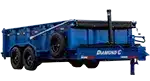
The current Diamond C LPT heavy-duty telescopic dump line is available in GVWR configurations from approximately 15,500 to 24,000 lb, with 12- to 16-foot body lengths and 81- to 82-inch bed widths. Current LPT bumper-pull configurations use Lippert axles as standard, with heavier axle packages available by model and configuration. They also use a telescopic hydraulic hoist and Diamond C’s DM Difference Maker multi-stage coating system.
As one real-world example, a properly equipped 2026 Diamond C LPT207 with a 15,500 lb GVWR may weigh approximately 4,870 lb empty, producing a listed payload of approximately 10,630 lb. Three yards of wet topsoil calculated at 2,800 lb per yard would weigh about 8,400 lb. That leaves more than 2,000 lb between the estimated cargo weight and the trailer’s calculated payload, although the tow vehicle, tongue weight, axle distribution, and actual scale weight still have to be checked.
Smaller trailers leave much less room. Consider a tandem-axle dump trailer with a 7,000 lb GVWR and an as-equipped empty weight of 2,400 lb. Its calculated payload is 4,600 lb. That payload might accommodate five yards of mulch by weight alone if the mulch weighs 800 lb per yard, but a typical 6×10 body will run out of physical space well before five level yards will fit. For wet topsoil at 2,800 lb per yard, the weight-limited capacity is only about 1.64 cubic yards.
A medium-duty tandem dump can provide a useful step between a 7,000 lb trailer and an LPT. For example, one current Diamond C MDT configuration with a 12,000 lb GVWR and an as-equipped empty weight near 3,420 lb provides approximately 8,580 lb of payload. At the conservative 2,800 lb topsoil figure, two and a half yards would weigh about 7,000 lb and leave a reasonable margin. Three yards would weigh approximately 8,400 lb, leaving almost no allowance for a heavier-than-estimated load, extra equipment, or weighing error. Three yards should therefore be accepted only when the actual material and trailer weights have been verified.
Volume vs. Weight: Which Limit Do You Hit First?
Here is the real question, and the answer depends on both the material and the dump body’s actual interior dimensions.
With mulch, volume usually wins. A true 6-foot-wide by 10-foot-long body with 18-inch sides has a level volume of approximately 3.33 cubic yards. The same body with 24-inch sides has a level volume of approximately 4.44 cubic yards. Many trailers advertised as “6×10” have interior bed widths closer to 60 inches than 72 inches, so measuring the inside of the body is important. A 60-inch-wide by 10-foot-long body holds approximately 2.78 cubic yards with 18-inch sides or 3.70 cubic yards with 24-inch sides.
At 800 lb per cubic yard, 3.33 yards of mulch weighs approximately 2,664 lb, while 4.44 yards weighs approximately 3,552 lb. Those loads may be below the payload limit of a typical 7,000 lb tandem dump, meaning the body reaches its level-volume capacity before the trailer reaches its weight capacity. Side extensions can increase volume, but they do not increase GVWR, axle capacity, tire capacity, or tow-vehicle capability.
Mulch piled above the sides can shift, settle, and catch significant airflow in transit. Indiana does not have a universal law stating that every load must use one particular kind of tarp, but Indiana Code 9-21-8-48 prohibits operating a vehicle on a highway when its contents are dripping, sifting, leaking, or otherwise escaping. A properly fitted and secured tarp is the practical way to contain mulch, compost, soil, and other loose landscape material.
With topsoil, weight wins quickly. Three yards of wet topsoil at 2,800 lb per yard is approximately 8,400 lb of cargo. On a 7,000 lb GVWR trailer weighing 2,400 lb empty, the calculated payload is only 4,600 lb. The cargo alone is approximately 3,800 lb beyond that payload. The dump body may not look full, but the trailer’s frame, suspension, axles, tires, coupler, brakes, and tow vehicle are being asked to carry substantially more than the certified limit.
This is why ordering “a few yards” without doing the arithmetic first causes problems. Landscape suppliers generally sell bulk products by volume. Trailers are certified by weight. The two systems do not translate automatically, and moisture can change the answer between the day you place the order and the day you pick it up.
Your Tow Vehicle Is Part of the Equation Too
A trailer’s GVWR is its ceiling, but it does not tell you whether your particular truck or SUV can tow that trailer at its maximum weight. The tow vehicle has separate limits for maximum loaded trailer weight, GCWR, vehicle GVWR, payload, front and rear GAWR, receiver capacity, and allowable tongue weight. The lowest applicable rating controls the combination.
For a conventional bumper-pull trailer, tongue weight is commonly planned at approximately 10 to 15 percent of the trailer’s actual loaded weight, subject to the trailer manufacturer’s loading instructions. A 7,000 lb loaded trailer could therefore transfer approximately 700 to 1,050 lb to the tow vehicle. That tongue weight counts against the truck’s available payload along with the driver, passengers, tools, fuel, bed accessories, and other cargo.
A truck may advertise a tow rating high enough for the trailer while still lacking enough payload or rear-axle capacity for the tongue weight. Check the vehicle’s door-jamb certification and tire-loading labels, the owner’s manual, and the receiver-hitch label. Do not assume that a Class IV receiver or a weight-distributing hitch automatically increases the truck’s ratings. A weight-distributing system should be used only when it is approved for the specific tow vehicle, receiver, coupler, and trailer, and it does not increase the manufacturer’s GVWR, GCWR, GAWR, or maximum trailer-weight rating.
A three-quarter-ton or one-ton truck may provide more towing, payload, braking, and rear-axle capacity than a half-ton, but the badge on the fender is not enough. Cab style, wheelbase, engine, drivetrain, axle ratio, tires, factory towing equipment, and installed body or toolbox weight all affect the final ratings. An aftermarket service body or flatbed adds weight to the truck and can reduce the payload available for trailer tongue or gooseneck load.
Braking is another essential part of the calculation. Indiana Code 9-19-3-3 requires a trailer or semitrailer with a gross weight of at least 3,000 lb, when operated on a highway, to have brakes adequate to control, stop, and hold the trailer. The brakes must be controllable from the tow vehicle’s cab and must apply automatically if the trailer separates from the tow vehicle. Before loading, inspect the connector, breakaway switch and cable, breakaway battery, brake controller, wiring, drums or rotors, and all installed trailer brakes. A heavily loaded dump trailer is not the time to discover that the controller is poorly adjusted or one brake circuit is not working.
A Practical Load Planning Approach
Before you call the supply yard, do this:
- Find the trailer’s GVWR on its VIN or certification plate, usually located on the tongue, A-frame, or front portion of the frame. Also record the axle, tire, wheel, and coupler ratings.
- Determine the trailer’s actual empty weight with its installed tarp, ramps, spare tire, battery, accessories, and permanently carried equipment. A certified scale is better than a brochure estimate. If you need the original specifications, your dealer, such as Spencer Trailers, can help identify the model and factory configuration.
- Subtract the actual empty trailer weight from GVWR to estimate available payload. Then confirm that the planned load distribution will not exceed an axle, tire, coupler, hitch, tow-vehicle payload, rear-GAWR, or GCWR limit.
- Ask the landscape supplier for the actual weight of the material or a recent scale-ticket estimate. When no verified number is available, use conservative figures such as 800 lb per cubic yard for moist hardwood mulch and 2,800 lb per cubic yard for wet topsoil.
- Calculate both limits. Divide available payload by the estimated pounds per cubic yard to find the weight-limited quantity. Separately calculate the dump body’s level volume by multiplying interior length, width, and side height in feet and dividing by 27. Use the lower result and leave a practical margin.
For a 7,000 lb GVWR tandem-axle dump weighing 2,400 lb empty, the calculated payload is 4,600 lb. Dividing 4,600 by 800 gives a theoretical weight limit of 5.75 yards of mulch. However, a true 6×10 body with 18-inch sides holds only about 3.33 level yards, so volume limits the mulch load to approximately three to three and a quarter yards. With 24-inch sides, the same nominal body holds about 4.44 level yards, still below the weight-only calculation.
Dividing the same 4,600 lb payload by 2,800 gives approximately 1.64 yards of wet topsoil. Ordering one and a half yards leaves a small weight buffer, provided the empty weight and material estimate are accurate. If the soil is extremely wet, clay-heavy, or mixed with dense aggregate, even one and a half yards may need to be verified on a scale. Making two controlled trips is better than making one overloaded trip.
Also account for the loader operator’s bucket size. A “scoop” may be one-half yard, three-quarters of a yard, one yard, or another amount depending on the machine and bucket. Tell the operator your maximum cargo weight or exact yard limit before loading begins, and stop between buckets if a scale is available.
When to Step Up to a Bigger Trailer
If you are doing occasional landscaping, garden work, or property maintenance, a light-duty dump can be an excellent tool. Diamond C’s current GST single-axle telescopic dump has a 6,000 lb GVWR, an 8-foot by 60-inch body, a published capacity of approximately 2.2 cubic yards, a 6,000 lb Lippert drop axle, and a telescopic hydraulic hoist. A 7,000 lb tandem-axle dump provides additional stability and payload, but neither class is intended to carry three or four yards of wet topsoil simply because that volume fits below or near the top of the sides.
If you regularly move dense soil, gravel, broken concrete, demolition material, or other heavy bulk products, moving into a heavier tandem-axle dump changes the job considerably. A current Diamond C LPT207 with a 15,500 lb GVWR can provide more than 10,000 lb of payload in certain configurations, while heavier LPT models extend through approximately 24,000 lb GVWR. The LPT line uses Lippert axles, a telescopic hydraulic hoist, heavy-duty dump-body construction, and the DM Difference Maker coating system. Diamond C has built trailers in Mt. Pleasant, Texas, since 1985.
With approximately 10,630 lb of payload, an as-equipped 15,500 lb LPT207 can carry three yards of topsoil estimated at 2,800 lb per yard while retaining meaningful payload margin. Its larger body can also accommodate five or six level yards of mulch without approaching the weight limit under ordinary conditions. The exact capacity still depends on body length, side height, installed options, material density, axle loading, and tow-vehicle ratings.
Comparable heavy-duty dump trailers from Delco and other manufacturers should be evaluated with the same process. Start with the certification plate and actual empty weight rather than relying on a broad model description or body size. Two trailers with the same nominal GVWR can have different empty weights and therefore different payload capacities.
For a middle step, the Diamond C MDT and comparable medium-duty tandem dumps may be available in configurations around the 9,890- to 12,000-lb class. A rating such as 9,890 or 9,990 lb should not be treated as a universal legal shortcut. For commercial operation, the federal Class A CDL threshold generally applies when the combination has a GCWR of 26,001 lb or more and the towed unit has a GVWR greater than 10,000 lb. The 26,001-lb figure applies to the rated combination, not to the trailer by itself. Licensing, registration, operating-authority, and commercial-vehicle requirements can also depend on how and where the equipment is used.
Browse what’s currently in stock at Spencer Trailers’ inventory, or reach out to us directly at (812) 829-0226. We’re at 291 West State Hwy 46 in Spencer, Indiana. Tell us what material you haul, how many cubic yards you want to move, how wet or dense it normally is, what truck you use, and how often you make the trip. We can help you compare body volume, payload, axle configuration, hitch type, and tow-vehicle requirements without guessing.
And if you are not sure whether your current trailer is the right fit for what you are asking it to do, that is exactly the conversation to have before the loader starts dropping material into the bed, not after the axles, tires, hitch, brakes, or tow vehicle have already been overloaded.


