









You ordered six yards of pea gravel. The quarry loaded the trailer. Somewhere between the pit and your driveway, a nagging thought hit you: Is this thing overloaded? That question matters more than most people think, and the math is simpler than you might expect if you know the material weight, the trailer’s verified empty weight, and its Gross Vehicle Weight Rating (GVWR).
Here’s the short version. A cubic yard of common gravel often weighs somewhere around 2,500 to 3,000 lb, although moisture, stone type, particle size, and compaction can move the number outside that range. A 14-ft dump body may have enough physical volume for roughly 7 cubic yards with 24-inch sides or more than 10 cubic yards with 36-inch sides. That does not mean the trailer can legally or safely carry that much gravel. Payload, axle loading, tire capacity, hitch limits, and the tow vehicle’s ratings determine the usable load.
The trailer’s GVWR is the manufacturer’s maximum allowable loaded trailer weight. Exceeding it can overload tires, running gear, the frame, the coupler, the hydraulic system, or the tow vehicle. With dense aggregate, a trailer can be seriously overweight while the bed still looks only half full.
What a 14-ft Dump Trailer Can Actually Hold
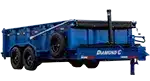
Current 14-ft dump trailers are available in several capacity classes. Common configurations include 14,000-lb trailers with tandem 7,000-lb axles and 16,000-lb trailers with tandem 8,000-lb axles. Premium heavy-duty trailers may carry a higher manufacturer-assigned GVWR because the complete design accounts for the load supported at the hitch as well as the load carried by the axles. The sum of the axle ratings alone should never be treated as the trailer’s payload rating.
Diamond C’s current 14-ft heavy-duty low-profile dump is the LPT, or Heavy Duty Low Profile Telescopic Dump Trailer. The LPT is offered in 12-, 14-, and 16-ft lengths, with current GVWR packages ranging from 15,500 to 24,000 lb. Its standard running gear uses two 7,000-lb Lippert axles, with heavier Lippert axle packages available by configuration. It uses a three-stage telescopic-cylinder hoist and has an approximately 82-inch-wide bed. The exact GVWR, empty weight, axle package, tires, frame, coupler, and options must be confirmed for the individual trailer.
H&H also offers 14-ft dump configurations in multiple classes, including 14,000- and 16,000-lb telescopic and industrial models, while heavier TOPLINE telescopic versions extend beyond that range. Delco’s current 83-inch-wide bumper-pull dump lineup includes 14-ft configurations in 14,000- and 16,000-lb classes. Specifications vary considerably among models even when the bed lengths appear identical.
Payload capacity begins with a simple calculation:
Estimated payload = GVWR − actual empty trailer weight
A steel 14-ft dump trailer may weigh approximately 4,000 to more than 6,000 lb depending on its GVWR package, wall height, frame, hoist, running gear, ramps, tarp system, spare tire, rear gate, battery, tool storage, and other options. Here are sample calculations using representative empty weights:
| GVWR | Empty Weight (example) | Calculated Payload | Gravel at 2,800 lb/yd |
|---|---|---|---|
| 14,000 lb | 4,100 lb | 9,900 lb | ~3.5 yd |
| 15,500 lb | 4,500 lb | 11,000 lb | ~3.9 yd |
| 16,000 lb | 4,500 lb | 11,500 lb | ~4.1 yd |
| 20,000 lb | 5,800 lb | 14,200 lb | ~5.1 yd |
These are examples, not guaranteed capacities for a particular trailer. A certification label normally identifies the GVWR, Gross Axle Weight Rating (GAWR), required tire information, and other manufacturing data, but it may not state the trailer’s current empty weight. Published brochure weights are usually configuration-dependent and may not include every installed option.
The most dependable method is to weigh the empty, fully equipped trailer on a certified scale while connected in the same general configuration used for hauling. Record the axle-group weight and, if possible, determine the hitch-supported portion as well. Then compare the loaded scale readings with the trailer GVWR, each GAWR, tire capacities, hitch and coupler ratings, and the truck’s limits.
Why 2,700 lb Per Yard Isn’t the Whole Story
Using 2,700 lb per cubic yard can be a reasonable planning estimate for some gravel, but it is not a universal conversion. Aggregate is commonly sold by the ton precisely because cubic-yard weight changes with the material and its condition.
Loose pea gravel may be around 2,500 to 2,800 lb per cubic yard. Other crushed aggregates may approach or exceed 3,000 lb per cubic yard depending on gradation, fines, source rock, moisture, and compaction. Screenings containing a high percentage of fines can retain water and become substantially heavier than the same apparent volume when dry.
For example, six cubic yards at 2,700 lb per yard weighs 16,200 lb before the trailer’s own weight is included. If the empty trailer weighs 4,500 lb, the loaded trailer would weigh approximately 20,700 lb. That is far beyond a 14,000-, 15,500-, or 16,000-lb GVWR trailer, even though six yards may physically fit inside a 14-ft bed.
If the material instead weighs 3,000 lb per cubic yard, the same six-yard order weighs 18,000 lb by itself. Moisture added after a rain can further change the result. Bucket count and visual estimates are therefore poor substitutes for an actual scale weight.
The safest move is to ask the quarry for a load ticket showing the net material weight. Most commercial aggregate facilities determine the loaded and empty weights on a truck scale. Give the operator a maximum net cargo weight rather than asking for an approximate number of yards. If an outgoing scale is unavailable, use the quarry’s material-specific tons-per-yard estimate, calculate conservatively, and leave a meaningful safety margin.
Reading Your GVWR Plate (And What Happens If You Ignore It)
The trailer’s certification label is the starting point for understanding its limits. GVWR is the maximum allowable total trailer weight, including the trailer, cargo, installed equipment, fluids, battery, tools, and anything else carried on or in it. GAWR is the maximum allowable load assigned to an axle system. Tire and wheel capacities, inflation requirements, coupler rating, safety-chain rating, jack capacity, and the tow vehicle’s receiver or gooseneck rating must also be respected.
Do not assume that staying under GVWR automatically means every component is correctly loaded. A poorly positioned load can overload the tongue, rear axle, one side of the trailer, or individual tires while the trailer’s total weight remains under GVWR. Scale readings and correct fore-and-aft distribution matter.
Tires are particularly vulnerable to excessive loading, underinflation, speed, heat, age, road damage, and uneven side-to-side weight. Read the tire sidewall and trailer label for the required size, load range, maximum load at the specified cold pressure, and other limitations. A tire’s lettered load range by itself is not enough; actual capacity varies by tire size and construction.
Overloading also increases heat and stress in hubs, bearings, brakes, suspension parts, wheels, and spindles. Diamond C uses Lippert axles on its current trailer lineup, including the LPT. Other brands use running gear specified for their respective models. Regardless of brand, an axle’s rating is not permission to exceed the trailer manufacturer’s GVWR or the ratings of the tires, wheels, coupler, hitch, frame, or tow vehicle.
Braking distance grows as combination weight rises, and an overloaded trailer can reduce stability during lane changes or emergency maneuvers. Dumping an overweight or badly distributed load introduces another hazard because the hoist, body, frame, and stabilizing footprint are working under high stress while the center of gravity rises. Dump only on firm, level ground, keep people clear, and follow the trailer manufacturer’s operating instructions.
Indiana law requires a trailer or semitrailer with a gross weight of at least 3,000 lb to be equipped with brakes adequate to control, stop, and hold the vehicle. A heavy dump trailer should have functioning brakes at the wheels specified by its manufacturer, a properly adjusted brake controller, an operational breakaway system, and a charged breakaway battery before it enters the road.
Weight enforcement is more complicated than a single GVWR comparison. Officers may consider actual gross weight, axle weight, tire capacity, registered weight, equipment compliance, vehicle classification, and applicable road or bridge limits. An overweight or unsafe combination can be cited or placed out of service, and the cargo may have to be reduced before travel continues. Manufacturer ratings can also become important in crash investigations, warranty decisions, and insurance disputes.
Matching the Trailer to the Job
If you are making occasional driveway-gravel runs, a properly configured 14,000-lb dump trailer may handle approximately three to three-and-a-half yards of many aggregates, depending on the trailer’s empty weight and the quarry’s measured material density. Four yards may be too much for some 14,000-lb trailers, especially when the trailer is heavily optioned or the material is wet and dense.
Current 14-ft options include H&H telescopic and industrial dump configurations, Delco 83-inch-wide dump configurations, and Diamond C’s heavy-duty LPT. These are not interchangeable simply because they share a nominal bed length. Their GVWR, empty weight, axle packages, bed width, side height, hoist design, tires, couplers, and available options differ.
For regular aggregate work, a 15,500-, 16,000-, 20,000-, or heavier configuration can provide more payload and operating margin, but only after accounting for the heavier trailer itself. Diamond C’s LPT is currently offered from 15,500 through 24,000 lb GVWR, depending on configuration. Standard LPT running gear consists of two 7,000-lb Lippert axles; available upgrades include heavier tandem or triple-axle Lippert packages, along with the corresponding tire, wheel, frame, and coupler requirements.
Diamond C also offers the DOD deck-over dump in 14- and 16-ft lengths for buyers who need a wider 96-inch dump body. Its current configurations cover heavy-duty GVWR classes and use Lippert running gear. A deck-over design increases usable bed width, but it also places the bed higher, affects loading height and center of gravity, and may carry a different empty weight. Choose it for the job requirement, not simply because it holds more volume.
The tow vehicle must be matched to the exact loaded trailer. Pickup classifications such as half-ton, three-quarter-ton, or one-ton do not establish a universal tow rating. Two trucks carrying the same badge may have dramatically different ratings because of engine, transmission, axle ratio, cab, bed, drivetrain, wheelbase, tires, suspension, factory tow package, hitch type, and installed equipment.
Check the truck manufacturer’s towing guide using the truck’s year, configuration, VIN information, and equipment. Verify conventional or gooseneck tow rating as applicable, Gross Combined Weight Rating (GCWR), truck GVWR, front and rear GAWR, receiver or gooseneck rating, payload label, and tire capacities. Payload is especially important because hitch weight, passengers, fuel, tools, and cargo all load the truck.
Licensing rules also depend on the rated combination, the nature of the use, and other factors. Under the federal Class A CDL threshold reflected in Indiana licensing rules, the relevant combination threshold is a GCWR of 26,001 lb or more when the towed unit has a GVWR greater than 10,000 lb. A trailer exceeding 10,000 lb GVWR does not, by itself, create that Class A CDL requirement when the combination rating remains below 26,001 lb. Commercial operation can trigger additional requirements even below CDL thresholds, so business operators should verify their exact intrastate or interstate use.
Side Height and Cubic Yard Math
Here is where people get tripped up at the quarry. Bed volume and legal payload are separate constraints. For dense material such as gravel, payload is usually reached long before the bed is full.
The basic water-level calculation is:
Length × inside width × side height ÷ 27 = cubic yards
A bed that measures 14 ft long by approximately 82 inches wide by 24 inches high has a theoretical level volume of about 7.1 cubic yards. The same footprint with 36-inch sides has a theoretical volume of approximately 10.6 cubic yards. Actual usable dimensions, rounded corners, structural components, gate design, and the shape of the load can change the practical volume.
At 2,700 lb per cubic yard, 7.1 yards would weigh about 19,170 lb. At 3,000 lb per cubic yard, it would weigh about 21,300 lb. Add the empty trailer weight and a level-to-the-top load would exceed the GVWR of many bumper-pull dump trailers by several thousand pounds.
Consider a 14,000-lb GVWR trailer with an actual empty weight of 4,400 lb. Its theoretical payload is 9,600 lb before checking axle, tire, hitch, and truck limits. At 2,700 lb per yard, that equals about 3.6 yards. At 3,000 lb per yard, it equals only 3.2 yards. In a 24-inch-side body holding about seven yards by volume, the correct load may look less than half full.
Load shape matters too. Gravel is normally heaped rather than perfectly level, so judging capacity by how high the center pile reaches can be misleading. The loader may also drop material unevenly, creating excessive tongue weight or concentrating the load behind the axles. Ask for controlled placement and confirm the completed load on the scale.
Tell the quarry operator your maximum net cargo weight, not just the trailer’s cubic-yard volume. “Please keep the aggregate at or below 9,000 lb and give me a scale ticket” is much clearer than “fill it about halfway.”
Common Overload Mistakes (And How to Skip Them)
- Ordering by volume without confirming density. Six yards of dry pea gravel and six yards of wet aggregate base may have substantially different weights. Obtain the quarry’s tons-per-yard figure and, whenever possible, a scale ticket.
- Subtracting a brochure’s minimum weight from GVWR. Published weights may describe a base trailer. Taller sides, a tarp, ramps, spare tire, upgraded running gear, heavy gate, toolbox, and other equipment reduce available payload. Weigh the trailer as actually equipped.
- Reading GVWR as cargo capacity. GVWR includes the trailer itself. A 14,000-lb GVWR trailer weighing 4,400 lb does not have a 14,000-lb payload; its starting payload calculation is 9,600 lb.
- Using axle ratings as the only limit. GVWR, GAWR, tire and wheel ratings, coupler, hitch, frame, tow vehicle, and road limits all apply. The lowest applicable rating controls.
- Assuming the truck can handle whatever the trailer can. Confirm the exact truck’s towing, payload, axle, GCWR, tire, and hitch limits. A high advertised maximum for another configuration does not apply to every truck in the same series.
- Ignoring tire condition and pressure. Check cold inflation, tread, sidewalls, valve stems, lug-nut torque, and visible damage before hauling. Replace tires according to condition and manufacturer guidance, not appearance alone.
- Forgetting tongue weight. Too little hitch weight can promote sway; too much can overload the hitch or truck’s rear axle and reduce steering control. Load distribution must remain within the trailer and tow-vehicle instructions.
- Assuming a legal total weight guarantees proper balance. A trailer can be under GVWR while an axle, tire, wheel, or hitch is overloaded. Obtain separate axle weights when practical.
- Loading first and calculating later. Determine the maximum cargo weight before arriving, communicate it to the loader, and verify the load before leaving the quarry.
What to Ask When You’re Shopping for a Dump Trailer
Before buying a dump trailer for aggregate hauling, verify its GVWR, GAWR per axle, actual or configuration-specific empty weight, calculated payload, bed dimensions, side height, tire and wheel capacities, brake equipment, coupler rating, frame construction, hoist type, dump angle, rear-gate design, and tarp availability. Ask which features are standard on the exact unit and which are optional.
Do not select a minimum GVWR solely from bed length or a general rule of thumb. A 14,000-lb trailer can be appropriate for carefully weighed smaller loads, while a 15,500- or 16,000-lb trailer offers more potential payload. Frequent heavy aggregate work may justify a 20,000-lb-or-higher configuration, provided the tow vehicle, hitch, licensing, registration, tires, brakes, and operating conditions are suitable.
For a Diamond C LPT, confirm the individual trailer’s VIN label and build configuration. Current LPT specifications include 12-, 14-, and 16-ft lengths, approximately 81- to 82-inch bed widths, a three-stage telescopic-cylinder hoist, Lippert axles, and GVWR packages from 15,500 to 24,000 lb. Diamond C builds its trailers in Mt. Pleasant, Texas, and applies its DM Difference Maker multi-stage coating process. Specifications and installed components can change, so the unit-specific documentation and dealer build sheet remain controlling.
If comparing H&H, Delco, Diamond C, or another manufacturer, compare exact model configurations rather than broad brand claims. A 14-ft bed can be paired with different axles, tires, suspension, frames, hoists, side heights, and GVWR packages. Even two trailers from the same product family may have different legal payloads after options are installed.
You can browse the current dump trailer inventory at Spencer Trailers’ full inventory to see what’s in stock. If you want to calculate capacity for a specific aggregate, bring the material’s scale weight or tons-per-yard figure along with your truck’s towing information. The team at Spencer Trailers in Spencer, Indiana can help you compare the trailer’s GVWR, configured weight, running gear, and available payload. Call (812) 829-0226 or reach out here.
And if you’re still sorting out the right trailer class for what you actually haul, take a look at what’s moved recently to see which configurations other buyers have chosen. Use those examples as a starting point, then verify the ratings and weights for the exact trailer and tow vehicle you intend to operate.
The math on a gravel haul is not complicated, but it has to use real numbers. Confirm the trailer’s GVWR, weigh it empty, obtain the aggregate’s actual weight, verify the truck and hitch ratings, and leave room for uncertainty. Do that before the loader drops the first bucket, not after the trailer is already full and you are hoping the combination is within its limits.


