




You’re cruising at 65 mph on a wide-open stretch of highway in Owen County when a gust hits the side of your 7×16 enclosed trailer. The whole combination moves toward the edge of its lane. Your hands tighten on the wheel. Your heart rate spikes. You’ve still got 80 miles to go.
That moment is more common than many drivers admit, but it should not automatically be dismissed as normal or blamed on one component. Crosswind response is influenced by the trailer’s side area, loaded weight, center of gravity, tongue weight, tire condition, hitch setup, tow vehicle wheelbase and ratings, road exposure, and speed. Understanding how those factors interact helps a driver recognize when a modest push is manageable, when the combination is beginning to sway, and when conditions justify leaving the road at a safe location.
Why Enclosed Trailers Get Hit Harder Than Open Ones
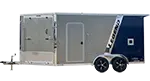
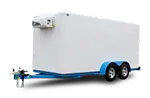
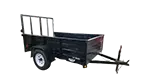
An unloaded open car hauler or flatbed utility trailer ordinarily presents much less side area to the wind than an enclosed cargo trailer. A tall enclosed trailer has a large, mostly uninterrupted sidewall. The larger that exposed area is, the greater the potential lateral force from a crosswind. A nominal 7×16 enclosed trailer with a sidewall approximately 7 feet high has about 112 square feet of rectangular side area before accounting for the roof profile, fenders, tongue, V-front, and other details. A strong gust acting across that area can produce a noticeable push.
That does not mean every 7×16 trailer has the same dimensions or wind behavior. Wells Cargo FastTrac configurations vary by width, length, axle arrangement, GVWR, and interior height. The Wells Cargo Road Force V-Front line likewise includes several sizes, with published specifications differing by configuration. Always use the certification label and current manufacturer specifications for the individual trailer rather than treating “7×16” as a complete specification.
Height also affects how far above the road the wind force acts. A taller body creates a larger overturning moment than a shorter body of similar weight and width. Cargo can make that condition better or worse. Heavy material carried low generally helps keep the loaded center of gravity down, while tall equipment, stacked boxes, or liquid tanks can raise it. Trailer skin over a frame does not by itself make the center of gravity dangerously high; the complete trailer design and the location of the load are what matter.
For example, the current Legend Thunder V-Nose aluminum enclosed line includes tandem-axle 7×16 configurations with a published 7,000-pound GVWR. Its actual unloaded vehicle weight and resulting payload must be confirmed on the specific trailer because dimensions, doors, interior packages, and installed options can change those figures. GVWR is the maximum permitted weight of the loaded trailer, not its empty weight or automatic payload capacity.
What Gusts Actually Do to Your Trailer
A steady crosswind can still be hazardous, but it is generally easier to anticipate than a rapidly changing gust. The abrupt change in lateral force is what can surprise a driver. Wind may also be disturbed by terrain, buildings, tree lines, bridge structures, and large passing vehicles, so the force can change even when the reported regional wind speed appears steady.
Three related things can happen in a strong gust:
- Yaw begins. The trailer rotates slightly around its vertical axis, changing its angle relative to the tow vehicle. Insufficient tongue weight, rear-heavy loading, excessive speed, worn suspension parts, improper tire pressure, or hitch looseness can make that movement harder to control.
- Sway can develop. One push is not necessarily trailer sway. Sway is an oscillating side-to-side motion that continues or grows after the initial disturbance. A properly loaded and maintained combination should settle rather than build progressively larger oscillations.
- Abrupt driver inputs can amplify it. Rapid steering, hard tow-vehicle braking, or sudden acceleration can destabilize an already oscillating combination. Keep the steering wheel pointed along the intended path, remain calm, and gradually reduce accelerator pressure. If the rig has a compatible electric-brake controller with a manual control, applying the trailer brakes manually without applying the tow vehicle brakes can help pull the trailer back into line. Follow the tow vehicle, brake-controller, hitch, and trailer manufacturers’ instructions.
Do not attempt to “steer into” each swing. That usually puts the tow vehicle out of phase with the trailer and can increase the oscillation. Do not accelerate in an attempt to pull out of sway. After the combination is stable, slow further and stop somewhere safely off the roadway to inspect the load, hitch, tires, and suspension before continuing.
Crosswind exposure is often greatest on open farmland, elevated roads, bridges, highway cut openings, and transitions between sheltered and unsheltered terrain. The airflow can also change abruptly when a large truck passes: the trailer may first be pushed away, then drawn toward the truck’s low-pressure wake, and pushed again as the vehicles separate.
The Speed Question: How Much Should You Back Off?
There is no reliable formula that converts a forecast crosswind speed into one universally safe towing speed. A 20 mph crosswind does not automatically require one particular reduction, and a fixed rule cannot account for gusts, trailer size, road surface, traffic, load placement, tow vehicle capability, or driver experience. The correct speed is one that remains comfortably within the posted limit and allows the combination to track steadily with a meaningful safety margin. In some conditions, no highway speed is reasonable.
Reduce speed early when the trailer begins requiring repeated corrections, when gusts are moving the combination within the lane, or when weather alerts warn of damaging winds. Increase following distance and avoid cruise control when changing conditions require frequent speed adjustments. If maintaining lane position is difficult even after slowing substantially, take the next safe exit and park in a designated area. Do not stop on a bridge, beneath an overpass, or on a narrow shoulder unless an emergency makes it unavoidable.
Aerodynamic pressure increases approximately with the square of air velocity, but the real towing situation requires care when applying that principle. The direct side force from an ambient crosswind principally depends on the crosswind component and the trailer’s shape and side area; merely reducing road speed does not eliminate that wind. Slower travel still provides important benefits: it reduces the energy involved, gives the driver more time to respond, reduces forces created by steering corrections, and generally makes an incipient sway event easier to control.
Tow vehicle size, loaded weight, wheelbase, suspension, tires, hitch ratings, and electronic stability systems also matter. A properly equipped three-quarter-ton pickup may provide more stability margin for a large enclosed trailer than a lightly configured half-ton, but vehicle class alone proves nothing. Use the tow vehicle’s door-jamb certification label, payload label, owner’s manual, hitch rating, axle ratings, tire ratings, and manufacturer towing guide. Published maximum tow ratings often apply only to specific configurations and may be reduced by passengers, tools, accessories, cargo, and tongue weight.
For an 8.5×24 Darkhorse Cargo trailer, use the VIN-specific GVWR, GAWR, unloaded weight information, and tire-and-loading label rather than assuming a standard loaded weight. Confirm that the truck, receiver, ball mount, hitch ball, weight-distribution equipment, safety chains, brake controller, and tires are each rated for the actual combination.
Trailer Specs That Affect Wind Stability
Not all enclosed trailers respond identically in crosswinds. These are useful comparisons, but none substitutes for correct loading, adequate tow vehicle capacity, and an appropriate hitch:
| Feature | Generally More Favorable | Potential Concern |
|---|---|---|
| Body height | Lower profile with cargo kept low | Tall body and high-stacked cargo increase side area and overturning leverage |
| Front shape | Rounded or V-front design may improve forward-airflow characteristics | Front shape cannot cancel the lateral force on a large sidewall |
| Trailer length | Shorter body generally has less exposed side area | Longer body usually presents more side area to a crosswind |
| Tongue weight | Within the trailer, hitch, and tow vehicle manufacturers’ specified range; commonly about 10-15% for conventional ball-pull trailers | Rear-heavy or insufficient tongue weight can promote sway; excessive tongue weight can overload the truck or hitch |
| Axles and running gear | Correctly aligned axles, sound suspension, matched tires, and proper inflation | Misalignment, worn components, tire problems, or uneven loading can impair tracking |
A V-front can affect airflow and may reduce some front-end aerodynamic drag compared with an otherwise similar blunt front, but it should not be marketed as a cure for crosswind instability. Most of an enclosed trailer’s sail area remains along its sides. A Wells Cargo Road Force V-Front, Legend Thunder V-Nose, or current Darkhorse Cargo V-nose configuration still needs the same careful attention to loaded weight, tongue weight, hitch setup, tires, brakes, and weather.
Tandem axles can offer useful load distribution and a longer running-gear footprint, but the number of axles alone does not guarantee stability. A correctly loaded single-axle trailer can tow properly, while a rear-heavy tandem-axle trailer can sway. Axle placement, alignment, suspension condition, tire construction, tire pressure, loading, and hitch geometry all contribute.
Equipment That Helps
A correctly selected weight-distribution hitch can restore part of the load transferred from the tow vehicle’s front axle when a conventional trailer applies tongue weight at the rear hitch. Some systems also incorporate sway resistance. The Equal-i-zer design uses integrated four-point friction sway control, while Andersen offers a weight-distribution design that uses chains and urethane spring elements. These systems work differently, and each must be properly sized, installed, and adjusted for the actual loaded trailer and tongue weight.
A separate friction sway-control device adds resistance to relative movement between the tow vehicle and trailer. It may help damp small disturbances, but it cannot correct rear-heavy loading, excessive speed, overloaded components, bad tires, worn suspension, or an undersized tow vehicle. Restrictions may apply when backing, turning sharply, or operating in certain conditions, so follow the device manufacturer’s instructions rather than relying on a generic setting.
Do not assume every trailer should use weight distribution. The tow vehicle, receiver, trailer frame, and coupler must permit it, and some applications require specific equipment or prohibit certain arrangements. Verify compatibility and both weight-carrying and weight-distributing ratings before installation.
Tow-vehicle trailer-sway control can selectively reduce engine torque and apply individual vehicle brakes when sensors detect instability. It is a valuable backup, not permission to exceed ratings or continue in unsafe wind. It also cannot repeal the physics of an overloaded or improperly balanced trailer.
Correct load distribution remains fundamental. Place heavy items low, secure them against movement in every direction, and balance the load from side to side. Position cargo fore-and-aft to achieve the tongue-weight range required for the specific trailer and tow vehicle. Do not simply move everything forward: too much tongue weight can overload the rear axle, receiver, hitch, tires, or suspension of the tow vehicle.
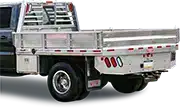
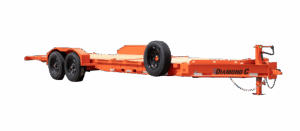
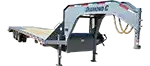
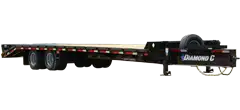
If you’re hauling with an H&H tilt trailer or a Diamond C FMAX gooseneck flatbed, the wind dynamics depend heavily on the load. A tall skid steer attachment, compact tractor with an elevated canopy, stacked material, or other high-profile cargo can catch substantial wind even though the trailer has no enclosed body. Keep the load as low as practical, position it for correct axle and hitch loading, and secure it with properly rated equipment and attachment points. Diamond C’s current FMAX family includes several configurations with different GVWRs, lengths, axle capacities, frames, and deck arrangements, so use the VIN label and build specifications for the individual unit.
Practical Checklist Before a Windy Day Haul
- Check the National Weather Service forecast, hourly wind prediction, hazardous-weather outlook, and any high-wind warnings for the complete route. Pay attention to gust speed, direction, and the timing of a passing front.
- If gusts near or above 40 mph are forecast, seriously consider postponing the trip, particularly with an empty or lightly loaded high-profile trailer. No single wind speed is a guaranteed safe or unsafe threshold for every combination.
- Measure or reliably calculate loaded trailer weight and tongue weight. For many conventional ball-pull trailers, tongue weight is commonly around 10-15% of loaded trailer weight, but the applicable manufacturer limits control.
- Confirm that the trailer is level or set at the attitude specified by its manufacturer and that the coupler is fully seated and latched. Install the coupler lock or safety pin.
- Cross the safety chains correctly where required by the equipment instructions, connect the breakaway cable to a proper point independent of the chains, plug in the electrical connector, and test all lamps and brakes.
- Confirm any weight-distribution and sway-control equipment is correctly sized and adjusted. Attachment alone does not establish correct setup.
- Check cold tire pressures against the tow vehicle placard and trailer tire requirements. Inspect for damage, abnormal wear, inadequate tread, mismatched construction, and expired or deteriorated tires.
- Verify that cargo cannot slide, tip, roll, or shift. Recheck securement shortly after departure and periodically during the trip.
- Test the brake controller at low speed in a safe area and adjust it according to its instructions and road conditions. Indiana generally requires a trailer or semitrailer with a gross weight of at least 3,000 pounds to be equipped with brakes adequate to control and stop it.
- Plan safe stopping locations such as truck stops, rest areas, or large parking areas. Do not plan to shelter beneath an overpass or park where the trailer could obstruct traffic.
- Reduce speed before reaching exposed sections, bridges, construction zones, or gaps in tree cover. Leave extra following distance and avoid sudden lane changes.
A Word on Bridges and Overpasses
Bridges can be especially demanding for enclosed-trailer towing in high wind. An elevated deck may have little protection from terrain or vegetation, and the wind can change abruptly as the combination enters or leaves the structure. Narrow lanes, barriers, construction, and nearby traffic can leave less room for correction.
There is no universal instruction to reduce speed by exactly 10 or 15 mph for every bridge. Slow to a prudent speed before entering, remain in your lane, allow extra space, and hold the steering wheel firmly without making abrupt corrections. If a gust moves the trailer, ease off the accelerator smoothly. Avoid slamming on the tow vehicle’s brakes. If actual sway begins and your electric-brake controller provides an approved manual control, use it as directed to apply the trailer brakes independently. Once stable, continue slowing smoothly.
Do not enter a bridge if officials have closed it to high-profile vehicles or if you cannot maintain control on the approach. Obey variable-message signs, reduced speed limits, lane restrictions, and instructions from law enforcement or transportation agencies. If conditions appear unsafe, exit before the bridge whenever a legal, suitable route or parking location is available.
Indiana and the surrounding Midwest can experience strong winds with thunderstorms, squall lines, rapidly passing fronts, and winter systems. If you’re towing an 8.5-foot-wide enclosed trailer near the White River in the Spencer area during a front passage, expect exposed approaches and open terrain to behave as gust zones. Width is only part of the issue; overall height, length, loading, and wind direction determine how much side area is exposed.
When to Pull Over
Sometimes the correct decision is to stop. If the trailer is repeatedly moving across the lane, active sway returns after you reduce speed, steering corrections are becoming frequent, or visibility and traction are deteriorating, conditions are beyond a reasonable towing margin. Take the next safe exit or designated stopping area. A truck stop, rest area, or substantial parking area is preferable to a narrow shoulder.
Park where the combination will not block traffic and where falling limbs, signs, carts, or other windblown objects are not an added hazard. Whenever practical, orient the trailer so its narrow end faces the wind rather than leaving the full sidewall broadside to the strongest gusts. Remain aware that wind direction can change as a front passes.
Waiting 30 to 60 minutes may allow a short squall line or frontal boundary to move through, but do not assume every wind event will improve that quickly. Recheck current observations, radar, warnings, and the forecast before restarting. If the wind remains severe, postpone the remainder of the trip.
The trailer does not care about your schedule. A crash involving a trailer crossing a lane, striking a barrier, or overturning can cost far more than a delay. That remains true whether the trailer has a 7,000-pound GVWR or a 14,000-pound GVWR, and whether it is empty or loaded. In fact, an empty enclosed trailer can react sharply to wind because it retains nearly all its side area while carrying less mass.
If you’re shopping for an enclosed trailer and wind stability is a real concern for your typical routes, come talk to us at Spencer Trailers. We can walk through the current specifications on our Wells Cargo, Legend, and Darkhorse Cargo units and help match the trailer’s height, length, GVWR, payload capacity, axle configuration, brakes, tires, and doors to your cargo and tow vehicle. Or give us a call at (812) 829-0226 and describe the haul. A difference in interior height can materially change exposed side area, but it must be weighed against cargo-clearance requirements and the rest of the trailer’s design. If you’re unsure which hitch and sway-control setup is compatible with what you’re pulling, our contact page is the fastest way to get a straight answer.


