








You lined up a forklift, bought the blocks, and now you are staring at two pallets in the yard wondering whether your trailer can safely and legally handle them. Concrete masonry units are deceptively heavy, but there is no single dependable “standard pallet weight.” One supplier may cube 72 normal-weight 8x8x16 hollow units, while another may stack 90 or more. Individual 8x8x16 units can weigh roughly 28 lb for some lightweight products, about 38 lb for a normal-weight line block, and 44 to 51 lb for certain architectural, bond-beam, corner, or solid-top configurations. A full cube can therefore range from the mid-2,000s to well above 4,000 lb before accounting for the pallet, banding, wrap, broken pieces, or moisture.
Two ordinary pallets can put 5,400 to 7,000 lb of cargo on the deck, while two heavier architectural or specialty cubes can approach 8,000 to 9,000 lb. This is not a job for a light-duty single-axle utility trailer, a 7,000 lb GVWR landscape trailer with limited payload, or a car hauler selected only because the pallets physically fit. You need enough certified payload, axle capacity, tire capacity, hitch capacity, deck strength, and tow-vehicle capacity for the actual load.
Know Your Pallet Weight Before You Pull Up
Not all concrete block is the same weight. Hollow normal-weight CMU, lightweight CMU, split-face block, solid-top units, bond beams, lintels, corners, and truly solid masonry units can have substantially different unit weights and pallet quantities. ASTM weight classifications describe the density of the concrete used in the units, but they do not tell you the finished weight of every block shape. Lightweight units can be materially lighter than normal-weight units, yet the difference must come from the manufacturer’s data rather than a blanket percentage applied to every pallet.
Ask the supplier for the exact product number, units per cube, unit weight, and total pallet or cube weight. A sales receipt showing only the number of blocks is not enough unless you also know the manufacturer’s listed unit weight. If the supplier cannot document the weight, have the pallet weighed or calculate a conservative figure from the heaviest applicable unit specification. Do not automatically assume 3,000 lb; that estimate may be reasonable for one hollow-block cube and dangerously low for another. Pallet and cube dimensions also vary. Measure the actual load, including overhanging block, straps, and wrap, before assuming it will fit between 80- or 83-inch fenders. A 102-inch deck-over or gooseneck flatbed gives a forklift operator considerably more side-loading clearance than a narrow deck between the fenders.
Which Trailer Can Handle It
For two typical pallets, the practical starting point is often a commercial tandem-axle equipment or flatbed trailer in the 12,000 to 15,500 lb GVWR range, provided its certified empty weight leaves enough payload for the blocks. Heavier cubes, a long or heavily optioned trailer, additional tools, or other building materials may require 16,000 to 20,000 lb GVWR. One pallet may fit a lower-rated trailer, but only after subtracting the trailer’s actual empty weight and confirming that the concentrated pallet load is acceptable for the deck and crossmember construction. Suitable current configurations include:
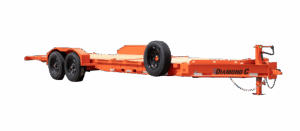
- Diamond C HDT (Hydraulically Dampened Tilt): The current bumper-pull HDT is offered from 15,500 to 24,000 lb GVWR, in 16- to 28-foot lengths, with an 80- or 82-inch deck. The standard axle configuration uses two 7,000 lb Lippert axles, with higher-capacity packages available. Its tilt system is intended primarily for loading wheeled or tracked equipment, so repeated forklift pallet work is usually easier on a fixed flat deck. When an HDT is used, the bed must be fully lowered and locked in its transport position, and the pallets must sit on a section approved for their concentrated weight. Diamond C’s 102-inch-wide DEC deck-over equipment trailer, rated from 15,500 to 23,000 lb GVWR, is generally better suited to side loading. For gooseneck users, the FMAX207 provides a 102-inch-wide flat deck, 15,500 lb GVWR, 20- to 35-foot lengths, and two 7,000 lb Lippert axles. Its published base weight varies from approximately 4,600 to 8,430 lb by length and configuration, so the payload must be calculated for the specific trailer rather than assumed from the model name.
- H&H Industrial Equipment Trailer: H&H’s current Super Deluxe Ramp Industrial Equipment Trailer is available with an 82-inch bed, 16- to 24-foot lengths, 14,000- or 16,000 lb GVWR, and axle ratings of 7,000 or 8,000 lb per axle. The main deck can handle palletized material when the trailer’s payload and deck-loading limits are respected, although its dovetail and fold-over ramps are designed for equipment loading rather than pallet placement. Published curb weights vary by size and option package, so use the VIN-specific weight or a scale ticket to determine available payload.
- Liberty LE14K Equipment Trailer: Liberty’s current LE14K equipment line carries a 14,000 lb GVWR, an 83-inch-wide deck, 18- and 20-foot length choices, and two 7,000 lb axles. It includes a self-cleaning dovetail and stand-up ramps, but the flat main-deck area remains usable for forklift-loaded materials. Confirm that the actual pallet width clears the fenders and that the trailer’s empty weight, spare tire, ramps, toolbox, and other installed options leave enough payload for the planned block weight.
- Delco Equipment or Deck-Over Trailer: Delco’s current C5 bumper-pull equipment trailer is an 83-inch-wide, 14,000 lb GVWR platform offered in multiple lengths from 12 to 26 feet. Contractors needing more side-loading room can consider Delco’s 102-inch deck-over line, which includes bumper-pull models in the 12,000- to 16,000 lb GVWR range and heavier gooseneck configurations. The full-width deck eliminates between-the-fender clearance problems, but the correct GVWR still depends on the trailer’s empty weight, hitch style, and the total block weight.
A single-axle 3,500 or 5,200 lb trailer is generally not appropriate for two pallets. A 7,000 lb GVWR tandem utility trailer may also be inadequate even though it has two axles. For example, if the trailer weighs 2,000 lb, only about 5,000 lb of theoretical payload remains before considering the load carried on each axle, the tires, the hitch, or the concentrated deck load. Two 3,200 lb pallets would already exceed that payload. Select the trailer from its certification label and actual empty weight, not from the number of axles or the seller’s description.
Axle Ratings and the Gross Vehicle Weight Equation
The trailer’s GVWR is the maximum allowable loaded weight assigned by the manufacturer. Available payload is generally calculated by subtracting the trailer’s actual empty weight from its GVWR. A 14,000 lb GVWR equipment trailer weighing 3,500 lb has approximately 10,500 lb of theoretical payload. A 15,500 lb GVWR gooseneck weighing 6,000 lb has approximately 9,500 lb. Optional ramps, a hydraulic dovetail, spare tires, winches, batteries, toolboxes, upgraded flooring, and other equipment increase empty weight and reduce payload pound for pound.
Do not assume that two 7,000 lb axles automatically mean the manufacturer must assign a 14,000 lb GVWR. Some properly engineered trailers carry part of their loaded weight through the tongue or gooseneck hitch and therefore have a GVWR above the combined axle ratings. Diamond C’s FMAX207, for example, is rated at 15,500 lb GVWR while using two 7,000 lb Lippert axles. That does not permit 15,500 lb to sit on the trailer axles. The actual load on each axle must remain below its GAWR, the tires must remain below their individual ratings, and the tongue or gooseneck load must remain within the coupler, hitch, truck payload, rear-axle, and truck GVWR limits.
Your tow vehicle must be evaluated by its specific configuration, not simply by whether it is called a half-ton, three-quarter-ton, or one-ton. Check the truck’s certification labels, payload label, receiver or gooseneck rating, rear GAWR, tire ratings, maximum loaded trailer weight, and GCWR. Passengers, tools, fuel, bed accessories, and the trailer’s tongue or pin weight all consume truck payload. A properly configured heavy-duty pickup will usually provide more useful payload, braking capacity, cooling, and axle margin for a loaded 14,000- or 15,500 lb trailer, but even trucks from the same model line can have very different ratings. Some half-ton configurations can tow substantial trailers, yet their available payload or receiver rating may become the limiting factor before the advertised maximum tow rating is reached.
Indiana also requires a trailer or semitrailer with a gross weight of at least 3,000 lb to have brakes adequate to control, stop, and hold the trailer. Those brakes must be controllable from the cab and connected to apply automatically during an accidental breakaway. A Class A CDL is generally triggered for a commercial combination only when the combination has a GCWR of 26,001 lb or more and the towed unit has a GVWR greater than 10,000 lb, subject to applicable exemptions. A trailer rated above 10,000 lb does not by itself create the federal Class A threshold when the combination rating remains below 26,001 lb. Separate commercial-motor-vehicle rules can apply below the CDL threshold, particularly when a business operates a vehicle or combination rated at 10,001 lb or more. Indiana buyers should also complete the trailer title application within the state’s 45-day window to avoid an administrative penalty.
Forklift Loading: What You Need to Know
Concrete block pallets are normally placed from the side or rear by a forklift that remains on the ground. Keep the trailer coupled to the tow vehicle during loading unless the trailer manufacturer specifically provides another approved procedure. Park on firm, level ground, set the truck’s parking brake, place the transmission in park, and chock the trailer wheels on both sides. If the trailer has rear stabilizer jacks, loading legs, or other supports, deploy them according to the owner’s manual. Never rely on the tongue jack alone to resist the leverage created by a heavy pallet or forklift.
Do not drive a forklift onto the trailer unless the trailer, ramps, dovetail, floor, crossmembers, tires, axles, and support system are all rated for the forklift’s total weight and concentrated wheel loads. A forklift that weighs 8,000 lb can impose far more severe localized loading than an 8,000 lb pallet spread over a broad wooden base. For ordinary block delivery, the safer approach is for the forklift to stay on the ground and place each pallet directly onto the deck.
Inspect the deck before loading. Remove stones, broken block, loose fasteners, mud, and other debris. Check wooden flooring for rot, splits, raised ends, or damage around fasteners. Set each cube on an intact pallet or substantial load-distributing dunnage so that it bears across multiple crossmembers. Once placed, the pallet should sit flat without rocking. Do not reach under a suspended or partially supported pallet to insert a loose shim. Have the forklift operator lift and reposition the load, replace a damaged pallet, or install suitable dunnage while the load is safely supported.
Keep the load centered side-to-side. Two nominal 48-by-40-inch pallets may theoretically fit side-by-side on an 83-inch deck when the 40-inch dimension runs across the trailer, but real block cubes frequently exceed their nominal pallet dimensions because of block overhang, banding, or wrap. Measure before loading. If they do fit side-by-side, leave equal clearance on both sides and prevent the pallets from moving toward one another. If they are loaded in line, position them relative to the trailer’s axle group to achieve the manufacturer’s recommended tongue or pin weight rather than using an arbitrary distance from the front of the deck.
Securing the Load: Straps, Chains, and Edge Protection
Concrete block is heavy, but its weight does not secure it. A pallet can slide during braking, move laterally during an evasive maneuver, or tip when the trailer drops into a pothole. Commercial cargo-securement rules require cargo to be immobilized or secured against movement, and the aggregate working load limit of the tiedowns securing an article or group of articles must equal at least one-half of the cargo’s weight. The system must also withstand forward, rearward, lateral, and vertical forces encountered in normal transportation.
When a palletized article is 5 feet long or less but weighs more than 1,100 lb, federal rules generally call for at least two tiedowns if it is not blocked or positioned to prevent forward movement. For two separately placed block pallets, a sensible baseline is therefore two properly positioned tiedowns over each pallet, plus blocking, direct restraint, or other measures needed to prevent forward and rearward sliding. Run over-the-top straps from a rated anchor on one side of the trailer to a rated anchor on the opposite side, placing one near the front and one near the rear of each pallet so that neither can slip off. Do not depend solely on plastic stretch wrap or the supplier’s light shipping bands as road securement.
Two-inch ratchet straps are commonly used, but their ratings are not universal. Read the permanently attached WLL label on each complete assembly. A strap advertised with a high break strength may have a much lower working load limit, and the assembly is limited by its weakest component, including the webbing, ratchet, hook, attachment hardware, and trailer anchor. Four straps labeled at 3,333 lb WLL would provide substantial aggregate capacity when installed across the load from one side of the trailer to the other, but four unmarked, cut, sun-damaged, chemically contaminated, or poorly anchored straps are not acceptable. Tighten the straps enough to maintain restraint without crushing the upper blocks or breaking the pallet.
Use purpose-built edge protectors anywhere webbing contacts a sharp or abrasive concrete edge. Edge protection distributes pressure, reduces block chipping, and prevents vibration from sawing through the strap. The protector must stay in position as the strap is tensioned. If the block cube has loose units, damaged banding, or a collapsing pallet, stop and have it restacked or reunitized before transport; additional ratchet pressure does not repair a structurally unstable pallet.
Grade 70 transport chain and properly matched binders can be used when the trailer and load provide suitable bearing and attachment points, but chain should not be laid directly over unprotected block where it can concentrate force and break the units. A labeled 3/8-inch Grade 70 chain commonly carries a 6,600 lb WLL, yet the usable rating remains limited by the binder, hooks, anchors, and the way the chain is routed. Chain is not automatically required merely because a pallet exceeds 3,000 lb. For intact palletized CMU, rated synthetic webbing, substantial blocking, correct anchor points, and edge protection are often the cleaner securement system.
Inspect every strap, chain, binder, block, pallet, and anchor before moving. Commercial drivers must inspect the cargo and securement within the first 50 miles and reexamine it during the trip at prescribed intervals or changes in duty status. Even when those specific commercial rules do not apply, stop after the first few miles and again after encountering rough roads. Wood pallets and dunnage can compress, allowing straps to lose tension.
What About a Tarp?
Concrete masonry units do not normally need a tarp for weather protection, and Indiana does not impose a universal rule that every block load must be tarped. Indiana does prohibit operating a vehicle when its contents are dripping, sifting, leaking, or otherwise escaping. Remove broken pieces and loose gravel before departure, replace damaged units, and make sure the pallet is properly banded or wrapped. A securely fastened mesh tarp or debris net is useful when small fragments could work loose, but a tarp is only containment for debris; it does not replace the straps, chains, blocking, or other devices that restrain the pallets themselves.
A Quick Weight Reality Check
| Scenario | Cargo Weight | Trailer Weight | Total GVWR Needed |
|---|---|---|---|
| 1 pallet (typical hollow CMU) | 2,700-3,500 lb | 2,500-4,000 lb | 7,000-10,000 lb class, depending on actual tare |
| 2 pallets (typical hollow CMU) | 5,400-7,000 lb | 3,000-4,000 lb | 12,000-15,500 lb class |
| 2 pallets (heavy or specialty units) | 7,000-9,000 lb | 3,000-4,500 lb | 14,000-18,000 lb class |
| 3 pallets (typical hollow CMU) | 8,100-10,500 lb | 3,500-5,000 lb | 15,500-20,000 lb class |
These are planning ranges, not permission to load by estimate. The actual loaded trailer must remain below its certified GVWR, every axle must remain below its GAWR, every tire must remain below its load rating, and the hitch weight must remain within the truck and hitch limits. Three typical pallets commonly push a bumper-pull setup toward a 15,500- to 18,000 lb equipment trailer, while three heavy cubes may require an 18,000- or 20,000 lb configuration. A current Diamond C LPX can be configured from 15,500 through 24,000 lb GVWR, including two-axle and three-axle packages. H&H, Liberty, and Delco also offer higher-capacity equipment or deck-over configurations. Select from the actual cargo ticket and certified trailer weight rather than trying to make the load fit a predetermined rating.
One More Thing: Deck Length and Load Balance
A 20-foot deck provides plenty of physical room for two pallets, but deck length alone does not determine correct placement. The goal on a conventional bumper-pull trailer is generally a stable tongue load in the range specified by the tow-vehicle and trailer manufacturers, often about 10 to 15 percent of the trailer’s total loaded weight. That percentage is calculated from the trailer, cargo, spare tire, ramps, tools, and every other item on the trailer, not from the block weight alone. A trailer weighing 3,500 lb with 6,500 lb of block has a loaded weight of approximately 10,000 lb, so a 10- to 15-percent tongue load would be roughly 1,000 to 1,500 lb. The truck must have enough available payload for that hitch load plus its occupants and bed cargo. Gooseneck and fifth-wheel trailers normally carry a larger percentage on the truck, commonly within a 15- to 25-percent planning range, subject to the manufacturer’s instructions.
Do not try to judge axle loading by looking at tire squat or by measuring a fixed distance from the tongue. Use a certified platform scale. Position the truck’s steer axle, rear axle, and trailer axle group on separate scale platforms so the ticket shows how much weight each group carries. A second weighing with the trailer disconnected can be used to calculate actual tongue weight when the scale location permits safe uncoupling. As of 2026, a standard U.S. CAT Scale first weigh is listed at $15.25, with qualifying same-location reweighs at $5.25 within 24 hours. That is inexpensive compared with overloaded tires, damaged axles, unstable handling, or an enforcement citation.
Trailers Worth Looking At
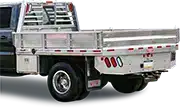
If you do not own a trailer rated and configured for this job, Spencer Trailers carries current flatbed, deck-over, equipment, and tilt trailers from Diamond C, H&H, Liberty, and Delco. Check the current inventory and compare the certification label, published empty weight, deck width, axle package, tire ratings, hitch type, brakes, anchor points, and usable flat-deck area. Current inventory changes regularly, so do not assume that every trailer with “14K” in its description has the same payload or deck construction.
If you are not sure which specification fits your truck and your typical load, give us a call at (812) 829-0226 with the block manufacturer’s weight ticket, the number of pallets, your truck’s year and configuration, and a list of anything else you plan to carry. We can help compare a fixed flatbed, deck-over, equipment trailer, tilt trailer, or dump trailer without guessing at payload. Buying enough trailer for the actual weight, while preserving legal axle and hitch margins, is far less expensive than replacing overloaded tires, axles, brakes, flooring, or an undersized trailer.
What are you typically hauling alongside the block? Concrete forms, rebar, bagged mortar, tools, compact equipment, fill sand, or loose gravel all change the best trailer choice. Palletized block favors an open flat deck with forklift access and rated tie-down points. Loose aggregate favors a dump body. Contractors who regularly carry both may need separate trips, a higher-GVWR trailer, or a trailer configuration selected around the heaviest real-world combination rather than the lightest load they occasionally haul.


