


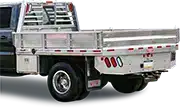
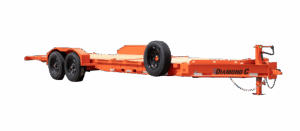



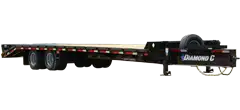
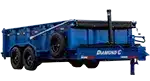
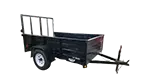

You just priced out a gooseneck trailer and your heart is set on it. Maybe it is a 22-foot Diamond C FMAX207 flatbed or a heavy-duty H&H gooseneck equipment trailer built for substantial cargo. But you are driving an F-150, and somebody at the shop told you that a half-ton pickup cannot tow a gooseneck. So what is the truth?
The answer is that certain properly equipped F-150 configurations can tow certain lightly loaded gooseneck trailers, but the usable margin is usually much smaller than owners expect. The trailer’s actual loaded weight, the truck’s published gooseneck rating, available payload, rear-axle rating, tire capacity, hitch rating, bed clearance, and combined vehicle weight must all remain within their respective limits. Most full-capacity commercial gooseneck trailers, including a Diamond C FMAX207 loaded anywhere near its rating, are better matched to an F-250, F-350, or another properly configured heavy-duty truck.
How a Gooseneck Hitch Works in a Half-Ton Bed
A gooseneck hitch mounts through the pickup bed to brackets attached directly to the truck’s frame. The ball is normally positioned over or slightly forward of the rear axle. The trailer’s coupler drops over that ball, transferring part of the loaded trailer weight into the truck’s bed and rear axle. That downward force is commonly called pin weight, gooseneck ball load, or vertical load. Whatever term is used, it counts against the truck’s available payload and rear gross axle weight rating.
That distinction is what trips people up. Towing capacity and payload capacity are two different numbers, and gooseneck towing consumes both at the same time. A truck can have enough power and published trailer capacity to pull a particular weight while still lacking enough payload or rear-axle capacity to carry the trailer’s vertical load safely. The truck must remain within its GVWR, front and rear GAWR, GCWR, tire ratings, hitch limits, and maximum loaded trailer weight simultaneously.
The F-150 Payload Problem
For the 2026 model year, Ford advertises a maximum available F-150 payload of up to 2,440 lbs. That is a best-case maximum for a particular configuration, not the payload rating of every F-150. Cab style, bed length, four-wheel drive, engine, trim level, factory options, wheels, accessories, running boards, bed covers, spray-in liners, and other equipment can all reduce the payload available on an individual truck. Many well-equipped SuperCrew 4×4 trucks have substantially less payload than the advertised maximum.
Your actual payload allowance is printed on the Tire and Loading Information label inside the driver’s door or on the door pillar. Look for wording stating that the combined weight of occupants and cargo should never exceed a specific number. That number already reflects the truck as it was built, and it is more useful than a generic payload figure from a brochure. The certification label nearby lists the truck’s GVWR and front and rear GAWR. Passengers, tools, cargo, aftermarket accessories, the installed gooseneck hitch, and the trailer’s ball load all count against those limits.
For example, suppose an F-150 has a 1,650-lb occupant-and-cargo allowance on its door label. Two occupants may account for approximately 350 lbs, while a toolbox, bed cargo, and the installed hitch hardware could add another 250 lbs or more. That would leave roughly 1,050 lbs for the gooseneck’s vertical load. Even though the truck might have a trailer rating of several thousand pounds, a 1,350-lb or 1,500-lb ball load would already exceed the remaining payload. The rear axle or rear tires may reach their ratings even sooner, which is why checking only the total payload number is not enough.
What Is a Typical Gooseneck Pin Weight?
There is no universal rule that every gooseneck must place exactly 25 percent of its weight on the truck. Ford’s current F-150 towing guidance uses approximately 15 percent of loaded trailer weight when estimating fifth-wheel or gooseneck vertical load. Depending on the trailer design, axle placement, cargo position, and manufacturer instructions, the actual percentage can be higher. Equipment and livestock trailers are especially sensitive to how the load is positioned. The correct ball load is the amount required by the trailer and hitch manufacturers while keeping every truck and trailer rating within limits.
If a trailer weighs 20,000 lbs loaded, a 15-percent vertical load would be approximately 3,000 lbs. At 20 percent, it would be approximately 4,000 lbs. Either figure is beyond the available payload of an F-150 after accounting for the occupants, hitch, and cargo. A Diamond C FMAX207 has a 15,500-lb GVWR and uses two 7,000-lb Lippert axles as standard. At its full GVWR, even a 15-percent ball load would be about 2,325 lbs before adding anyone or anything else to the truck. Its 15,500-lb GVWR also exceeds the highest published 2026 F-150 gooseneck trailer rating.
Even a trailer weighing 9,000 lbs loaded can present a problem. At 15 percent, the estimated ball load is 1,350 lbs; at 20 percent, it is 1,800 lbs. A lightly optioned F-150 with unusually high payload might accommodate the lower figure after careful calculation, but many crew-cab trucks would not. Do not rely solely on a percentage estimate. Once the trailer is loaded, use a certified vehicle scale to verify the truck’s front axle, rear axle, total truck weight, trailer axle weight, and combined weight. Repositioning cargo can change the ball load, but moving too much weight rearward can also create dangerous instability.
What the F-150’s Gooseneck Rating Actually Says
Ford publishes separate conventional and fifth-wheel/gooseneck ratings for the F-150. For 2026, the maximum advertised conventional trailer rating reaches approximately 13,500 lbs in a qualifying configuration. The maximum published fifth-wheel/gooseneck rating is lower, reaching approximately 11,700 lbs. Many SuperCrew 4×4 combinations are rated below that maximum, and PowerBoost hybrid fifth-wheel/gooseneck ratings are lower still. Owners must consult the towing guide or Ford’s VIN-specific towing information for the exact engine, wheelbase, axle ratio, drivetrain, cab, and equipment installed on their truck.
This distinction matters because the 13,500-lb conventional maximum cannot be applied automatically to a gooseneck trailer. The appropriate fifth-wheel/gooseneck table controls. The trailer’s actual loaded weight must stay within that rating, the actual combined weight must stay within the truck’s GCWR, and the loaded truck must remain within its GVWR and both axle ratings. The trailer’s GVWR is not necessarily its current scale weight, but a high trailer GVWR can still affect licensing, commercial regulations, insurance, and how the combination is evaluated for its intended use.
Payload remains the hard practical ceiling for many half-ton combinations. Even when the trailer’s scale weight falls below the truck’s published gooseneck limit, the vertical load may exceed the door-label allowance or rear GAWR. A hitch rated for more weight does not increase the truck’s ratings. Neither additional suspension springs nor air bags raise the GVWR, GAWR, GCWR, tire capacity, or Ford’s maximum loaded trailer rating.
So When Can You Realistically Use an F-150 With a Gooseneck?
There are legitimate situations in which an F-150 can tow a gooseneck, but they normally involve a genuinely light trailer, a high-payload truck configuration, disciplined loading, and confirmed scale weights. The fact that a gooseneck coupler fits over the ball does not establish that the combination is within specification.
- Light, purpose-built gooseneck trailers: A trailer weighing approximately 6,000 to 8,000 lbs when fully loaded might place roughly 900 to 1,600 lbs on the ball at a 15-to-20-percent vertical-load range. The lower end may fit a qualifying F-150 after passengers, hitch hardware, cargo, and accessories are deducted from the door-label payload allowance. The truck’s exact gooseneck rating, rear GAWR, tire ratings, and GCWR must still be checked.
- Empty or near-empty repositioning: Moving a gooseneck without cargo can reduce its actual weight and ball load, but “empty” does not automatically mean safe for a half-ton. A long commercial trailer may have substantial empty weight and vertical load before any equipment is added. Verify the manufacturer’s empty-weight information for the exact VIN and confirm the combination on a scale rather than relying on the trailer’s advertised base weight.
- Proper short-bed clearance: Short-bed trucks require careful attention to cab, coupler, trailer nose, tailgate, bed-rail, and toolbox clearance. An adapter is not a substitute for adequate turning clearance or manufacturer approval. Any offset ball or coupler must be approved for the specific hitch and trailer, and full-turn clearance should be checked carefully in a controlled area before normal towing.
What an F-150 generally cannot do within its ratings is carry the vertical load from a fully loaded livestock trailer, multi-vehicle hauler, or heavy equipment gooseneck. A skid steer, excavator, tractor, or multiple vehicles can quickly push both actual trailer weight and ball load beyond the truck’s limits. Those applications normally require an F-250, F-350, or larger truck selected according to the exact trailer, cargo, hitch, axle, tire, and combined-weight calculations.
When You Need to Move Up to an HD Truck
The Ford F-250 Super Duty and F-350 Super Duty are engineered for substantially greater in-bed towing loads. For 2026, a properly configured F-250 can carry a maximum payload of approximately 4,246 lbs and tow up to approximately 23,000 lbs with a gooseneck. Those are maximum figures for specific configurations; a diesel crew-cab 4×4 may have materially less payload than a gas-powered regular-cab truck. The exact door label and towing guide remain controlling.
The Ram 2500 and Ram 3500 provide comparable heavy-duty options. A properly configured 2026 Ram 3500 can tow up to approximately 36,610 lbs with the high-output Cummins diesel, while certain gas-powered configurations offer payload ratings up to approximately 7,590 lbs. Ford’s F-350 dual-rear-wheel configurations can provide gooseneck ratings approaching 38,600 lbs and maximum payload figures approaching 7,774 lbs, depending on engine, cab, drivetrain, axle ratio, and equipment.
If your trailer is a 40-foot Diamond C FMAX, a high-GVWR tandem-dual gooseneck, or a full-size livestock trailer carrying animals, an F-150 is not an appropriate full-capacity tow vehicle. Current Diamond C FMAX models range from the 15,500-lb-GVWR FMAX207 to substantially heavier configurations, including models rated for 25,000 lbs, 25,900 lbs, 30,000 lbs, or 40,000 lbs. Those trailers use Lippert axle systems and are designed to be paired with a truck whose towing, payload, axle, tire, hitch, and braking capacities match the intended load. For commercial use in Indiana, also remember that a Class A CDL can be triggered when the combination has a GCWR of 26,001 lbs or more and the trailer has a GVWR over 10,000 lbs, subject to applicable exemptions. The 26,001-lb threshold refers to the rated combination, not the trailer by itself.
The Bed-Mounted Hitch Setup
If you have a qualifying F-150 configuration and a sufficiently light trailer, the hitch installation still matters. Most gooseneck trailers in the weight range suitable for an F-150 use a 2-5/16-inch ball, but the ball must match the trailer coupler and be rated for the intended load. The hitch must attach to the truck’s frame through a model-specific mounting system; it cannot rely only on the pickup bed sheet metal. The installation must also provide properly rated safety-chain attachment points and adequate clearance around the ball and coupler.
Aftermarket systems such as the B&W Turnoverball are popular because the ball can be inverted or removed to leave a relatively unobstructed bed. Use the manufacturer’s current application guide to confirm the correct hitch for the truck’s model year, bed length, frame, and equipment. A hitch assembly may carry a gross trailer and vertical-load rating that is much higher than the F-150 itself, but the lowest-rated component governs. Installing a higher-capacity hitch never raises Ford’s payload, GVWR, rear GAWR, GCWR, tire, or gooseneck trailer limits. A professional installation should also include a properly functioning seven-way connector, compatible in-cab brake controller, safety chains, and breakaway system. Under Indiana law, a trailer or semitrailer weighing 3,000 lbs or more must have compliant brakes that can be controlled by the driver and an automatic breakaway function.
A Quick Way to Check Your Truck
| Truck | Payload Reference | Gooseneck Tow Rating (max config) | Practical Gooseneck Use |
|---|---|---|---|
| F-150 Crew Cab 4×4 | Check the door label; many are well below the 2,440-lb lineup maximum | Up to approximately 11,700 lbs across the lineup; many Crew Cab 4×4 configurations are lower | Light, carefully loaded and scaled goosenecks only |
| F-250 Super Duty | Up to approximately 4,246 lbs; configuration-specific | Up to approximately 23,000 lbs | Medium and heavy trailers when ratings and ball load match |
| F-350 Super Duty (dually) | Up to approximately 7,774 lbs; configuration-specific | Up to approximately 38,600 lbs | Heavy commercial and high-pin-weight applications when properly configured |
Open the driver’s door and read both labels. The Tire and Loading Information label gives the maximum combined weight of occupants and cargo for that individual truck. The certification label lists the GVWR and front and rear GAWR. Do not estimate your truck’s remaining payload by subtracting a generic brochure curb weight from GVWR; optional equipment, accessories, tools, and modifications may make the truck heavier than the published base figure. Instead, subtract the actual weight of passengers, cargo, hitch components, and accessories from the door-label allowance, then confirm the loaded combination at a certified scale. Compare the measured truck weight with GVWR, each axle weight with its GAWR, the combined weight with GCWR, and the trailer weight with the exact published gooseneck rating. All limits must be satisfied at the same time.
Choosing the Right Trailer If You’re on the Edge
If you are committed to keeping the F-150, consider whether a properly sized bumper-pull trailer is the better match. Current Diamond C options such as the GTF car hauler and GDD deck-over equipment trailer are available in configurations beginning around 7,000 lbs GVWR, with certain configurations rated up to approximately 9,890 lbs. The GTU premium tandem-axle utility trailer is another 7,000-lb-GVWR option, built with dual 3,500-lb Lippert axles and a 4-inch channel frame. These trailers still require careful matching to the truck, but they may impose less vertical load than a gooseneck carrying the same gross weight. By comparison, the current Diamond C LPX is a heavy-duty equipment trailer with GVWR options beginning around 15,500 lbs, so it should not be treated as a light half-ton trailer simply because a bumper-pull version is available.
Ford generally uses approximately 10 percent tongue weight when calculating conventional trailer requirements, while the appropriate real-world percentage may fall around 10 to 15 percent depending on the trailer and manufacturer instructions. A 9,000-lb bumper-pull trailer at 10 percent would place approximately 900 lbs on the hitch, compared with approximately 1,350 lbs at the 15-percent gooseneck calculation. That difference can help, but 900 lbs still counts against payload and rear-axle capacity. The receiver, ball mount, coupler, safety chains, brake controller, and weight-distribution system must all be rated and configured correctly. Ford limits F-150 conventional towing without a weight-distributing hitch to much lower loads, so consult the owner’s manual and towing guide before pairing the truck with a heavier bumper-pull trailer.
Gooseneck trailers are excellent for many working applications because locating the connection near the rear axle can improve control, distribute vertical load through the truck’s frame, and allow a long usable deck without placing the coupler behind the bumper. Those advantages do not cancel the truck’s payload or axle limits, and they do not make an overloaded combination safe. Proper trailer selection starts with the exact truck configuration, actual cargo weight, realistic vertical load, and enough reserve capacity for passengers, tools, accessories, and changing job-site conditions.
Not sure what will work with your current truck, or whether it is time to size up? Talk to the team at Spencer Trailers. We can review the specifications and VIN information for trailers in our inventory, help calculate realistic loaded and vertical weights, and compare those figures with your truck’s door label and manufacturer ratings. And if you are ready to browse what is available now, check the current inventory to see which gooseneck and bumper-pull options are on the lot. The right trailer starts with the right match to your truck.


