







You’ve got a Bobcat S650 that needs to move from one job site to another. Depending on the machine’s generation, tires, cab, counterweights, options, and installed attachment, you may be dealing with well over 8,000 lb before the chains and binders ever come out. The tires are muddy, the schedule is tight, and the wrong trailer can turn a routine move into a very expensive afternoon.
This isn’t about what’s technically possible for one slow trip down a back road. It’s about what’s smart, legal, properly rated, and repeatable every time you load that machine.
Start with the S650’s Real Numbers
The Bobcat S650 does not have one universal transport weight across every model year and configuration. Bobcat’s current North American specifications for the Classic S650 list an operating weight of approximately 7,901 lb, while specifications for an earlier non-current S650 configuration list approximately 8,327 lb. Tires, counterweights, cab equipment, optional features, and attachments can change the actual number further.
That means an assumed 8,061-lb figure should not be treated as a guaranteed weight for every S650. Check the machine’s serial-number-specific Operation & Maintenance Manual, review the attachment identification plate, and use a certified scale when the remaining trailer capacity is close. A published operating weight is a planning reference, not a substitute for knowing what your particular machine weighs in transport configuration.
Attachments require careful math. A bucket, grapple, pallet fork frame, hydraulic breaker, broom, or other attachment may add hundreds of pounds, but you also need to know whether the published operating weight already includes a standard attachment. When one attachment replaces another, the increase may be the difference between the two attachment weights rather than the full weight of the new attachment. The safest method is to weigh the loader with the attachment, counterweights, fluids, and accessories exactly as it will travel.
For trailer shopping, plan around the heaviest configuration you expect to haul. An S650 that is near 8,300 lb before a heavier attachment, optional counterweights, chains, binders, fuel cans, or job-site accessories are considered can quickly become a 9,000-lb-plus payload. Building in reserve capacity gives you room for real-world equipment changes without immediately exceeding the trailer’s payload rating.
You also need to account for the machine’s footprint. Bobcat lists the Classic S650 at approximately 72.1 inches wide over the tires, about 74 inches wide with a standard bucket, and approximately 136.4 inches long with the standard bucket installed. Some earlier S650 specifications list a length close to 136.8 inches, so treating the loader as roughly 74 inches wide and 137 inches long is a reasonable starting point. Measure your actual tires and attachment before buying a trailer, especially when considering an 80-inch deck with limited side clearance.
What Trailer GVWR Do You Actually Need?
A common mistake is matching the trailer’s GVWR to the machine’s weight and calling it done. GVWR is the maximum permitted weight of the loaded trailer, including the trailer itself. Your usable payload is generally the trailer’s GVWR minus its actual empty weight, and that payload can be limited further by the axle ratings, tires, wheels, coupler, hitch components, or another lower-rated part of the system.
A 14,000-lb GVWR trailer that weighs 4,200 lb empty provides approximately 9,800 lb of theoretical payload. That may be enough for some S650 configurations, but the margin can disappear quickly once you load a heavier attachment, extra bucket, chains, binders, toolbox, spare tire, or other equipment. Trailer empty weight also changes with deck length, ramp system, frame options, steel flooring, winches, hydraulic components, and spare tires, so use the weight of the specific trailer rather than a generic catalog estimate.
For regular S650 hauling, properly configured equipment trailers in the 14,000- to 24,000-lb GVWR range may be appropriate. A 14,000- or 16,000-lb trailer can work when its verified payload is sufficient. A higher-GVWR trailer provides more reserve capacity, but only when the truck, hitch, tires, axles, brakes, and registration are also rated for the resulting combination.
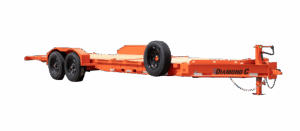
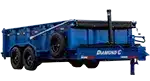
Current Diamond C options include the HDT and HDT-GN hydraulically dampened tilt equipment trailers and the LPX and LPX-GN low-profile equipment trailers. These lines are available from approximately 15,500 to 24,000 lb GVWR, depending on the selected package, length, and configuration. Standard configurations use dual 7,000-lb Lippert axles, with available triple-7K, dual-8K, or dual-10K axle packages on eligible builds. Bed widths generally range from 80 to 82 inches, so an S650 with a 74-inch bucket can fit while still requiring careful centering.
H&H currently offers 82-inch-wide Gravity Tilt and Industrial Equipment Trailer configurations in the 14,000- to 16,000-lb GVWR range. Delco offers 83-inch-wide bumper-pull tilt equipment trailers, including T3 stationary-tilt and T6 full-tilt configurations, in the 14,000- to 16,000-lb range. Any of those can be a viable S650 trailer when the specific unit’s empty weight, payload label, deck length, tie-down layout, ramp or tilt capacity, and axle ratings all work for your machine.
Your tow vehicle has to be matched just as carefully. Check the truck’s GVWR, GCWR, rear gross axle weight rating, tire capacities, payload sticker, maximum conventional or gooseneck trailer rating, and the rating of the installed receiver, ball, coupler, and safety equipment. A dual-rear-wheel one-ton can provide useful stability and rear-axle capacity, but it is not a universal legal minimum. Some properly equipped single-rear-wheel one-ton or three-quarter-ton trucks may handle certain S650 combinations, while other trucks that look similar on the outside may not have the ratings to do it legally.
Deck Type: Tilt or Fixed Ramps?
Both can work well for the S650, but they load differently and require different checks.
Tilt decks remove the need to lift and position separate ramps. The standard Diamond C HDT tilt system is a gravity-fed bed controlled by hydraulic dampening, not necessarily a powered hydraulic deck that raises and lowers itself. The operator unlatches the bed, allows it to tilt in a controlled manner, loads the machine, and then brings the deck back into its locked transport position. Diamond C also offers powered tilt and Pro Tilt configurations on eligible builds. H&H offers both gravity-tilt and powered hydraulic tilt designs, depending on the trailer series.
A tilt trailer can provide a smooth transition from the ground to the deck, but the loading angle still depends on the trailer’s length, deck geometry, stationary front section, tire size, suspension, and ground conditions. Do not assume that every tilt deck has a shallower approach than every ramp trailer. Confirm that the bucket edge, attachment plate, and rear of the loader clear the transition throughout the loading cycle.
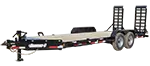
Fixed ramp trailers are mechanically straightforward and can be an excellent choice when the ramp system is designed for concentrated equipment loads. Diamond C LPX and LPX-GN configurations may be equipped with loading systems such as spring-assisted flip-knee ramps, MAX Ramps, or the full-width X-Ramp on eligible max-width packages. Diamond C also offers XDR extreme-duty ramps on applicable deckover, gooseneck, pintle, and step-deck configurations.
The important number is the manufacturer’s rated capacity for the complete ramp system and its intended loading pattern. A skid steer does not place its total weight evenly across the full trailer deck while climbing. Much of the load may be concentrated on one axle and a relatively small area of each ramp. Use ramps approved for the trailer and machine, position them exactly as instructed, confirm that all pins and latches are engaged, and inspect the hinges, supports, welds, and ramp feet before loading.
The 4-Point Chain Setup (This Is Not Optional)
For a safe and repeatable S650 haul, use four direct tie-downs attached to the loader’s designated front and rear transport points. Bobcat’s S650 transport instructions identify front and rear loader tie-down locations and call for the attachment to be lowered, the engine stopped, the parking brake engaged, and chains tightened with binders.
Federal cargo-securement rules draw an important line at 10,000 lb. Equipment weighing 10,000 lb or more is subject to the heavy-equipment requirements in 49 CFR 393.130, including a minimum of four tie-downs positioned near the front and rear or attached to manufacturer-designed mounting points. An S650 below 10,000 lb may be secured under the general cargo rules or voluntarily under the heavy-equipment method. Four direct chains remain the sensible setup because they restrain the machine independently against forward, rearward, lateral, and vertical movement.
Here’s how to do it correctly on an S650:
- Front tie-down points: Use the designated front loader tie-down locations shown in the correct Bobcat manual for your machine. Do not wrap chains around hydraulic cylinders, hoses, lift-arm components, steps, or the bucket. The bucket or attachment should be lowered and secured, but it should not replace the machine’s structural tie-down points.
- Rear tie-down points: Use the designated rear tie-down locations on both sides of the loader. Route each chain so it cannot rub against a tire, hydraulic line, sharp edge, or movable component. Arrange the chains to oppose movement in the direction they are intended to control rather than pulling all four chains in nearly the same direction.
- Chain rating: Grade and diameter both matter. A 5/16-inch Grade 70 transport chain has a working load limit of 4,700 lb, while a 3/8-inch Grade 70 chain is rated higher. The effective working load limit of the complete assembly is controlled by its lowest-rated component, including the chain, hooks, binder, connecting hardware, and trailer anchor point.
- Working-load calculation: Federal rules require the aggregate working load limit of the securement system to equal at least one-half of the cargo’s weight. A direct tie-down running from one trailer anchor to one machine attachment point generally contributes one-half of its rated WLL to the aggregate calculation. Four direct 5/16-inch Grade 70 chains rated at 4,700 lb each therefore contribute an aggregate of 9,400 lb, not 18,800 lb, assuming every hook, binder, and anchor point is rated at least as high.
- Binders: Use transport-rated binders that match the chain size and WLL. Ratchet binders are popular because they allow controlled tensioning and are less likely to release suddenly during adjustment. Properly rated lever binders may also be used when handled, secured, and inspected correctly. Never extend a binder handle with an improvised cheater pipe unless the binder manufacturer specifically permits that method.
- Attachments: Make sure the Bob-Tach or other attachment-locking mechanism is fully engaged. Lower the bucket or attachment to the deck, shut the loader down, engage the parking brake, and follow the Bobcat manual. An attachment carried separately is a separate article of cargo and needs its own properly rated securement.
Before pulling out, walk the entire trailer. Confirm that every binder is locked, loose chain is secured, the attachment coupler is engaged, the bucket is down, and no chain is twisted, damaged, stretched, badly corroded, or loaded over a sharp edge. Also inspect the hitch latch, safety chains, breakaway cable, electrical plug, jack, ramps, tilt lock, tires, lug nuts, and trailer lights.
For commercial motor-vehicle operations subject to federal rules, the driver must inspect the cargo and securement devices within the first 50 miles and make any necessary adjustments. Additional inspections are required when the driver’s duty status changes and after three hours or 150 miles of driving, whichever comes first. Even on a short local move, stopping after the machine settles is a smart habit.
Loading the S650: Ramp Approach and Weight Distribution
Load and unload on firm, flat, level ground whenever possible. Keep the trailer properly connected to the tow vehicle, place the truck in park, engage the parking brake, and use wheel chocks when appropriate. If the trailer has rear stabilizer legs, loading supports, a tilt lock, or other manufacturer-provided loading equipment, deploy it exactly as instructed. Loading a disconnected or improperly supported trailer can cause the tongue to rise or the trailer to move unexpectedly.
Clear mud, loose gravel, ice, oil, and debris from the loader tires, trailer deck, and ramps before loading. Approach slowly and squarely. Keep the bucket or attachment low enough to maintain visibility and stability without allowing it to strike the ramp or ground. Avoid abrupt steering inputs on narrow ramps because a skid steer’s turning action can push a tire toward the ramp edge quickly.
Center the S650 side to side. With a 74-inch bucket on an 80-inch deck, you may have only about three inches of clearance per side when perfectly centered. Wider 82- or 83-inch equipment decks provide more room, but they still do not leave space for careless loading. Watch the tires and bucket edges rather than relying only on your seating position inside the cab.
Fore-and-aft position must be based on actual hitch weight and axle loading, not a generic rule such as placing 60% of the payload over the axles and 40% ahead of them. The loader’s center of gravity changes with the attachment, bucket contents, counterweights, and orientation. A skid steer is normally heavier at the rear with an empty bucket, so backing it onto some trailers may place the heavier end toward the tongue, but that is only a starting point.
For a bumper-pull trailer, the loaded combination generally needs enough positive tongue weight to remain stable, commonly within the trailer and truck manufacturers’ specified range. Too little tongue weight can cause sway. Too much can overload the receiver, hitch, truck rear axle, tires, or GVWR and can remove useful weight from the steering axle. A gooseneck normally carries a greater percentage of its loaded weight on the truck, so rear-axle and payload capacity become especially important.
The dependable method is to load the machine, secure it, and weigh the complete combination. Obtain individual axle weights and, when possible, measure bumper-pull tongue weight or gooseneck pin weight. Reposition the loader until the truck, trailer axles, hitch, and tires are all within their ratings and the manufacturer-recommended hitch-weight range. Marking the correct tire position on the deck can make future loading faster and more consistent when the same attachment is used.
Once positioned, lower the bucket or attachment fully to the deck, place the controls in neutral, stop the engine, engage the parking brake, and relieve hydraulic pressure as directed by Bobcat. Do not transport the loader with the lift arms raised or depend on hydraulic pressure alone to hold an attachment in place. Measure overall transport height when carrying unusual attachments, even though a standard S650 on a low-profile equipment trailer normally remains well below Indiana’s standard 13-foot-6-inch height limit.
A Quick Spec Comparison Table
| Trailer Option | GVWR | Deck Width | Fits S650? |
|---|---|---|---|
| H&H Gravity Tilt Trailer | 14,000-16,000 lb | 82 in | Potentially; verify actual payload |
| Diamond C HDT-GN | 15,500-24,000 lb | 80-82 in | Yes; strong tilt option |
| Delco T3 or T6 Bumper-Pull Tilt | 14,000-16,000 lb | 83 in | Potentially; verify actual payload |
| Diamond C LPX or LPX-GN | 15,500-24,000 lb | 80-82 in | Yes; strong ramp option |
| Typical 10K Utility Trailer | 10,000 lb | Varies | Generally no; insufficient margin |
These ranges describe current trailer families, not the payload of every individual unit. Length, frame package, flooring, ramps, tilt components, winches, spare tires, toolboxes, and other options change empty weight. Always read the VIN/data plate and obtain the actual empty weight before deciding that a trailer fits.
A 10,000-lb GVWR utility trailer is generally the wrong tool for an S650. Once the trailer’s own weight is subtracted, the remaining payload will commonly be below the machine’s operating weight. Even when the loader can physically fit between the rails, physical fit does not create legal payload capacity.
What About a Bumper Pull vs. Gooseneck?
For an S650, either design can work when every rating and dimension is correct. A properly configured 14,000- to 16,000-lb bumper-pull equipment trailer may provide enough payload for the loader and attachment while avoiding the need for an in-bed hitch. It can also be easier to use with trucks that perform other work requiring an open bed.
The bumper-pull setup puts tongue weight behind the truck’s rear axle, so receiver capacity, hitch rating, rear-axle load, tire capacity, wheelbase, suspension, and correct tongue weight all matter. Weight-distribution equipment should be used only when approved by the truck, receiver, trailer, and hitch manufacturers. It does not increase the truck’s GVWR, GCWR, axle ratings, or maximum trailer rating.
A gooseneck places the coupling point over or slightly ahead of the truck’s rear axle. That geometry generally improves stability, maneuverability, and weight transfer on heavier trailers, especially during longer highway trips. It also places substantial pin weight directly into the truck bed, which can overload a truck’s payload or rear axle before the advertised maximum gooseneck tow rating is reached.
If you haul the S650 frequently, a Diamond C HDT-GN tilt trailer or LPX-GN ramp trailer in an appropriately selected GVWR package can be a strong long-term setup. Current Diamond C premium equipment lines use Lippert axles as standard, are built in Mt. Pleasant, Texas, and receive the DM Difference Maker multi-stage coating system. Diamond C has manufactured trailers in the United States since 1985.
The right answer is not automatically “gooseneck” or “bumper pull,” and it is not automatically “dually.” The right answer is the combination that keeps the truck, trailer, hitch, axle, tire, brake, registration, and driver’s-license requirements within their legal limits while providing enough reserve capacity for the actual machine.
A Note on Permits and Legal Weight
A standard Bobcat S650 is approximately 74 inches wide with a standard bucket, well inside Indiana’s normal 8-foot-6-inch width limit. A properly loaded S650 on a conventional equipment trailer will also ordinarily remain below standard height and gross-weight permit thresholds. That does not mean the federal 80,000-lb gross limit is the only number that matters.
You must remain within the truck and trailer manufacturers’ GVWR, GCWR, GAWR, tire, wheel, hitch, coupler, and payload ratings. State axle-weight rules, bridge formulas, registered weight, posted bridge limits, and route restrictions may impose lower limits. County roads, city streets, construction zones, and rural bridges can have posted or temporary restrictions that apply even when the combination is legal on an unrestricted state highway.
Indiana generally requires an oversize or overweight permit when a vehicle or load exceeds legal dimensions or weight, including the standard 8-foot-6-inch width or 13-foot-6-inch height limits. Permit availability can also depend on whether the load is non-divisible. An S650 with its normal bucket should not be an oversize load, but wider attachments, side-mounted tools, or improperly positioned cargo can change the measured width.
Indiana law also requires a trailer or semitrailer with an actual gross weight of at least 3,000 lb to have brakes adequate to control, stop, and hold it. The brakes must be controllable from the tow-vehicle cab and must apply automatically if the trailer breaks away. Confirm that the brake controller is compatible with the trailer’s brake system, that the breakaway battery is charged, and that the breakaway cable is attached to the truck independently of the safety chains.
Commercial driver’s-license requirements are based on the vehicle ratings, not simply the weight of the skid steer. A Class A CDL is generally triggered when the combination has a GCWR of 26,001 lb or more and the towed trailer has a GVWR greater than 10,000 lb. A 20,000-lb trailer does not automatically require a CDL by itself, but pairing it with a truck can easily produce a rated combination above the Class A threshold. Commercial-use rules, farm exemptions, intrastate provisions, and other exceptions can be fact-specific, so do not rely on what another contractor was told at a job site.
If you recently purchased the trailer, Indiana requires a newly acquired, unregistered vehicle to be registered within 45 days to avoid the administrative penalty. That 45-day filing window is not a blanket authorization to operate an unregistered trailer on the highway for 45 days. Make sure the trailer has the proper plate, registration, title paperwork, or valid temporary permit before putting it into service.
If an attachment or machine configuration takes the individual loader to 10,000 lb or more, recalculate everything. At that point, the federal heavy-equipment rule expressly requires at least four tie-downs, and accessory equipment must be lowered and secured as required. Recheck trailer payload, truck ratings, securement WLL, axle weights, license requirements, and the route before moving it.
The Right Trailer Is Already Out There
Hauling an S650 is straightforward when the equipment is matched correctly. The machine tells you what it needs: enough verified payload for its actual transport weight, a deck wide and long enough for the tires and attachment, a loading system rated for concentrated equipment loads, functional brakes and breakaway equipment, and properly rated tie-down points.
The trailer label tells only part of the story. You also need the truck’s ratings, the hitch rating, the actual empty trailer weight, the machine’s exact configuration, and the loaded axle weights. When those numbers work together, the loader travels predictably. When one of them is ignored, the combination can be overweight or unstable even though the machine appears to fit perfectly on the deck.
If you’re not sure whether your current trailer is the right fit, bring the trailer specifications, truck door-jamb ratings, hitch information, and S650 configuration to us. We stock and order Diamond C, H&H, and Delco equipment trailers for machines in this weight class, and we can walk through payload, deck width, loading style, axle package, and tow-vehicle requirements before you commit to a setup that costs you later. Browse our current equipment trailer inventory or reach out to the team at (812) 829-0226.
What attachment does your S650 usually run? The exact machine, attachment, counterweight, and trailer combination changes the calculation more than most people expect.


