










You spent 10 years restoring that ’69 Camaro. The paint is flawless. The interior is correct down to the seat stitching. And now you need to move it 400 miles to a show in Columbus. The last thing you want is to secure it the same way you would a work truck or a piece of construction equipment.
Hauling a classic car requires more planning than hauling an ordinary daily driver. The wrong trailer can leave you without enough payload capacity. The wrong loading angle can scrape a spoiler, exhaust system, or rocker panel. The wrong tie-down point can bend a suspension component, crush a brake line, damage a painted frame, or place stress on a unibody or subframe that was never intended to carry the load that way. Here is how to move the car safely without turning the trip into another restoration project.
Enclosed or Open: This Decision Matters More Than the Trailer Brand
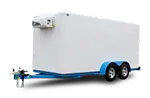
The first question is almost always enclosed versus open. For a freshly restored, highly valuable, or show-quality classic, an enclosed car hauler usually provides the best protection. An open car hauler is lighter, less expensive, easier to inspect during the trip, and often easier to load. However, the vehicle remains exposed to rain, insects, road spray, gravel, tire debris, salt residue, construction dust, and material thrown from passing traffic. Even when the weather forecast is clear, debris from the tow vehicle and surrounding traffic can damage paint, glass, chrome, and trim.
An enclosed trailer costs and weighs more, but its walls, roof, front structure, and rear door provide a much better barrier against weather and road debris. It should not be treated as an airtight or perfectly dust-free container, because enclosed trailers normally have vents, door seams, and other openings. Even so, a properly maintained enclosed car hauler dramatically reduces the hazards that concern most classic-car owners. The important point is to choose an enclosed trailer with sufficient payload, floor length, interior width, door-opening height, ramp capacity, tie-down locations, and loading clearance rather than assuming that every 8.5-foot-wide cargo trailer is automatically suitable for a car.
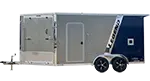
At Spencer Trailers we carry Wells Cargo and United enclosed trailers that can be configured for single-car hauling. A current Wells Cargo Road Force V-Front Auto in a nominal 8.5×20 configuration is listed at approximately 3,220 pounds empty, a 7,000-pound GVWR, and roughly 3,780 pounds of payload capacity. That can work for many classics, but a 3,500-pound muscle car leaves only about 280 pounds for straps, a spare tire, tools, fuel cans where legally permitted, cabinets, winch equipment, and other cargo. A heavier car or heavily optioned trailer may require a higher-GVWR configuration. The United Classic Car Hauler is currently offered in 8.5×20, 8.5×24, and 8.5×28 sizes, with approximately seven feet of interior height, a ramp door with a beavertail, four D-rings, electric brakes, torsion suspension, and commonly specified 9,990-pound GVWR configurations. Always use the certification label and actual scale weight of the individual trailer, because axle packages and installed options can change curb weight and payload.
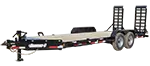
If open transport is the practical choice, use a purpose-built Legend or H&H car hauler with an appropriate deck width, vehicle-rated ramps, adequate D-rings or other engineered anchor points, functional brakes, and enough payload for the actual car. The current H&H 82×18 steel car hauler is available at 7,000 pounds GVWR with dual 3,500-pound axles and an approximate 2,140-pound curb weight, while higher-GVWR versions are also offered. Legend’s aluminum Open Car Hauler is available in several lengths and GVWR configurations, with an 83-inch width between the fenders on current specifications. Measure the car at its widest tire and body points before buying or renting. A trailer can be wide enough for the tires but still leave too little clearance for doors, side pipes, wheel arches, or tie-down hardware.
Low Clearance Is the Problem Nobody Talks About
Ground clearance alone does not tell you whether a classic will load without scraping. You also need to consider the car’s front overhang, rear overhang, wheelbase, approach angle, breakover angle, departure angle, tire diameter, and any exhaust components hanging below the chassis. Trailer deck height, dovetail length, ramp length, ramp-door hinge position, suspension movement, pavement slope, and the height of the hitch all affect the real loading angle. A car that loads cleanly on level concrete may scrape when the trailer is parked across a crowned road, at the bottom of a driveway, or with the tongue too high.
The fixes:
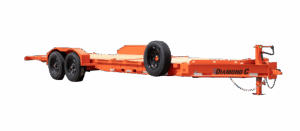
- Use a properly designed tilt-deck trailer. A dampened tilt car hauler can create a smoother approach than a conventional deck with short ramps. It does not make the loading angle disappear, and the car can still contact the deck at the transition point, but a long tilt section can substantially improve clearance. Current examples include the Legend Tilt Car Hauler and H&H Speed Loader configurations. Confirm the deck angle, stationary-deck length, width between fenders, tilt lockout operation, and available payload for the exact unit.
- Use manufacturer-approved ramp extensions. Longer ramps or purpose-built low-profile approach extensions reduce the angle where the tire first meets the ramp. The extension must be rated for the vehicle’s axle load and compatible with the trailer door or ramp system. Do not assume a lightweight lawn-equipment ramp can support a classic car simply because it fits against the trailer.
- Use secured transition ramps rather than loose lumber. Purpose-built race ramps or properly engineered transition blocks can smooth the gap between the pavement and the main ramp. Loose boards can split, slide, kick out, or overload the edge of a ramp door. Any transition aid must sit on a firm surface, remain secured against movement, and support the expected tire and axle load.
- Load slowly with a spotter or winch. Sudden throttle input can make ramps move, cause the suspension to rebound, or carry the car beyond its intended stopping point. A properly mounted winch provides more control for very low, valuable, or non-running cars. Keep everyone away from the cable or strap line, verify that the steering remains straight, and stop immediately if the spotter sees the body, exhaust, suspension, or tires approaching an obstruction.
On enclosed trailers, inspect the beavertail and the transition from the ramp door to the trailer floor. A beavertail normally improves the initial approach, but the car can still scrape at the hinge or where the sloped rear floor meets the level deck. Measure the rear-door opening, the clear width between door cables or assist hardware, the distance between wheel boxes, and the usable floor length. Also plan how the driver will exit after loading. A trailer may physically fit the car but leave no room to open the door unless it has a properly positioned escape door, removable fender, or enough interior space for the driver to climb out safely.
Use Wheel Straps or Soft Loops at Approved Tie-Down Points
This is where preventable damage often happens. A person grabs whatever straps are nearby, hooks them around the nearest suspension part, and tightens them until nothing appears able to move. That approach can bend control arms, damage brake hoses, cut into painted components, distort thin factory shipping slots, or pull against parts that were never designed to serve as tie-down points.
The right hardware for a classic car:
- Wheel nets and over-the-tire straps. These restrain the vehicle through its tires and allow the suspension to move normally while the body remains isolated from most tie-down forces. Four independently secured wheel straps, one at each corner, are a common choice for show cars. The strap must fit the tire correctly, provide lateral as well as longitudinal restraint, and connect to anchors positioned so the webbing cannot rub a fender, brake component, wheel face, or sharp trailer edge. Use the working load limit printed on the equipment rather than relying on a generic capacity associated with a particular strap width or brand.
- Soft loop straps. When the vehicle must be secured through approved structural tie-down locations, a soft loop can keep a metal hook away from the painted or plated surface. Use only attachment points identified by the vehicle manufacturer, an experienced restoration specialist, or a properly engineered transport setup. Do not wrap around steering links, sway bars, brake lines, shock absorbers, exhaust components, half-shafts, or thin suspension brackets. Every soft loop, ratchet, hook, strap, and floor anchor has its own working load limit, and the capacity of the entire system is limited by its weakest component.
- Do not improvise with hooks or chains. Rated chain can be legitimate cargo-securement equipment when connected to engineered attachment points, but it is rarely the first choice for a finished classic car. Never drape chain across a frame, axle housing, chrome component, bumper bracket, or painted suspension part. Likewise, do not place an open ratchet hook into an unverified hole or wheel opening. Hooks must be compatible with the anchor and positioned so they cannot rotate, release, or contact the car as the trailer moves.
For most single-car hauling, use four properly rated restraints arranged to control movement at all four corners. Commercial cargo-securement rules require automobiles weighing 10,000 pounds or less to be restrained at both the front and rear against lateral, forward, rearward, and vertical movement, but four independent wheel restraints provide a practical and easily inspected system for a classic. More straps do not correct weak anchors, poor geometry, damaged webbing, or an overloaded trailer. Over-the-tire straps should be snug and correctly seated without crushing or visibly deforming the tire. If you secure approved chassis points instead, follow the strap manufacturer’s instructions for suspension compression and never pull the suspension against its stops.
A Quick Comparison: Trailer Options for Single-Car Hauling
| Trailer Type | Best For | Typical GVWR | Low-Clearance Friendly |
|---|---|---|---|
| Wells Cargo Road Force V-Front Auto 8.5×20 | Lighter classics when the measured payload is sufficient | 7,000 lbs on the current 20-ft specification | Better with beavertail and proper transition ramps; verify payload and breakover |
| United Classic Car Hauler 8.5×20 | Muscle cars and full-size classics needing enclosed protection | Commonly 9,990 lbs; verify the certification label | Good beavertail arrangement, but check ramp rating, hinge transition, and door hardware |
| H&H Steel Car Hauler 82×18 | Open transport, local or long-distance hauling on a dedicated car deck | 7,000 lbs; 9,900-lb versions are also available | Two-foot dovetail helps, but low cars may still need longer approved extensions |
| Legend Aluminum Open Car Hauler 7×18 | Classics where lower trailer weight preserves tow-vehicle payload | 7,000 lbs in a common tandem configuration; higher ratings are available | Standard ramp setup requires measurement; the dedicated tilt model is better for very low cars |
Protecting the Car Once It’s On
Loading the car correctly is only half the job. The vehicle’s position, the cleanliness of the trailer, the security of every loose item, ventilation, strap inspection, and driving technique all matter once the combination is moving.
For enclosed trailers, use the installed vents according to the trailer manufacturer’s instructions, especially in hot weather or when the car may release fuel or battery vapors. The inside of an uninsulated enclosed trailer can become substantially hotter than the outdoor air when parked in direct sun. Heat alone does not automatically ruin properly cured automotive paint, but prolonged heat can affect some adhesives, temporary trim installations, soft interior materials, batteries, electronics, and a finish that has not completed the paint manufacturer’s curing process. Never transport a car with a known fuel, oil, coolant, or battery leak, and do not leave the trailer sealed in the sun longer than necessary.
Use a cover inside an enclosed trailer only when the car and cover are clean and the cover is designed to remain fully secured during transport. A loose cover can move against the finish for hundreds of miles and create fine scratches, especially at mirrors, body lines, spoilers, emblems, and sharp trim. Many owners choose to transport the car uncovered inside a clean enclosed trailer for that reason. If a cover is used, choose a soft, breathable, fitted transport cover with no loose buckles or cords near the paint. Never cover a wet vehicle, and follow the paint shop’s guidance before covering a recently refinished car.
For open trailers, do not put an ordinary fitted storage cover over the car for highway travel. Air can enter beneath the cover, causing it to balloon, tear, loosen, and repeatedly rub the paint. A loose cover can also obscure lights, detach into traffic, or damage trim. Better options include an enclosed trailer, an integrated trailer stone guard, removable mud flaps on the tow vehicle, and temporary automotive transport film installed according to its manufacturer’s instructions. Do not apply household plastic, adhesive tape, or untested film directly to fresh paint.
Inspect the securement system after the first part of the trip and again at every fuel or rest stop. For commercial operations, federal rules require a cargo-securement inspection within the first 50 miles and additional inspections after a change in duty status, after three hours, or after 150 miles, whichever comes first. A private owner can use the same schedule as a sensible minimum. Check that wheel straps remain centered, ratchets are locked, hooks are still seated, webbing has not contacted a sharp edge, the car has not moved, and no trailer component is touching the body. Never crawl beneath a loaded vehicle or stand in moving traffic to perform the inspection.
What Your Tow Vehicle Needs to Handle
A loaded enclosed car trailer can become heavy quickly, and the advertised trailer size does not tell you its actual loaded weight. For example, a Wells Cargo Road Force V-Front Auto 8.5×20 listed at approximately 3,220 pounds empty would weigh about 6,720 pounds after loading a 3,500-pound car, before adding a spare, winch, battery, straps, tools, cabinets, or personal gear. That is already close to the current 7,000-pound GVWR specification. A United 8.5×20 with a higher GVWR may provide more payload, but its heavier structure and options also increase empty weight. The reliable method is to obtain the trailer’s actual curb weight and then weigh the fully loaded combination on a certified scale.
Do not choose a tow vehicle by a broad label such as half-ton or three-quarter-ton. Towing capacity changes with engine, axle ratio, transmission, cab, wheelbase, bed length, drivetrain, factory tow package, tires, suspension, and installed equipment. Use the VIN-specific towing information or the manufacturer’s towing guide to confirm maximum loaded trailer weight and GCWR. Then use the driver’s-door certification and tire-loading labels to confirm truck GVWR, front and rear GAWR, and available payload. The trailer’s tongue weight, hitch hardware, passengers, luggage, tools, and anything carried in the truck all consume payload. A conventional car trailer commonly places roughly 10 to 15 percent of its loaded weight on the hitch, subject to the trailer and tow-vehicle manufacturers’ instructions.
A weight-distributing hitch may be required or recommended depending on the truck, receiver, trailer weight, and hitch rating; 5,000 pounds is a recommendation used by some manufacturers, not a universal legal threshold for every pickup. Follow the owner’s manual and the ratings printed on the receiver and hitch. The combination must remain within the tow vehicle’s GVWR, rear GAWR, receiver rating, payload limit, maximum trailer rating, and GCWR. In Indiana, a trailer with a gross weight of at least 3,000 pounds must have brakes adequate to control, stop, and hold it, controllable from the tow vehicle, along with an automatic breakaway system. A commercial Class A CDL is generally triggered when the combination reaches 26,001 pounds or more and the towed unit exceeds 10,000 pounds; a trailer over 10,000 pounds by itself does not create that Class A threshold when the combination remains below 26,001 pounds. Strictly personal, non-business transportation may qualify for different treatment, so commercial, sponsored, or for-hire hauling should be reviewed separately.
Before You Load: One Checklist Worth Printing
- Confirm the trailer’s GVWR and payload from its certification label. Add the trailer’s actual empty weight, the car’s actual weight, the winch, battery, spare tire, straps, tools, cabinets, fuel, and every other item carried in or on the trailer. Leave a practical margin rather than planning to operate exactly at the rating.
- Measure the car’s front and rear overhang, lowest fixed component, wheelbase, tire width, body width, and door-opening requirements. Compare those measurements with the ramp angle, hinge transition, beavertail, width between fenders, rear-door opening, interior height, floor length, and available escape-door position.
- Carry four compatible vehicle restraints with legible working load limits, along with undamaged ratchets and hardware. Confirm that the floor anchors are rated, securely installed, and positioned for the strap system. Replace cut, melted, chemically damaged, heavily abraded, knotted, or sun-degraded webbing.
- Inspect the trailer floor, D-rings, E-track or L-track where fitted, ramp hinges, ramp-assist cables, door latches, welds, fenders, and underside. Remove loose screws, metal shavings, stones, tools, and other debris that could strike the car or puncture a tire.
- Verify the coupler, hitch pin, safety chains, breakaway cable, breakaway battery, trailer connector, lights, electric brakes, brake controller, tires, valve stems, wheel bearings, and lug-nut torque before departure. Inflate cold tires to the pressure specified for the trailer tire and load, not an arbitrary passenger-car pressure.
- Photograph the car before loading and again after it is secured, including all four corners, wheels, tie-downs, trailer interior, odometer, and any existing marks. Confirm that the collector-car policy or other insurance coverage applies while the vehicle is being transported and keep policy and emergency contact information available during the trip.
If you are not sure which enclosed or open trailer fits your specific car, bring us the vehicle’s weight, overall length, wheelbase, tire width, body width, ground-clearance measurements, and front and rear overhang. We can compare those numbers with the trailer’s payload, rear opening, floor dimensions, ramp capacity, beavertail, breakover point, anchor placement, and tow-vehicle requirements. Our inventory at Spencer Trailers covers single-car and multi-car enclosed options as well as purpose-built open car haulers, and we can inspect the exact certification label and loading system before you buy or plan a haul. Call us at (812) 829-0226 or reach out here and we will help make sure that restoration project reaches the show in the same condition it left the garage.


