







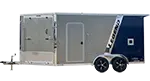

You’ve got a compact excavator and a job site 40 miles away. The trailer you already own might be properly matched to the machine, or the combination might exceed the trailer, hitch, axle, tire, or tow-vehicle ratings before you leave the yard. The difference comes down to more than the tonnage printed on the excavator’s decal. You need the machine’s actual transport weight as configured, the trailer’s usable payload, adequate axle and tire capacity, a deck and loading system that fit the machine’s dimensions, properly rated securement hardware, and a tow vehicle that can legally and safely control the entire combination. Get those pieces right and the haul should be routine. Miss one and you can end up with overloaded running gear, excessive or insufficient hitch weight, a machine that high-centers during loading, or a load that shifts under braking.
This post is about choosing and configuring the right trailer before the machine ever touches the loading surface. Loading technique, operator positioning, job-site ground conditions, and unloading procedures deserve their own discussion. This one is about the specifications that determine whether the trailer and tow rig are suitable in the first place.
Know Your Machine’s Actual Weight
The “3-to-4-ton” label describes a broad equipment class, not a dependable transport weight. A current Kubota U35-4 is listed at approximately 8,478 lbs with a canopy and rubber tracks or 8,800 lbs with a cab, with angle-blade versions weighing more. A standard Bobcat E35 is listed around 7,659 lbs, while long-arm and extendable-arm configurations can reach approximately 8,362 to 8,590 lbs. John Deere lists the 35 P-Tier at about 7,760 lbs with a canopy and standard arm or 8,135 lbs with a cab; long-arm configurations are approximately 8,340 to 8,715 lbs. At the upper end of what buyers may casually call a four-ton machine, the current Cat 304 ranges from roughly 8,655 to 9,867 lbs depending on canopy, cab, tracks, stick, counterweight, and other equipment. A Cat 305 CR is a larger transport problem, with published configurations ranging from about 11,016 to 12,688 lbs before a bucket is included in the manufacturer’s stated minimum and maximum weight definitions.
Read the footnotes behind every operating-weight figure. Some manufacturers include a full fuel tank and a 175-lb operator. Some published configurations include a standard counterweight but exclude the bucket. A quick coupler, hydraulic thumb, angle blade, steel tracks, additional counterweight, guarding, bucket, breaker, compactor, or other attachment can materially change the number. There is no universal weight allowance that can safely be added for every thumb or hammer because attachment weights vary widely. Obtain the weight of the exact machine and attachments from the build sheet, attachment identification plates, rental paperwork, or dealer. For the most reliable answer, weigh the configured machine or the complete loaded combination on a certified scale.
GVWR: The Number That Sets the Floor
GVWR is the maximum allowable weight of the trailer and everything carried on it. Payload is not the same thing as GVWR. Usable payload begins with the trailer’s GVWR minus the actual empty weight of that exact trailer, including ramps, spare tires, toolboxes, winches, steel decking, upgraded axles, batteries, hydraulic equipment, and other installed options. A trailer with a 15,500-lb GVWR may be suitable for an excavator weighing 7,600 to 9,000 lbs, but only when its as-built empty weight leaves enough capacity for the machine, attachments, chains, binders, fuel cans, and any other cargo. A generic claim that every trailer in a particular GVWR class carries the same payload is not dependable.
Diamond C’s current LPX is a low-profile, bumper-pull equipment trailer offered from 15,500 to 24,000 lbs GVWR, with lengths from 16 to 30 feet. A 22-foot LPX207 carries a 15,500-lb GVWR and uses two 7,000-lb Lippert axles. The LPX208 increases the GVWR to 18,000 lbs with two 8,000-lb axles, while the LPX210 is rated at 20,000 lbs with two 10,000-lb oil-bath torsion axles. The LPX307 is a 24,000-lb configuration using three 7,000-lb Lippert axles. That gives buyers a real capacity ladder instead of forcing one trailer specification to cover every excavator. An E35, U35-4, or 35 P-Tier may fit a properly configured LPX207, while a machine approaching 10,000 lbs with attachments may justify an LPX208 or LPX210. An excavator in the 11,000-to-13,000-lb range will commonly push the trailer selection toward a 20,000-lb or heavier package after the trailer’s own weight is included. H&H’s current TOPLINE I-Beam Equipment Trailer is another option, with GVWR packages from 15,400 to 22,000 lbs. For example, the manufacturer lists its 8.5-by-22-foot, 22,000-lb model at a 4,320-lb curb weight, producing a nominal 17,680-lb payload before additional options are installed. Confirm the certification label and as-delivered weight rather than relying solely on a catalog example.
The working calculation is straightforward: actual trailer weight as equipped, plus the configured excavator, plus every attachment and loose item, must remain below the trailer’s GVWR. The loaded weight carried by the axle group must also remain below the applicable GAWRs, while the load transferred through the coupler must remain within the coupler, ball mount, receiver, hitch, truck rear-axle, tire, payload, and vehicle ratings. Do not treat a calculated payload that leaves only a few hundred pounds as a comfortable match. Mud packed into the tracks, a different bucket, an added thumb, a winch, or a future attachment can consume that margin quickly. A certified scale ticket is more useful than an optimistic brochure calculation.
Axle Configuration and Why It Matters Beyond GVWR
GVWR establishes the trailer’s maximum total rating, but the axle configuration shows how much of that weight can be carried by the running gear. The numbers do not always match exactly because part of a properly loaded trailer’s weight is carried by the tow vehicle through the coupler. That is why a 15,500-lb LPX207 can use two 7,000-lb axles rather than axles totaling 15,500 lbs. Current Diamond C LPX and HDT equipment trailers use Lippert axles as standard. In the LPX line, the 18,000-lb package uses two 8,000-lb axles, the 20,000-lb package uses two 10,000-lb axles, and the 24,000-lb package uses three 7,000-lb axles. H&H’s current TOPLINE I-Beam Equipment Trailer similarly pairs its 15,400-, 17,600-, and 22,000-lb packages with axle ratings appropriate to each configuration.
Each axle or axle group has a GAWR, and the tires, wheels, suspension, hubs, brakes, and other components must also be capable of carrying the imposed load. A compact excavator does not distribute its weight evenly from one end of its tracks to the other. The engine, pumps, counterweight, blade, boom position, attachment, additional counterweight, and undercarriage configuration all affect the center of gravity. Moving the machine only a few inches can substantially change the trailer-axle weight and the load transferred to the truck. A trailer can remain below its GVWR while still overloading the tow vehicle’s rear axle, the receiver, a tire, or the trailer axle group.
Do not rely on one universal loading orientation such as always placing the cab, blade, boom, or counterweight toward the front. The correct direction and final position depend on the excavator’s center of gravity, the location of the trailer axles, the length of any stationary deck, the attachment position, and the hitch-load range specified by the trailer and tow-vehicle manufacturers. Center the machine side-to-side, place it where the combination has stable and manufacturer-compliant hitch weight, and verify the result on a scale. Ideally, obtain separate steer-axle, drive-axle, and trailer-axle-group weights. Those measurements tell you whether moving the machine forward or rearward is actually improving the combination instead of merely changing how it looks on the deck.
Deck Length and Type: Not Just a Size Question
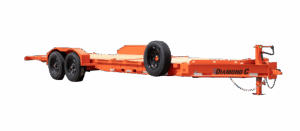
The two most practical deck styles for this work are a low-profile, between-the-fenders equipment trailer with a dovetail and ramps, and a hydraulically dampened or powered tilt trailer. Both can handle compact excavators when correctly rated, but they solve the loading problem differently. Deck length must provide enough room for the tracks, lowered boom and attachment, securement angles, and the fore-and-aft adjustment needed to achieve proper hitch weight. A machine may physically fit on an 18- or 20-foot trailer yet leave too little room to reposition it or place the bucket securely. A 22-foot deck often gives contractors more adjustment room, but deck length by itself does not determine deck height or loading angle.
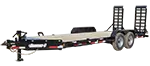
Low-Profile Channel Frame With Ramps
A modern low-profile equipment trailer should be evaluated by its actual frame, deck, dovetail, axle, tire, and ramp configuration rather than by a generic “channel frame” description. The current Diamond C LPX uses an I-beam or Engineered Beam frame depending on the GVWR package, length, and selected options. It is offered with an 80- to 82-inch bed between the fenders and several loading systems. The standard configuration uses spring-assisted, 24-by-60-inch flip-knee ramps with a 24-inch diamond-plate dovetail. Available MAX Ramps are 37 inches wide and include a 36-inch self-cleaning dovetail. The X-Ramp is designed for the 102-inch Max-Width Package and works with frame extensions and drive-over fenders. H&H’s current TOPLINE I-Beam Equipment Trailer is available in 18- to 22-foot lengths and uses a three-foot self-cleaning dovetail with stand-up steel ramps. Verify the exact deck height and loading geometry on the trailer being purchased because axle style, tire size, deck material, and options can change them. On the LPX, for example, a straight-axle option raises the deck and ground clearance by four inches.
Ramp angle is determined by vertical rise and horizontal run, not by the trailer’s overall deck length. In a simplified example, a 26-inch rise over 60 inches of horizontal run is approximately 23.4 degrees. Extending the horizontal run to 108 inches lowers the calculated angle to approximately 13.5 degrees. A real equipment trailer is more complicated because the machine travels across a ramp, a dovetail, and the main deck, producing separate transition angles. The excavator can clear the initial ramp and still high-center where the ramp meets the dovetail or where the dovetail meets the deck. Track length, ground clearance, undercarriage shape, blade position, attachment position, ramp spacing, ramp capacity, and the manufacturer’s loading instructions all matter. There is no universal 15-degree limit that applies to every compact excavator.
The practical takeaway is to choose a manufacturer-approved loading system that is wide enough, properly supported, and rated for the machine’s concentrated track loading. Longer ramps or a longer dovetail can reduce the approach angle, while wider systems such as MAX Ramps provide a larger surface for positioning tracks. A full-width X-Ramp can be useful when the trailer has the corresponding 102-inch Max-Width Package. Do not assume that a homemade extension, stacked lumber, or an unsupported ramp will safely carry an 8,000- to 12,000-lb tracked machine. Compare the excavator’s dimensio


