







A demolition crew burns through equipment fast. Concrete chunks, rebar, broken block, splintered lumber, roofing, drywall, and mixed construction debris all need to move, often several times in the same day. The trailer you bring to the job site either keeps pace with the crew or becomes the bottleneck that delays cleanup, equipment moves, and the next phase of work.
Light-duty trailers can develop cracked welds, bent crossmembers, damaged floors, overloaded tires, and premature suspension wear when they are repeatedly used beyond their intended duty cycle. Dump systems can also struggle when dense material is loaded too far forward or the trailer is operated above its rated capacity. The right demolition trailer is selected around the actual material, equipment, tow vehicle, payload, and route rather than an optimistic estimate of what the trailer might carry.
Here is what demolition crews should actually be running and what needs to be checked before a trailer is placed into daily commercial service.
Why Dump Trailers Are the Core Tool
Loose demolition debris should be carried in a trailer designed to contain and unload that material. A properly sized dump trailer with suitable side walls, a secure rear gate, and an correctly fitted tarp is safer and more efficient than piling loose rubble onto an open equipment trailer. Hydraulic dumping also reduces the manual labor and machine time required at the disposal site, especially when a crew is making multiple trips per day.
The key specifications for demolition work are GVWR, actual payload capacity, dump-body construction, hoist geometry, axle and tire ratings, brakes, coupler rating, side height, and floor thickness. Many professional crews work in the 14,000-lb to 24,000-lb GVWR range, while specialized dual-tandem gooseneck dumps can reach 25,000 to 30,000 lbs. GVWR is not payload. Payload is calculated by subtracting the trailer’s actual empty weight, including installed options, from its GVWR. The trailer must also remain within its axle, tire, wheel, coupler, hitch, and tow-vehicle ratings.
For commercial combinations, CDL classification is based on the truck and trailer together. A Class A CDL generally applies when the combination has a GCWR or actual gross combination weight of at least 26,001 lbs and the towed unit has a GVWR or actual gross weight above 10,000 lbs. A trailer rated above 10,000 lbs does not, by itself, trigger a Class A CDL when the entire combination remains below 26,001 lbs. Demolition contractors should also check whether their operation is subject to USDOT registration, inspections, driver qualification rules, hours-of-service requirements, and other commercial-carrier regulations.
Floor thickness matters because demolition debris creates concentrated impact loads. A 10-gauge steel floor can be appropriate for lighter material such as drywall, insulation, framing lumber, shingles, and carefully loaded mixed debris. Crews that routinely haul broken concrete, masonry, rock, scrap, or other dense and abrasive material should strongly consider a 7-gauge floor, which is roughly 3/16 inch thick. A heavier floor resists denting and gouging better, but it does not make abusive loading safe. Large chunks should still be placed rather than dropped from excessive height, and the load should be distributed instead of concentrated in one corner of the body.
Indiana also requires a trailer or semitrailer operated at a gross weight of at least 3,000 lbs to have brakes adequate to control, stop, and hold the trailer. Those brakes must be controllable from the tow vehicle and arranged to apply automatically if the trailer breaks away. A demolition trailer in this weight class therefore needs a compatible in-cab brake controller, a functioning breakaway system, and brakes that are inspected and adjusted as required.
Telescoping vs. Single-Stage Cylinders, Pick the Right One
Dump performance cannot be judged by cylinder type alone. The cylinder, mounting position, subframe, hinge location, hydraulic pressure, body length, dump angle, and hoist geometry work as a complete system. A properly engineered single-stage cylinder or scissor hoist can provide excellent dumping performance, while a poorly matched hoist can struggle even when the cylinder looks large on paper.
Single-stage cylinders use one piston and one continuous stroke. They are commonly incorporated into scissor-hoist systems, where the hoist geometry multiplies the cylinder’s movement and changes its leverage as the body rises. A quality scissor system can lift evenly and remain compact beneath the dump body. Buyers should evaluate the manufacturer’s complete hoist rating and approved payload rather than assuming that a single-stage cylinder automatically means a low dump angle or inadequate capacity.
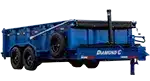
Telescoping cylinders extend through multiple nested stages. Their compact retracted length allows a direct-push cylinder to produce a long extension and strong front-of-body leverage. Current Diamond C LPT dump trailers use a three-stage telescoping cylinder and are designed for a 45-degree dump angle. H&H also offers telescopic dump models for contractors who prefer this direct-lift arrangement. A steep, properly engineered dump angle helps release dirt, aggregate, demolition debris, and other material that may otherwise bridge or remain in the body.
The correct maintenance procedure is to follow the trailer and hydraulic-component manuals. Inspect the exposed cylinder stages for dirt, rust, scoring, or impact damage; keep the rod surfaces clean; inspect hoses and fittings for abrasion or leaks; check pivot pins and retaining hardware; maintain the recommended hydraulic-fluid level; keep the battery charged; and repair leaks promptly. Do not work beneath a raised dump body unless the manufacturer’s approved body-support system is correctly engaged. Never rely on hydraulic pressure alone to hold the body up.
H&H Trailers: A Workhorse for Mid-Size Demo Loads
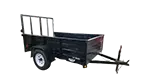
H&H builds a current range of dump trailers suitable for construction and demolition work. The Industrial Dump Trailer is offered with an 83-inch bed in 12-, 14-, and 16-foot lengths. Current bumper-pull configurations include 14,000-lb GVWR models with tandem 7,000-lb axles and 16,000-lb GVWR models with tandem 8,000-lb axles. Gooseneck configurations are also available in selected lengths and ratings.
The H&H Industrial Dump uses a 10-gauge one-piece steel floor, a structural steel frame, a combination barn-door and spreader gate, slipper-spring suspension, and a scissor-lift hoist. Its hydraulic system is power-up and power-down, and current specifications include a mesh tarp system, battery, hydraulic pump, charger, sealed wiring, stake pockets, rub rail, and loading ramps. That configuration is a practical fit for mixed construction debris, landscaping material, equipment transport within the trailer’s ratings, and moderate demolition work where a 7-gauge floor is not required.
For more frequent concrete, masonry, rock, or scrap hauling, the H&H TOPLINE Telescopic Dump is the heavier-duty option. It is offered with an 83-inch-wide body in 14- and 16-foot lengths, GVWR ratings from 15,400 to 22,000 lbs, and axle ratings from 7,000 to 10,000 lbs per axle depending on configuration. The TOPLINE uses 10-gauge steel sides, a 7-gauge one-piece steel floor, a reinforced 7-gauge top rail, an I-beam frame, and a telescoping hoist.
Hoist style does not remove the need for safe dumping conditions. Every raised dump body requires substantial overhead clearance. Never raise a dump body beneath utility lines, inside a low building, beside an unstable excavation, or on soft or sharply sloped ground. The truck and trailer should be aligned as straight as practical on firm, level ground, and the load should be reasonably balanced from side to side before dumping.
H&H availability at Spencer Trailers changes as units are sold and new inventory arrives. Checking current stock is important because body length, floor thickness, axle package, coupler type, tarp, ramps, and hydraulic options can differ from one trailer to another. The data plate and build sheet for the specific unit should control the purchasing decision.
Diamond C Trailers: Heavy-Duty When the Job Gets Serious
Diamond C’s primary heavy-duty low-profile dump is the LPT, available as a bumper-pull trailer from 15,500 to 24,000 lbs GVWR. Current LPT lengths are 12, 14, and 16 feet, with an approximately 81- to 82-inch-wide dump body. Published trailer weights range from about 4,440 to 6,930 lbs depending on length, axle package, and options. Every buyer should calculate payload from the actual empty weight of the selected trailer rather than using a generic advertised number.
The LPT uses a three-stage telescoping cylinder and a 45-degree dump angle. Standard running gear includes two 7,000-lb Lippert axles, with current upgrade paths that can include three 7,000-lb axles, two 8,000-lb axles, or two 10,000-lb axles. Lippert axles are standard across Diamond C’s premium LPT, LPX, HDT, FMAX, WDT, and DEC families. Axle selection also changes the suspension, hubs, tires, wheels, brakes, frame requirements, and allowable GVWR, so an axle upgrade should always be evaluated as a complete factory package.
The standard heavy-duty LPT body uses 10-gauge steel, while a 7-gauge dump-body package is available for crews that need greater resistance to concrete, rock, scrap, and repeated loader impact. For demolition work, the heavier body can be a worthwhile upgrade, but it also increases empty weight. That additional weight must be included when calculating legal payload.
Contractors who need a gooseneck connection can select the LPT-GN, while crews that need a full-width deck-over dump body can consider the DOD or DOD-GN. For dual-tandem gooseneck dump capacity, Diamond C’s WDT is the appropriate current line, with configurations in the 25,000- to 30,000-lb GVWR range. Choosing among these designs depends on loading method, required body width, truck configuration, hitch capacity, expected tongue or pin weight, and whether the trailer will also be used to carry compact equipment.
Diamond C’s higher-capacity packages use model-specific frame engineering, and Engineered Beam Technology is included where specified for the configuration. The frame, tongue or gooseneck, dump subframe, hinge, suspension, coupler, chains, wheels, and tires are engineered as a system. These parts still require routine inspection. Even a premium trailer should be checked for loose fasteners, cracked welds, damaged wiring, hydraulic leaks, worn brakes, tire damage, and suspension movement before small problems become expensive failures.
Diamond C also uses its DM Difference Maker multi-stage powder-coating process. The process includes steel-shot blasting, a multi-stage wash, force drying, a zinc-epoxy primer, a powder topcoat, and oven curing. The coating improves corrosion and chip resistance, but demolition crews should still wash away road salt, concrete residue, and corrosive material and should repair chips before exposed steel begins to rust.
Diamond C trailers are built in Mt. Pleasant, Texas, where the company has operated since its founding in 1985. Spencer Trailers carries Diamond C inventory and can order specific body lengths, axle packages, tarp systems, jacks, ramps, tires, and other options. Check the full inventory for what is currently on the lot, and verify the listed specifications for the individual stock number before purchasing.
Equipment Trailers for Moving Excavators
Debris hauling is one half of the demolition trailer equation. The other half is moving excavators, skid steers, compact track loaders, attachments, breakers, buckets, and support equipment. A machine in the 8,000- to 12,000-lb range needs a trailer with enough actual payload, a suitable deck width, an acceptable loading angle, properly rated ramps or tilt system, adequate tire capacity, and tie-down points positioned for the machine.
Operating weight should be taken from the machine’s identification plate or current manufacturer specification for the exact configuration. Published base weight may not include a cab, counterweight, thumb, quick coupler, hydraulic hammer, larger bucket, blade, fuel, accumulated mud, or other attachments. Chains, binders, spare buckets, tools, and trailer-mounted equipment also reduce available payload.
Commercial securement rules matter as much as trailer capacity. Heavy equipment weighing 10,000 lbs or more must generally be restrained against forward, rearward, lateral, and vertical movement with at least four tie-downs attached near the front and rear or to manufacturer-approved mounting points. Hydraulic shovels and other accessory equipment must be lowered and secured, and articulated machines must be restrained against articulation. Tie-down working-load limits, anchor ratings, chain condition, and attachment methods all need to meet the applicable cargo-securement requirements.
Matching Trailer GVWR to Machine Weight
| Excavator Class | Operating Weight (approx.) | Typical Trailer GVWR Range |
|---|---|---|
| Mini (1.5-2 ton) | 3,000 – 4,500 lbs | 7,000 – 10,000 lbs |
| Compact (3-5 ton) | 6,000 – 11,000 lbs | 14,000 – 18,000 lbs |
| Mid-Size (6-8 ton) | 12,000 – 18,000 lbs | 20,000 – 30,000 lbs |
These ranges are starting points, not universal minimums. The correct calculation is trailer GVWR minus the actual empty trailer weight, followed by a comparison with the fully equipped machine and everything else being carried. The loaded trailer must remain within the GVWR and within every axle, tire, wheel, suspension, coupler, hitch, and tow-vehicle rating. It is wise to retain usable capacity for attachments, chains, fuel, mud, and future equipment, but an arbitrary percentage cannot replace an actual weight calculation.
A certified scale is the best way to confirm the completed combination. Weigh the truck and trailer together and, when possible, obtain separate steer-axle, drive-axle, and trailer-axle weights. A combination can be below its total GCWR and still overload the truck’s rear axle, the trailer axles, or an individual tire.
Diamond C FMAX and Similar Heavy Equipment Trailers
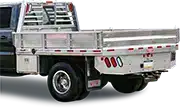
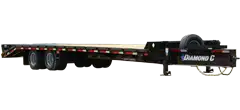
Diamond C’s FMAX family is a 102-inch-wide gooseneck flatbed line designed for equipment, materials, attachments, and commercial hauling. It is not the same layout as a low-profile between-the-fenders equipment trailer. Current FMAX models span a broad range, including the 15,500-lb GVWR FMAX207, the 25,900-lb GVWR FMAX212, and heavier dual- and triple-wheel configurations. The FMAX216 is offered from 25,900 to 30,000 lbs GVWR with an optional 40,000-lb package, while the FMAX310 uses three 10,000-lb Lippert axles for a 30,000-lb GVWR.
The 102-inch deck provides room for wider equipment, attachments, pallets, and multiple pieces of machinery, but the selected machine still has to fit within legal width and securement requirements. Deck-over designs sit higher than low-profile equipment trailers, so the loading system and breakover angle must be checked carefully for compact excavators with low ground clearance.
Diamond C’s correct loading options include MAX Ramps, XDR Ramps, a hydraulic dovetail on applicable FMAX configurations, and rear slide-in ramps on straight-deck versions. MAX Ramps are wide spring-assisted ramps intended to create a broad loading surface. XDR Ramps are narrower extreme-duty knee ramps designed for concentrated equipment such as excavators and backhoes where space between the ramps can provide knuckle or attachment clearance. The appropriate system depends on machine width, track placement, weight distribution, loading angle, and the rating of the exact ramp package.
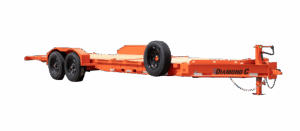
For contractors who want a lower deck between the fenders, the Diamond C LPX and LPX-GN equipment trailers are available from 15,500 to 24,000 lbs GVWR. The HDT and HDT-GN cover the same general GVWR range while providing a hydraulically dampened tilt bed rather than conventional loading ramps. Current LPX and HDT base configurations use tandem 7,000-lb Lippert axles, with factory packages that can include triple 7,000-lb, tandem 8,000-lb, or tandem 10,000-lb running gear.
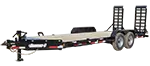
H&H’s current Industrial Equipment Trailer is available in 14,000- and 16,000-lb GVWR configurations, with tandem 7,000- or 8,000-lb axles depending on the model. For substantially heavier equipment, H&H also offers a Low Profile Dual Tandem Deckover with GVWR ratings from 22,500 to 32,000 lbs, a 12-inch pierced I-beam frame and tongue, a five-foot dovetail, and full-width flip-over ramps. As with every equipment trailer, the ramp rating, empty weight, axle package, deck height, and loaded machine weight must be checked for the specific unit.
Practical Q&A: What Demolition Crews Ask Us
Do I need a CDL to haul a loaded demo trailer? A Class A CDL generally applies to a commercial combination when the GCWR or actual gross combination weight is at least 26,001 lbs and the towed unit’s GVWR or actual weight exceeds 10,000 lbs. The 26,001-lb threshold applies to the combination, not to the trailer by itself. For example, a truck rated at 14,000 lbs paired with a 15,500-lb trailer creates a 29,500-lb rated combination, placing an ordinary commercial demolition operation in Class A territory. A trailer above 10,000 lbs paired with a truck that keeps the total combination below 26,001 lbs does not trigger Class A solely because of the trailer rating. Limited exemptions may apply to specific farm, military, emergency, or non-business operations, but ordinary for-hire or business demolition hauling should not assume an exemption.
How thick should the dump trailer floor be for concrete debris? For frequent concrete, block, rock, and scrap loads, a 7-gauge floor, approximately 3/16 inch thick, is the preferred heavy-duty choice. A 10-gauge floor can handle lighter demolition material and occasional dense loads when the trailer is loaded carefully and kept within its ratings. Floor thickness is only one part of durability; crossmember spacing, body construction, top-rail strength, hoist design, and loading technique also matter.
Can I dump a full load of wet concrete without damaging the trailer? Demolition trailers are normally used for cured concrete rubble, saturated soil, mud, aggregate, and mixed debris rather than transporting fresh concrete as a mixer would. Dense wet material can be hauled only when the loaded weight, distribution, and material characteristics remain within the trailer manufacturer’s limits. Do not compare a cylinder’s advertised push force directly with payload capacity. The complete hoist and dump body must be approved for the trailer’s rated load. Material should be distributed evenly, the trailer should be dumped on firm and level ground, and any load that has frozen, bridged, or adhered to one side should be addressed before raising the body.
What is the advantage of a gooseneck dump over a bumper-pull? A gooseneck connects to a rated ball mounted in the truck bed and transfers pin weight over or slightly ahead of the rear axle. That arrangement can improve stability and allow higher-capacity combinations, but it also consumes bed space and places substantial load on the truck’s rear axle. A properly matched heavy-duty bumper-pull dump can still be the correct choice when maneuverability, truck-bed use, or fleet compatibility matters. The decision should be based on the tow vehicle’s receiver or gooseneck rating, rear-axle rating, available payload, hitch hardware, turning clearance, trailer GVWR, and expected tongue or pin weight. A gooseneck trailer requires an approved gooseneck hitch system unless the manufacturer specifically authorizes another connection or adapter.
Getting the Right Trailer Spec’d for Your Crew
The most common mistake is buying according to purchase price and body length without calculating payload. A 14,000-lb GVWR dump can be a legitimate workhorse for framing debris, roofing, landscaping material, light masonry, and carefully managed mixed demolition loads. Dense concrete and soil can use up its available payload long before the body looks full. A higher-GVWR trailer may reduce trips, but only when the truck, hitch, driver, route, disposal facility, and operating rules are prepared for the heavier combination.
Before ordering, write down the heaviest machine, every attachment, the densest debris, typical daily volume, disposal distance, truck GVWR, truck payload, rear-axle rating, hitch rating, and driver-license class. Then select the body length, floor thickness, axle package, hoist, ramps, tarp, jack, tires, brakes, and hitch type around those numbers. Confirm the completed trailer’s empty weight after options because heavy floors, hydraulic jacks, spare tires, tarps, ramps, and toolboxes all reduce payload.
Indiana buyers should title and register a newly acquired trailer within 45 days of purchase or acquisition to avoid the applicable administrative penalty. As of July 1, 2025, the Indiana Secretary of State stated that it would not take enforcement action against dealer documentation preparation fees at or below $251.05. Business purchasers should also discuss tax treatment with a qualified tax professional. Under current federal rules, certain qualifying business property acquired and placed in service after January 19, 2025 may be eligible for 100% first-year bonus depreciation, but eligibility, business-use requirements, basis, financing, and elections depend on the taxpayer’s circumstances.
Spencer Trailers stocks Diamond C and H&H trailers in Spencer, Indiana and can order specific configurations when the required model is not currently available. Inventory specifications and prices change, so compare the data plate, build sheet, warranty, installed options, and actual empty weight of the exact stock unit. Stop in at 291 West State Hwy 46, call (812) 829-0226, or reach out online to talk through your load specifications before you buy.
What does your heaviest typical load look like, including the machine, attachments, debris, and everything else carried on the trailer? That answer shapes almost every other part of the correct trailer specification.


