








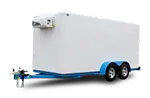
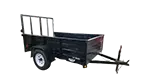

Most roofing contractors are managing two separate hauling jobs at the same time, even if they do not think of them that way. The crew has to remove dense tear-off debris while also transporting nail guns, compressors, hoses, ladders, fall-protection equipment, underlayment, flashing, fasteners, sealants, and other materials that must remain secure and dry. Those are fundamentally different jobs, and trying to handle both with one trailer usually creates unnecessary unloading, poor organization, lost production time, or an overloaded rig.
For an established roofing crew, the most efficient setup is often a properly sized dump trailer for waste and a contractor-ready enclosed trailer for tools and weather-sensitive materials. The right sizes depend on the type of roofs you handle, the number of layers being removed, disposal distances, crew size, tow-vehicle ratings, and how much equipment stays with the crew. Here is a practical breakdown of configurations that work for roofing contractors, including Diamond C dump trailers and enclosed cargo trailers available through Spencer Trailers in Spencer, Indiana.
The Dump Trailer Side: Handling Tear-Off Debris
Asphalt shingles are much heavier than their appearance suggests. Depending on the product, a square of three-tab shingles may weigh around 180 to 240 pounds, while laminated or architectural shingles commonly weigh approximately 200 to 400 pounds per square. Tear-off material can weigh more than the original packaged shingles because the load may also contain felt, synthetic underlayment, nails, flashing, saturated material, ridge products, and damaged roof decking.
A 2,000-square-foot roof contains about 20 roofing squares. Removing one layer of architectural shingles can therefore produce roughly 4,000 to 8,000 pounds of shingles before accounting for sheathing, underlayment, nails, moisture, or additional roofing layers. A roof with two existing layers can produce substantially more debris. That is why a small dump trailer can reach its legal payload long before the body looks completely full.
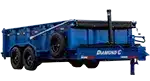
Roofing crews comparing Diamond C dump trailers should look first at the GST for repairs and light-volume work, the LPT207 for regular residential tear-offs, and the LPT208 for larger residential, multi-family, and commercial workloads. Diamond C has manufactured trailers in Mt. Pleasant, Texas, since 1985. Current Diamond C dump trailers use the company’s DM Difference Maker multi-stage coating process, and LPT models are equipped with Lippert axles.
Diamond C GST (Single Axle Telescopic Dump)
The Diamond C GST is a compact single-axle telescopic dump trailer with a 6,000 lb GVWR, an 8-foot-long body, and a 60-inch bed width. It rides on one 6,000 lb Lippert drop axle and uses a front-mounted telescopic hydraulic cylinder to achieve an approximately 45-degree dump angle. The compact body provides about 2.2 cubic yards of capacity with the standard sides.
The GST is well suited to repair crews, small tear-offs, flashing and gutter work, landscaping around completed roofing projects, and contractors who need a secondary debris trailer. It is easier to maneuver in tight residential driveways than a full-size tandem-axle dump, but its payload and body volume are not intended for an entire high-volume tear-off. A full residential replacement will normally require multiple disposal runs, especially when architectural shingles, wet debris, or roof decking are involved.
Standard equipment varies by production year and ordered configuration, but current GST specifications include a telescopic dumping system, a three-way rear gate, a mesh tarp, and an integrated steel dump body. Board brackets and taller side configurations may be available. Taller sides increase volume for light material, but they do not increase the trailer’s GVWR, axle rating, tire capacity, or legal payload.
Diamond C LPT207 (Heavy Duty Telescopic Dump, 15.5K)
The LPT207 is the practical starting point for many full-time residential roofing contractors. The current 207 package carries a 15,500 lb GVWR and uses two 7,000 lb Lippert axles with slipper-roller suspension. Its bed is 82 inches wide, and available body lengths include 12, 14, and 16 feet. The 82-inch by 14-foot configuration is especially useful for residential roofing because it offers meaningful debris volume without becoming as difficult to place in a driveway as a longer commercial trailer.
Depending on tire, axle, and body configuration, the LPT deck height is generally in the low-to-mid 20-inch range. That lower loading height matters when crew members are tossing tear-off debris over the side or shoveling material from a ground tarp. The LPT uses a front-mounted multi-stage telescopic hydraulic cylinder and dumps to approximately 45 degrees. The number of cylinder stages can vary by production configuration, so buyers should verify the build sheet for the specific VIN rather than assuming every LPT207 is identical.
A representative current 82-inch by 14-foot LPT207 at Spencer Trailers has a listed empty weight of approximately 4,930 pounds and a calculated payload of approximately 10,570 pounds. Empty weight changes with body length, side height, ramps, spare tires, hydraulic options, tarp equipment, toolboxes, and other installed features. The legal payload for a specific trailer is always its stated GVWR minus the trailer’s actual empty weight and any permanently carried equipment.
Current LPT207 builds may include 24-inch, 10-gauge integral steel sides and floor, a three-way rear gate with hold-back hardware, an easy-roll heavy-duty mesh tarp, rear stabilizer equipment, and slide-in ramps. Some Spencer-stocked units are also configured with trailer ABS, a solar battery-maintenance panel, and RECOVR GPS service. Those features are configuration-dependent and should be confirmed on the individual trailer’s equipment sheet.
Board brackets are useful when hauling bulky, low-density debris such as insulation, packaging, synthetic underlayment, or light demolition material. Wood side extensions can increase containment volume, but they should never be treated as permission to exceed GVWR. Shingles are dense enough that the trailer will usually reach its weight limit before a properly loaded 24-inch body is filled to the top.
For most one-layer residential tear-offs, the LPT207 offers a strong balance of payload, body volume, maneuverability, and purchase cost. It can often reduce a job that would require several trips with a compact dump trailer to one or two properly weighed loads. Spencer Trailers stocks multiple LPT configurations; check the full inventory for current body lengths, side heights, empty weights, payloads, and installed options.
Diamond C LPT208 (Heavy Duty Telescopic Dump, 18K)
The LPT208 is the next step for crews handling large homes, multi-family buildings, commercial roofing, multiple layers, or several jobs in succession. The current 208 package has an 18,000 lb GVWR and uses two 8,000 lb oil-bath Lippert axles with electric brakes and heavy-duty slipper-roller suspension. The bed is approximately 81 inches wide, with 12-, 14-, and 16-foot body lengths available.
Current LPT208 configurations use Diamond C’s Engineered Beam frame design and a front-mounted telescopic hydraulic hoist with an approximately 45-degree dump angle. Specific units may use different multi-stage cylinder arrangements depending on production date and body length. Commercial-grade 17.5-inch radial tires are commonly fitted to this package, but tire size, ply rating, load range, and wheel capacity must still be verified from the VIN-specific build sheet.
A representative current 81-inch by 14-foot LPT208 at Spencer Trailers has an empty weight of approximately 5,440 pounds and a listed payload of approximately 12,560 pounds. A 16-foot model will generally weigh more and therefore carry less payload at the same 18,000 lb GVWR. The longer body provides more volume, but it does not automatically provide more legal cargo capacity.
Many current LPT208 builds use a heavier 7-gauge integral steel floor and side structure, although the exact material specification should be confirmed on the individual unit. Common equipment includes 24-inch sides, a three-way rear gate, a heavy-duty mesh tarp, ramps, a high-flow hydraulic power unit, an enclosed tongue-mounted hydraulic and battery compartment, and a heavy-duty adjustable coupler. Solar battery maintenance, RECOVR GPS service, electric tarp systems, wireless hydraulic controls, taller sides, and other equipment may be standard within a particular dealer package or installed as options.
For model-year 2026 and newer Diamond C trailers, Diamond C’s current limited warranty program provides up to six years of structural coverage and two years of comprehensive coverage, subject to the written warranty’s eligibility requirements, exclusions, maintenance obligations, and commercial-use terms. Earlier model years may be covered under the previous warranty program, so the warranty should be checked against the trailer’s actual model year and purchase documents.
The additional payload of the LPT208 is useful, but it also increases demands on the tow vehicle. An 18,000 lb bumper-pull dump trailer requires a truck with sufficient conventional-towing capacity, receiver and ball capacity, rear-axle rating, tire capacity, available payload, and GCWR. Tongue weight is carried by the truck and can consume payload quickly, particularly when the trailer is loaded with dense roofing debris. The truck’s advertised maximum tow rating alone is not enough to establish that a combination is properly matched.
Side Height and What It Means for Shingle Volume
A 24-inch side height is common on LPT207 and LPT208 roofing configurations. An 82-inch-wide, 14-foot-long body with 24-inch sides provides approximately 7.1 cubic yards of geometric volume. An 81-inch-wide body of the same length provides approximately 7 cubic yards. A 16-foot body with 24-inch sides provides approximately 8 cubic yards, depending on the exact interior dimensions and body construction.
Diamond C offers taller LPT side configurations, including approximately 32-inch and 44-inch options on applicable builds. Taller sides are valuable for low-density material, but roofing shingles usually make payload the limiting factor. Wet shingles, multiple layers, built-up roofing, wood decking, and mixed demolition material can make a load much heavier than it appears. Side extensions, taller factory sides, and a tightly packed body never increase the ratings shown on the certification label.
Load placement is equally important. Dense debris should be distributed so the trailer remains within its axle, tire, wheel, coupler, hitch, tongue-weight, and GVWR limits. Material piled heavily at the rear can reduce tongue weight and contribute to instability, while too much material at the front can overload the truck’s receiver, rear axle, or tires. The only reliable way to confirm a heavily loaded roofing trailer is legal is to weigh the loaded truck and trailer, including individual axle groups when possible.
| Model | GVWR | Bed Size | Axle Rating | Best For |
|---|---|---|---|---|
| Diamond C GST | 6,000 lb | 8 ft, 60″ wide | 1 x 6,000 lb Lippert | Repairs, small tear-offs, and secondary debris duty |
| Diamond C LPT207 | 15,500 lb | 12–16 ft, 82″ wide | 2 x 7,000 lb Lippert | Regular residential re-roofs and mid-size crews |
| Diamond C LPT208 | 18,000 lb | 12–16 ft, approximately 81″ wide | 2 x 8,000 lb oil-bath Lippert | Large residential, multi-family, commercial, and high-volume work |
Trailer GVWR is not determined only by adding the two axle ratings. A properly loaded bumper-pull trailer transfers part of its weight to the tow vehicle through the coupler. Even so, the actual weight carried by each trailer axle must remain within the axle, suspension, tire, wheel, and brake ratings, and the total loaded trailer must remain within its certified GVWR.
Indiana requires a trailer or semitrailer with a gross weight of at least 3,000 pounds to have brakes that can be controlled from the towing vehicle, along with an automatic breakaway function. The GST, LPT207, LPT208, and contractor-size tandem enclosed trailers should be inspected before every trip to confirm that the brake controller, breakaway battery, switch, wiring, lights, tires, coupler, safety chains, and load securement are working correctly.
A trailer rated above 10,000 pounds does not, by itself, automatically require a CDL. For the ordinary property-carrying roofing combination, a Class A CDL is generally triggered when the combination has a GCWR or actual gross combination weight of 26,001 pounds or more and the towed unit has a GVWR or actual gross weight greater than 10,000 pounds. Commercial motor-vehicle, USDOT, medical-card, inspection, and operating requirements can apply at lower weight thresholds depending on whether the work is intrastate or interstate, so contractors should verify the rules that apply to their operation.
The Enclosed Trailer Side: Tools, Materials, and Keeping Things Dry
Roofing equipment is expensive to replace and inefficient to unload every night. Nail guns, pneumatic hoses, compressors, generators, hand tools, safety harnesses, ropes, anchors, cap nailers, fasteners, caulk, flashing, underlayment, repair materials, and personal gear add up quickly. Keeping those items in a secure enclosed trailer gives the crew a consistent inventory and makes it easier to identify missing equipment before leaving the yard.
An enclosed trailer functions as a rolling tool room, but it still has to be treated as a cargo trailer rather than a storage building. Shelving, compressors, generators, tool chests, material racks, and spare parts all count against payload. Heavy equipment must be positioned to maintain proper tongue weight and secured to rated attachment points. Adhesives, sealants, batteries, fuels, compressed-gas cylinders, and temperature-sensitive products must be stored and transported according to their manufacturers’ instructions.
Spencer Trailers’ enclosed inventory changes throughout the year. Darkhorse Cargo is a common contractor-oriented choice in current inventory, while other steel-frame and aluminum-frame cargo trailers may be available in different sizes and axle packages. Buyers should compare the actual VIN sheet, empty weight, payload, floor construction, crossmember spacing, door openings, interior height, tie-down equipment, and warranty rather than relying on the brand name or nominal box size alone.
Darkhorse Cargo (7′ x 14′ and 8.5′ x 24′)
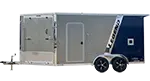
A tandem-axle Darkhorse 7-foot by 14-foot enclosed trailer is a practical tool trailer for a residential roofing crew. Current Spencer-stocked examples carry a 7,000 lb GVWR, use two 3,500 lb axles with electric brakes, and provide approximately 7 feet of interior height. That interior height allows most crew members to stand upright and provides room for shelving above compressors, toolboxes, and hose storage.
A 7-foot-wide body is narrow enough to remain manageable on residential streets and driveways while still providing useful wall space for racks, E-track, cabinets, and hand-tool storage. The tandem axles improve stability and provide redundancy compared with a light single-axle cargo trailer. Actual payload must be calculated from the trailer’s certification label and empty weight, especially after shelves, cabinets, batteries, racks, or a generator are installed.
Crews that carry more equipment or need separate material and tool zones can move to an 8.5-foot-wide Darkhorse. Current Spencer inventory has included 8.5-foot by 24-foot tandem models with a 9,990 lb GVWR, dual 5,200 lb axles, electric brakes, and approximately 7 feet of interior height. That size provides room for shelving on both walls while preserving a center aisle for compressors, carts, tear-off machines, ladders, and job boxes.
A 9,990 lb GVWR does not mean the trailer can carry 9,990 pounds of cargo. The trailer’s own weight, spare tire, shelving, cabinets, tools, batteries, ramps, and permanently mounted equipment must be deducted first. A pallet of shingles can weigh several thousand pounds, and its concentrated floor load may exceed the trailer’s remaining payload or the capacity of the floor and crossmembers. Before using an enclosed trailer for palletized shingles, verify the pallet weight, ramp capacity, door opening, floor rating, axle loading, and available payload.
Darkhorse specifications vary by series and ordered package. Depending on the unit, available equipment may include a rear ramp door or double doors, LED lighting, a one-piece aluminum roof, radial tires, plywood interior surfaces, a side-access door, vents, tie-down points, and upgraded floor or wall construction. Spencer Trailers can provide the build sheet for the exact trailer being considered.
Wells Cargo Road Force (7′ x 14′ and 8.5′ x 16′)
Wells Cargo’s current Road Force line is another contractor-oriented enclosed-trailer option to compare when evaluating the market. A 7-foot by 14-foot tandem Road Force can be configured as a daily-use tool trailer with a rear ramp, side-access door, electric brakes, interior lining, tie-down equipment, and contractor storage options. Interior height and GVWR depend on the selected model and build, so a buyer should not assume every 7-foot by 14-foot Road Force has the same 7,000 lb rating or ceiling height.
The 8.5-foot-wide Road Force provides more room for two-sided shelving, carts, workbenches, and a usable center aisle. Current 8.5-foot Road Force specifications include an extra-wide rear ramp opening on applicable models, a low-profile beavertail transition, and heavy exterior-panel construction. Axle packages and GVWR vary by length and configuration, with both standard-duty and heavier contractor builds available. The certification label and manufacturer order sheet remain the controlling specifications.
The extra 18 inches of body width between a 7-foot and an 8.5-foot trailer is most valuable for organization rather than for carrying a particular roll width. A wider trailer can support shelving or cabinets on both sides without leaving an uncomfortably narrow aisle. It also provides more room to secure compressors, tear-off equipment, generators, carts, and material racks as separate load zones.
Wider trailers require more awareness in narrow lanes, residential driveways, fuel stations, and job-site entrances. Many 8.5-foot enclosed trailers also use fender boxes or drive-over wheel-box designs that affect interior floor width. Before ordering shelving or racks, measure the actual interior width, wheel-box dimensions, ramp opening, side-door opening, and usable wall height.
What to Look For in a Roofing Enclosed Trailer
- Interior height of at least 6’6″: A 6-foot-6-inch interior is workable for many crews, while a 7-foot interior provides better standing room and more vertical storage. Verify the finished interior height after roof bows, lighting, vents, and ceiling liner are installed.
- A rear door that matches the workflow: A ramp door is valuable for wheeled compressors, generators, carts, and tool chests. Double rear doors may be preferable for loading from a dock, using a forklift, or opening the trailer where there is not enough room to lower a ramp. Ramp capacity should be verified before loading concentrated or motorized equipment.
- Rated E-track or D-ring tie-down points: Compressors, generators, shelving, job boxes, and material carts can move violently during emergency braking or a collision. E-track and D-rings should be attached to structural members and used within their rated working-load limits. Plywood wall panels alone are not reliable cargo anchors.
- Construction matched to the job, not a steel-versus-aluminum assumption: Steel-frame trailers often cost less initially and can be straightforward to repair. Aluminum-frame trailers reduce empty weight, resist corrosion, and may provide more usable payload. Either construction can perform well on a roofing site when the frame, floor, roof, fasteners, doors, and running gear are engineered for commercial use.
- Enough payload after the build-out: Cabinets, shelving, racks, batteries, inverters, generators, spare tires, and mounted tools can remove hundreds or thousands of pounds from available payload. Plan the finished trailer, not just the empty shell.
- Appropriate floor and crossmember construction: Heavy compressors, pallet jacks, tear-off machines, and concentrated loads require more than a nominal plywood thickness. Ask about floor material, crossmember size and spacing, ramp rating, wheel-box construction, and whether the manufacturer approves the intended load.
- Brakes, tires, and serviceability: Contractor trailers should have brakes on the required axles, an operational breakaway system, tires with adequate reserve capacity, accessible hubs and bearings, and parts that can be serviced without excessive downtime. Carry a properly rated spare tire and the tools needed to change it safely.
- Security, lighting, and ventilation: Quality door hardware, protected locks, interior LED lighting, roof or side ventilation, and a documented tool-storage system make the trailer more useful every day. GPS recovery equipment can assist after theft, but it does not replace physical locks, insurance, and an accurate equipment inventory.
Do You Actually Need Both?
For a crew of four or more completing regular residential tear-offs, a two-trailer system is often the most productive arrangement. The dump trailer can travel to the landfill or transfer station while the enclosed trailer remains at the project with the tools. The crew does not lose access to compressors, fasteners, safety equipment, or repair materials every time debris has to leave the site.
A smaller contractor may begin with one dump trailer and carry tools in the truck, or use an enclosed trailer while a dumpster company handles debris. That approach can work when tear-offs are occasional or parking space is limited. The decision should be based on actual local disposal costs, travel time, landfill rules, included dumpster tonnage, overweight charges, rental periods, crew downtime, truck operating cost, and trailer ownership expenses.
Dumpster service is commonly priced as a combination of delivery, rental period, included weight, pickup, disposal, and overweight fees. Roofing shingles are dense, so a low included-tonnage allowance can make an inexpensive quote much more costly after disposal. Owning a dump trailer eliminates recurring container rental charges, but it does not eliminate landfill tipping fees, fuel, tires, brakes, hydraulic maintenance, insurance, registration, financing, or the labor required to make disposal runs.
For many residential roofing businesses, the LPT207 is the most balanced primary debris trailer because its approximately 10,000-pound payload range on a typical 14-foot build is useful without moving immediately to the size and tow-vehicle demands of an 18,000 lb trailer. The LPT208 becomes more compelling when heavier jobs, multiple layers, longer disposal distances, or high daily volume justify the additional capacity.
The enclosed trailer should be selected separately according to the equipment it will carry. A 7-foot by 14-foot tandem trailer can serve as a well-organized tool room for a smaller crew. An 8.5-foot-wide trailer provides more room for two-sided shelving, workstations, wheeled equipment, and separate material zones. In either case, the correct size is the smallest trailer that safely carries the finished load without forcing the crew to stack tools in aisles or exceed payload.
For qualifying business property acquired and placed in service after January 19, 2025, federal law restored 100% bonus depreciation. Whether a particular trailer qualifies, how business-use percentages apply, and whether bonus depreciation or another tax treatment is preferable depends on the buyer’s circumstances. Contractors should obtain tax advice from a qualified professional rather than treating a deduction as an automatic discount on the purchase price.
Indiana purchasers should also apply for title and registration within the applicable 45-day period after acquiring a trailer to avoid administrative penalties. Insurance, apportioned registration, USDOT obligations, and commercial operating requirements depend on how and where the trailer is used.
A Quick Question Worth Answering Before You Buy
Q: Can I haul new shingles to a job in a dump trailer?
Yes, provided the load is within every applicable rating and is properly supported, protected, distributed, and secured. An LPT207 or LPT208 has a flat steel dump floor that can carry bundled material, and optional board brackets can support side extensions for better containment. Board brackets do not increase payload or replace proper cargo securement.
Shingle bundles should remain flat, dry, and supported so they are not bent over an edge or damaged in transit. Pallet and bundle weights must be checked before loading because a concentrated stack can overload the trailer floor, an axle group, the tongue, or the tow vehicle even when the trailer is below its total GVWR. Forklift access can also be more difficult in a dump body than on an open flatbed.
For regular material delivery, a properly rated flatbed, equipment trailer, or enclosed trailer may provide easier loading and better weather protection. An enclosed trailer still needs sufficient payload, floor strength, door clearance, and ramp capacity for the intended pallet. Use the dump trailer primarily for the job it performs best: containing, transporting, and unloading tear-off debris efficiently.
Spencer Trailers keeps Diamond C dump trailers and enclosed cargo trailers at 291 West State Hwy 46 in Spencer, Indiana. You can browse current inventory online or reach out directly with questions about a specific VIN, body length, payload, axle package, tire rating, tarp system, side height, or enclosed-trailer build.
If you are deciding between the LPT207 and LPT208, call the lot at (812) 829-0226 with your truck’s year, make, model, cab, bed, engine, drivetrain, receiver rating, payload label, rear-axle rating, and intended load. Spencer Trailers can help compare those numbers with the trailer’s actual empty weight and GVWR. That conversation is far more useful than choosing a trailer from the model name alone, and it can prevent a combination that overloads the truck every time the body is filled.


