











You load tens of thousands of dollars’ worth of solar modules, inverters, electrical gear, and installation tools before sunrise, drive an hour to the job site, and expect everything to arrive ready to install. If the trailer is overloaded, poorly balanced, or not equipped with proper cargo-control points, a hard stop or rough railroad crossing can damage equipment and take a crew off schedule. The right trailer for solar installation work is not a luxury. It is transportation risk management.
Solar contractors generally carry cargo in three categories: fragile equipment such as modules, inverters, microinverters, and controls; structural material such as racking rails, conduit, wire spools, and mounting hardware; and access equipment such as ladders, pipe benders, carts, roof jacks, and fall-protection gear. Each category places different demands on the trailer. Choosing correctly means matching the trailer’s interior dimensions, GVWR, payload capacity, axle configuration, cargo-control system, and ramp capacity to the crew’s actual load.
Enclosed Trailers for Panels and Inverters
Modern solar modules vary considerably in size and weight. Many residential modules weigh roughly 40-55 lbs, while larger commercial modules can be longer, wider, and heavier. A load of 20 modules may represent approximately 800-1,100 lbs before adding padded racks, inverters, wiring, tools, and mounting hardware. The glass may look durable, but repeated vibration, frame twisting, edge impacts, and concentrated strap pressure can cause frame damage or cell microcracks that are not always visible during unloading.
An enclosed cargo trailer addresses two major concerns at once: it protects equipment from road debris, rain, salt, and casual theft, and it provides a controlled space for a properly designed module rack. For a two-person residential crew completing smaller installations, a 6×12 or 7×16 enclosed trailer may provide a practical balance of capacity and maneuverability. Larger residential or commercial crews may need an 8.5×20, 8.5×24, or longer trailer. Nominal trailer size alone is not enough. Measure the actual modules, shipping cartons, rack structure, rear-door opening, interior height, wheel-box locations, and aisle space before ordering.
At Spencer Trailers we carry enclosed units from established trade-focused manufacturers, including Wells Cargo and Darkhorse Cargo. Wells Cargo offers several enclosed-trailer families for commercial users, including Road Force and Wagon HD configurations. Applicable Wagon HD models use a durable 3/4-inch high-performance floor system, while axle packages, wall construction, interior height, ramp capacity, and GVWR vary by model and option package. A tandem-axle 7×16 enclosed trailer is commonly available around the 7,000 lb GVWR class, but the usable payload must always be calculated by subtracting the trailer’s actual empty weight and installed options from its certified GVWR.
Legend Manufacturing enclosed trailers are another strong option, especially for crews interested in an all-aluminum structure. Aluminum construction can reduce empty trailer weight compared with many similarly equipped steel-frame trailers, but the difference depends on the exact series, wall height, axle package, ramp door, cabinetry, roof accessories, and interior finish. Compare the certified empty weight of the trailers being considered instead of relying on a generic weight estimate. This is particularly important when towing with a half-ton pickup, because passengers, toolboxes, ladder racks, hitch equipment, and cargo in the truck all consume available payload.
Inside the trailer, the cargo system matters as much as the trailer itself. Solar modules should remain in manufacturer-approved packaging whenever practical or be carried in a purpose-built, padded rack that supports the frames without placing pressure on the glass. Modules are commonly transported vertically or at a controlled angle with edge protection and nonabrasive separators. Straps should restrain the rack or packaged load rather than press directly against module faces. A homemade divider that is attached only to interior wall panels is not an adequate cargo restraint.
Inverters, combiner equipment, rapid-shutdown components, and sealed hardware containers should be secured to shelving or cargo tracks with documented working-load limits. Heavy equipment belongs low in the trailer and positioned to maintain proper axle loading and tongue weight. Lightweight hand tools can be stored on reinforced wall panels, but shelving, cabinets, E-track, and pegboard systems should be fastened to structural framing or factory-installed backing rather than thin interior lining alone. Leave enough aisle space for the crew to remove expensive equipment without leaning modules against the trailer or placing them on the ground.
What to Look for in an Enclosed Trailer for Solar Gear
- Enough interior height and door-opening clearance for the tallest module, shipping carton, or padded rack your crew will use; a 78-inch interior may suit some loads but will not accommodate every current commercial module vertically
- A curbside access door wide enough for routine tool and inverter removal without opening the rear ramp and exposing the entire load
- A 12-volt interior lighting package and, when needed, a properly installed 120-volt shore-power package with protected outlets for charging cordless tools
- E-track, L-track, recessed D-rings, or other cargo-control fittings with published working-load limits and structural backing appropriate for the complete secured load
- A rear ramp door with a published capacity that covers the heaviest cart, inverter, spool, or piece of equipment, plus stabilizers or loading supports when required by the manufacturer
A rear ramp is especially valuable when the crew moves string inverters, tool chests, wire carts, or equipment skids. Even equipment that can technically be lifted by one person becomes a strain risk when it must be carried repeatedly over a high rear threshold. Check the ramp door’s distributed and concentrated load ratings, the transition angle at the ground, and whether the trailer requires rear stabilizer jacks before loading. A ramp door is useful only when the complete loading system is rated for the equipment being rolled across it.
Utility Trailers for Racking, Conduit, and Wire
Racking rails, conduit, strut, grounding components, and weather-resistant mounting hardware are often better suited to an open utility trailer. These materials are long, awkward, and difficult to arrange around an enclosed trailer’s wheel boxes and doorway. Common rail and conduit lengths may be 10, 12, or 20 feet, so the trailer should be long enough to support the material properly and minimize overhang. Weather-tolerant cargo still needs securement, edge protection, and organized bundling so individual rails or conduit sections cannot slide, bounce, or separate in transit.
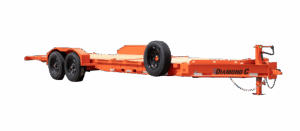
For residential work, a Diamond C or H&H utility trailer in the 5×10 to 7×16 range can provide a simple and efficient material platform. The current Diamond C GTU is an 83-inch-wide tandem-axle utility trailer with a 7,000 lb GVWR, a 4-inch channel frame, and two 3,500 lb Lippert brake axles. H&H also offers an 82×16 tandem Rail Side Utility in the 7,000 lb GVWR class with two 3,500 lb axles. The exact payload depends on the trailer’s certified empty weight, spare tire, ramp, toolbox, sides, and other installed equipment.
Longer material does not automatically require a heavier trailer, but the trailer must provide adequate support and usable payload for the complete load. H&H’s standard 82×20 tandem Rail Side Utility remains in the 7,000 lb GVWR class, while its Heavy Duty Rail Side line is available at approximately 9,900 lbs GVWR with heavier tandem axles. Diamond C’s TUT premium tandem utility is available in longer configurations, including 20-foot lengths, with a 9,890 lb GVWR and Lippert axles. These heavier utility models can be a better match when the crew regularly combines long racking bundles with conduit, wire reels, generators, and installation equipment.
For utility-scale, ground-mount, or large commercial work, a Diamond C FMAX208 Flatbed Max gooseneck provides substantially more deck space and capacity than a bumper-pull utility trailer. The FMAX208 is available with an 18,000 lb GVWR, two 8,000 lb Lippert axles, a 102-inch-wide deck, and multiple deck lengths. Heavier FMAX models are available when the job requires greater certified capacity. Before loading palletized hardware or a scissor lift, verify the trailer’s actual empty weight, available payload, deck concentrated-load limits, axle and tire ratings, ramp capacity, and the equipment manufacturer’s loading instructions. A high GVWR does not mean every combination of equipment and material can be loaded anywhere on the deck.
| Trailer | GVWR | Best Use |
|---|---|---|
| Diamond C GTU 83×16 Tandem Utility | 7,000 lbs | Residential racking, conduit, and installation tools |
| H&H 82×20 Heavy Duty Rail Side | Approximately 9,900 lbs | Long material, wire reels, and heavier multi-trade loads |
| Diamond C FMAX208 Flatbed Max Gooseneck | 18,000 lbs | Commercial ground-mount material and properly matched equipment |
Ladder Racks: The Most Overlooked Upgrade
A ladder rack sounds simple, but it should be treated as part of the trailer’s cargo-control system. Solar crews may carry fiberglass step ladders, extension ladders, roof jacks, conduit carriers, safety rails, and lightweight scaffold components. The rack must have a published capacity, be attached to structural mounting points, and provide enough crossbar spacing to support the longest ladder without excessive flex. A light-duty rack or an improvised attachment to sheet metal can loosen, crack, or fail under repeated highway vibration.
The correct capacity is based on the actual road load, not a universal rating. Add the weight of every ladder, carrier, pipe tube, rack accessory, and tie-down device, then select a system with an adequate published dynamic load rating. The rack’s own weight also reduces trailer payload and raises the loaded center of gravity. Ladders should be restrained at multiple points with rated straps or purpose-built clamps, and the front ends should be positioned so they cannot contact the tow vehicle during tight turns.
Legend Manufacturing offers factory-installed exterior rack options on applicable enclosed trailers, including roof-rack and access-ladder configurations. Ordering the rack with the trailer allows the manufacturer to account for structural attachment points and overall height. For truck-based storage, Spencer Trailers also carries Zimmerman and Martin truck bodies. Zimmerman’s contractor-body configurations can include lockable tool storage and ladder-rack systems, while selected Martin body configurations can be ordered with ladder- and top-deck storage options. Capacities and attachment designs should be confirmed for the exact body and rack being ordered.
Think through how the crew will load and unload the rack at every job. A lower rear-cantilevered system may be easier to reach from the ground, while a rack on top of a tall enclosed trailer can require a manufacturer-approved access ladder or loading aid. Do not assume the trailer roof is a safe walking surface. Roof racks also increase the rig’s overall height, which affects garage doors, tree limbs, service-bay entrances, and other overhead clearances. Measure the finished trailer with its normal ladder load and mark the total height where the driver can see it.
Matching Your Rig to Your Fleet
Most residential solar crews work efficiently with one of two configurations:
- Pickup + enclosed cargo trailer: Modules, inverters, controls, and weather-sensitive tools ride in the enclosed trailer, while ladders are carried on a properly rated truck or trailer rack. The combination is relatively compact, protects expensive cargo, and is easier to position in residential neighborhoods than a commercial flatbed.
- Two-vehicle split load: One pickup tows the enclosed trailer with fragile equipment, and a second pickup tows an open utility trailer carrying rails, conduit, wire reels, and larger access tools. This arrangement requires another qualified driver but gives the crew better cargo separation and avoids overloading one trailer or tow vehicle.
Do not assume that an enclosed bumper-pull trailer can safely tow a second trailer. A three-vehicle combination is subject to Indiana length, coupling, lighting, brake, registration, and driver-licensing requirements, and many cargo trailers are not engineered or approved to carry a receiver for another loaded trailer. Indiana’s general maximum length for combinations of three or more vehicles is 65 feet, but equipment-specific and commercial-carrier rules can also apply. A commercial combination may require a Class A CDL and the appropriate doubles/triples endorsement when its ratings cross federal thresholds. For ordinary solar fleet planning, two separate tow vehicles are generally the more practical and defensible solution unless every manufacturer has approved the configuration in writing and the complete combination has been reviewed for legal compliance.
Do not forget payload, tongue weight, brakes, and licensing. Twenty residential modules alone may weigh roughly 800-1,100 lbs, depending on the products being installed, but the trailer also carries racks, inverters, shelving, spare parts, and tools. For a conventional bumper-pull trailer, proper loaded tongue weight is commonly around 10-15% of the trailer’s total loaded weight, subject to the trailer and hitch manufacturer’s instructions. That tongue weight counts against the pickup’s payload and must remain within the truck’s rear-axle, tire, receiver, hitch, and gross-vehicle ratings. Indiana requires brakes on a trailer or semitrailer with a gross weight of at least 3,000 lbs, along with driver-controlled operation and an automatic breakaway function. A Class A CDL is generally triggered when the combination has a GCWR or actual gross combination weight of 26,001 lbs or more and the towed unit or units have a GVWR or gross weight over 10,000 lbs. A trailer rating over 10,000 lbs by itself does not automatically create a Class A CDL requirement when the complete combination remains below 26,001 lbs. Check the truck certification label, trailer VIN plate, hitch ratings, and a certified scale ticket rather than relying only on an advertised tow-capacity number.
Buying New vs. Used for Trade Use
Used enclosed and utility trailers can offer meaningful savings, but market prices vary too much by year, condition, construction, axle package, interior height, and installed equipment to rely on a single price range. Inspect a used enclosed trailer for floor softness, water intrusion, damaged roof seams, loose wall panels, bent crossmembers, frame corrosion, coupler wear, and previous rack installations. Confirm the GVWR and axle ratings from the certification label and VIN documentation. Check tire age and load range, wheel condition, bearings, suspension, brakes, brake wiring, the breakaway battery and switch, safety chains, lights, door hardware, and ramp capacity. A recently replaced floor or fresh paint should not substitute for an inspection of the structure underneath.
New units from Spencer Trailers include the applicable manufacturer warranty and can be ordered around the crew’s actual workflow. That may include additional interior height, a heavier axle package, a higher-capacity ramp, reinforced cargo-track locations, shore power, roof-rack preparation, side access doors, shelving backing, stabilizer jacks, and spare-tire storage. Factory planning is especially valuable when modules or ladders require custom racks, because structural mounting points can be incorporated during construction instead of being improvised after the trailer is finished. Whether the trailer is new or used, complete the Indiana title application within 45 days of purchase to avoid the state’s administrative penalty, and make sure the registration reflects the trailer and intended operation.
Browse what is available now at Spencer Trailers’ full inventory, or contact us to discuss a custom order. Bring the crew size, module dimensions, average panel count, inverter and wire-spool weights, longest rail or conduit length, tow-vehicle certification information, and a list of the equipment that must travel on the same trip. We can use those numbers to compare trailer dimensions, GVWR, empty weight, payload, axle configuration, ramp capacity, and hitch requirements. The right trailer is the one that protects the cargo, remains within every rating, and makes the crew’s daily loading process safer and more efficient.


