












You’re buying a new trailer, its loaded weight will be about 3,500 lbs, and someone tells you brakes are “probably required.” Probably is not good enough when you’re descending a grade, trying to stop in traffic, or passing through several states with different equipment laws. It is also not good enough if a law-enforcement officer inspects the combination after a traffic stop or crash.
Trailer-brake laws are primarily state equipment and highway-use laws for private towing. Federal Motor Vehicle Safety Standards also affect how new trailers and brake components are manufactured, while Federal Motor Carrier Safety Regulations may apply when a trailer is used in interstate commercial operations. The state rules summarized below vary by trailer weight, trailer type, number of axles, stopping performance, and sometimes the weight relationship between the trailer and tow vehicle. Always verify the current statute or agency guidance for every state on your route before you tow, especially when operating commercially or towing a trailer near a legal threshold.
The Two Things States Regulate
Most states address two related but separate systems: service brakes and automatic breakaway braking. Service brakes slow and stop the trailer during normal towing. A breakaway system applies the trailer brakes if the trailer separates from the tow vehicle. A state may impose different weight thresholds, equipment requirements, or performance tests for each system.
Service brakes may be electric drum brakes, electric-over-hydraulic brakes, hydraulic surge brakes, or another legally compliant system. Conventional electric trailer brakes are common on utility, cargo, dump, and equipment trailers. They normally require a compatible in-cab or factory-integrated brake controller that sends current to the trailer’s brake magnets. Surge brakes work mechanically through the coupler and generally do not use an electric service-brake controller. The correct system depends on the trailer’s axle and brake package, the tow vehicle, and applicable law.
Do not assume that a trailer is exempt merely because its wiring connector includes a brake circuit. A brake-ready harness is not the same as functioning brakes. Conversely, do not assume that every trailer under 7,000 lbs is unbraked. Many tandem-axle trailers and some single-axle configurations are equipped with brakes because of their ratings, intended use, customer order, or the laws of the market where they are sold. The trailer’s certification label, axle and hub assemblies, breakaway equipment, and build sheet provide more reliable answers than a model-family name alone.
Breakaway systems for electric-brake trailers typically include an independent battery, a switch with a removable pin, and a lanyard secured to the tow vehicle. If the trailer separates, the lanyard pulls the pin and the battery supplies power to the brakes. The lanyard should be connected to a suitable point on the tow vehicle, not looped around a safety chain or attached only to a removable hitch component. The battery must remain charged and capable of holding the brakes for any period required by applicable law. Breakaway equipment supplements safety chains and proper coupling; it does not replace them.
Some statutes require automatic application whenever a trailer at or above a specified weight separates from the tow vehicle. Others connect the breakaway requirement to trailers already required to have service brakes. Air, vacuum, surge, and electric systems may also be treated differently. That is why a simple “yes” or “no” chart cannot capture every lawful configuration.
General Weight Thresholds Across the U.S.
A gross-weight threshold of approximately 3,000 lbs is common, but it is not a national rule. Some states use 1,500 lbs, 2,000 lbs, 4,000 lbs, 4,500 lbs, or 5,000 lbs. Several states rely substantially on stopping-distance or trailer-to-tow-vehicle weight tests instead of one universal trailer rating. The legal term may also be gross weight, actual gross weight, registered weight, empty or unladen weight, or manufacturer’s GVWR. Those terms are not interchangeable.
| Brake Requirement Pattern | How the Rule Commonly Works |
|---|---|
| Approximately 3,000 lbs gross weight | Many states require service brakes when a trailer reaches or exceeds 3,000 lbs, or when it exceeds 3,000 lbs. The exact inclusion of a trailer weighing exactly 3,000 lbs depends on the wording of the state statute. |
| Lower thresholds of 1,500–2,000 lbs | California and Nevada generally use a 1,500-lb gross-weight threshold. Idaho uses 1,500 lbs unladen weight. Mississippi generally uses 2,000 lbs, while Ohio’s commonly cited threshold is based on empty weight rather than loaded gross weight. |
| Different axle requirements at different weights | Illinois, Louisiana, Maryland, Nebraska, Vermont, Texas, and other states distinguish between brakes on two wheels, one axle, or all wheels as weight increases. A single number does not necessarily describe how many wheels must be braked. |
| Stopping-performance or weight-ratio rule | Kansas, Kentucky, Missouri, Oregon, Utah, and several other states rely in whole or in part on stopping performance, trailer type, or the trailer’s weight relative to the tow vehicle. A trailer may need brakes even without a simple published GVWR trigger. |
| Separate breakaway threshold | Some states specify a separate gross-weight threshold for automatic breakaway operation. Others require automatic application as part of the service-brake rule. Required holding time is commonly 15 minutes where a duration is stated, but it is not uniform nationwide. |
Indiana Code 9-19-3-3 applies to a trailer or semitrailer with a gross weight of at least 3,000 lbs when operated on a highway. It requires brakes adequate to control, stop, and hold the trailer. The brakes must be operable by the driver from the towing vehicle’s cab and must apply automatically if the towed vehicle accidentally breaks away. Indiana’s statute refers to gross weight, so it should not be described solely as a GVWR rule. For a trailer that may reach 3,000 lbs in service, the prudent setup is an operable brake system and functioning breakaway equipment.
State-by-State Quick Reference
The table below provides a planning reference, not a substitute for the controlling statute. It deliberately identifies rules that are based on actual or gross weight, unladen weight, trailer type, axle count, or stopping performance instead of presenting every state as a simple GVWR threshold. Agricultural trailers, pole trailers, house trailers, antique vehicles, and certain commercial combinations may be subject to separate provisions or exemptions.
| State | General Service-Brake Rule | General Breakaway Rule |
|---|---|---|
| Alabama | Generally required when trailer gross weight exceeds 3,000 lbs; lighter trailers may also be restricted by the trailer-to-tow-vehicle weight ratio and stopping-performance rules. | Automatic application generally required when the trailer is within the class required to have brakes. |
| Alaska | Generally required at 5,000 lbs or more gross weight, subject to applicable vehicle and stopping-performance provisions. | Verify automatic-breakaway requirements for the trailer type and brake system with Alaska authorities. |
| Arizona | Generally required when trailer gross weight is 3,000 lbs or more; lighter trailers can be subject to a 40% tow-vehicle weight condition and stopping requirements. | Automatic braking is generally required for a braked trailer at the statutory threshold. |
| Arkansas | Generally required when trailer gross weight reaches 3,000 lbs, with wheel and performance requirements controlled by Arkansas law. | Automatic application generally required for trailers subject to the brake requirement. |
| California | Generally required on trailers and semitrailers with gross weight of 1,500 lbs or more. California also regulates the number of braked wheels and stopping performance. | Generally required at the applicable 1,500-lb threshold; verify trailer type and system-specific provisions. |
| Colorado | Generally required over 3,000 lbs gross weight. A trailer at or below that weight may still be limited if its weight exceeds 40% of the towing vehicle’s gross weight. | Automatic application generally required when the trailer is required to have brakes. |
| Connecticut | Generally required at 3,000 lbs or more gross weight, rather than 4,000 lbs. | Verify the applicable automatic-breakaway and holding requirements with the Connecticut DMV. |
| Delaware | Generally required when trailer gross weight exceeds 4,000 lbs, subject to stopping-performance requirements. | Generally required on trailers within the class required to have brakes; confirm system-specific requirements. |
| Florida | Trailers and semitrailers over 3,000 lbs gross weight generally require brakes acting on all wheels. | Trailers over 3,000 lbs generally require brakes that apply automatically and remain applied for at least 15 minutes after breakaway. |
| Georgia | Generally required on all wheels when trailer gross weight exceeds 3,000 lbs. | Automatic application is generally required for trailers subject to the brake requirement. |
| Hawaii | Generally required when trailer gross weight exceeds 3,000 lbs; county rules and adopted motor-carrier provisions may also matter. | Generally required for trailers subject to the service-brake rule; confirm local and vehicle-specific provisions. |
| Idaho | Generally required on all wheels when a trailer has an unladen weight of 1,500 lbs or more. This is not merely a 1,500-lb loaded-weight or GVWR rule. | Generally required at the applicable unladen-weight threshold. |
| Illinois | Over 3,000 through 5,000 lbs generally requires brakes on at least one wheel on each side; over 5,000 lbs generally requires brakes on all wheels. | Automatic breakaway requirements apply to covered braked trailers; verify the threshold and holding requirement for the specific trailer. |
| Indiana | Required at a gross weight of at least 3,000 lbs. Brakes must be controllable from the towing vehicle and adequate to stop and hold the trailer. | The same statute requires automatic application in an accidental breakaway. |
| Iowa | Generally required over 3,000 lbs gross weight, subject to statutory stopping-performance and trailer-to-tow-vehicle weight provisions. | Automatic application requirements depend on the covered weight and vehicle configuration; verify before travel. |
| Kansas | No single universal trailer-weight threshold adequately states the rule. The combination must meet Kansas stopping-performance requirements, and trailer weight relative to the tow vehicle can determine whether trailer brakes are necessary. | Verify based on trailer type, equipped brake system, and applicable vehicle classification. |
| Kentucky | Kentucky relies substantially on braking performance rather than a universal 3,000-lb equipment threshold for every private trailer. The combination must meet the statutory stopping requirement. | Verify the applicable rule for the trailer type and brake system rather than assuming a universal threshold. |
| Louisiana | Generally required over 3,000 lbs gross weight. Trailers above 3,000 through 5,000 lbs generally require brakes on one axle; trailers over 5,000 lbs generally require brakes on all wheels. | Automatic application is generally required at the covered threshold, commonly with a 15-minute holding requirement. |
| Maine | Generally required on all wheels when trailer gross weight exceeds 3,000 lbs. | Confirm automatic-breakaway requirements for the particular trailer and brake system with Maine authorities. |
| Maryland | Generally required when trailer gross weight exceeds 3,000 lbs. For certain two-axle trailers through 10,000 lbs, brakes may be required on the wheels of at least one axle; heavier trailers generally require brakes on all wheels. | Automatic application generally applies to covered braked trailers, with details depending on weight and configuration. |
| Massachusetts | Massachusetts does not use a general 3,000-lb service-brake threshold for every trailer. State law and regulations include stopping-performance rules and equipment provisions, including requirements affecting heavier trailers around 10,000 lbs. | Automatic-breakaway equipment is required for specified braked trailers; confirm the exact trailer class with the Massachusetts RMV. |
| Michigan | Trailers under 3,000 lbs gross weight may be exempt if they satisfy the statutory weight-ratio and stopping conditions. At 3,000 lbs or more, trailer brakes are generally required. | Automatic application generally applies to trailers required to be equipped with brakes. |
| Minnesota | Generally required when trailer gross weight exceeds 3,000 lbs, subject to statutory exemptions and stopping-performance conditions. | Covered trailers generally require an automatic breakaway system capable of applying and holding the brakes. |
| Mississippi | Generally required when trailer gross weight exceeds 2,000 lbs. | Automatic application generally required for covered trailers; verify the applicable holding and equipment provisions. |
| Missouri | Missouri’s rules depend on trailer type, coupling arrangement, equipment, and stopping performance; a universal 3,000-lb rule does not accurately describe every private trailer. | Automatic-breakaway requirements apply to specified trailers and combinations rather than through one simple statewide threshold. |
| Montana | Generally required when trailer gross weight exceeds 3,000 lbs, with a weight-ratio condition applying to certain lighter trailers. | Automatic application generally required for covered trailers, commonly with a specified holding period. |
| Nebraska | Trailers over 3,000 through 6,500 lbs generally require brakes on at least two wheels; trailers over 6,500 lbs generally require brakes on all wheels. | Verify automatic-breakaway requirements for the trailer’s weight and configuration. |
| Nevada | Generally required on all wheels when trailer gross weight is 1,500 lbs or more. | Automatic application is generally required at 3,000 lbs gross weight, commonly with a 15-minute holding requirement; do not confuse this with the lower service-brake threshold. |
| New Hampshire | General trailers commonly require brakes when gross weight exceeds 3,000 lbs. Separate provisions may apply to house trailers and other classifications. | Generally required around the 3,000-lb covered threshold; verify trailer classification. |
| New Jersey | Generally required when gross weight exceeds 3,000 lbs, with stopping-performance requirements also applying. | Automatic application generally required for covered trailers. |
| New Mexico | Generally required when trailer gross weight is 3,000 lbs or more, subject to weight-ratio and stopping-performance provisions. | Generally required for trailers subject to the service-brake rule. |
| New York | New York’s rule is not limited to a 3,000-lb GVWR test. Brakes generally apply when a trailer has an unladen weight of 1,000 lbs or more, or a maximum gross weight of 3,000 lbs or more, subject to statutory details and exemptions. | Automatic breakaway generally applies to trailers over 3,000 lbs gross weight and other specified configurations. |
| North Carolina | Generally required when actual gross weight is 4,000 lbs or more, subject to trailer type and statutory exemptions. | Verify automatic-breakaway requirements for the particular weight, trailer type, and braking system. |
| North Dakota | North Dakota uses trailer-type, weight-ratio, and performance provisions rather than one universal 3,000-lb rule for every trailer. House trailers and certain other trailers have specific requirements. | Automatic-breakaway requirements apply to specified trailer classes; verify the classification before towing. |
| Ohio | Generally required on trailers and semitrailers with an empty weight of 2,000 lbs or more. That is different from a 2,000-lb loaded gross-weight threshold. | Automatic application requirements depend on the trailer and equipped brake system; verify with the Ohio BMV or current Ohio Revised Code. |
| Oklahoma | Generally required when trailer gross weight exceeds 3,000 lbs, with lighter trailers subject to weight-ratio and stopping-performance provisions. | Generally required for trailers subject to the brake requirement. |
| Oregon | Oregon does not impose a general 1,800-lb trailer-brake threshold. The combination must have a brake system on one or more vehicles and must stop from 20 mph within the statutory distance; combinations generally must stop within 35 feet. | Oregon has automatic-breakaway requirements for specified trailers and systems; verify the exact trailer class. |
| Pennsylvania | Generally required when trailer gross weight exceeds 3,000 lbs, with requirements governing the number of braked wheels and stopping performance. | Automatic application generally required for covered trailers, commonly with a specified holding period. |
| Rhode Island | Generally required when trailer gross weight exceeds 4,000 lbs, subject to stopping-performance rules. | Automatic application generally required for trailers within the covered class. |
| South Carolina | Generally required when trailer gross weight exceeds 3,000 lbs. Lighter trailers may also be subject to a trailer-to-tow-vehicle weight condition and stopping rules. | Automatic application generally required for covered trailers. |
| South Dakota | Generally required when trailer gross weight exceeds 3,000 lbs, subject to statutory exceptions and performance provisions. | Automatic application generally required for covered trailers. |
| Tennessee | Generally required on all wheels when trailer gross weight is 3,000 lbs or more, subject to limited trailer-type exceptions. | Automatic application generally required at the covered threshold. |
| Texas | Generally required when trailer gross weight exceeds 4,500 lbs. Texas permits limited axle-braking exceptions for certain trailers through 15,000 lbs when operated at no more than 30 mph, but those exceptions should not be treated as general highway-towing permission. | Generally required when gross weight exceeds 3,000 lbs, commonly with a 15-minute holding requirement. |
| Utah | Utah relies on adopted braking standards and stopping performance rather than a simple universal 2,000-lb private-trailer threshold. The combination must satisfy the applicable equipment and stopping rules. | Automatic-breakaway requirements apply to specified trailers and combinations; verify based on weight and use. |
| Vermont | Trailers over 3,000 through 6,000 lbs generally require brakes on at least one axle; trailers over 6,000 lbs generally require brakes on all wheels. Lighter trailers may be subject to a 40% weight-ratio rule. | Automatic application generally required over the applicable threshold, commonly with a 15-minute holding requirement. |
| Virginia | Generally required when registered or actual gross weight is 3,000 lbs or more. A trailer below 10,000 lbs manufacturer’s GVWR may not be required to have brakes on every wheel, although service brakes are still required. | Automatic application generally required for covered trailers, with inspection and system-specific provisions also applying. |
| Washington | Generally required on all wheels when trailer gross weight exceeds 3,000 lbs. A trailer at or below 3,000 lbs must satisfy the 40% tow-vehicle weight condition and applicable stopping-performance requirements to use the exemption. | Generally required over 3,000 lbs, commonly with a 15-minute holding requirement. |
| West Virginia | Generally required when trailer gross weight exceeds 3,000 lbs, subject to weight-ratio, wheel, and stopping-performance provisions. | Automatic application generally required for covered trailers. |
| Wisconsin | Wisconsin’s requirements depend on trailer type, weight, brake equipment, and stopping capability; 3,000 lbs is a commonly relevant point but should not be treated as the only rule for every private trailer. | Verify automatic-breakaway requirements for the trailer’s registered weight, construction, and use. |
| Wyoming | Generally required when trailer gross weight exceeds 3,000 lbs. Lighter trailers may be exempt only when they satisfy the trailer-to-tow-vehicle weight relationship and stopping rules. | Automatic application generally required for covered trailers, commonly with a specified holding period. |
These entries are a general reference to ordinary highway towing. They do not reproduce every definition, exemption, axle rule, stopping-distance test, inspection rule, or provision for commercial, agricultural, house, boat, or pole trailers. Confirm the current law with the relevant DMV, state police, department of transportation, or published state code before towing.
What This Means When You’re Buying a Trailer
Do not select a brake package solely by assuming that every state uses the trailer’s advertised GVWR. Start with the trailer’s certification label and intended loaded weight, then consider every state where it will operate. Also verify how many axles and wheels are equipped with brakes. Some states require brakes on all wheels above a specified weight, while others permit brakes on one axle within a limited weight range.
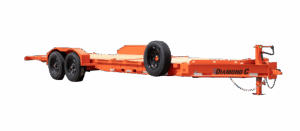
Many tandem-axle trailers in the 7,000-lb-and-higher classes are built with electric brakes, but equipment varies by manufacturer, model, axle option, model year, and dealer order. Diamond C’s premium FMAX, HDT, LPT, LPX, WDT, and DEC lines use LIPPERT axles as standard. Available axle capacities, brake types, GVWRs, and wheel-brake configurations vary by model and selected options, so the trailer’s VIN-specific certification label and build documentation remain controlling.
A current Diamond C LPX is a low-profile extreme-duty equipment trailer available in multiple lengths and ratings beginning around the 14,900- to 15,500-lb class and extending higher with the appropriate configuration. A tandem-axle LPX equipped with electric brakes on all four wheels and a functioning breakaway system is substantially different from a light utility trailer that is merely wired for a brake controller. Before purchasing, confirm the exact GVWR, GAWR for each axle, number of braked wheels, coupler or gooseneck rating, tire capacity, and payload shown for that individual trailer.
The gray zone is often the 3,000- to 6,000-lb range. A single-axle utility trailer with a 3,500-lb axle may be sold as an unbraked configuration in a market where that setup is lawful for its intended weight, or it may be ordered with an electric-brake axle. The axle’s nominal capacity does not by itself establish the trailer’s GVWR, and neither number proves that brakes are installed. Inspect the hubs, wiring, breakaway switch, battery, seven-way connector, and certification label, and ask the dealer to identify the actual axle and brake package.
Skipping brakes is not simply a question of whether the tow vehicle is powerful enough. A trailer that is lawful while empty can cross a gross-weight threshold after equipment, materials, water, fuel, or cargo are added. In Indiana, a trailer operated at a gross weight of at least 3,000 lbs must have compliant brakes even if its rated capacity is higher and it happens to be lightly loaded on another trip. If the same trailer enters a state with a lower threshold or a different unladen-weight rule, that state’s operating requirements also need to be considered.
Brakes also do not increase the tow vehicle’s certified towing capacity, GCWR, receiver rating, hitch-ball rating, payload rating, rear GAWR, or tire capacity. Every limit in the towing system still applies. Trailer payload is generally the trailer’s GVWR minus its actual empty weight, but installed options, ramps, spare tires, batteries, tarps, and toolboxes can reduce the cargo capacity available on a particular unit.
A Note on Multi-State Trips
When crossing state lines, do not assume that the equipment law of the trailer’s registration state automatically overrides the law of every state where it is operated. Reciprocity provisions and exemptions vary, and they may not excuse unsafe or noncompliant brake equipment. Review each state’s current rules and configure the trailer to meet the most demanding applicable requirement on the planned route.
For example, a trailer that is lawful without brakes under one state’s gross-weight or performance rule may still require brakes in California or Nevada at 1,500 lbs gross weight, or in Idaho once its unladen weight reaches 1,500 lbs. Oregon is a different kind of example because it emphasizes the combination’s braking equipment and stopping performance rather than a general 1,800-lb trailer threshold. Route planning therefore requires more than choosing the lowest number from a secondary-source chart.
A practical baseline for interstate travel is to equip a trailer that can reach 3,000 lbs with properly sized service brakes and an independent breakaway system, but that baseline does not guarantee compliance everywhere. A lower state threshold, an all-wheel requirement, an unladen-weight rule, a trailer-type provision, or a commercial-vehicle regulation may demand more.
Brake Controller Requirements
A conventional electric-brake trailer needs a compatible, functioning brake controller in the tow vehicle. Factory-integrated controllers are available in many modern trucks. Aftermarket controllers may be proportional or time-delayed. Proportional units, including appropriate models in the Tekonsha Prodigy family, sense deceleration and vary trailer-brake output accordingly. Time-delayed units, such as the Reese Towpower Pilot, increase output according to their programmed timing and gain settings. The Reese Pilot should not be described as a proportional controller.
Either design can be suitable when correctly installed, adjusted, and lawful for the application, although proportional control is generally smoother during varied braking. The controller’s maximum axle capacity must match the trailer configuration. Gain and boost settings should be adjusted for the trailer’s loaded condition according to the controller and tow-vehicle instructions. Excessive output can lock the trailer wheels; insufficient output forces the tow vehicle to do too much of the stopping.
A controller is not required merely because every trailer must have one. It is required when the service-brake design needs electrical control from the tow vehicle. A purely hydraulic surge-brake trailer operates differently and normally does not use a conventional electric-brake controller. Electric-over-hydraulic systems require a controller specifically compatible with that actuator. Air-brake systems have their own controls and regulations.
Before every trip, connect the trailer and verify normal controller response at low speed in a safe area. Use the manual control to confirm that the trailer brakes engage, but do not rely on the manual lever as a substitute for correct automatic operation. Check the seven-way connector, grounds, brake wiring, breakaway switch, battery charge, and any warning displayed by the tow vehicle. Never tow with the breakaway pin intentionally removed; the breakaway circuit is intended for an actual separation, not as a parking brake.
Common Questions
Does the threshold apply to GVWR or actual loaded weight? It depends on the state. Indiana uses “gross weight” in IC 9-19-3-3. Other jurisdictions may use actual gross weight, registered gross weight, maximum gross weight, manufacturer’s GVWR, or empty or unladen weight. Idaho and Ohio are important examples of states whose commonly cited rules involve unladen or empty weight. Read the controlling definition instead of automatically substituting GVWR.
What does “gross weight” mean in practice? It generally refers to the trailer and everything carried on or in it at the time of operation, but the controlling statutory definition can differ. The only reliable way to know actual gross weight is to weigh the loaded trailer on a suitable scale. Tongue or gooseneck weight transferred to the tow vehicle also matters when checking truck payload, axle, hitch, and combination limits.
Do borrowed or rented trailers count? Yes. The equipment laws apply to the trailer being operated, not only to its owner. Before leaving with a rental or borrowed trailer, confirm the certification label, loaded-weight allowance, number of braked wheels, controller compatibility, breakaway operation, coupler, safety chains, tires, lights, and electrical connection. The driver remains responsible for operating a safe and lawful combination even when another business or person owns the trailer.
Does a utility trailer with a 5,000-lb GVWR need brakes even if I never load it heavily? The answer depends on the governing state’s chosen weight measurement. In Indiana, the statutory trigger is a gross weight of at least 3,000 lbs, so an actually loaded trailer below 3,000 lbs is not brought within that section merely because its GVWR is 5,000 lbs. However, another state may use GVWR, registered weight, unladen weight, or a different standard. Because loading changes and interstate travel are common, fitting compliant brakes to a trailer in this class is usually the more versatile and safer configuration.
Are brakes required on every axle? Not always. Some states require brakes on all wheels above the threshold. Others permit brakes on one axle or at least one wheel on each side within a particular weight band. The law of every state where the trailer operates, together with the manufacturer’s approved configuration, determines what is acceptable. Removing brakes from one axle or substituting a lower-capacity axle can also invalidate the trailer’s certified configuration and create serious safety problems.
Does having a breakaway switch prove the trailer brakes work? No. The switch, battery, wiring, magnets or hydraulic actuator, drums or rotors, and mechanical adjustments all must function. A dead breakaway battery or corroded connection can leave the trailer without automatic braking. Test and maintain the system according to the trailer, axle, brake, and battery manufacturers’ instructions.
Do these rules apply differently to commercial towing? They can. Federal Motor Carrier Safety Regulations apply to covered commercial motor vehicles in interstate commerce and contain their own brake-equipment, automatic-braking, inspection, maintenance, and performance requirements. State commercial rules may apply as well. Commercial status is based on the operation and vehicle definitions, not simply whether the driver happens to be paid on a particular day.
If you’re not sure what’s on your trailer or what your current setup requires, we can walk you through the equipment. Take a look at our current inventory to review available brake packages and model configurations, or contact us at (812) 829-0226. Before you load up and roll out, verify the trailer’s actual rating, loaded weight, braked wheels, controller operation, and breakaway battery. Those checks are faster and less expensive at the dealership than on the shoulder of a highway.

