





Your trailer tongue cracked. Maybe you spotted a hairline fracture near a main frame rail on your Diamond C LPX. Maybe a cross-member connection opened after a heavy equipment load and you heard it pop. Whatever the source, you are now looking at a potentially structural repair and wondering: can I repair this myself, or does the trailer need to go to a qualified shop?
The honest answer is that limited repairs to non-load-bearing attachments may be suitable for an experienced home welder, while damage involving the tongue, coupler, frame rails, suspension mounts, ramp supports, or securement points generally is not. The decision depends on where the damage occurred, why it occurred, what steel and frame design are involved, and whether the repaired area can be inspected before the trailer returns to service.
Why Trailer Frame Welds Fail
Steel and welds do not normally crack without a cause. Common contributors include cyclic fatigue, overloading, impact damage, corrosion, poor load distribution, altered frame components, and defects in an original weld or previous repair.
Fatigue cracks usually begin at a stress concentration, such as a weld toe, abrupt change in section, unblended repair, improperly placed hole, sharp corner, corrosion pit, or gusset termination. Each trip applies another cycle of bending, twisting, acceleration, and braking force. A crack can begin too small to see and then grow into the surrounding base metal as the trailer accumulates service cycles. Its direction depends on the stress path, so a crack may follow the edge of a weld, cross the heat-affected zone, or extend into the parent steel.
Overloading is more straightforward, but GVWR must be understood correctly. A trailer’s gross vehicle weight rating is the maximum allowable weight of the loaded trailer, including the trailer itself, cargo, fluids, accessories, and permanently installed equipment. It is not the cargo capacity. Loading a 7,000 lb GVWR trailer to an actual trailer weight of 9,500 lb exceeds its rating even if the axles, tires, or coupler appear capable of carrying more. Concentrated cargo can also overload a local section of the frame without exceeding the trailer’s total GVWR. Tongue connections, spring hangers, frame transitions, and the areas beneath equipment tracks can all be affected by improper loading.
Manufacturing or previous-repair defects are another possibility. Undercut, incomplete fusion, inadequate joint preparation, excessive porosity, an incorrect filler metal, or an unsuitable repair sequence may remain hidden until repeated loading exposes the weak area. A visible crack should therefore be treated as evidence of an underlying problem, not merely as a gap that needs to be covered by another bead.
The Frame Zones That Matter
Not every part of a trailer frame carries the same type or magnitude of load. Before considering any repair, determine which zone is damaged and whether it belongs to the trailer’s primary load path.
- Tongue, gooseneck, and coupler area. These are among the most highly loaded areas of a trailer. They transfer acceleration, braking, cornering, and vertical hitch forces between the tow vehicle and the trailer. A crack, deformation, loose fastener, elongated hole, or broken weld here can permit the trailer to separate from the tow vehicle. Do not tow a trailer with suspected damage in this area until it has been evaluated.
- Main longitudinal frame rails. These run from front to rear and carry the trailer body and cargo. A crack in a main rail is serious regardless of its apparent length. The correct repair depends on the rail’s shape, grade, thickness, loading, and original design. Simply placing a bead over the surface may conceal the crack without restoring the rail’s strength or fatigue resistance.
- Cross-members. These lateral members support the deck, maintain frame geometry, and distribute concentrated cargo loads into the main rails. A damaged cross-member or connection can allow the deck to deflect, shift load into neighboring members, or permit the frame to rack. Cross-members should not automatically be treated as non-structural.
- Suspension and running-gear mounts. Spring hangers, equalizer brackets, torsion-axle mounting structures, and their frame connections transmit road impacts and braking forces into the chassis. Cracks, torn mounting holes, displaced hangers, or damaged welds in this area require professional evaluation and an alignment check.
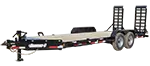
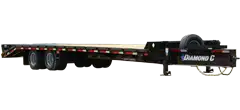
- Rear frame and ramp area. On equipment trailers such as Diamond C LPX and HDT models, rear frame members, ramp supports, hinge mounts, and transition points experience substantial loads as equipment enters or leaves the deck. The severity depends on machine weight, axle spacing, ramp geometry, loading speed, and ground conditions. Cracks or permanent deformation here require more than a cosmetic weld repair.
- Fender mounts and accessory brackets. A stand-alone fender brace, light bracket, or empty toolbox bracket may be non-structural if it does not reinforce the frame or carry cargo. Verify its purpose before cutting or welding. Wiring, brake lines, hydraulic hoses, batteries, fuel, and combustible material must be protected or removed from the work area.
- Stake pockets, rub rails, and tie-down points. These components may be part of the cargo-securement system. Their failure can release cargo even if the trailer frame remains intact. A damaged D-ring, stake pocket, chain spool, or rub-rail connection should be repaired or replaced to a known working-load requirement, not dismissed as a cosmetic attachment.
What “Structural” Actually Means in Practice
A structural weld is one whose failure could reduce the trailer’s load-carrying capacity, change its alignment, release cargo, affect the suspension or brakes, or allow any part of the trailer to separate from the tow vehicle. That ordinarily includes the tongue or gooseneck structure, coupler mounting system, main rails, important cross-members, suspension mounts, ramp or tilt pivots, hoist supports, safety-chain attachments, and structural securement points.
Potentially non-structural work includes certain light brackets, cosmetic fender braces, license-plate mounts, and accessory holders. Even these jobs require care because welding current, heat, grinding debris, and sparks can damage nearby wiring, bearings, brake components, tires, batteries, coatings, or hydraulic systems.
Here is a useful preliminary check. If the damaged component transfers hitch, suspension, cargo, braking, hoist, tilt, ramp, or securement loads, treat it as structural until the manufacturer or a qualified repair professional determines otherwise. The number of visible welds or fasteners does not, by itself, show whether a part is redundant. Several connections may be designed to work together, and failure of one can overload the others.
DIY: When You Can Do It Yourself
A skilled home welder may be able to handle a limited repair if all of the following are true:
- The damaged part is confirmed to be a non-load-bearing accessory or cosmetic attachment, such as an isolated light or license-plate bracket. It is not part of the tongue, frame, suspension, ramp, tilt mechanism, hoist support, safety-chain system, or cargo-securement system.
- The cause of the damage is known and has been corrected. Reattaching a bracket without correcting vibration, interference, corrosion, or inadequate support invites another failure.
- The base-metal type, thickness, and coating are known, and you have a welding procedure, filler metal, equipment, and demonstrated skill appropriate for that exact joint. Machine amperage alone does not establish whether a welder can produce an acceptable joint.
- The joint can be returned to proper alignment and fit-up without forcing distorted pieces together. Allowable root openings, bevels, and joint dimensions depend on the selected welding procedure; there is no universal gap limit that applies to every trailer repair.
- The work area can be made safe. Paint, rust, oil, moisture, and contamination must be removed as required, while tires, wiring, brake lines, batteries, hydraulic hoses, wood decking, insulation, and other combustible or heat-sensitive components are protected. Disconnecting electronics should follow the trailer and equipment manufacturers’ instructions.
- You can inspect the completed work for correct weld size and profile, adequate fusion, cracks, undercut, overlap, arc strikes, and unacceptable porosity. If the repair’s soundness cannot be confirmed visually or if additional examination is warranted, the trailer should remain out of service until a qualified inspector evaluates it.
Replacing a simple, stand-alone fender brace or light bracket may be reasonable for an experienced welder. Reattaching a stake pocket or tie-down point is different because that component may restrain cargo and must have a known capacity after repair. Adding a receiver, pintle connection, stabilizer, winch mount, or other load-bearing attachment changes the forces applied to the frame and should be designed and installed with approval from the trailer manufacturer or a qualified engineer or fabricator.
Call a Pro: When DIY Is Off the Table
Some repairs require a qualified trailer-repair facility or fabricator with the ability to identify the material, develop an appropriate procedure, control distortion, and inspect the finished work. Depending on the damage and applicable requirements, the shop may also need direction from the trailer manufacturer or a professional engineer.
Cracked or broken tongue or gooseneck. Remove the trailer from service and arrange safe transport to a shop. Do not assume the safety chains make towing a damaged tongue acceptable. The shop should inspect the coupler, safety-chain attachments, jack mounts, tongue-to-frame transitions, and neighboring welds in addition to the visible crack.
For commonly used carbon and low-alloy structural steels, AWS D1.1 is a relevant structural-welding code when it is specified for the work. AWS D1.3 addresses qualifying sheet-steel welding within its scope. Neither code should be selected solely from the trailer’s appearance, and an individual welder’s certification does not automatically qualify every procedure, material, position, or repair design. Ask the shop what repair specification, welding procedure, welder qualification, and inspection method it will use.
Main frame rail crack. A cracked longitudinal rail requires evaluation of the entire affected area. Repair may involve removing the crack completely, preparing a suitable joint, replacing a damaged section, installing an engineered reinforcement, controlling heat input and distortion, and inspecting the result. Whether preheat is required depends on factors such as steel composition, thickness, restraint, filler metal, ambient conditions, and the selected welding procedure. It should not be applied from a generic rule.
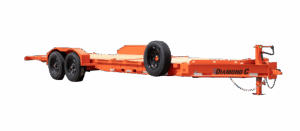
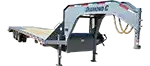
Diamond C FMAX gooseneck trailers are offered in multiple configurations and GVWR classes, with current models using engineered frame structures and Lippert axles. Current LPX equipment trailers are also offered in several configurations, generally from 15,500 through 24,000 lb GVWR, with Lippert axle packages selected for the model. Those ratings do not reveal the thickness or grade at the damaged location. The VIN plate, model configuration, manufacturer documentation, and physical inspection must guide the repair.
Any crack that is growing, branching, recurring, or accompanied by deformation. Crack length alone is not a reliable dividing line between DIY and professional work. A short crack at a highly loaded connection can be more dangerous than a longer crack in a lightly stressed attachment. Rust staining, flaking paint along a line, a visible opening under load, buckling, a shifted axle, an uneven deck, or a repair that has cracked again all justify a comprehensive inspection.
Coupler mount damage. If a coupler, mounting plate, adjustable channel, fastener pattern, or surrounding structure is cracked or deformed, stop using the trailer. Couplers and mounting hardware carry their own component ratings; they are not rated in terms of trailer GVWR alone. Every component in the hitch system must be properly matched to the trailer’s loaded weight and application. Replacement parts, bolt grades, torque values, weld details, and installation procedures should follow the component and trailer manufacturers’ requirements.
Suspension, brake, tilt, or hoist support damage. Repairs near spring hangers, axle mounts, brake hardware, hydraulic cylinders, pivots, or lift supports can affect tracking, braking, stability, and safe operation. These areas need professional inspection, and axle alignment or functional testing may be necessary after the structural work is completed.
A Quick Q&A
Can I just bolt a splice plate over a cracked rail instead of welding?
Do not improvise a field splice and tow the trailer on public roads. A permanent bolted repair can be valid when it is engineered for the rail section, loads, fastener type, hole preparation, edge distance, slip resistance, and corrosion protection. A random plate and bolt pattern can weaken the rail, create new stress concentrations, or hide a growing crack. Arrange safe recovery or transport and have the repair designed for the specific trailer.My frame is galvanized. Does that change anything?
Yes. Heating galvanized steel can produce zinc-oxide fume, which can cause metal fume fever and other respiratory effects. Coatings may also contain additional hazardous substances, and grinding creates its own dust exposure. Coating removal, ventilation or local exhaust, respiratory protection, fire prevention, and restoration of corrosion protection must be addressed through a job-specific hazard assessment. Welding outdoors does not automatically provide adequate exposure control, and an ordinary dust mask is not a substitute for properly selected respiratory protection. Galvanized structural repairs are best referred to a shop equipped for coated-metal work.How much does professional trailer frame repair typically cost?
There is no dependable flat price for a structural trailer repair. Cost varies with the damaged area, trailer design, material, disassembly, access, alignment work, replacement steel, welding procedure, inspection, refinishing, and whether suspension, wiring, brakes, hydraulics, decking, or accessories must be removed. Ask for a written estimate after inspection. For older or extensively fatigued trailers, compare the complete repair cost and remaining service life with the cost of replacement.
Inspecting for Frame Damage Before It Becomes a Repair
The best repair is often the problem caught before it progresses into a major failure. Add frame observations to the manufacturer’s prescribed inspection and maintenance schedule, as well as your normal pre-trip inspection:
- Clean and visually inspect the tongue or gooseneck, coupler mounting structure, adjustable coupler channel, safety-chain attachments, and tongue-to-frame transitions. Look for cracking, rust trails, loose or missing fasteners, elongated holes, displaced components, buckled steel, or paint that has lifted in a straight line.
- Inspect the main rails, cross-members, suspension hangers, equalizers, axle-mounting areas, and visible connections. Check for fresh metal, distortion, cracked coating, loose hardware, uneven tire clearance, abnormal tire wear, or a trailer that no longer tracks correctly.
- Examine rear corners, dovetail transitions, tilt pivots, hydraulic supports, ramp hinges, and ramp-support points on equipment trailers. Loading shock increases when equipment is driven rapidly, approaches at an angle, has narrow track contact, or exceeds the permitted axle or concentrated-load capacity.
- Inspect securement points before every use. Do not attach a chain or strap to a cracked, bent, heavily corroded, or partially detached D-ring, stake pocket, rub rail, or chain spool. Use only designated securement points within their applicable ratings.
- Check underneath the trailer after a pothole strike, curb impact, jackknife, bottoming event, shifted load, collision, or suspected overload. Also inspect wheels, tires, axles, suspension, brake wiring, hydraulic lines, and breakaway equipment.
- Watch a suspect area under good lighting and use mirrors where necessary, but do not crawl beneath an unsupported trailer or enter the path of a raised dump body or tilt deck. Use the manufacturer’s approved supports and lockout procedures.
- Do not rely on tapping a weld with a hammer and judging its sound. Ring or tone is not a recognized substitute for visual examination or nondestructive testing. Hammering can damage coatings and may worsen an existing defect.
On a new trailer, inspect the frame and connections before accepting delivery. Confirm that the VIN plate matches the ordered model and GVWR, that the coupler, safety chains, jack, tires, wheels, axles, brakes, breakaway system, ramps, and securement points match the trailer’s configuration, and that no shipping damage is present. Diamond C builds its trailers in Mt. Pleasant, Texas, and current premium models use Lippert axles and the DM Difference Maker multi-stage coating process. If you find a suspected manufacturing defect, photograph it and contact the dealer or manufacturer before grinding, drilling, heating, or welding anything that could affect warranty review.
What to Tell the Welding Shop
When you take a damaged trailer to a shop, bring as much information as possible: the VIN, manufacturer, exact model, GVWR, unloaded trailer weight if known, axle configuration, photographs, service history, prior repairs, and a description of the cargo and event associated with the damage. GVWR appears on the certification or VIN label, but available payload must be calculated from the trailer’s actual empty or scaled weight and must also account for component and load-distribution limits.
Tell the shop whether the trailer has been overloaded, struck, modified, exposed to road salt, or repaired before. A shop approaching a cracked rail on a heavy equipment or gooseneck trailer needs to evaluate more than the visible opening. The repair plan may change based on the frame design, steel grade, axle and suspension loads, nearby heat-sensitive equipment, and whether the frame is bent or out of alignment.
Ask the shop to inspect the surrounding structure rather than repairing only the obvious crack. Fatigue damage can appear at parallel connections, on the opposite rail, around a reinforcement termination, or beneath paint and accessories. Depending on the location and consequence of failure, visual examination may be supplemented by an appropriate nondestructive method. The shop should also check frame geometry, coupler alignment, axle alignment, brake and lighting operation, and the condition of any components removed during repair.
Ask what caused the failure and how the proposed repair addresses that cause. A sound repair plan should cover crack removal or damaged-section replacement, joint design, reinforcement where appropriate, filler metal, heat and distortion control, qualified personnel, inspection, and restoration of the protective coating. Adding a heavy plate without accounting for how stiffness changes at its ends can simply move the next fatigue crack to another location.
If you are buying a used trailer and the frame has visible weld repairs, that is not automatically a dealbreaker. However, have a qualified trailer-repair professional inspect the work before you put money down or load the trailer. Ask for repair invoices and documentation, look for concealed cracks or distorted rails, and confirm that the VIN plate has not been altered. We see trailers come through our lot in Spencer and at swap meets with professionally completed repairs, while others have surface beads placed over cracks without correcting the underlying fatigue or alignment problem. The difference matters.
Got questions about a trailer you are considering, or one you already own that is showing wear? Reach out to us at (812) 829-0226. Clear photographs of the VIN plate, the full damaged area, the opposite side of the frame, and several wider views can help us understand what you are seeing, although an in-person inspection may still be necessary. We can also help identify qualified structural repair resources in the area. See what we currently have in new and used inventory if replacement is safer or more economical than repairing a heavily damaged or fatigued trailer.


