


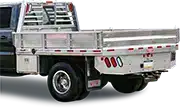
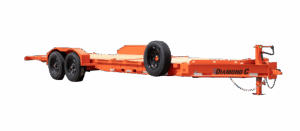


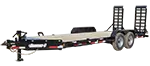


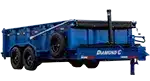



You’re loading a gooseneck equipment trailer with a skid steer, and someone at the dealership says, “It comes with electric brakes.” That’s normal. Electric drum brakes remain the default on many utility, equipment, dump, cargo, livestock, and flatbed trailers. Then you price a car hauler or heavy-duty gooseneck build and the salesperson mentions hydraulic disc brakes, electric-over-hydraulic actuation, or trailer ABS, and suddenly the brake specification matters a lot more than the word “brakes” on a build sheet.
Here’s the truth: most trailer buyers do not think seriously about brakes until they experience weak braking, wheel lockup, an overheated hub, or a controller that will not recognize the trailer. That’s backwards. Brake type affects control, heat management, controller compatibility, breakaway operation, service costs, and legal road use. In Indiana, a trailer or semitrailer with a gross weight of at least 3,000 pounds must have brakes adequate to control, stop, and hold it; the brakes must be applicable from the tow vehicle and must apply automatically if the trailer breaks away. A new trailer at that threshold generally must have service brakes on all wheels. The brake system must also be matched to the trailer’s certified ratings, the tow vehicle, and the actual load. :contentReference[oaicite:0]{index=0}
Electric Brakes: The Standard for a Reason
Electric drum brakes use an electromagnet inside each brake drum. When the tow vehicle’s brake controller sends current through the trailer’s brake-output circuit, the magnet contacts the rotating armature surface inside the drum. That movement operates a lever that pushes the brake shoes outward against the drum. The amount of braking depends on controller output, brake condition, adjustment, wiring quality, available voltage, and tire traction. Depending on the axle and brake assembly, adjustment may be manual or forward self-adjusting, but even self-adjusting brakes still require inspection and proper initial burnishing.
Electric drum hardware normally costs less than a comparable hydraulic disc conversion, and replacement assemblies are widely available. However, pricing should be based on the axle tag and exact hub specification rather than a generic description such as “7K brakes.” Drum diameter and width, bearing combination, wheel bolt pattern, stud size, grease or oil lubrication, ABS sensor provisions, and left- or right-hand orientation all matter. On many common axles, replacing a complete loaded backing-plate assembly can be more economical and reliable than installing individual shoes, springs, and magnets into an old assembly. Labor time varies considerably depending on corrosion, wiring condition, bearing service, drum condition, and whether the trailer has two, four, six, or eight braked wheels.
The brake assembly itself does not decide how aggressively to stop; the controller does. A time-delay controller increases output according to a preset ramp after the brake-light circuit is activated. It can work, but the output is not directly tied to the actual severity of the stop. A proportional controller uses an inertia sensor or, in some factory-integrated systems, vehicle brake-pressure and network data to better match trailer braking to tow-vehicle deceleration. The Tekonsha Prodigy P2 is a proportional controller rated for electric and compatible electric-over-hydraulic operation, but it must be placed in the correct mode for the system being controlled. Proper gain and boost settings still have to be established through a controlled road test with the trailer loaded as it will normally be used. :contentReference[oaicite:1]{index=1}
Electric brakes work best on:
- Utility, equipment, dump, cargo, livestock, and flatbed trailers that need a proven, widely serviceable brake system
- Tandem- and triple-axle trailers where replacement drums, magnets, shoes, and complete brake assemblies need to be available across a broad service network
- Applications where lower initial cost, straightforward diagnostics, and field repairability are more important than maximum resistance to repeated high-energy braking
- Trailers used on dry land and inspected regularly after storage; enclosed drums are protected from direct road debris, but they can still collect moisture, rust, grease contamination, or corrosion and should not be treated as maintenance-free
Diamond C uses Lippert axles across its current trailer lineup. On models such as the FMAX gooseneck flatbed and LPX low-profile equipment trailer, the exact brake package depends on axle capacity, GVWR package, and build configuration. Current configurations commonly pair 7,000-lb Lippert axles with electric drums, while several 8,000-lb-and-up packages offer or include electric drum brakes with Lippert ABS. Electric-over-hydraulic disc brakes remain available on many heavy-duty FMAX, LPX, HDT, and LPT configurations. The 2026 Lippert ABS system adds wheel-slip management, dynamic brake assistance, sway-control functions, and system diagnostics while retaining electric drum brake hardware. Many current H&H and Delco equipment, utility, dump, cargo, and car-hauler models also use electric brakes, but the exact unit’s VIN, axle tag, and build sheet should always control the answer. :contentReference[oaicite:2]{index=2}
Hydraulic Disc Brakes: Where the Physics Get Better
Hydraulic disc brakes use pressurized brake fluid to move caliper pistons and clamp pads against a rotor. Pressure can be created by a surge coupler or by an electric-over-hydraulic actuator. Do not confuse the actuation method with the friction hardware: hydraulic drum systems also exist, while the systems discussed here combine hydraulic actuation with disc rotors and calipers. On heavy Diamond C builds, selecting hydraulic disc brakes generally means an electric-over-hydraulic system rather than a surge coupler.
The main advantage of a properly sized disc system is consistent braking during repeated or high-energy stops. An exposed rotor transfers heat to surrounding airflow more effectively than a brake drum, and the pad and rotor surfaces are easier to inspect without removing a drum. That can reduce fade during repeated braking on grades or in stop-and-go commercial service. It does not guarantee one universal stopping-distance improvement. Tire grip, axle loading, controller calibration, ABS, brake size, brake temperature, road surface, tow-vehicle brakes, hitch setup, and load distribution all influence the result. No responsible dealer should promise a fixed number of feet without a controlled comparison involving the same truck, trailer, load, tires, and test conditions. :contentReference[oaicite:3]{index=3}
There are two common delivery systems:
- Surge/hydraulic actuator: The trailer’s forward movement compresses a sliding coupler during tow-vehicle deceleration. That movement operates a master cylinder and sends hydraulic pressure to the calipers. A conventional in-cab electronic brake controller is not used. Disc-brake surge systems normally require a reverse-lockout arrangement so the brakes do not apply while backing, and they still need functioning trailer-light wiring. They also require a dedicated breakaway cable and mechanism. Surge brakes are common on boat trailers and selected car haulers, but federal commercial rules limit their use according to trailer GVWR and the relationship between trailer and tow-vehicle ratings. For commercial operation, surge brakes are allowed on trailers up to 12,000 lb GVWR when the trailer rating does not exceed 1.75 times the tow vehicle’s GVWR, and on trailers above 12,000 but below 20,001 lb when the trailer rating does not exceed 1.25 times the tow vehicle’s GVWR. State and application-specific rules should also be checked. :contentReference[oaicite:4]{index=4}
- Electric-over-hydraulic (EOH): A powered actuator receives the tow vehicle’s brake-controller signal and converts it into hydraulic pressure. A complete installation requires a compatible brake controller, the brake-output circuit, adequate 12-volt power and ground, hydraulic lines, the correct brake fluid, and an operational breakaway battery and switch. EOH preserves controller-adjustable braking and manual trailer-brake application while providing the heat management and clamping force of disc hardware. Diamond C offers EOH disc packages on numerous heavy-duty flatbed, equipment, tilt, and dump configurations. :contentReference[oaicite:5]{index=5}
A complete hydraulic disc package costs more initially because it includes rotors, calipers, brackets, hydraulic lines, fluid, an actuator, wiring, and breakaway equipment. Current factory upgrade prices vary by model and axle package and can amount to several thousand dollars, so a dealer quote is more useful than a generic per-axle price. Diamond C identifies DeeMaxx as its disc-brake component partner for 7,000- through 16,000-lb disc-brake applications. Disc pads can often be serviced separately without replacing an entire drum assembly, which may reduce wear-item costs for a high-mileage operator, but the actuator, hydraulic plumbing, brake fluid, caliper slides, seals, and rotors add maintenance points that electric drums do not have. :contentReference[oaicite:6]{index=6}
Controller Compatibility: You Can’t Mix These Up
This is where buyers make expensive mistakes. Electric drum brakes, electric drum brakes with trailer ABS, surge-actuated hydraulic brakes, and EOH disc brakes do not all use the same control strategy. An electric drum controller sends modulated voltage and current to brake magnets. A pure surge system does not use that signal to create brake pressure. An EOH actuator uses a brake-output signal as a command, but the controller and actuator must be compatible. An incompatible controller is more likely to produce weak output, pulsing, a trailer-not-connected warning, fault codes, or no useful braking than to operate normally. Controller compatibility should be confirmed before the trailer is delivered, not guessed during the first loaded trip.
Surge-brake trailers do not require an electronic brake controller for service-brake operation, but that does not mean they require no electrical or safety setup. The trailer still needs its road-light circuits, and a disc-brake surge actuator commonly uses a reverse-lockout solenoid connected through a five-way or seven-way plug. The breakaway cable must be attached independently of the safety chains and must be capable of applying the trailer brakes if separation occurs. A surge system also does not give the driver the same independent manual trailer-brake control available with an electronic controller, which can be useful when correcting trailer sway. The truck, hitch, coupler, tires, and combination still have to be properly rated even though no electronic controller is used.
EOH systems require a controller or factory-integrated brake controller that expressly supports hydraulic mode and the specific actuator. The Prodigy P2 supports most customer-supplied EOH systems and includes separate electric and electric/hydraulic modes. That does not make every factory controller universally compatible. Compatibility can vary by tow-vehicle manufacturer, model year, software, actuator generation, and whether a compatibility module is required. Older trucks may also lack a complete seven-way brake-output and charging circuit. Test the actual truck and trailer together, verify the selected brake mode, confirm that the actuator builds pressure smoothly, and test the breakaway system before loading. :contentReference[oaicite:7]{index=7}
Quick rule: Electric drum brakes need a compatible controller. Surge disc brakes operate mechanically and do not use an electronic brake controller, although reverse-lockout wiring may still be required. EOH disc brakes need a hydraulic-compatible controller, adequate power and ground, a functioning actuator, and an operational breakaway system. Confirm the complete combination before you buy.
A Direct Comparison
| Factor | Electric Drum | Hydraulic Disc |
|---|---|---|
| Initial cost (per axle, parts) | Generally lower; complete brake assemblies and drums are broadly available | Generally higher because the system also needs calipers, rotors, lines, fluid, and either a surge or EOH actuator |
| Stopping power at speed | Good when correctly sized, burnished, adjusted, wired, and controlled; ABS can improve lockup management on equipped trailers | Typically stronger and more consistent during repeated high-energy stops, provided the actuator and controller are correctly matched |
| Heat resistance | Moderate; the enclosed drum retains more heat and can fade when repeatedly worked near its thermal limit | High; the exposed rotor sheds heat more effectively and is easier to inspect |
| Controller required | Yes, unless the tow vehicle has a properly configured factory-integrated controller | EOH requires a hydraulic-compatible controller; surge does not use an electronic controller |
| Field repairability | Excellent; magnets, shoes, drums, and complete backing plates are common service parts | Moderate; pads may be simple to replace, but calipers, rotors, hydraulic lines, and actuators must match the system |
| Storage/corrosion | Drums shield components from direct debris but can hide moisture, rust, grease contamination, or seized hardware | Rotors may develop visible surface rust and caliper slides can corrode, but the friction surfaces are easier to inspect |
| Best application | General utility, equipment, dump, cargo, livestock, and flatbed service where cost and parts availability matter | High-mileage car hauling, marine use with corrosion-resistant components, repeated mountain grades, and demanding commercial duty |
When Hydraulic Disc Brakes Are Worth the Extra Cost
High-mileage car hauling is one of the clearest cases. If you’re running a loaded Legend or United aluminum car hauler down I-69 in heavy traffic, carrying a valuable vehicle, or making repeated interstate trips, the additional heat capacity and consistent response of a properly configured disc system may justify the price. That does not mean every aluminum car hauler automatically has hydraulic discs. Depending on the exact model and order, a unit may have electric drums, surge-actuated discs, or EOH discs. Read the build sheet, identify which wheels are braked, and verify the actuator and controller before treating “disc ready” or “hydraulic” as a complete specification.
Boat trailers are another strong application, but the reason is not that hydraulic components stay out of the water. The rotors, calipers, hubs, lines, and portions of the actuator system may all be exposed to water during launching. Disc brakes are popular because they are easier to rinse and inspect, drain more openly, and can be built with galvanized, coated, or stainless corrosion-resistant components. Surge actuation is also convenient because it does not depend on an electronic brake controller. Even a premium marine disc system still needs freshwater rinsing after saltwater use, inspection of hoses and fittings, correct bearing protection, functional reverse lockout, and periodic brake-fluid service. Electric marine brakes exist, but ordinary electric drum hardware should not be assumed suitable for repeated immersion.
Steep terrain and repeated heavy braking also favor disc brakes. On a long descent, each brake application converts the trailer’s kinetic and potential energy into heat. An exposed rotor generally releases that heat faster than a drum, helping the system maintain more consistent braking as temperatures rise. Disc brakes do not replace proper gear selection, tow/haul mode, engine braking, conservative speed, adequate following distance, or a stop to cool the brakes when necessary. A poorly adjusted EOH controller, overloaded axle, dragging caliper, underinflated tire, or bad load distribution can still create a dangerous situation.
But for many trailers most buyers use, including 14,000- to 15,500-lb equipment trailers, utility trailers, dump trailers, livestock trailers, and enclosed cargo trailers, electric drum brakes are completely appropriate when they are sized correctly and maintained. Electric brakes are also used successfully on substantially heavier configurations. GVWR alone does not dictate the answer. Mileage, terrain, stop frequency, axle capacity, number of braked wheels, tire grip, controller quality, and maintenance discipline matter more than a simple claim that one brake type is always superior. Current electric drum ABS packages further narrow the control gap by reducing wheel lockup and managing brake output at the trailer. :contentReference[oaicite:8]{index=8}
Maintenance: What You’re Actually Signing Up For
Electric brake magnets do not have a universal 30,000- or 50,000-mile replacement interval. They should be replaced according to wear, electrical testing, braking performance, and the axle manufacturer’s inspection criteria. New brake shoes and magnets must be burnished so their contact surfaces seat correctly. Inspect wiring, connectors, grounds, magnet faces, shoe lining, springs, drums, seals, and adjustment. A resistance figure such as 3.2 ohms applies to particular Lippert magnet specifications, not every electric brake on every axle, so diagnostics should use the correct manual and expected total current for the number and size of brakes installed. If one brake is badly worn or contaminated, inspect the other brake on that axle and restore braking evenly rather than repairing one wheel in isolation. :contentReference[oaicite:9]{index=9}
Disc brakes need pad, rotor, caliper, hose, hard-line, fitting, fluid, actuator, and electrical inspection. There is no trustworthy universal rotor minimum thickness covering every trailer disc system; use the limit cast, stamped, or published for the exact rotor. Check for tapered pad wear, scoring, cracks, excessive runout, heat discoloration, leaks, contaminated fluid, swollen hoses, damaged wiring, and calipers that do not slide or release correctly. A trailer returning to service after extended storage should be inspected and road-tested in a controlled area before it is loaded. Compare braking response across the axles and investigate any wheel that runs noticeably hotter or colder than the others, but never touch a rotor, drum, or hub immediately after braking because it may cause a serious burn. :contentReference[oaicite:10]{index=10}
Both systems require hub and bearing service, but the interval depends on the hub design rather than the brake type. Traditional grease-lubricated hubs commonly call for bearing inspection and repacking at 12 months or 12,000 miles, whichever comes first, with shorter intervals under severe duty or water exposure. Oil-bath hubs are not repacked like grease hubs; their oil level, cap, seals, contamination, and leakage must be checked according to the axle manual. Diamond C’s current maintenance schedule calls for a pre-trip brake and breakaway check, broader inspections at six months or 6,000 miles, and annual or 12,000-mile inspection of brake systems, brake lines, wheel bearings, and grease or oil level. Follow the schedule for the actual axle, hub, ABS, and brake package installed on the trailer. :contentReference[oaicite:11]{index=11}
What to Ask Before You Buy
When you’re looking at a trailer, ask the dealer these three questions:
- What brake system is installed on this exact trailer, which wheels are braked, does it include ABS, and what does the VIN-specific build sheet show for axle capacity, hub lubrication, actuator, and breakaway equipment?
- Is the system compatible with my truck’s factory or aftermarket controller, and does EOH operation require a hydraulic mode, software setting, compatibility adapter, seven-way charging circuit, or different controller?
- What brake, hub, pad, drum, rotor, caliper, magnet, actuator, and ABS parts are available for this exact axle, and what inspection, fluid, bearing, and breakaway-battery schedule does the manufacturer specify?
We stock and sell trailers from Diamond C, H&H, Delco, Liberty, Legend, and we can walk you through the brake specifications on any unit in our current inventory. We will look at the actual axle tag and build configuration rather than assuming every trailer in a model family is equipped alike. If you’re not sure what your tow vehicle supports, whether the truck’s integrated controller has an EOH mode, or what brake system fits how you will actually use the trailer, give us a call at (812) 829-0226 and we’ll sort it out before you’re standing in a parking lot staring at a wiring diagram.
Brake type does not change the trailer’s certified GVWR, the tow vehicle’s rating, or the driver’s licensing threshold. In Indiana, treat a trailer rated above 3,000 lb as brake-required and verify that its service and breakaway brakes comply with the applicable statutes. For the usual federal Class A CDL analysis, the key combination threshold is a GCWR or actual gross combination weight of 26,001 lb or more together with a towed unit having a GVWR or actual gross weight over 10,000 lb. A trailer exceeding 10,000 lb by itself does not automatically create a Class A CDL requirement when the total combination remains below 26,001 lb, although commercial-use, hazardous-material, passenger, and state-specific rules can add requirements. :contentReference[oaicite:12]{index=12}
The right brake system is the one that matches your load, duty cycle, terrain, tow vehicle, controller, axle package, service network, and willingness to maintain it. Start with the exact trailer specification, verify the complete truck-and-trailer combination, and choose the system that will remain controllable and serviceable after thousands of real-world miles.


