





You’ve got a 10,000-pound mini excavator sitting in a muddy lot and a deadline to move it. The ground is soft, the grade is uneven, and you’re about to deploy a pair of heavy steel ramps before anything moves. That scenario plays out constantly for contractors, farmers, and equipment haulers across Owen County. It is also where a hydraulic dovetail can save time and physical effort.
Hydraulic power comes at a price, though, and it does not make every loading site or every machine automatically safe. For plenty of loads, a properly rated set of spring-assisted manual ramps remains the more practical choice. Here is an honest breakdown of both setups, what affects their real cost, and where each one makes sense.
How a Hydraulic Dovetail Works
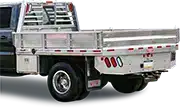
A hydraulic dovetail is a hinged rear section of the trailer deck that lowers under hydraulic power to form a continuous loading surface from the main deck toward the ground. Instead of removing and positioning two separate ramps, the operator uses the trailer’s wired control or wireless remote to lower the tail. Once loading is complete, the dovetail raises to its transport position and an automatic latch secures it. The operator must still confirm that the latch is fully engaged before moving the trailer.
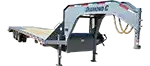
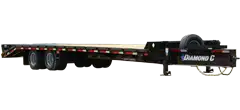
On Diamond C’s FMAX gooseneck flatbed line, the current hydraulic dovetail is a 12-foot loading section with a manufacturer-published 12.5-degree approach angle. It is available on multiple FMAX configurations rather than being a separate trailer model. The FMAX family ranges from 15,500-pound single-wheel configurations to select dual-wheel configurations rated as high as 40,000 pounds.
For a specific comparison, the current FMAX210 is a 25,000-pound GVWR tandem-dual-wheel gooseneck with two 10,000-pound Lippert axles, a 102-inch-wide deck, a 16-inch low-profile engineered-beam frame, and available hydraulic-dovetail loading. Buyers who need more capacity can move to models such as the FMAX212, FMAX310, FMAX312, or FMAX216, with the exact GVWR, axle arrangement, tires, brakes, coupler, and frame determined by the selected configuration.
It is important to understand why a gooseneck trailer’s published GVWR may be higher than the combined axle ratings. Part of the loaded trailer weight is carried by the tow vehicle through the gooseneck connection. That does not permit the operator to exceed the trailer’s axle, tire, wheel, suspension, coupler, hitch, truck payload, rear-axle, or gross-combination ratings. Every rating must remain within its limit.
The Diamond C hydraulic dovetail is rated to lift or carry 10,000 pounds distributed across the length of the tail. That distributed rating is not permission to place an unlimited point load on one runner or one small section. A machine’s total operating weight, axle or track loading, attachment weight, center of gravity, and position during the loading cycle all matter. A 10,000-pound excavator must also fit within the trailer’s available payload after subtracting the trailer’s actual empty weight and any installed options.
The 102-inch deck width on an FMAX is another major distinction. Because the deck sits above the tires, it provides the full legal-width loading platform commonly needed for equipment with wide buckets, tires, tracks, or attachments. Width should still be measured at the machine’s widest fixed point, and attachments must be positioned and secured so they do not create an overwidth load.
The Manual Ramp Options
Manual loading systems generally fall into two categories: removable slide-in ramps and attached spring-assisted ramps that stand up, fold over, or pivot from the rear of the trailer.
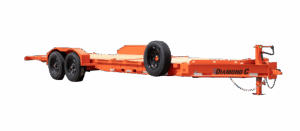
Slide-in channel ramps are removable steel ramps carried in storage channels beneath or alongside the trailer deck. On a straight-deck Diamond C FMAX configuration, for example, the current loading package includes 96-inch rear slide-in ramps made from 3-inch channel. The operator removes the ramps, places them at the correct spacing, confirms that they are fully seated against the trailer, loads the machine, and returns the ramps to their storage position. Slide-in ramps keep the rear of the deck open during transport, but they require more handling and more careful placement on uneven ground.
The weight and capacity of a removable ramp depend on its length, construction, reinforcement, and intended trailer. There is no reliable universal ramp weight. Some can be handled comfortably by one operator, while heavier equipment ramps may be difficult to move repeatedly without assistance. The ramp’s published capacity, attachment method, spacing, and suitability for concentrated wheel or track loads must be verified before use.
Attached folding or stand-up ramps remain connected to the trailer. H&H’s current Industrial Equipment Trailer line uses 5-foot heavy-duty stand-up ramps with spring assist and is offered in 14,000- and 16,000-pound GVWR configurations. H&H’s Super Deluxe Ramp Industrial Equipment Trailer uses full-width fold-over ramps with a 4-foot self-cleaning dovetail. These arrangements eliminate the need to carry loose ramps and can be deployed quickly, but the operator must still release, lower, raise, latch, and inspect them correctly.
Diamond C offers several current manual loading systems matched to specific trailer families. FMAX goosenecks can be ordered with 44-inch-wide MAX Ramps or 24-inch-by-60-inch XDR Ramps. The bumper-pull LPX can use spring-assisted 24-inch-by-60-inch flip-knee ramps, 37-inch-wide MAX Ramps on compatible lengths, or an X-Ramp with the appropriate max-width package. The LPX MAX Ramp configuration includes a 36-inch self-cleaning dovetail, while the ramp frames use high-strength steel and spring assistance to reduce lifting effort.
Manual does not mean maintenance-free. Hinges, springs, pivot points, ramp feet, support bars, latches, welds, and the ramp-to-trailer connection all require inspection. A bent ramp or worn hinge can be just as serious as a hydraulic leak. The advantage is that the system contains fewer electrical and hydraulic components and is often easier to diagnose in the field.
Loading Ease: Real Differences, Not Marketing Copy
Approach angle is the first major difference, but it has to be compared correctly. A 5-foot ramp rising directly to a 20-inch-high deck would create an angle of roughly 19.5 degrees. Most serious equipment trailers improve on that geometry with a dovetail, lower deck, longer ramp, or a combination of all three. Therefore, not every manual-ramp trailer has a 20-degree approach angle, and no single angle applies to every fold-ramp design.
Diamond C publishes a 12.5-degree approach angle for its current 12-foot FMAX hydraulic dovetail. That is a useful, verifiable figure, but actual loading conditions can still change the effective angle. Parking the trailer with its rear downhill can flatten the transition, while placing the rear uphill can make it steeper. Soft ground may allow the end of the tail or a manual ramp foot to sink, twist, or lose support.
A hydraulic dovetail should not be treated as a solution for an unsafe loading site. Before lowering it, position the truck and trailer on firm, stable ground, set the truck’s parking brake, chock as required, clear people from the operating area, and make sure the tail has adequate clearance. Where approved blocking or cribbing is necessary, it must be stable and appropriate for the load. Never rely on loose scrap lumber, unstable soil, or the hydraulic system alone to compensate for a poor setup.
Machine geometry matters as much as machine weight. Track length, wheelbase, belly clearance, rear counterweight, attachment position, tire diameter, grouser design, and the distance between the machine’s contact points determine whether it will transition cleanly from the loading surface to the deck. A lower angle can reduce breakover problems, but it does not eliminate the need to check clearance.
Rubber-tracked compact equipment often benefits from a long, continuous loading surface because the tracks stay supported through more of the transition. Steel-tracked equipment requires additional attention to traction, deck protection, and the loading-surface material. Wheeled skid steers, tractors, telehandlers, and vehicles may tolerate a steeper transition, but low attachments, mower decks, stabilizers, steps, and exhaust components can still drag.
The second difference is setup consistency. A hydraulic dovetail lowers to the same basic position without requiring the operator to carry and align two separate ramps. Attached spring-assisted ramps are also much faster than older loose-ramp arrangements and can often be handled efficiently by one experienced operator. The actual time saved may be a few minutes per loading cycle rather than a fixed 15- or 20-minute figure. The financial value depends on how often the trailer is loaded, how many operators are available, and how much jobsite time the system saves over a season.
A hydraulic system is especially useful when one operator loads several times per day. Manual ramps remain competitive when the trailer is loaded occasionally, the site is predictable, and the ramps are properly balanced with effective spring assistance. The safest system is the one that fits the machine and is consistently used according to the manufacturer’s instructions.
Capacity and Build Specs Side by Side
| Feature | Diamond C FMAX210 With Hydraulic Dovetail | H&H 82″ x 20′ Super Deluxe Ramp 14K | Diamond C LPX 18′ With MAX Ramps |
|---|---|---|---|
| GVWR | 25,000 lb | 14,000 lb | 15,500 lb in the 207 package; other LPX configurations reach 24,000 lb |
| Axle Rating | Dual 10,000 lb Lippert axles | Dual 7,000 lb axles | Dual 7,000 lb Lippert axles in the 207 package |
| Ramp Setup | 12-ft hydraulic dovetail with automatic latch and wireless remote | Full-width fold-over ramps with 4-ft self-cleaning dovetail | Two 37-in spring-assisted MAX Ramps with 36-in self-cleaning dovetail |
| Load Time (solo) | Powered and highly repeatable; no loose ramps to position | Manual but spring assisted; deployment time depends on the operator and site | Manual but heavily spring assisted; no separate slide-in ramps to carry |
| Approach Angle | 12.5 degrees as published by Diamond C | Configuration and ground dependent; no universal angle should be assumed | Configuration and ground dependent; lower than a straight ramp because of the dovetail |
| Best For | Frequent loading, low-clearance machines, heavy equipment, and repeated jobsite cycles | Equipment within the trailer and ramp ratings where mechanical simplicity is preferred | Heavy bumper-pull equipment applications where deck width, fender clearance, and payload fit the machine |
GVWR is not payload. Payload is the trailer’s GVWR minus its actual empty weight as equipped. Hydraulic loading equipment, upgraded brakes, heavier flooring, toolboxes, spare tires, winches, additional axles, and other options all affect empty weight. Use the completed trailer’s VIN label, certified weight information, and actual scale weight rather than subtracting a generic brochure weight.
Ramp capacity also remains a separate limit. A trailer can have enough overall payload while its ramps, dovetail, deck section, or tie-down points are not appropriate for a particular concentrated load. Confirm the capacity of the exact loading system installed on the trailer, not merely the model family’s maximum GVWR.
Diamond C’s current premium FMAX and LPX lines use Lippert axles and the company’s DM Difference Maker multi-stage coating system. That coating process includes surface preparation, washing, corrosion-resistant primer, topcoat, and controlled curing. Diamond C has manufactured trailers in Mt. Pleasant, Texas, since 1985.
Where Manual Ramps Still Win
Do not write off ramps entirely. For many buyers, a properly designed manual-ramp trailer is still the smarter purchase.
- The price difference is real, but it is not a fixed number. A hydraulic dovetail adds the powered tail structure, cylinder, pump, reservoir, battery, controls, wiring, remote system, and automatic latching hardware. Current similarly sized inventory examples commonly show a several-thousand-dollar difference between hydraulic-dovetail and manual-ramp FMAX configurations, but the final spread also reflects length, GVWR, brakes, tires, flooring, suspension, jacks, and other options. Compare itemized, out-the-door quotes for genuinely equivalent trailers rather than assuming an automatic $8,000-to-$15,000 premium.
- There are fewer powered components to service. A manual system still has hinges, springs, latches, ramp feet, and welds, but it does not depend on a hydraulic pump, charged battery, cylinder seals, hoses, electrical connections, or remote control. For owners working far from a shop, that mechanical simplicity can be valuable.
- The trailer can be lighter. A hydraulic dovetail adds structure and power-system components, increasing the trailer’s empty weight and reducing available payload pound for pound. The exact difference varies substantially by model and configuration, so it should be taken from the completed build sheet or verified scale weight instead of using a generic 300- or 600-pound estimate.
- Manual-ramp choices cover a broad capacity range. H&H offers current industrial equipment trailers with 14,000- and 16,000-pound GVWR packages, while Diamond C’s LPX ranges from approximately 15,500 to 24,000 pounds and the FMAX line extends much higher. Manual ramps are not limited to ATVs and mowers; the correct heavy-duty system can load skid steers, tractors, compact track loaders, excavators, and other machinery within every applicable rating.
For a business purchase, eligible qualifying property acquired and placed in service after January 19, 2025, may qualify for 100% bonus depreciation under current federal tax rules. That is a tax treatment rather than an immediate discount, and business-use, ownership, placed-in-service, basis, and other requirements apply. Buyers should obtain advice from their tax professional instead of assuming that every trailer purchase produces the same deduction.
The Decision Is Really About Your Machine
Ask yourself one question: what is the heaviest and most difficult piece of equipment you will load regularly? Then go beyond its advertised operating weight. Record the weight with the bucket, forks, hammer, mower, counterweights, fuel, chains, and other attachments that will actually travel with it.
Also measure overall width, track or tire width, wheelbase or track-contact length, ground clearance, attachment clearance, and the location of the machine’s center of gravity. A trailer that has adequate payload can still be a poor match if the machine will not clear the fenders, the tracks do not align with the ramps, the bucket overhang creates an overwidth condition, or the load cannot be positioned for safe tongue or pin weight.
If you load low-clearance or tracked equipment several times per day, routinely work alone, or need the repeatability of a continuous powered loading surface, the Diamond C 12-foot hydraulic dovetail can earn its additional cost. It is particularly attractive for contractors who value reduced ramp handling and who have a tow vehicle correctly matched to an FMAX gooseneck configuration.
If you haul less frequently, work on predictable surfaces, or prefer a simpler trailer with lower empty weight, a spring-assisted manual system can be the better call. An H&H industrial equipment trailer, a Diamond C LPX with flip-knee ramps or MAX Ramps, or an FMAX with MAX Ramps or XDR Ramps can handle serious machinery when correctly configured. The decision should not be based on an arbitrary 8,000-pound cutoff.
Hitch type is another dividing line. A bumper-pull LPX places tongue weight on the truck’s receiver system and is limited by the receiver, ball mount, ball, truck payload, rear axle, and towing ratings. An FMAX transfers pin weight through a bed-mounted gooseneck hitch, generally improving stability and weight distribution for larger trailers, but it consumes truck payload and requires a compatible hitch installation.
A Quick Q&A
Can a hydraulic dovetail replace ramps entirely? For normal ground-level loading within the dovetail’s ratings, yes. It provides the loading surface without separate ramps. It should not be used as an unsupported bridge, a dock plate, or a substitute for purpose-built loading equipment across a gap. Dock loading or loading from a raised surface requires a setup specifically approved for that application.
Does the trailer need a special truck? A Diamond C FMAX requires a truck equipped with a bed-mounted gooseneck hitch and a ball or adapter matched to the trailer’s coupler and rating. A properly equipped one-ton dually is common with 25,000-pound FMAX configurations, but it is not a universal minimum or an automatic approval. Check the truck’s specific VIN-based towing guide, payload label, GVWR, rear GAWR, GCWR, tire ratings, hitch rating, and available payload after passengers, fuel, tools, and bed cargo. Base the decision on the trailer’s expected actual loaded weight and pin weight, not solely on its maximum GVWR.
Every equipment trailer discussed here is well above Indiana’s trailer-brake threshold. Indiana requires a trailer or semitrailer at or above 3,000 pounds gross weight on the highway to have adequate brakes controllable from the tow vehicle and an automatic breakaway function. The truck therefore needs a compatible brake controller. A trailer equipped with electric-over-hydraulic brakes may require a controller specifically capable of operating that system.
How long does the hydraulic system last? There is no responsible fixed lifespan because service life depends on use, weather exposure, battery care, contamination, maintenance, and physical damage. Inspect the cylinder, hoses, fittings, wiring, battery, charger, pivot pins, latch, and remote operation regularly. Keep the battery charged, repair leaks promptly, and use the fluid specified for the system; Diamond C’s current general guidance identifies Dexron III automatic-transmission fluid for its applicable trailer hydraulic systems. Never work beneath an unsupported raised dovetail.
Will I need a CDL? Trailer GVWR by itself does not create the federal Class A threshold. For commercial operation, a Class A CDL generally applies when the combination’s rated or actual gross combination weight is 26,001 pounds or more and the towed unit’s rated or actual gross weight is more than 10,000 pounds, using the applicable regulatory definitions. Commercial use, interstate versus intrastate operation, farm and other exemptions, medical-card rules, USDOT requirements, and the driver’s state of licensing can affect the answer. Confirm the exact combination and type of operation before hauling.
How quickly must an Indiana buyer register the trailer? Indiana residents generally must title and register a newly acquired, previously unregistered vehicle within 45 days of purchase or acquisition. Keep the bill of sale, title or manufacturer’s certificate of origin, temporary permit, and other purchase documents available until the permanent registration is complete.
What to Do Next
If you are trying to determine which setup fits your equipment and truck, bring the machine information and the truck information to the lot. For the machine, include operating weight with attachments, outside width, track or tire spacing, ground clearance, wheelbase or track-contact length, and photographs of the underside and attachments. For the truck, bring the VIN, door-jamb payload label, receiver or gooseneck-hitch rating, rear-axle rating, and the manufacturer’s towing information for that exact configuration.
Spencer Trailers carries Diamond C FMAX hydraulic-dovetail and manual-ramp configurations, Diamond C LPX and HDT equipment trailers, H&H equipment and tilt trailers, and other working-trailer options. Inventory changes, so compare the actual VIN labels, loading systems, empty weights, brakes, tires, couplers, and installed options on the units currently available. Seeing the deck height, dovetail, ramp width, and loading transition in person is more useful than comparing model-family maximums on a generic chart.
Browse the current trailer inventory at Spencer Trailers or call (812) 829-0226 to talk through your haul requirements before you commit. The right trailer usually becomes clear once the machine’s real dimensions and weight are matched against the completed trailer’s ratings.
And if you are still deciding between a gooseneck hydraulic dovetail and a bumper-pull manual-ramp setup, that is a separate comparison worth making carefully. Hitch type changes pin or tongue weight, truck payload use, turning characteristics, bed access, overall capacity, licensing exposure, and the amount of truck required to operate the combination safely.


