









You bought the sleds. You’ve got a truck. Now you’re standing in your driveway realizing you need a safe way to move two machines that may weigh 500 to 700 pounds apiece before fuel, accessories, ice, and riding gear are added. A pickup bed is rarely practical for two sleds. A general-purpose farm trailer may not have the deck geometry, ramp system, brakes, or rated securement points needed for winter highway travel. And that old single-axle utility trailer your neighbor offered may have too little payload, the wrong coupler, worn tires, or no legally required brakes.
Snowmobile-ready trailers are built or configured around several requirements that ordinary cargo hauling does not always address: low-angle loading, ski clearance, track traction, rated tie-down points, corrosion resistance, and enough usable floor space for the complete machines. The right trailer will load predictably in the dark at 5 a.m., handle winter road spray, and remain within the ratings of the trailer, tires, hitch, and tow vehicle. The wrong one can cost you loading time, damage expensive sleds, overload your truck, or create a serious securement problem on the highway.
Here’s what actually matters when you’re shopping.
Open or Enclosed: The Real Trade-Off
Most buyers start with this question, and it’s the right one to start with because it affects purchase price, empty weight, towing demand, storage, maintenance, and how much cleanup you will face after every trip.
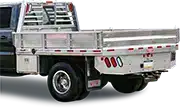
Open snowmobile trailers are generally less expensive, lighter, and easier to inspect and wash. Purpose-built versions commonly use a low, full-width aluminum deck that allows two sleds to sit side by side, while adaptable utility trailers may use an extruded aluminum or treated-wood floor with separate ramps or a rear gate. Current aluminum utility models from H&H Trailers can be configured for recreational use when the deck dimensions, ramp approach, payload, and tie-down system fit the sleds. Open trailers are easy to rinse after a slushy ride, and you can visually check the machines during fuel stops. The disadvantage is exposure: road salt, liquid brine, gravel, freezing spray, and dirty snow can reach the suspension, skis, cooling system, controls, and finish. For occasional local trips, that may be an acceptable trade. For repeated multi-hour highway trips, the cleanup and corrosion prevention become a much bigger part of ownership.
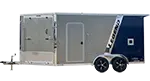
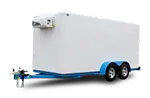
Enclosed snowmobile trailers provide substantially better protection from direct salt spray, road debris, and weather. They are not completely sealed environments, however. Snow and brine still enter on the skis and track, moisture can condense inside, and the trailer needs appropriate ventilation and drying after use. Current snow-and-sport trailers from Legend Manufacturing are available with aluminum tube-frame construction and front and rear ramp doors, creating a drive-through loading arrangement that is especially useful when several sleds are carried in a narrow trailer. Wells Cargo also offers enclosed sport-trailer configurations, including aluminum SportTrac models designed around powersports use. Depending on size, construction, interior finish, cabinets, spare tires, fuel storage provisions, and other options, an enclosed trailer can weigh from roughly 1,500 pounds to well over 3,500 pounds before the first sled is loaded. That empty weight must be deducted from GVWR to determine actual cargo capacity.
So which one? Choose open when minimizing purchase price and tow weight matters most, your trips are relatively short, and the sleds are stored indoors between rides. Choose enclosed when you make longer trips, regularly travel on treated winter roads, want secure storage, or need room for riding gear, tools, spare parts, and track maintenance. The number of sleds matters, but it is not the only factor. Two high-value sleds hauled through winter storms may justify an enclosed trailer just as easily as a four-sled group does.
Deck Length: Don’t Get This Wrong
Snowmobile track length and overall machine length are different measurements. A track described as 137, 146, 155, or 165 inches does not mean the sled occupies that exact amount of trailer floor. For example, a current Polaris TITAN Adventure Ultimate uses a 155-inch track while the complete machine is approximately 133 inches long. Current trail, crossover, mountain, and utility sleds commonly occupy roughly 10 to 11 feet of floor from the ski tips to the rear bumper, but windshields, bumpers, storage boxes, hitch assemblies, and aftermarket accessories can change the required space. Always use the manufacturer’s overall-length specification and then confirm the actual sled with a tape measure.
The loading pattern determines the trailer length. A full-width open deck approximately 101 to 102 inches wide can often carry two compatible sleds side by side on a deck roughly 10 to 12 feet long. A deck-between-the-fenders utility trailer is much narrower and usually cannot carry two modern sleds side by side. Two sleds loaded truly nose-to-tail may require approximately 20 to 24 feet of usable floor, although an enclosed V-nose, angled positioning, or staggered loading can reduce the rectangular box length needed. Be careful when comparing advertised enclosed-trailer sizes: a snow trailer identified as 7×17, for example, may combine a shorter rectangular box with several feet of usable V-nose. The model’s floor plan, not the number in its name, tells you whether your sleds will fit.
For most recreational riders with two trail sleds, the practical open-trailer target is a full-width deck around 101 to 102 inches wide and enough usable length for the longer machine, commonly 10 to 12 feet. A narrow enclosed drive-through trailer generally needs a longer layout because the sleds are arranged inline, staggered, or partly into the V-nose. Measure each sled’s overall length, maximum ski width, height with the windshield installed, and width with mirrors or accessories. Then compare those dimensions with the clear ramp-door opening, interior fender boxes, wall-to-wall width, V-nose geometry, and the space needed to reach tie-down points. Mountain and utility sleds deserve particular attention because long tunnels, tall windshields, rear cargo systems, and wide ski stances can change the fit even when two models have similar track lengths.
Tilt Decks: The Feature Nobody Talks About Enough
Snowmobiles sit low, their skis need a smooth approach, and the track needs enough traction to climb without spinning. That makes loading angle important, especially when the parking area is icy, the trailer tires are sitting in packed snow, or the ramp is coated with frozen slush.
A purpose-built tilt-deck trailer lowers the rear of the deck and reduces the transition between the ground, ramp, and trailer floor. On a properly designed snowmobile platform, the sled can be driven or winched onto the deck without handling separate ramps. The deck then returns to its travel position and must be positively latched before the trailer moves. A dampened tilt mechanism can make the deck’s movement more controlled, but traction material, ski guides, deck balance, and correct latch operation remain essential. Never assume that every equipment tilt trailer has snowmobile-friendly dimensions simply because the deck moves.
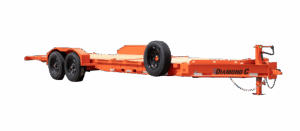
Diamond C Trailers offers hydraulically dampened equipment tilt models for owners who need one trailer to handle machinery as well as recreational equipment. The HDT, for example, is a heavy-duty tilt trailer with model-dependent GVWRs from approximately 15,500 to 24,000 pounds and a deck roughly 80 to 82 inches wide. That width and weight class make it an equipment-hauling platform rather than a conventional side-by-side two-place sled deck. Diamond C’s smaller DSA tilt is offered with narrower deck widths and shorter lengths for compact equipment. Either may serve a mixed-use owner when the exact sled dimensions, deck surface, approach angle, and securement arrangement have been verified, but they should be selected by specification rather than by the tilt feature alone.
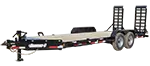
Fixed-deck trailers with properly rated ramps are lighter and mechanically simpler, and experienced riders often load them without difficulty on firm, level ground. An enclosed trailer with both rear and front ramp doors can be even more convenient because each sled can be driven forward through the trailer instead of being backed down a ramp. In winter conditions, the best system is the one that gives you a low, predictable approach, positive footing, enough steering room, and a secure way to load without standing in the sled’s path.
Winter Use Details That Matter
A trailer that’s fine in September can expose weak maintenance, wiring, and loading choices in January. A few specifics are worth considering:
- Coupler freeze. Remove packed snow and ice from the hitch ball, coupler socket, latch, safety-chain attachment points, and jack before connecting. Use only a lubricant or deicer suitable for the coupler manufacturer’s components, because heavy dirt-catching products can make the mechanism harder to inspect. After lowering the coupler onto the ball, close and pin the latch, raise the tongue jack enough to confirm the connection, attach crossed safety chains, connect the breakaway cable separately, and perform a pull test before departure.
- LED lighting. Current trailers from H&H, Diamond C, and Legend commonly use LED exterior lighting, but LEDs do not generate enough heat to clear heavy snow from the lenses. Brush snow and road film from the tail, brake, clearance, and license-plate lights at every stop. Inspect the seven-way or four-way connector for moisture and corrosion, keep the plug secured when disconnected, and verify all lighting functions with the tow vehicle running.
- Aluminum vs. steel construction. Aluminum is lighter and highly corrosion-resistant, but it is not maintenance-free. Chloride road treatments can stain or corrode aluminum, particularly where dissimilar metals meet, so the frame and deck still need to be rinsed. Steel trailers remain an excellent option when the coating is maintained. Diamond C steel trailers use the DM Difference Maker multi-stage coating process, but chips, exposed fasteners, and damaged edges should still be cleaned and repaired promptly. Treated-wood floors are common and serviceable, although ski guides, track mats, or traction strips can reduce wear and improve loading.
- Tie-down points. There is no universal rule requiring a specific number of rings per sled. Use the snowmobile and trailer manufacturers’ recommended securement method, which may include a front ski bar, ski loops, rated straps, and one or more rear restraints. Every anchor, bar, strap, and fitting must have an adequate working-load limit and must be attached to structural points intended for securement. Do not hook straps to controls, plastic bodywork, or suspension parts unless the sled manufacturer identifies them as approved attachment locations. Recheck the system after the first few miles and at every fuel stop.
- Fender, tire, and brake clearance. Packed snow can build around tires, fenders, brake wiring, and suspension components. Adequate clearance helps, but no fender design eliminates the need to stop and remove accumulated ice. Set tire pressure when the tires are cold, confirm that each tire’s load rating is sufficient, inspect the date and condition of the sidewalls, and follow the trailer manufacturer’s lug-nut torque procedure. On trailers with electric brakes, test the brake controller and breakaway battery before the trip rather than discovering a fault on a downhill winter road.
GVWR and Axle Ratings: Do the Math
Modern snowmobiles vary widely, but many weigh approximately 450 to 700 pounds dry. Fuel, oil, luggage, spare belts, tools, helmets, clothing, traction products, a spare tire, and ice packed into the suspension all add to the real traveling weight. Two sleds may therefore contribute 1,100 to 1,600 pounds or more once they are ready to ride. Add that to the trailer’s actual empty weight, including installed options, and a two-place enclosed combination can easily weigh 3,500 to 5,000 pounds. GVWR is the maximum allowable loaded trailer weight; it is not the trailer’s payload. Available payload is calculated by subtracting the trailer’s actual empty weight from its GVWR.
A lightweight single-axle open sled trailer is often rated at 2,990 pounds. That can provide adequate capacity for two compatible trail sleds when the trailer itself is light, but the calculation must be based on actual weights rather than the number of designated “places.” Some single-axle platforms are rated at 3,500 pounds. In Indiana, a trailer with a GVWR over 3,000 pounds must be equipped with brakes, so a 3,500-pound unit is not legally equivalent to a 2,990-pound idler-axle trailer. Even below the statutory threshold, brakes may improve control when they are properly installed, adjusted, and operated through a compatible controller.
A tandem-axle trailer rated at 7,000 pounds usually provides considerably more payload for sleds, gear, interior finishing, and accessories. Current tandem snow-and-sport models from Legend commonly use two 3,500-pound torsion axles with electric brakes, while larger model-specific configurations may carry different ratings. Current Wells Cargo sport-trailer configurations are available in classes around 7,000 and 9,990 pounds, depending on size and equipment. For a multipurpose open trailer, the Diamond C GTU is rated at 7,000 pounds and uses two 3,500-pound Lippert brake axles with a 4-inch channel frame. Its 83-inch deck is useful for general utility hauling but does not provide the approximately 101- to 102-inch full-width surface normally used to carry two sleds side by side.
More GVWR does not automatically make a trailer a better match. A heavier trailer increases tongue weight, reduces the truck’s available payload, and may require a higher-rated receiver, hitch ball, drawbar, brake controller, and tow vehicle. Most ordinary two- and three-sled combinations remain well below CDL territory. When a combination falls under commercial-driver licensing rules, Indiana follows the Class A threshold of a GCWR or actual combination weight of 26,001 pounds or more together with a towed unit having a GVWR or actual weight over 10,000 pounds. A trailer rated just over 10,000 pounds does not trigger that Class A threshold by itself. After purchasing an unregistered trailer in Indiana, complete the applicable title and registration process within the state’s 45-day penalty-free window.
The following ranges are practical planning figures for new 2025–2026 equipment, not guaranteed selling prices. Aluminum construction, front and rear ramps, upgraded interiors, cabinets, track systems, heaters, spare tires, wheel packages, and freight can move the final price substantially.
| Trailer Type | Typical GVWR | Best For | Approx. New Price Range |
|---|---|---|---|
| Open full-width single-axle (2-place) | 2,990–3,500 lb | 2 compatible trail sleds, local or occasional use | $3,500 – $7,000+ |
| Open full-width tandem (3-place or multipurpose) | 7,000 lb | 2-3 sleds, added payload, brakes, and gear capacity | $6,500 – $12,000+ |
| Enclosed 7-wide tandem snow/sport | 7,000–8,500 lb | 2-3 sleds, drive-through loading, weather protection | $11,000 – $20,000+ |
| Enclosed 8.5-wide 20-foot-class tandem | 7,000–9,990+ lb | Multi-sled use, storage, tools, and model-dependent work space | $15,000 – $30,000+ |
A Quick Q&A for the Undecided
Q: Can I use a regular utility trailer for snowmobiles?
A: Yes, when the specifications work. Confirm the usable deck length and width, GVWR, payload, axle and tire ratings, ramp capacity, loading angle, brake equipment, and structural tie-down points. A treated-wood deck is common and can work well, but ski guides and track mats make steering easier and help protect the floor. An aluminum utility trailer from H&H or a steel Diamond C utility model can be adapted when the sleds fit and the securement system is properly installed. Remember that an 83-inch deck-between-the-fenders trailer cannot carry two typical sleds side by side; it may require one-at-a-time, angled, or inline loading and enough additional deck length for that arrangement.Q: Do I need a special hitch for a sled trailer?
A: Use the ball size stamped on the coupler or specified by the trailer manufacturer. A 2-inch ball is common on many lightweight units, while 2-5/16-inch couplers are common on heavier tandem enclosed trailers, but exceptions are frequent. The complete towing system is limited by its lowest-rated component, including the truck, receiver, drawbar or ball mount, hitch ball, coupler, safety chains, tires, axles, and trailer frame. Check the tow vehicle’s maximum trailer weight, GCWR, payload, rear-axle rating, and receiver label rather than relying only on a hitch-class name. Load a conventional bumper-pull trailer to maintain the tongue-weight range specified by the trailer and vehicle manufacturers, commonly around 10 to 15 percent of loaded trailer weight, and use a compatible brake controller whenever the trailer has electric brakes.Q: Is it safe to carry fuel on the trailer?
A: A snowmobile can normally be transported with fuel in its installed tank when the fuel system is in good condition, the cap is secure, the engine has cooled, and the sled manufacturer’s transportation instructions are followed. Portable fuel must be carried in containers designed and labeled for that fuel, secured upright against movement, and kept away from heat, sparks, batteries, and other ignition sources. Do not transport leaking equipment or leave loose fuel cans rolling inside an enclosed trailer. Use the trailer’s ventilation system as int


