








You’ve got a demolition crew generating debris five days a week. The container fills quickly, the disposal facility is 20 minutes away, and your driver loses productive time traveling, waiting in line, unloading, and returning to the job. Sound familiar? That’s the point when many operators start asking whether a conventional dump trailer is still the best tool, or whether a roll-off trailer with removable containers would improve scheduling and keep crews moving.
These two trailer types can haul many of the same materials, including construction debris, roofing tear-off, scrap, brush, soil, mulch, and aggregate. The important difference is not simply what they carry. It is how the body is loaded, transported, unloaded, and assigned to a job. Choosing the wrong system can cost real money through excess labor, unnecessary trips, idle equipment, reduced payload, and containers that do not match the work.
How Each System Actually Works
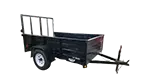
A conventional dump trailer has a permanently attached dump body. A trailer-mounted electric-hydraulic system raises that body, allowing material to discharge through a rear gate. Depending on the model, the hydraulic power unit may be configured for power-up and gravity-down operation or power-up and power-down operation. The trailer, dump body, hydraulic system, and load travel together at all times. You take the trailer to the job, load it, tow it to the disposal or delivery point, dump it, lower the body, and return.
A trailer-mounted roll-off system uses a removable container rather than a permanently attached dump body. Most pickup-towable systems use a tilting trailer frame or subframe, hydraulic hoist, rollers, securement hardware, and an electric winch that pulls the container onto the trailer. To leave a container at a site, the operator tilts the frame and carefully rolls the container onto firm, level ground. When the container is ready for removal, the trailer returns, the winch pulls the container back onto the frame, and the container is secured for transport. Cable roll-off and hook-lift equipment mounted on commercial trucks accomplish a similar container-handling job, but they are a separate equipment category and should not be confused with pickup-towable roll-off dump trailers.
The removable container is the central advantage. One trailer can rotate among several compatible bins, allowing a contractor or dumpster-rental operator to leave containers at different properties while the trailer and tow vehicle continue working. That does not eliminate disposal trips or landfill lines. A full container still has to be hauled to an approved disposal facility and emptied. What the system eliminates is the need to leave the complete trailer sitting at a job while a crew gradually fills it.
GVWR, Payload, and What the Numbers Mean
Dump trailer capacities cover a much wider range than one simple contractor-grade category. Current Diamond C dump trailers span approximately 6,000 to 30,000 pounds GVWR across single-axle, tandem-axle, triple-axle, bumper-pull, and gooseneck configurations. In the broader market, compact dump trailers can be rated below 7,000 pounds, while common professional tandem-axle models are frequently rated from about 14,000 to 17,600 pounds. Heavy gooseneck and tandem-dual dump trailers can reach 20,000, 25,000, or 30,000 pounds GVWR.
Payload is not the axle rating or the GVWR printed in an advertisement. It is the amount of cargo that can be carried after accounting for the actual empty weight of the trailer, installed options, accessories, and anything else traveling on the trailer. For example, H&H’s current 83-inch-wide Industrial Dump Trailer is offered in 12-, 14-, and 16-foot lengths with 14,000- or 16,000-pound GVWR packages. The published 83-by-14 bumper-pull versions have curb weights of approximately 4,100 pounds at 14,000 pounds GVWR and 4,500 pounds at 16,000 pounds GVWR. That produces theoretical payload figures of about 9,900 and 11,500 pounds before allowing for optional equipment, tools, tarp changes, tongue load distribution, or other additions.
Pickup-towable roll-off trailers are not automatically heavier than conventional dump trailers. Current production examples include bumper-pull and gooseneck roll-off models rated from 14,000 to 17,500 pounds GVWR. The difference is that the removable bin is part of the trailer’s empty operating weight when calculating cargo capacity. One current 14,000-pound bumper-pull system lists a 3,310-pound trailer, a 2,280-pound bin, and an 8,410-pound cargo capacity. Its 17,500-pound counterpart lists an 11,910-pound cargo capacity with the compatible bin. That is why comparing only the GVWR can be misleading: a conventional dump trailer of the same GVWR may carry more material because it does not need a separate roll-off frame and removable container.
Use Cases: Where Each One Wins
Dump Trailers Are the Right Call When…
- You’re hauling each load from pickup to disposal or delivery yourself, one job at a time, and do not need to leave a container behind.
- The job changes frequently, such as landscaping, excavation, farm work, property maintenance, roofing, equipment transport, and small construction projects at different addresses.
- You want the trailer to handle both loose material and equipment. Many dump trailers can be ordered with loading ramps, rear stabilizers, tarp systems, spreader gates, and tie-down points, although the exact equipment must be matched to the model and load.
- Budget is a major factor. Smaller dump trailers can still be advertised below $10,000, while new professional 14,000- to 16,000-pound models commonly sell in the five-figure range. Premium builds, higher GVWR packages, hydraulic jacks, power tarps, upgraded tires, gooseneck packages, and heavy-gauge bodies can move the price substantially higher. A roll-off operation also requires at least one compatible bin, and its business advantage usually depends on purchasing several.
- You haul dense material such as rock, soil, broken concrete, sand, or aggregate. A conventional dump body often provides more usable payload than a comparable-GVWR roll-off because the removable-bin system adds empty weight.
Roll-Off Is the Right Call When…
- You’re building a dumpster-rental, junk-removal, roofing-container, scrap-collection, or construction-cleanup business around removable bins.
- You need to leave a container at a customer’s property for several hours, days, or weeks while retaining the trailer for other jobs.
- Several crews or customers need containers at the same time, and you can keep enough compatible bins in circulation to support them.
- Equipment utilization and container scheduling matter more than achieving the maximum possible payload from each GVWR class.
- You’re hauling construction and demolition debris, roofing material, brush, household cleanout material, or scrap at enough volume to justify the extra containers, storage area, maintenance, and dispatch work.
There is more overlap between the two systems than it first appears. Either can haul debris, landscaping material, scrap, and many construction loads. The deciding factor is usually whether the removable container creates measurable value. If customers need containers left on site, a roll-off trailer can turn one trailer into a small container fleet. If the operator loads, transports, and dumps every load immediately, a conventional dump trailer is usually simpler, lighter, less expensive, and easier to use across unrelated jobs.
Container Swapping: The Real Productivity Argument
Consider three active demolition or roofing sites, each filling a container every few days. With conventional dump trailers, each site would need its own complete trailer if the crews want a dump body continuously available. Otherwise, the trailer has to be moved among the sites, and crews may have to stop loading whenever it leaves for disposal. That can tie up both the trailer and the tow vehicle even when the trailer is not moving.
With a roll-off trailer and several compatible bins, the trailer can deliver an empty container to the first site, leave it there, and continue to another job. When a bin is full, the operator can arrive with an empty bin, set the empty bin down, load the full one, secure it, and transport it to the disposal facility. Under favorable conditions, the physical exchange can be completed relatively quickly, but the time depends on available space, ground conditions, container alignment, traffic control, securement, and the operator’s experience. The full bin still has to be weighed, dumped, and returned or reassigned.
The containers absorb the loading time at the job site; they do not absorb travel time, landfill queues, tipping fees, or disposal restrictions. If you have only one active site and generate one load per day, the extra frame weight, bin cost, maintenance, and container-storage requirements may provide little return. The system becomes more valuable as the number of simultaneous sites, container rental days, and scheduled exchanges increases.
A Quick Comparison
| Feature | Dump Trailer | Roll-Off / Hook-Lift |
|---|---|---|
| Typical GVWR range | Approximately 6,000 to 30,000 lbs across current Diamond C dump models; common contractor tandem-axle builds are often 14,000 to 17,600 lbs | Common pickup-towable roll-off examples are 14,000 to 17,500 lbs; truck-mounted commercial systems are a separate, substantially heavier category |
| Container stays on site? | No; the dump body is permanently attached to the trailer | Yes; compatible removable bins can be placed at multiple sites |
| Tow vehicle required | A properly rated heavy-duty pickup or medium-duty truck, depending on loaded trailer weight, hitch type, payload, GCWR, and manufacturer limits | A properly rated heavy-duty pickup can tow many trailer-mounted systems; commercial roll-off trucks use purpose-built chassis and hoist equipment |
| Entry price (new) | Smaller models may be below $10,000; professional 14K-and-up builds are commonly five figures and premium configurations can exceed $20,000 | The trailer may be priced in the low-to-mid five figures, but each compatible bin adds cost; a working trailer-and-bin package can reach roughly $20,000 or more before adding extra containers |
| Best for | Direct hauling, landscaping, excavation, farms, equipment transport, aggregate, and single-site cleanup | Dumpster rental, roofing, junk removal, scrap collection, and multi-site container service |
| Hydraulic requirement | Trailer-mounted 12V electric-hydraulic power unit operating a telescopic cylinder, scissor hoist, or other manufacturer-specified lift | Trailer-mounted electric-hydraulic tilt or hoist system plus a heavy-duty winch on many models; truck PTO hydraulics apply to truck-mounted roll-off equipment |
What About Diamond C and H&H Dump Trailers Specifically?
If a conventional dump trailer fits your operation, Diamond C offers several legitimate weight classes rather than one universal frame and hoist specification. The current LPT Heavy Duty Low Profile Telescopic Dump Trailer is a bumper-pull model offered in 12- to 16-foot lengths, with an 81- to 82-inch bed width and GVWR packages from approximately 15,500 to 24,000 pounds. It uses a three-stage telescopic cylinder, reaches a published 45-degree dump angle, and comes standard with dual 7,000-pound Lippert axles, with factory packages using triple 7,000-pound, dual 8,000-pound, or dual 10,000-pound axles. Higher-GVWR packages incorporate Diamond C’s Engineered Beam Technology. The heavy-duty body uses robust top rails and side supports, and Diamond C’s dump trailers receive the company’s DM Difference Maker multi-stage coating process. Diamond C trailers are manufactured in Mt. Pleasant, Texas, where the company has built trailers since 1985.
H&H’s current Industrial Dump Trailer takes a different approach. Published models use an 83-inch-wide body in 12-, 14-, and 16-foot lengths, with bumper-pull and gooseneck configurations available at 14,000 or 16,000 pounds GVWR. The 14,000-pound packages list 7,000-pound GAWR per axle, while the 16,000-pound packages list 8,000-pound GAWR per axle. Standard published features include a 10-gauge one-piece steel floor, combo barn-door and spreader gate, slipper-spring suspension, scissor hoist, power-up and power-down hydraulics, 12V pump, deep-cycle battery, charger, integrated ramps, LED lights, sealed wiring, and a mesh tarp with an anti-sail system. Because axle suppliers, tires, brakes, and smaller components can change by production run, the final component list should always be confirmed from the exact trailer’s VIN label, build sheet, and current dealer documentation rather than assumed from an older advertisement.
For a trailer-mounted roll-off operation, compare purpose-built current systems by GVWR, actual cargo capacity with the bin installed, container volume, winch duty cycle, hoist design, securement system, axle package, tire capacity, battery and charging setup, and bin compatibility. As one current reference point, Big Tex lists bumper-pull roll-off models at 14,000 and 17,500 pounds GVWR and gooseneck versions at 15,900 and 17,500 pounds GVWR. The compatible 14-foot bin is published with approximately 13 cubic yards of aggregate capacity. The bumper-pull model uses a scissor hoist, greaseable rollers, electric brakes on both axles, and a high-duty-cycle 15,000-pound winch. These specifications illustrate why a trailer roll-off should be evaluated as a complete trailer-and-bin system, not as a conventional dump trailer with a detachable box.
One More Thing Worth Considering
Some operators eventually run both systems. A conventional dump trailer handles daily material hauling, equipment transport, aggregate, mulch, soil, and jobs where the trailer returns the same day. A roll-off trailer manages staged containers for roofing, demolition, cleanouts, scrap, or rental customers. When both sides of the operation produce enough revenue, the tools complement each other instead of competing for the same work.
For a first purchase, the conventional dump trailer normally wins on simplicity, available payload, flexibility, and lower total system cost. It does not require a separate inventory of bins, and it can move between unrelated jobs without worrying about container compatibility. A roll-off trailer is more specialized, but it can be the better investment when removable containers are the service being sold. Run the numbers using expected rental days, number of bins, disposal trips, driver time, tipping fees, maintenance, storage space, insurance, and realistic payloads rather than comparing purchase prices alone.
Your tow vehicle and licensing requirements also have to be checked before choosing either system. Do not assume that every three-quarter-ton or one-ton pickup can safely tow every trailer in a given GVWR class. Verify the truck’s conventional or gooseneck tow rating, GCWR, rear-axle rating, tire capacity, receiver or hitch rating, payload available for tongue or pin weight, and the trailer-brake controller. Indiana requires brakes on trailers with a declared gross weight above 3,000 pounds. For commercial operation, a Class A CDL is generally triggered when the combination has a GCWR of 26,001 pounds or more and the towed vehicle has a GVWR above 10,000 pounds, subject to applicable exemptions and operating rules. The 26,001-pound threshold applies to the combination, not to the trailer by itself.
Not sure which payload class or trailer build matches your current hauling jobs? Browse current dump trailer inventory to see what’s on the lot, or reach out to the team at Spencer Trailers at (812) 829-0226. The right answer depends on the density of the material, the actual loaded weight, how many loads you run each week, whether equipment must be loaded into the body, and whether customers need containers left on site. Give us those details, along with your tow vehicle’s ratings, and we can point you toward a build that makes sense.


