





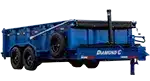
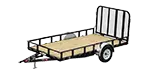

You’ve got a piece of iron to move. Maybe it’s a 6,000 lb skid steer, a 9,000 lb mini excavator, or a 14,000 lb compact track loader with a bucket or attachment. At first glance, several trailers may look capable of carrying the machine, but the number printed as GVWR is not the same as usable payload. The trailer’s actual empty weight, installed options, axle and tire ratings, hitch load, equipment weight, attachments, fuel, chains, and other cargo all count toward the final calculation.
The choice between a tilt deck, a deck-over, and a hydraulic dovetail is not about which design is universally “best.” It is about how you load, what you load, where you work, what tow vehicle you have, and whether the loading method will still make sense three years from now when the equipment in your yard looks different. Capacity matters, but deck width, approach angle, hitch type, load distribution, maintenance, and driver licensing can matter just as much.
Tilt Deck: Fast, Lightweight, No Ramps to Deal With
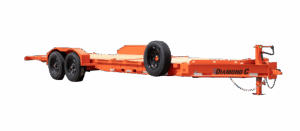
A tilt deck trailer does exactly what the name says. The tilting portion of the deck lowers toward the ground so the machine can drive on without separate ramps. As the equipment’s center of gravity moves forward across the trailer’s pivot point, the deck returns to its travel position and is secured with the trailer’s locking mechanism. The standard system is simple and quick, but it is still important to distinguish a hydraulically dampened gravity tilt from a fully powered hydraulic tilt.
The Diamond C HDT (Hydraulically Dampened Tilt) is the current heavy-duty low-profile tilt model built around this concept. Current HDT configurations cover approximately 15,500 to 24,000 lb GVWR, with deck lengths from 16 to 28 feet and bed widths of approximately 80 to 82 inches, depending on the selected axle and frame package. Standard configurations use tandem 7,000 lb Lippert axles, while available higher-capacity packages can use three 7,000 lb axles, tandem 8,000 lb axles, or tandem 10,000 lb torsion axles. The axle package, brake package, tires, frame, coupler, and final manufacturer-assigned GVWR must all be considered together rather than assuming that axle ratings alone determine the trailer’s legal capacity.
The HDT can be configured as a full-bed tilt on shorter trailers or as a split-deck design with a stationary section at the front. Depending on overall length, the stationary portion may be 2, 4, 6, 8, or 10 feet, leaving the balance of the deck to tilt. That flexibility is useful for contractors who want a tilting section for equipment while retaining level deck space for attachments, pallets, a second compact machine, or other properly secured cargo.
Where tilt decks shine is day-to-day loading convenience. A tracked machine, scissor lift, compact roller, or low-clearance vehicle can travel up one continuous deck surface rather than climbing over the hinge and transition points created by separate ramps. The approach is generally more gradual than a short ramp-and-dovetail combination, although the exact angle varies with the trailer’s deck length, suspension, tires, axle configuration, and job-site surface. A smooth tilt is especially helpful when loading equipment with limited ground clearance or a short wheelbase.
The standard HDT is not completely free of hydraulic components. It uses a hydraulic dampening cylinder, a flow-control valve, and a fluid reservoir to control how quickly the gravity tilt moves. It does not require the same electric pump and battery system used by a fully powered tilt, but the cylinder, seals, valve, fluid level, latch, and pivot points still need inspection and maintenance. Diamond C also offers powered tilt configurations and the Pro Tilt option, which lets the operator switch between gravity operation and electric-hydraulic control. Pro Tilt can be especially useful for uneven ground, off-balance equipment, multiple-machine loading, or situations in which the load will not naturally move the deck through its normal cycle.
The tradeoff is that weight placement affects how a gravity tilt behaves. The equipment must move across the pivot point before the bed returns to level, and a machine with an unusual center of gravity may not settle the deck exactly when expected. That does not mean the machine should simply be pushed as far forward as possible. Final placement must still produce safe tongue weight without exceeding the tow vehicle’s receiver, hitch, rear-axle, tire, payload, or gross-weight ratings. Too little tongue weight can cause sway, while too much can overload the truck and hitch. The trailer should remain correctly hitched to a properly rated tow vehicle during loading, and the operator should follow Diamond C’s loading and latching procedures for the specific configuration.
Deck-Over: More Width, Flexible Loading, More Versatility
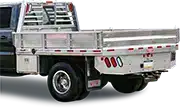
A deck-over trailer positions the deck above the tires instead of placing the load surface between exposed fenders. The biggest practical advantage is usable width. A conventional low-profile equipment trailer usually provides approximately 80 to 82 inches between the fenders, while a deck-over can provide a full 102-inch bed from side to side. That makes it easier to carry equipment with a wider stance, large attachments, pallets, building materials, or cargo that needs to be loaded from the side with a forklift.
The current Diamond C DEC (Heavy Duty Deck Over Equipment) is the appropriate model for this comparison. It is available in 20- to 30-foot deck lengths, has a 102-inch bed width, and is offered in current GVWR packages from approximately 15,500 to 23,000 lb. The standard axle arrangement uses tandem 7,000 lb Lippert axles, with heavier Lippert axle packages available depending on the desired GVWR. The DEC can be ordered as a bumper-pull or pintle-hitch trailer, so the correct tow vehicle, coupler, hitch, safety equipment, and commercial-use requirements must be evaluated before ordering.
A deck-over is higher than a between-the-fenders equipment trailer, but the difference is not always as large as buyers expect. Diamond C’s current DEC dimension information shows a deck height of approximately 32 1/2 inches on the illustrated configuration. Actual height can change with axle type, tire size, suspension, frame package, and installed options. That is still higher than many low-profile tilt or equipment trailers, so a machine’s center of gravity and the selected ramp-and-dovetail combination remain important considerations.
Deck-overs are especially useful when track width, tire width, attachments, or side-loading access make an 82-inch deck too restrictive. Forestry attachments, wide compact excavators, telehandler attachments, pallets of block, sod, lumber, pipe, and other construction materials can all benefit from the unobstructed 102-inch deck. A 102-inch trailer bed does not automatically authorize cargo to extend beyond the legal width limit, however. Loads wider than the trailer or applicable roadway limit may require permits, markings, routing restrictions, or additional safety equipment.
Length and width do not guarantee that a DEC can carry every excavator or telehandler that physically fits on the deck. Payload is the trailer’s GVWR minus the trailer’s actual empty weight as equipped. A longer trailer, heavier ramp package, winch, storage boxes, spare tires, upgraded frame, and other options consume part of the available payload before the machine is loaded. Many full-size excavators and larger telehandlers are too heavy for a 23,000 lb GVWR equipment trailer once trailer weight, attachments, and securement equipment are included. Those machines may require a heavier FMAX, PX, step-deck, lowboy, or commercial transport configuration.
The DEC offers several legitimate loading arrangements. Depending on the build, choices can include rear slide-in ramps, heavy-duty flip-knee ramps, extra-wide flip-knee ramps, or 44-inch-wide MAX Ramps with an appropriate dovetail. This gives the buyer more freedom to match ramp width and support to the equipment’s tires, tracks, wheelbase, and concentrated loading points. A narrow machine with high point loading may need a different ramp arrangement than a wide rubber-tracked loader.
Ramps require more setup than a gravity tilt and must be inspected for damage, bent supports, worn hinges, missing pins, weak springs, contamination, and secure stowage. The benefit is that the deck remains stationary while loading. That can make it easier to place more than one item or use the trailer as a flat working platform. Weight distribution still matters, though. A fixed deck does not eliminate the need to maintain adequate tongue weight, remain within each axle and tire rating, and position the load so that the truck-trailer combination remains stable.
Axle count by itself does not determine whether a trailer is easier to license, register, or operate without a CDL. A tandem-axle trailer may have a higher rating than some triple-axle trailers, and a triple-axle package may be selected for capacity, load distribution, tire loading, or application-specific reasons. Driver licensing and commercial-vehicle rules depend on the ratings and use of the complete combination, not simply whether the trailer has two or three axles.
Hydraulic Dovetail: The Right Tool for Ground-Sensitive Equipment
A hydraulic dovetail trailer uses an electric-hydraulic system to lower the rear dovetail to the ground and raise it back into its travel position. It removes the need to lift, unfold, or align separate loading ramps, but it does not create a perfectly flat, zero-degree transition. Diamond C’s current hydraulic dovetail is 12 feet long and provides an approximately 12.5-degree approach angle. That long transition can still be a major advantage for low-clearance equipment, long-wheelbase machines, rubber-tracked equipment, and vehicles that do not transition comfortably over short ramps.
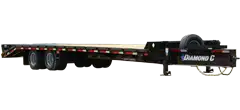
The Diamond C FMAX (Flatbed Max) is the gooseneck flatbed family most often considered for this setup. The hydraulic dovetail is a tail configuration available on qualifying FMAX builds rather than a separate FMAX model. The current FMAX family includes multiple real capacity classes, ranging from approximately 15,500 lb GVWR on the FMAX207 to as much as 40,000 lb on select heavy-duty configurations. Available models include the FMAX207, FMAX208, FMAX210, FMAX212, FMAX216, FMAX307, FMAX310, and FMAX312, with axle layout, wheel arrangement, frame, brakes, suspension, deck length, and GVWR varying by model.
FMAX trailers use Lippert axles as standard. A lighter single-wheel FMAX does not have the same axle configuration as a tandem-dual or triple-dual model, so the FMAX name alone is not enough to establish payload. For example, the current FMAX216 uses tandem 16,000 lb Lippert axles and can be configured at 25,900, 30,000, or an optional 40,000 lb GVWR, depending on the complete build. Other FMAX models use different Lippert axle packages and have different manufacturer-assigned ratings. Buyers should match the exact model code and certification label to the intended load instead of treating every FMAX as a 30,000 or 40,000 lb trailer.
FMAX deck width is 102 inches, and current deck lengths extend as long as 44 feet on select configurations. The 12-foot hydraulic dovetail includes an automatic latch, traction runners, and wireless remote operation. Diamond C rates the hydraulic dovetail to lift and carry 10,000 lb distributed across the length of the dovetail. That rating must not be confused with the trailer’s total payload. The operator also needs to consider concentrated axle or track loading as a machine crosses the dovetail, particularly with excavators, backhoes, forklifts, rollers, and equipment that places a large percentage of its weight on a small contact area.
The case for a hydraulic dovetail usually comes down to repeated loading, transition angle, and operator convenience. It is valuable when equipment has low ground clearance, when a long machine is prone to high-centering at a short ramp breakover, or when one operator regularly loads at changing job sites. The wireless remote allows the operator to position the dovetail while standing where the deck, equipment, and ground can be observed. The automatic latch also reduces manual handling compared with carrying and positioning separate heavy ramps.
A hydraulic dovetail is not automatically the correct choice for every heavy machine. Some equipment is better served by MAX Ramps or XDR Ramps because of track spacing, knuckle clearance, concentrated loading, steel tracks, or the need for an open center. FMAX configurations may also be available with a straight deck and rear slide-in ramps. The correct tail package should be selected around the equipment’s contact points and loading geometry, not simply because one system appears more convenient in a video.
Hydraulic systems add operating components and maintenance responsibility. The pump, battery, charger, fluid, reservoir, cylinders, hoses, fittings, wiring, remote, and latch all need periodic inspection. Connections should be checked for seepage and abrasion, the battery should remain charged, and damaged hoses or contaminated fluid should be addressed before the trailer is dispatched. A hydraulic dovetail also adds empty weight and cost, reducing payload compared with a lighter tail configuration on an otherwise similar trailer. For an operator who loads several times a day, that tradeoff may be worthwhile. For occasional use, a properly selected ramp package may be simpler and more economical.
Side-by-Side: What the Numbers Actually Say
| Model | GVWR | Deck Width | Max Deck Length | Loading Method |
|---|---|---|---|---|
| Diamond C HDT | 15,500–24,000 lb | 80–82 in | 28 ft | Gravity tilt with hydraulic dampening; powered and Pro Tilt options available |
| Diamond C DEC | 15,500–23,000 lb | 102 in | 30 ft | Slide-in, flip-knee, or MAX Ramp configurations |
| Diamond C FMAX | 15,500–40,000 lb by model | 102 in | Up to 44 ft on select models | 12 ft hydraulic dovetail option; ramp and straight-deck configurations also available |
The numbers do not create a simple light, medium, and heavy progression. The HDT and DEC overlap considerably in capacity, but they solve different loading problems. The HDT prioritizes a low deck and fast rampless loading within an approximately 80- to 82-inch bed. The DEC provides a full 102-inch deck and better side-loading access while retaining a fixed platform. The FMAX adds gooseneck stability, longer deck choices, additional loading systems, and capacity packages that extend beyond the HDT and DEC ranges.
For a 6,000 lb skid steer, several configurations may provide adequate payload once the trailer’s empty weight and attachments are included. A 9,000 lb mini excavator may also fit multiple HDT, DEC, LPX, or FMAX builds, but the bucket, hydraulic thumb, blade, coupler, fuel, and securement gear must be counted. A 14,000 lb compact track loader will usually push the buyer toward a higher-GVWR package because the machine alone can consume most or all of the payload on a lower-rated trailer. The correct comparison is always the machine’s verified operating weight against the specific trailer’s remaining cargo capacity, not a model-family name or advertised axle total.
A Quick Q&A Worth Answering
Q: Can I haul a full-size excavator on a tilt deck?
Possibly, but only if the exact machine, attachment package, trailer, and tow vehicle all fit within their ratings. The current HDT reaches 24,000 lb GVWR in its highest-capacity configuration, so it can carry substantially more than an older 14,000 lb tilt trailer. Even then, usable payload is the trailer’s GVWR minus its actual empty weight and everything else carried on it. Some excavators that people describe as “full-size” exceed the payload of an HDT, DEC, or even certain FMAX configurations and require a heavier commercial equipment-hauling setup.The trailer’s GVWR is only one limit. The load must also remain within the ratings for the frame, axles, tires, wheels, coupler, safety chains, brakes, hitch, truck, rear axle, and combined vehicle. In Indiana, a trailer or semitrailer with a gross weight of at least 3,000 lb must have brakes that can be controlled from the tow vehicle and applied automatically if the trailer breaks away. Every HDT, DEC, and FMAX configuration discussed here is well above that threshold and requires a correctly functioning trailer-brake and breakaway system.
A trailer rated above 10,000 lb does not, by itself, automatically create a Class A CDL requirement. For a commercial combination, the Class A threshold generally applies when the combination’s GCWR is 26,001 lb or more and the towed unit’s GVWR is more than 10,000 lb. The 26,001 lb threshold is a combined rating, not a trailer-only limit. Actual use, actual weight, hazardous materials, passenger capacity, farm provisions, personal-use exemptions, interstate operation, and other commercial-motor-vehicle rules can affect the final answer, so operators should verify their specific combination and business use before hauling.
The Ownership Decision Most Buyers Miss
The trailer you buy today may haul machines you do not own yet. That sounds obvious, but many buyers calculate capacity around one machine’s base published weight and leave out the attachments, fuel, tools, chains, spare components, and options that travel with it. Others plan for the machine they own today without considering whether the next replacement will be wider, longer, or several thousand pounds heavier.
Leaving reasonable payload and dimensional margin can prevent an early trade-up, but simply buying the highest GVWR available is not always the least expensive decision. A larger trailer may require a different truck, gooseneck hitch, higher-rated receiver, larger brake controller, commercial insurance, different registration, heavier tires, more maintenance, or a CDL-qualified driver. It may also weigh considerably more empty, reducing fuel economy and making it less convenient for small daily loads.
The better approach is to build a three- to five-year equipment list. Record the heaviest verified operating weight, widest track or tire stance, longest wheelbase, lowest ground-clearance point, preferred tie-down locations, and every attachment likely to travel on the trailer. Then add a realistic cargo margin without exceeding the truck’s ratings. This gives you room to grow without paying for capacity and complexity that your operation cannot use.
If loading speed is the main reason you are considering the HDT, compare the standard hydraulically dampened gravity tilt with the powered tilt and Pro Tilt options before moving immediately to a hydraulic-dovetail FMAX. Pro Tilt preserves the low-profile bumper-pull or gooseneck tilt layout while giving the operator powered control when gravity alone is inconvenient. For many compact-equipment businesses, that is enough flexibility without moving to a 102-inch flatbed gooseneck.
If you need a wider deck, longer platform, higher capacity, or gooseneck stability, an FMAX equipped with the 12-foot hydraulic dovetail may solve the same rampless-loading problem on a larger platform. Select FMAX packages extend beyond the HDT’s 24,000 lb ceiling and are available with longer decks. The tradeoff is a larger tow vehicle requirement, greater empty weight, more hydraulic equipment, more hitch and bed-clearance considerations, and a higher total cost of ownership.
A DEC can be the better long-term answer when deck width and material-handling versatility matter more than eliminating ramps. It can carry equipment during the week and accept pallets, pipe, lumber, or other properly secured material from the side. For contractors who routinely switch between machinery and construction materials, that unobstructed 102-inch fixed deck may be more useful than either a narrow tilt bed or a specialized hydraulic dovetail.
What Works for Owen County and the Surrounding Area
For common work around Spencer, Owen County, and the surrounding area, the decision usually starts with the machine rather than the trailer model. Compact excavators, skid steers, compact track loaders, small rollers, tractors, and landscaping equipment can fit several Diamond C platforms, but local hills, uneven job-site entrances, soft ground, narrow roads, and frequent short-distance loading can make deck height and loading method especially important.
An HDT is a strong fit when the equipment stays within the selected trailer’s payload and between-fender width, and the operator values quick loading without handling ramps. The hydraulically dampened gravity system keeps the standard setup relatively simple, while powered tilt or Pro Tilt can add control for uneven ground and difficult load placement. Buyers moving a 14,000 lb machine should pay particular attention to the trailer’s certified empty weight and should not assume that every HDT has enough payload simply because the model is available with a 24,000 lb maximum GVWR.
The DEC makes sense when a contractor needs the complete 102-inch deck, wants to side-load materials, or regularly hauls equipment whose stance will not fit comfortably between conventional fenders. Ramp selection should be based on track spacing, tire width, machine weight, ground clearance, and concentrated loading. A MAX Ramp package may be ideal for one machine, while flip-knee or slide-in ramps may be more appropriate for another.
The FMAX is the next conversation when the job requires a gooseneck flatbed, longer deck, higher payload potential, or the convenience of a 12-foot hydraulic dovetail. It is not one single capacity rating and it is not automatically the right trailer for every piece of equipment. A 15,500 lb FMAX207, a 25,900 lb FMAX212, and a 40,000 lb-capable FMAX216 or FMAX312 are very different trailers with different axle, wheel, frame, tow-vehicle, licensing, and operating requirements. The exact model code matters.
Diamond C trailers are built in Mt. Pleasant, Texas, where the company has manufactured trailers since 1985. Current premium HDT, DEC, and FMAX configurations use Lippert axles and receive Diamond C’s DM Difference Maker multi-stage coating system. Available axle packages, brakes, ABS availability, suspension, ramps, hydraulic systems, tires, and other options can change the final GVWR, empty weight, price, and lead time, so the build sheet and certification label should be reviewed before purchase.
HDT, DEC, and FMAX configurations can be sourced through Spencer Trailers. Check current inventory to see what’s in stock right now. If you’re not seeing exactly the configuration you need listed, call us at (812) 829-0226. Factory-order availability and lead times can change, so it is worth confirming the schedule before committing a particular trailer to an upcoming job. We’re at 291 West State Hwy 46, Spencer IN 47460 if you want to compare deck height, ramp systems, tilt operation, and hitch configurations on the lot in person.
Not sure which one fits your equipment list? Send us a message with the heaviest machine you move, its verified operating weight, attachments, overall width, wheelbase or track length, and the truck you plan to use. We’ll help match those numbers to the right trailer without overselling you on capacity you cannot use or putting you into a configuration that leaves too little payload margin.


