







Unusual Loads People Haul on Trailers
Most trailers spend their lives moving equipment, mulch, building materials, and ATVs. But spend enough time around a trailer dealership and you start hearing about the outliers: the buyer who needs to move a disassembled vintage airplane, the family relocating a tiny home, the gallery transporting a one-of-a-kind sculpture, or the fabrication shop moving a machine that weighs several thousand pounds within a footprint no larger than a dining table.
These loads are real, and they show up more often than you might expect. What makes them difficult is not always their total weight. An unusual load may be extremely long, top-heavy, fragile, concentrated on four small feet, sensitive to vibration, alive and constantly moving, or wider and taller than Indiana’s normal legal dimensions.
So what do these loads actually need? Let’s get into the specifics.
Small Aircraft and Ultralight Fuselages
Light-aircraft dimensions and weights vary substantially by model, year, equipment, and modifications. For a current reference point, a Cessna Skyhawk is listed at 27 feet 2 inches long with a basic empty weight of approximately 1,680 pounds. A current Piper Archer LX is 24 feet long with a standard empty weight of approximately 1,688 pounds. Removing the wings reduces transport width, but it does not meaningfully shorten the fuselage. The propeller, landing gear, stabilizer, antennas, and other projections can also affect the usable trailer length and the final permitted dimensions.
Published aircraft empty weight is only a starting point. The actual transported weight depends on fuel remaining in the aircraft, installed avionics and accessories, removed components, loose parts, the transport cradle, spare parts, and anything placed inside the cabin. The aircraft and cradle should be weighed or documented before trailer selection rather than relying on a brochure number.
Aircraft skins are thin and are not intended to serve as cargo-securement surfaces. A ratchet strap routed directly over a fuselage, cowling, control surface, or wing skin can dent the aluminum, damage composite material, distort a control surface, or crush an underlying structure. A safer plan uses an engineered or aviation-approved cradle with broad padded supports positioned beneath structural areas. The aircraft is then restrained through the cradle and through attachment points approved by the aircraft manufacturer, an aviation mechanic, or the specialist directing the move.
Wing removal, control disconnection, and reassembly should be planned with an appropriately certificated aviation mechanic or repair facility. Removed wings and control surfaces normally need their own padded racks, protection from twisting, and securement that does not load the leading edges or trailing edges. Propellers should be protected from impact, and control locks or purpose-built supports should prevent the rudder, elevator, and ailerons from moving during transport.
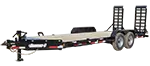
What kind of trailer works? A properly configured Diamond C LPX or FMAX may be appropriate, but the model and length must match the aircraft’s actual geometry. The current LPX is a low-profile bumper-pull equipment trailer offered in 16- to 30-foot lengths, with 80- or 82-inch bed widths and GVWR configurations from 15,500 to 24,000 pounds. It uses Lippert axle packages, with higher-capacity configurations available. An LPX can work when the cradle fits between the fenders or when a compatible maximum-width loading configuration is selected.
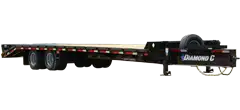
The FMAX is a 102-inch-wide deck-over gooseneck flatbed family offered in multiple lengths and GVWR classes. Current FMAX models range from approximately 15,500 pounds to as much as 40,000 pounds GVWR, depending on the specific model and axle package, and use Lippert axles. The full-width deck can be valuable when landing-gear track or cradle width will not fit between equipment-trailer fenders. Longer FMAX configurations also provide more room for a 24- to 27-foot fuselage, its supports, and safe front and rear clearance.
Do not select the trailer by GVWR alone. Confirm the trailer’s actual empty weight, payload capacity, deck dimensions, axle ratings, tire ratings, coupler rating, tie-down capacity, and the tow vehicle’s rear-axle, hitch, payload, and gross-combination ratings. A higher GVWR does not automatically make a poorly distributed aircraft load stable. The cradle position must produce the correct hitch or pin weight without overloading the truck or unloading the truck’s front axle.
Permits depend on the complete loaded combination, not simply the aircraft’s original wingspan. In Indiana, a vehicle or load exceeding 8 feet 6 inches in width or 13 feet 6 inches in height requires an oversize permit. Length rules depend on the type of vehicle combination, and unusual front or rear overhang may be subject to additional requirements. Confirm the measured loaded width, height, length, and route through Indiana’s oversize/overweight permitting system before the move.
Tiny Homes and Park Model Cabins
The tiny-home category covers several very different structures. Some tiny homes are permanently built on purpose-designed road chassis and are intended to be moved periodically. Others are built on trailers but are expected to remain parked for most of their lives. Park model recreational vehicles are manufactured to a separate standard, while modular cabins, sheds, and site-built structures may be designed to ride on temporary transport carriers rather than their own permanent running gear.
A tiny house on wheels should be built on a chassis engineered for the finished structure, not treated as ordinary cargo placed on a general-purpose car hauler. The trailer manufacturer or structural designer needs to account for the house’s completed weight, axle placement, frame deflection, side loading, floor loads, wind exposure, plumbing and utility penetrations, and the location of heavy components such as water tanks, batteries, appliances, lofts, and cabinetry.
Finished weights commonly reach well into five figures, but there is no dependable universal weight for a tiny home. Two structures with the same exterior dimensions can differ by thousands of pounds because of framing material, roofing, insulation, flooring, appliances, water tanks, solar equipment, cabinetry, and interior finishes. The usable cargo capacity is the chassis GVWR minus the actual empty weight of the completed trailer and all permanently installed equipment. A 14,000-pound GVWR does not mean the structure itself may weigh 14,000 pounds.
These homes may use bumper-pull, gooseneck, or fifth-wheel configurations depending on their chassis design. A gooseneck or fifth-wheel arrangement can improve maneuverability and distribute hitch load over the truck’s rear axle area, but it still requires a truck with sufficient payload, rear gross axle weight rating, tire capacity, hitch rating, and gross combination weight rating. The correct truck cannot be chosen from advertised maximum towing capacity alone.
Hitch or pin weight is especially important. A completed structure may place several thousand pounds on the tow vehicle, and the amount can change after furniture, water, batteries, propane cylinders, and personal belongings are added. Before a long move, use individual axle scales or a commercial scale to verify the loaded truck axles, trailer axles, total trailer weight, and complete combination weight. If the truck feels light in the steering, porpoises, or sways, the solution is not simply to add a heavier weight-distribution hitch; the load and combination need to be evaluated correctly.
Park model recreational vehicles are a different category. The current ANSI/RVIA A119.5 standard defines a park model as a single-chassis recreational unit with no more than 400 square feet of gross trailer area in setup mode. Some park models exceed 8 feet 6 inches in transport width and therefore travel as permitted oversize loads. Width, roof height, appendages, porch sections, and overall transport length vary by manufacturer and floor plan.
An assembled park model is normally moved by a specialist using its purpose-built chassis or an engineered transport system. A general equipment trailer is more likely to be used for a wall section, foundation skid, porch module, or other building component than for an entire finished park model. When a cabin does require a separate carrier, the transporter may use a lowboy, step-deck, hydraulic modular trailer, or another specialized platform selected for the structure’s weight, height, support points, and loading method.
The route must be planned before the structure is connected to the truck. Tree limbs, traffic signals, utility lines, railroad crossings, bridge restrictions, construction zones, tight turns, and road crowns can make a route unusable even when the legal permit can be issued. Exterior steps, awnings, gutters, skirting, vents, antennas, and other projections should be removed or secured as directed by the builder and transporter.
Driver-licensing requirements also need to be checked before the move. The Class A CDL threshold is based on the combination, not the trailer by itself: a combination rating or weight of 26,001 pounds or more that includes a towed unit over 10,000 pounds falls within the Class A definition. Commercial applicability and limited noncommercial or RV exemptions can depend on how the vehicle is being used and the driver’s licensing state, so a heavy tiny-home move should be reviewed before departure rather than at a roadside inspection.
The single biggest mistake is underestimating the finished weight, hitch load, and overall height. Run the numbers, obtain scale weights, and verify the route before you hitch up, not after the truck feels unstable or the roof approaches the first low obstruction.
Art Installations and Gallery Pieces
Large-scale sculpture, gallery installations, stage pieces, and architectural artwork move by trailer regularly. The load might be a welded-steel sculpture, a framed mural, a polished stone piece, a glass assembly, a kinetic installation, or a mixed-media work with delicate projecting components. A piece can weigh 3,000 pounds and still be difficult to secure because it has no flat base, no approved lifting points, and no surface that can safely accept strap pressure.
The challenge is usually a combination of contact, vibration, movement, weather, and handling. An enclosed cargo trailer from Wells Cargo, Legend, Darkhorse Cargo, or another established manufacturer can provide a cleaner and more weather-resistant environment than an open flatbed. However, enclosure alone does not make the load secure. The trailer must still have enough payload, door clearance, interior height, floor capacity, anchor capacity, and room for the artwork’s crate or handling frame.
E-track, L-track, D-rings, and other adjustable restraint systems can be useful when they are installed into adequate structural backing and used within their rated working load limits. Wall-mounted track may help control light lateral movement, but it should not automatically be treated as the primary restraint for a multi-thousand-pound sculpture. Heavy artwork normally needs a stable floor-mounted skid or crate, positive blocking at the base, rated floor anchors, and separate restraints against forward, rearward, lateral, and vertical movement.
For a high-value piece, the best contact surface is often a custom crate or handling frame designed by the fabricator, museum preparator, or art-transport company. Foam density, padding location, fastener placement, and restraint pressure should match the material. Soft foam that works for a painted panel may allow a dense stone piece to settle or shift. A polished metal surface may need a non-abrasive barrier, while glass and ceramics may require isolation from both impact and continuous vibration.
Suspension matters, but axle type by itself does not guarantee a gentle ride. Enclosed trailers may use spring or torsion suspension depending on the manufacturer, model, capacity, and options. Ride quality is also affected by whether the trailer is loaded within its intended range, tire construction and inflation, road speed, axle placement, suspension condition, load position, and the shock isolation built into the crate. Verify the suspension on the exact trailer instead of assuming every enclosed model uses the same system. Wells Cargo and Legend both offer multiple enclosed-trailer configurations rather than one universal running-gear specification.
Center-of-gravity control is essential for tall pieces. Place the mass as low as the artwork and handling frame allow, prevent the base from sliding, and use lateral stabilization only at points designed to accept it. Strapping high on a fragile sculpture can damage the piece or create enough leverage to overturn its base. For extremely irregular work, a temporary steel fixture attached to the transport skid may be safer than trying to restrain the artwork directly.
Interior temperature and humidity are additional considerations. Painted canvas, wood, adhesives, resin, wax, and composite materials can react to prolonged heat, freezing conditions, condensation, or rapid environmental changes. Roof vents may reduce heat buildup, but they do not create a controlled environment. Museum-grade, insured, or irreplaceable work may require climate-controlled art transportation rather than an ordinary enclosed trailer.
Oversized Industrial Machinery
CNC machines, plasma tables, industrial lathes, milling machines, transformers, presses, and fabrication equipment are dense, heavy, and frequently top-heavy. Their precision surfaces, electronics, leveling feet, spindle assemblies, rails, and control cabinets can be damaged by impact, excessive tilt, or uncontrolled vibration. A compact machine may weigh several thousand pounds while concentrating nearly all of that weight on four small feet.
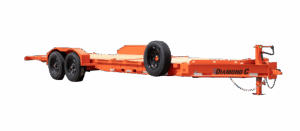
For machinery in roughly the 4,000- to 10,000-pound range, a Diamond C LPX, HDT, DEC, or appropriately configured FMAX may provide the required capacity, depending on the machine’s width, height, support footprint, loading method, and actual weight. The LPX and HDT are low-profile equipment trailers with GVWR configurations from 15,500 to 24,000 pounds. The HDT uses a hydraulically dampened gravity-tilt deck, while the LPX uses conventional loading systems such as slide-in ramps, MAX Ramps, or compatible X-Ramp configurations. The DEC is a heavy-duty deck-over equipment trailer, and the FMAX is a deck-over gooseneck flatbed available in substantially higher GVWR classes.
The trailer’s payload, not its GVWR alone, determines whether the machinery can be carried. Subtract the trailer’s actual empty weight, spare tires, winch, toolboxes, ramps, chains, blocking, and other installed equipment from GVWR. A machine near 10,000 pounds may leave inadequate payload on an entry configuration even when the GVWR number initially appears large enough.
Point loading is just as important as total payload. A machine supported on narrow feet can overload deck boards, steel flooring, crossmembers, or a small portion of the main frame even when total trailer weight remains below GVWR. The machine may need an engineered skid, spreader beams, steel plates, or cribbing that distributes the load across multiple structural members. Do not weld stops to the trailer, drill the frame, or add permanent attachment points without approval from the trailer manufacturer or a qualified engineer.
The loading method should be decided before the trailer arrives. A forklift must have sufficient rated capacity at the actual load center, not merely enough nominal mast capacity. Fork extensions reduce effective capacity and can bend or slip. Fork pockets or lifting points on the machine should be used only as the machinery manufacturer intended. If the machine must be lifted from above, the crane, rigging hardware, spreader bars, shackles, slings, and lifting points all need appropriate ratings and a competent operator.
Once the machine is on the deck, mechanically block or brace the base so restraint does not depend only on friction. Use structural attachment points identified by the machine manufacturer or rigger. Chains and binders are common for dense machinery because they provide high working load limits and limited stretch, but they must not be routed across controls, sheet-metal covers, precision rails, hydraulic lines, wiring, or unsupported castings. Rated web restraints may be appropriate for selected surfaces when properly protected, but the securement system must be designed as a whole rather than chosen solely by material type.
Commercial cargo securement rules require cargo to be contained, immobilized, or secured so it cannot fall or shift enough to affect vehicle stability. The aggregate working load limit and minimum number of tiedowns must meet the applicable federal rules, with blocking and bracing considered as part of the complete system. For an unusual machine, a professional rigger or experienced machinery transporter should prepare the securement plan instead of relying on a few straps added after loading.
A 10,000-pound machine does not automatically require a Class 8 tractor and detachable-neck lowboy. Some FMAX configurations provide enough legal payload for machinery well above that weight when paired with the correct truck. A lowboy, step-deck, removable-gooseneck trailer, or specialized heavy-haul carrier becomes the better choice when the machine’s total weight, concentrated loading, loading method, height, width, or route exceeds what a pickup-and-trailer combination can safely and legally handle.
For tall machinery, deck height can determine whether the move stays below Indiana’s 13-foot-6-inch legal-height threshold. A lower deck may be more important than extra unused GVWR. Measure from the pavement to the highest point after the machine is loaded, including temporary covers, exhaust stacks, control cabinets, and rigging supports.
Livestock: The Unexpected Complexity
Cattle, horses, hogs, sheep, and goats are moving, unpredictable cargo. A 1,200-pound horse can step sideways, brace against a partition, or move rearward immediately before the driver brakes. Several cattle shifting together can change axle and hitch loading more quickly than most inanimate cargo. That makes trailer stability, flooring, ventilation, compartment size, and driver behavior especially important.
Dedicated livestock and horse trailers are purpose-built with features such as non-slip flooring, adequate interior height, ventilation, animal-safe gates, smooth interior surfaces, appropriate partitions or center gates, and doors that can be operated without placing the handler in a dangerous position. A general-purpose utility or cargo trailer should not be substituted merely because its payload rating appears sufficient.
Horse and stock configurations are not interchangeable in every situation. Horse trailers may use stalls, dividers, breast and butt bars, escape doors, padding, and tie points designed around equine balance and behavior. Stock trailers commonly use open or slatted upper sides, solid lower panels, sorting gates, and rear gates with sliders. The correct interior arrangement depends on the animal species, number, size, temperament, journey length, and whether animals must be separated.
Current Delco bumper-pull horse and livestock lines are available in multiple widths, lengths, and GVWR classes. Depending on the configuration, bumper-pull models are offered in approximately the 7,000- to 12,000-pound range, with heavier packages available on selected builds. Current 7,000-pound horse configurations list dual 3,500-pound electric-brake torsion axles, while stock-trailer specifications and axle packages vary by model and length. Buyers should verify the VIN plate and current build sheet rather than assuming every trailer with the same exterior size has the same GVWR.
For cattle, hogs, sheep, or goats, a bumper-pull or gooseneck stock trailer normally combines a contained lower wall with ventilation above. The lower section helps prevent legs from entering openings and helps contain bedding and waste, while the upper openings provide airflow. Panel spacing, gate design, roof coverage, and interior height should match the animals being transported. Material alone does not determine durability; steel and aluminum trailers both depend on structural design, wall construction, floor condition, weld quality, maintenance, and correct loading.
Floor condition deserves a close inspection before every trip. Wet wood, worn rubber mats, exposed fasteners, corrosion, manure buildup, and smooth metal can all reduce traction. Mats should be lifted periodically so the floor beneath them can be cleaned and inspected. Ventilation openings, gates, latches, dividers, and emergency exits should also be checked before animals enter the trailer.
Loading angle and footing matter, but the safest arrangement is not always a ramp. Some animals load more confidently through a stable step-up opening, while others benefit from a properly supported, non-slip ramp with safe side protection. The trailer should be level, connected securely to the tow vehicle, and parked on firm ground before loading. Gaps between a ramp and trailer floor, unstable portable panels, sharp edges, and a slippery approach can cause both animal and handler injuries.
Weight calculations must include the trailer, animals, feed, water, bedding, tack, portable panels, and equipment. Do not estimate livestock payload only by counting animals. Weigh representative animals when possible, keep the load within the trailer’s payload and axle ratings, and distribute animals according to the trailer manufacturer’s guidance. The tow vehicle must also remain within its hitch, payload, tire, rear-axle, and combination ratings.
Quick Reference: Load Type vs. Trailer Priority
| Load Type | Trailer Style | Key Concern |
|---|---|---|
| Small aircraft fuselage | Long LPX when cradle width fits, or 102-inch deck-over Diamond C FMAX | Approved padded cradle, actual transport dimensions, protected aircraft structure, and adequate deck length |
| Tiny home / park model | Purpose-built tiny-home chassis or specialized lowboy, step-deck, or structural transport system | Finished scale weight, hitch or pin load, overall height and width, route survey, and oversize permits |
| Art / sculpture | Properly rated enclosed cargo trailer from Wells Cargo, Legend, Darkhorse Cargo, or a specialist art carrier | Custom skid or crate, rated floor anchors, vibration isolation, weather protection, and environmental control |
| Industrial machinery | Diamond C LPX, HDT, DEC, FMAX, or specialized lowboy depending on weight and geometry | Payload after trailer weight, concentrated floor loading, engineered blocking, rated securement, and safe rigging |
| Livestock | Purpose-built horse, stock, or combination trailer such as an appropriate Delco configuration | Dynamic load shift, flooring, ventilation, partitions, gates, loading method, animal welfare, and tow-vehicle capacity |
The Common Thread
Every unusual load comes down to three basic questions: Does the trailer have enough usable payload? Does it provide properly rated structural points for supporting and securing the load? And is the trailer style correct for the load’s geometry, fragility, center of gravity, loading method, and behavior?
Getting the GVWR right is essential, but GVWR is the maximum allowable weight of the loaded trailer, not the amount of cargo the trailer can carry. Usable payload is GVWR minus the trailer’s actual empty weight and everything permanently or temporarily carried on it. The selected combination must also remain within every axle rating, tire rating, wheel rating, coupler rating, safety-chain rating, jack rating, hitch rating, truck payload rating, rear-axle rating, and gross-combination rating.
A higher-capacity trailer cannot correct an unsuitable load position. Too little hitch weight can create sway, while too much can overload the receiver, gooseneck ball, truck suspension, tires, or rear axle. Tall or concentrated loads may require a different trailer even when a lighter-duty model appears to have enough total payload. Scale weights and measured dimensions are far more useful than estimates.
Braking requirements matter as capacity increases. Under Indiana law, trailers with a GVWR over 3,000 pounds require brakes. The brake controller, breakaway equipment where applicable, battery, wiring, connectors, brake assemblies, and tires should be inspected before transporting an unusual load. A trailer’s brakes must be capable of doing their share of the work; the truck should not be expected to stop the entire combination by itself.
Driver licensing must be evaluated using the full combination. A trailer rated over 10,000 pounds does not by itself create the standard Class A CDL threshold. The combination must reach at least 26,001 pounds and include a towed unit over 10,000 pounds. Commercial use, interstate operation, exemptions, medical-card requirements, USDOT registration, and hours-of-service rules are separate questions that may also apply depending on who is moving the load and why.
And then there are permits. In Indiana, an oversize or overweight permit is required when the vehicle or load exceeds 8 feet 6 inches in width, 13 feet 6 inches in height, applicable legal-length limits, or legal gross and axle-weight limits. The frequently cited 53-foot length threshold on Indiana’s permit information applies specifically to a semi-tractor-semitrailer combination; it should not be treated as a universal maximum for every pickup, trailer, load, or overhang arrangement. The permit may specify the approved route, travel times, signs, lighting, speed, or escort vehicles.
For a difficult move, use the Indiana Department of Revenue Motor Carrier Services oversize/overweight system and coordinate with the appropriate road authorities, utilities, specialized carrier, or escort provider. Measure the loaded combination after the cargo is positioned. Do not apply for a permit using the object’s catalog dimensions and assume the trailer, cradle, tie-downs, or overhang will not change the result.
Capacity alone is never the complete answer. A 25,900-pound FMAX will not automatically protect a polished sculpture, support a machine with extreme point loads, make a tiny home legal in height, or keep a nervous horse safely positioned. Matching trailer type, dimensions, structure, loading system, and securement to the behavior of the load is just as important as matching the weight rating.
If you’ve got an unusual load coming up and aren’t sure which trailer fits, reach out to the team at Spencer Trailers. We stock Diamond C, H&H, Wells Cargo, Legend, Liberty, Delco, and Darkhorse Cargo trailers and can talk through GVWR, usable payload, deck dimensions, axle configuration, loading systems, hitch requirements, and tie-down options for your specific situation. Diamond C trailers are built in Mt. Pleasant, Texas, and current premium models such as the FMAX, HDT, LPX, LPT, WDT, and DEC use Lippert axle packages. Or browse current inventory to see what’s on the lot right now. The right trailer for a weird load exists. It just takes a few more measurements and a few more questions to find it.

