








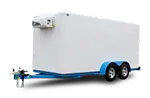


Every week somebody walks in and says some version of the same thing: “I don’t know exactly what I need, but here’s what I’m hauling.” Most of the time, one of four configurations answers that question. Not because they’re automatically the cheapest or the fanciest, but because they match the jobs people around Spencer actually need to do and can be configured around the tow vehicle they already own.
Here’s a close look at the four spec combinations we move most often, why each one works so well, and what to verify before you buy. The dimensions and ratings below describe common configurations, but the VIN label, manufacturer build sheet, and actual equipment installed on a particular trailer always control.
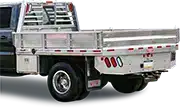
7×14 Tandem-Axle Dump Trailer
If you do landscaping, demolition cleanup, gravel hauling, firewood delivery, brush removal, or property maintenance, you’ve probably already heard somebody recommend a tandem-axle dump trailer. The nominal 7×14 size is a useful balance. It provides enough bed volume for serious work while remaining easier to place in residential driveways and job sites than a longer dump. A cord of firewood may fit by volume depending on how it is stacked, but the trailer’s available payload still determines how much weight you can legally and safely carry.
Specifications vary considerably within this category. An H&H 83-inch-wide by 14-foot dump may be configured around a 14,000 lb GVWR with two 7,000 lb axles, while the comparable Diamond C LPT heavy-duty low-profile telescopic dump is commonly 82 inches wide by 14 feet long and starts at a 15,500 lb GVWR. Diamond C premium trailers use LIPPERT axles, with heavier LPT packages available above the base rating. Current LPT trailers use a multi-stage telescopic front hoist, a steel dump body and floor, and a three-way rear gate that can be used for controlled spreading, conventional dumping, or barn-door access. H&H hoist, gate, floor, axle, and GVWR specifications depend on the exact series and option package, so compare build sheets rather than assuming every 7×14 is constructed the same way. Diamond C protects its trailers with the DM Difference Maker multi-stage coating process. :contentReference[oaicite:0]{index=0}
Why is this one of the most popular dump sizes we sell? Versatility. Landscapers can haul mulch and debris, homeowners can manage storm cleanup and firewood, and contractors can move demolition waste or bulk material without buying a dedicated truck body. However, a loaded 14,000 or 15,500 lb dump is not automatically a half-ton-truck trailer. Many buyers will need a properly equipped three-quarter-ton, one-ton, or heavier truck, depending on the trailer’s actual loaded weight, tongue weight, hitch type, receiver rating, payload capacity, GCWR, and axle ratings. Dense material such as gravel, dirt, concrete, and roofing debris can use up the available payload before the bed looks full.
- GVWR: Commonly 14,000 to 15,500 lb in this size, with heavier configurations available by model
- Axle setup: Often two 7,000 lb brake axles; Diamond C premium models use LIPPERT axles
- Bed: Approximately 82 to 83 inches wide by 14 feet long, depending on manufacturer
- Common brands: H&H and Diamond C
One thing to inspect closely is the complete hydraulic system, not just the size of the cylinder. Check the pump, reservoir, battery, charging circuit, cable gauge, grounds, hydraulic hoses, fittings, control location, and accessibility for service. Diamond C’s current LPT equipment includes a high-flow KTI hydraulic system, but the exact battery and charging options can vary. Also confirm the coupler size and rating before pickup. A rated adjustable 2-5/16-inch ball coupler is common in this class, but the coupler, ball, receiver, and drawbar must all be rated for the trailer’s loaded weight. Finally, calculate payload by subtracting the trailer’s actual empty weight from its GVWR; axle ratings alone do not tell you how many pounds of material the trailer can carry.
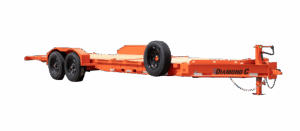
6×12 Utility Trailer with Ramp Gate
This is the “do everything small” trailer. A 6×12 single-axle utility is useful for lawn tractors, zero-turn mowers, many ATVs, landscaping tools, lumber runs, furniture, appliances, and general property-maintenance work. Its manageable footprint makes it easier to store and maneuver than a tandem trailer, although whether it fits inside a garage depends on the trailer’s overall width, ramp height, tongue length, and the garage-door opening. It may work behind a properly rated SUV, van, or midsize pickup, but vehicle class alone never guarantees adequate towing capacity.
A common 6×12 utility configuration from Liberty or H&H has a single 3,500 lb axle, a 2-inch ball coupler, a pressure-treated wood deck, and a full-width rear ramp gate. Many current single-axle units are certified at a 2,990 lb GVWR even though they use a 3,500 lb axle. That rating is intentional and should not be treated as permission to load the trailer to the axle’s full rating. Depending on deck width, frame construction, gate design, and empty weight, usable payload will often be well below 2,990 lb. Spencer Trailers regularly carries Liberty single-axle utility trailers in 72-, 78-, and 83-inch widths, including 12-foot lengths, while H&H offers comparable rail-side utility configurations. :contentReference[oaicite:1]{index=1}
The ramp gate is what makes this configuration especially practical for wheeled equipment. Drop the gate, line up the machine, load at a controlled speed, secure it at the manufacturer’s approved tie-down points, and verify that the tongue weight remains appropriate. Before assuming a mower, ATV, or side-by-side will fit, measure the machine at its widest point, including tires, deck extensions, mirrors, guards, or accessories. Also verify the ramp-gate opening, ramp capacity, deck capacity, axle placement, and tie-down locations. A machine can fit between the rails and still be unsuitable if it exceeds the gate rating or leaves too little payload for tools and supplies.
- GVWR: Commonly 2,990 lb for a single-axle 6×12, with other ratings available by model
- Axle rating: Commonly one 3,500 lb axle
- Deck: Nominally 6 feet wide by 12 feet long; actual widths commonly include 72-, 76-, 78-, or 82-inch builds
- Common brands: Liberty and H&H
If you’re going to haul a mower, ATV, or compact recreational vehicle regularly, look at more than the trailer’s length. Loading angle is affected by deck height, ramp length, ramp construction, dovetail design, tire size, and the machine’s wheelbase and ground clearance. Moving from a 6×12 to a 6×14 gives you more deck space and may improve weight placement, but it does not automatically make the ramp angle shallower. We can place the available trailers side by side, measure the gate opening, compare the breakover angle, and help you determine whether the machine will load without dragging its deck, frame, or attachments.
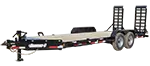
82×20 Equipment Trailer with MAX Ramps
Built for the Heavy Stuff
When you’re moving a compact track loader, skid steer, mini excavator, or full-size tractor, a light single-axle utility trailer is not built for the job. One of the popular upgrades is an approximately 82-inch-wide by 20-foot Diamond C LPX equipment trailer equipped with MAX Ramps. Buyers who prefer a tilt deck may instead consider the Diamond C HDT, which uses a hydraulically dampened gravity-tilt deck and does not rely on loading ramps. In either case, the truck, hitch, brake controller, tires, and load-securement equipment must all be rated for the actual combination.
The current Diamond C LPX is a low-profile extreme-duty equipment trailer offered in bed widths of approximately 80 to 82 inches and lengths from 16 to 30 feet. Its GVWR range runs from 15,500 to 24,000 lb depending on package. The LPX207 configuration uses two 7,000 lb LIPPERT axles and carries a 15,500 lb GVWR, while the LPX210 uses two 10,000 lb oil-bath torsion brake axles for a 20,000 lb GVWR. Triple-axle and 8,000 lb axle packages are also available in the broader LPX range. The standard deck is between the fenders; machinery approaching the trailer’s full legal road width requires the appropriate 102-inch Max Width package, drive-over fender arrangement, and compatible ramp system. Do not assume an 82-inch deck can accept 102-inch-wide equipment merely because the trailer’s overall exterior width is close to 102 inches. :contentReference[oaicite:2]{index=2}
MAX Ramps are designed as an integrated Diamond C loading system rather than a pair of generic loose ramps. On the LPX, they are 37 inches wide, spring-assisted, and built with multiple high-strength steel frame members. Their two-part hinge design works with the trailer’s 36-inch self-cleaning dovetail to create a broad loading path and a manageable transition for properly matched equipment. The important questions are the ramps’ rated capacity, the machine’s track or tire width, concentrated loading, approach angle, breakover clearance, and where the machine will sit once loaded. The trailer’s GVWR is not a ramp-capacity rating, and neither number replaces the need to verify the exact trailer specification and equipment weight. :contentReference[oaicite:3]{index=3}
| GVWR | Axle Setup | Recommended Tow Vehicle |
|---|---|---|
| 15,500 lb | 2 x 7,000 lb LIPPERT axles with electric brakes | Properly equipped 3/4-ton, 1-ton, or heavier truck after verifying every applicable rating |
| 20,000 lb | 2 x 10,000 lb LIPPERT oil-bath torsion axles with brakes | Properly equipped 1-ton, often a dually, or heavier tow vehicle with sufficient GCWR, payload, hitch, and braking capacity |
Buyers in this category are often contractors, excavation crews, farmers, and property-maintenance businesses that have outgrown a lighter trailer. Before upgrading, collect the operating weight of every machine, attachment, bucket, fuel load, and tool that will travel on the trailer. Positioning also matters because an equipment trailer can remain below GVWR and still overload the tongue, hitch, truck rear axle, or one trailer axle group. Commercial operators should also understand the licensing threshold: a Class A CDL is generally implicated when the combination has a GCWR or actual combined weight of at least 26,001 lb and the towed unit has a GVWR or actual weight over 10,000 lb. A trailer rating over 10,000 lb by itself does not automatically trigger that Class A threshold when the combination remains below 26,001 lb, although other commercial-carrier, medical-card, farm, registration, and operating rules may still apply. :contentReference[oaicite:4]{index=4}
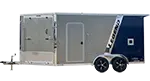
Enclosed 7×16 Cargo Trailer with Side Door
More Than Just Weatherproofing
Enclosed trailers sell on two obvious advantages: weather protection and security. A 7×16 with a side entry door adds another practical benefit. With only rear ramp doors or barn doors, reaching tools stored near the front can require unloading whatever is behind them. A properly placed side door creates a separate path to shelving, controls, small equipment, merchandise, or a work area without opening the entire rear of the trailer.
A nominal 7-foot-wide by 16-foot-long enclosed trailer has a 112-square-foot exterior floor footprint, but the usable interior dimensions will be smaller because of wall construction, trim, door framing, and wheel boxes. Interior height is a separate specification and is not determined simply by whether the trailer has a V-nose. Depending on the manufacturer and build, a 7×16 may have approximately 6 feet 6 inches, 7 feet, or another specified interior height. Current Darkhorse units stocked in this category may be built with a 7-foot interior, while Legend and Wells Cargo dimensions and height packages vary by model. A common tandem configuration uses two 3,500 lb axles for a 7,000 lb GVWR, normally with electric brakes on the required axles. Always verify the certification label because axle rating, GVWR, empty weight, wall construction, roof design, and door dimensions can change with the package. :contentReference[oaicite:5]{index=5}
The side door is one of the details buyers frequently say they missed on an earlier trailer. Electricians, plumbers, mobile detailers, contractors, and event vendors can reserve the rear opening for large loads while using the side door for routine access. Door width, hinge direction, holdback hardware, step height, latch type, and lock construction should all match the intended use. Indiana requires an adequate brake system on a trailer with a gross weight of at least 3,000 lb, including driver control from the towing vehicle and an automatic breakaway function, so a 7,000 lb enclosed trailer requires a compatible brake controller, correctly wired connector, charged breakaway battery, and functioning brakes before it is placed in service. :contentReference[oaicite:6]{index=6}
- GVWR: Commonly 7,000 lb for a tandem-axle 7×16, with other packages available
- Axle setup: Commonly 2 x 3,500 lb axles with electric brakes
- Interior dimensions: Model-specific; confirm clear floor width, box length, interior height, rear opening, and side-door opening
- Common brands: Darkhorse Cargo, Wells Cargo, and Legend
If you’re using the trailer as a mobile workspace, ask about factory-installed E-track, reinforced mounting areas, LED interior lighting, roof vents, wall liners, shelving preparation, and 120-volt electrical packages. A household-style outlet is not automatically powered while the trailer is moving; the electrical design may require shore power, a properly installed inverter and battery system, or a generator. Factory preparation is often cleaner and easier than retrofitting, especially when reinforcement or concealed wiring is needed. Remember that cabinets, generators, water tanks, batteries, tools, and permanently installed equipment all subtract from the available cargo payload, so plan the complete build rather than selecting the trailer from floor dimensions alone.
How to Find the Right One
Knowing the popular configurations is a starting point, not a finish line. A 7×14 dump might be exactly right, or it might be one size too small once you calculate the weight of wet soil, gravel, concrete, or demolition debris. A 6×12 utility may have enough deck room for a mower but not enough remaining payload for attachments and material. An equipment trailer may have adequate GVWR but the wrong deck width or axle placement. The right questions are: What am I hauling, what does it actually weigh, how often will I move it, where will its center of gravity sit, and what truck will tow it?
These four configurations represent trailers we stock and sell regularly from our lot in Spencer, although brands, dimensions, ratings, options, availability, and advertised prices change as inventory turns over. Browse our current inventory to see what’s on the lot right now, or check the recently sold page to get a feel for the types of trailers that move through the dealership. For any unit you are considering, use the individual listing and VIN-specific build information rather than relying on a category description alone.
If you’re not sure whether your tow vehicle can handle the trailer you’re considering, bring the truck information with you. We’ll look at the receiver and hitch ratings, ball or coupler rating, brake controller, tire ratings, payload label, rear-axle rating, factory towing guide, GCWR, and the expected loaded tongue weight. The lowest-rated component sets the working limit, and the advertised maximum tow rating is not the only number that matters. Reach out or stop by 291 West State Hwy 46 in Spencer and we’ll help you match the trailer, load, hitch, and tow vehicle without guessing.

