








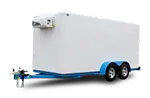


If you’re buying a trailer in Bloomington, here’s the practical version: Spencer Trailers is roughly 20 miles west of Bloomington on State Road 46 in Spencer, Indiana. From the Indiana University area, the drive is usually around half an hour, depending on your starting point, traffic through Bloomington and Ellettsville, and road conditions. That puts Bloomington buyers close to a family-owned, multi-brand trailer dealership without requiring a long trip across the state.
But buying the right trailer involves more than finding the nearest lot. You need to match the trailer’s actual payload capacity to the cargo, confirm that your tow vehicle and hitch are properly rated, understand which features are standard on the specific unit, and complete Indiana title and registration correctly. Let’s look at what Bloomington-area buyers commonly haul, which trailer lines fit those jobs, and what to expect before you visit the BMV.
What Bloomington Buyers Tend to Haul
Bloomington is best known as a college town, but Monroe County is also surrounded by farms, wooded acreage, lake properties, construction projects, landscaping businesses, and homeowners who regularly move equipment or materials. That creates a much wider range of trailer needs than people sometimes expect.
- IU move-ins and move-outs. A 6×12 enclosed cargo trailer is a practical size for many dorm-room, apartment, and small-household moves when paired with a properly rated tow vehicle. It provides weather protection and a lockable cargo area, but buyers still need to confirm the trailer’s payload, interior height, rear-door opening, hitch requirements, and the tow rating of the exact vehicle being used. A trailer that has enough interior volume can still be overloaded by dense furniture, appliances, books, or building materials.
- Lake Monroe recreation. Bloomington-area buyers frequently haul kayaks, paddleboards, coolers, camping equipment, fishing gear, lawn equipment, and supplies for seasonal properties near Paynetown, Cutright, Fairfax, and other lake access points. Aluminum and steel utility trailers can work well for this type of gear. A dedicated boat or pontoon trailer, however, must be selected for the boat’s hull, length, weight, axle placement, bunks, brakes, and launch conditions rather than treated as a general-purpose utility trailer.
- Contractors and landscapers. Remodelers, HVAC crews, roofers, landscapers, excavation contractors, and property-maintenance companies use enclosed cargo trailers, open utilities, dump trailers, tilt equipment trailers, and heavy-duty flatbeds. When hauling a skid steer, compact track loader, mini excavator, or tractor, the decision must be based on the machine’s operating weight plus attachments, fuel, buckets, forks, tools, and any other cargo. The trailer’s usable payload—not its GVWR by itself—is the number that determines whether the load fits legally and safely.
- Homesteaders and small farms. Buyers throughout Monroe and Owen counties use trailers for fencing materials, feed, firewood, hay, compact tractors, zero-turn mowers, logs, gravel, soil, livestock supplies, and cleanup debris. A tandem utility may be sufficient for lighter property work, while heavier tractors, attachments, round bales, and bulk materials may require an equipment trailer, dump trailer, deck-over, or gooseneck flatbed. Dedicated livestock transportation requires a trailer designed and equipped for animals rather than an improvised open utility.
Trailers Worth Knowing by Name
Spencer Trailers carries brands including Diamond C, Liberty, Delco, Darkhorse Cargo, H&H, Legend, and Wells Cargo, with exact availability changing as units are sold and new inventory arrives. These brands cover different price points, materials, axle packages, deck designs, ramp systems, and intended uses. The model, GVWR, axle rating, payload, coupler, brakes, and dimensions shown on the individual trailer’s certification label and build sheet should always take priority over assumptions based only on the brand name.
Diamond C Utility and Equipment Trailers
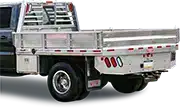
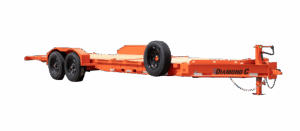
Diamond C has been building trailers in Mt. Pleasant, Texas, since 1985. Its current heavy-duty lines use Lippert axles as standard equipment and include model families for several different jobs. The FMAX is Diamond C’s Flatbed Max gooseneck line, not a single trailer with one universal rating. For example, the FMAX210 is a 102-inch-wide gooseneck flatbed offered in lengths from approximately 20 to 40 feet with a 25,000 lb GVWR and tandem 10,000 lb Lippert axles. The heavier FMAX216 is available in 25,900 lb and 30,000 lb GVWR configurations, with an available 40,000 lb package, and uses tandem 16,000 lb Lippert axles with hydraulic disc brakes in its published heavy-duty configuration. Lower-rated FMAX models are also available, so buyers should choose the model around the load rather than assuming every FMAX is a 25,900 lb trailer. For bumper-pull equipment hauling, the LPX Low Profile Extreme-Duty Equipment line currently spans approximately 15,500 to 24,000 lb GVWR, with some dealer-stock configurations derated to 14,900 lb. The LPX207 normally uses tandem 7,000 lb Lippert axles, while higher packages can use tandem 8,000 lb or 10,000 lb axles or triple 7,000 lb axles. Available loading systems include MAX Ramps and the full-width X-Ramp, depending on the selected length and package. Diamond C also uses its DM Difference Maker multi-stage powder-coat process, which includes surface preparation, washing, primer, powder application, and controlled curing. Before loading a skid steer or mini excavator, subtract the trailer’s actual curb weight and installed options from its certified GVWR to determine usable payload.
H&H Steel and Aluminum Trailers
H&H is an Iowa-based manufacturer with steel and aluminum utility, cargo, dump, tilt, and equipment-trailer offerings. Its current aluminum and steel rail-side utility lines cover multiple widths, lengths, axle packages, and GVWR classes rather than one universal 7×16 specification. A Bloomington contractor who needs easier equipment loading may be better served by an H&H EX or EXL electric-over-hydraulic tilt trailer. One current 82-inch-by-20-foot EX configuration has a 7,000 lb GVWR, tandem 3,500 lb axles, electric brakes, a 2-5/16-inch coupler, a 5-inch channel frame, an approximate 1,990 lb curb weight, and about 5,010 lb of listed payload before cargo or aftermarket accessories are added. Higher-rated H&H equipment trailers use different frames and axle packages. Aluminum trailers can reduce empty weight and improve corrosion resistance, but aluminum construction does not automatically increase payload, and an equipment tilt trailer should not be treated as a boat-launching trailer unless it was specifically designed for that purpose.
Wells Cargo and Darkhorse Cargo Enclosed Trailers
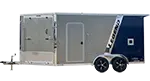
For IU moves, mobile service work, and tradespeople who need weather protection and lockable tool storage, enclosed cargo is often the right category. Wells Cargo’s Road Force remains a current enclosed-trailer line, but its GVWR, wall and floor construction, axle count, interior height, door package, and crossmember spacing vary by size and option package. Road Force configurations can be found in both approximately 2,990 lb single-axle and 7,000 lb tandem-axle classes, so buyers should compare the actual unit’s build sheet rather than applying one construction specification to every Road Force trailer. Darkhorse Cargo is another enclosed option stocked at Spencer Trailers. A current Darkhorse DHW 7×16 tandem-axle V-nose configuration is rated at 7,000 lb GVWR and uses two 3,500 lb axles with electric brakes, a 2-5/16-inch coupler, a seven-way electrical connection, 16-inch-on-center floor construction, a 3/4-inch floor, engineered wall construction, a one-piece aluminum roof, and an approximately seven-foot interior height. Its listed curb weight is about 2,825 lb, leaving approximately 4,175 lb of payload in that specific configuration. A refrigerator or other tall appliance may fit inside, but buyers should measure the appliance, packaging, ramp-door opening, interior height, and tie-down path before assuming it can be loaded upright.
Delco Dump Trailers
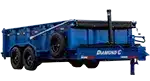
If you’re handling renovation debris, brush, mulch, soil, roofing material, firewood, or landscaping supplies, a dump trailer can reduce unloading time and manual labor. Delco offers more than one 83-inch-wide dump-trailer family, and the hydraulic system depends on the selected series. An 83-inch-by-14-foot D3 bumper-pull dump is available at approximately 14,000 lb GVWR and uses a conventional hydraulic-cylinder hoist. The D5 telescoping bumper-pull dump is offered in 83-inch widths, 12-, 14-, and 16-foot lengths, and approximately 14,000 or 16,000 lb GVWR configurations, depending on the build, with a telescoping hydraulic cylinder. Current Delco dump equipment can include electric brakes, a three-way rear gate, tarp system, and slide-in ramps, but the individual order sheet should be checked for exact standard and optional equipment. A 14,000 lb GVWR does not mean the trailer can carry 14,000 lb of rock: usable payload is the certified GVWR minus the trailer’s empty weight, installed options, tools, spare tire, and anything else carried on the trailer. Material density also matters because a dump body can reach its legal weight limit long before it looks full.
Hitch and Tow Ratings: Know Before You Buy
A common mistake is choosing a trailer first and checking the tow vehicle afterward. Two pickups with the same body style can have very different ratings because of engine, transmission, axle ratio, cab, bed length, drivetrain, suspension, wheel-and-tire package, factory towing equipment, and installed options. The receiver, ball mount, hitch ball, coupler, safety chains, breakaway system, wiring, brake controller, truck GVWR, rear-axle rating, tire ratings, payload capacity, maximum trailer weight, and GCWR all have to work together. A larger receiver opening or a 2-5/16-inch ball does not by itself prove that the tow vehicle can safely handle a heavy trailer.
| Trailer Type | GVWR | Connection and Brake Setup to Verify |
|---|---|---|
| Liberty 78×12 Single-Axle Utility | 2,990 lb | Typically a 2-inch ball; verify the coupler, loaded trailer weight, receiver, ball mount, and tow-vehicle ratings |
| Darkhorse DHW 7×16 Cargo V-Nose | 7,000 lb | 2-5/16-inch ball, properly rated receiver and ball mount, seven-way connector, breakaway system, and compatible brake controller |
| H&H EX 82×20 Equipment Tilt | 7,000 lb | 2-5/16-inch ball, properly rated towing system, seven-way electrical connection, electric brakes, and tilt-system power check |
| Delco D3 or D5 83×14 Dump | Approximately 14,000-16,000 lb by configuration | Heavy-duty 2-5/16-inch bumper-pull towing system, seven-way connector, brake controller, breakaway battery, and adequate truck payload |
| Diamond C FMAX210 Gooseneck Flatbed | 25,000 lb | Frame-mounted gooseneck hitch, ball, safety-chain anchors, wiring, brake controller, truck axle and tire capacity, and GCWR rated for the selected load |
The door-jamb label normally provides the truck’s GVWR, GAWR, tire information, and payload-related data, but it may not state the complete trailer rating. Use the manufacturer’s VIN-specific towing guide or owner’s manual and account for passengers, tools, fuel, bed cargo, hitch equipment, and trailer tongue or pin weight. Compare the trailer’s actual loaded weight with the vehicle’s maximum trailer rating, and compare the combined actual weight with the vehicle’s GCWR. Also confirm that the load does not exceed the truck’s GVWR, rear GAWR, tire ratings, hitch rating, trailer GVWR, axle ratings, or tire ratings. Trailer GVWR is not a target that the truck automatically has permission to tow; it is the maximum certified loaded weight of the trailer itself.
Indiana Title and Registration: The Real Process
For the ordinary utility, enclosed cargo, dump, equipment, and flatbed trailers sold for highway use, Indiana generally requires a title and registration. A newly acquired vehicle or trailer should be titled and registered within 45 days of purchase to avoid the state’s late-title administrative penalty. Indiana also bases a trailer’s declared gross weight on the empty trailer plus the heaviest load the owner expects to carry during the registration year, so selecting an artificially low registration weight can create a problem if the trailer is later operated heavier.
- We prepare the sale and ownership paperwork. Depending on how the transaction is processed, the dealer may submit the title application or provide the ownership documents needed for the buyer’s application. The paperwork can include the Manufacturer’s Certificate of Origin for a new trailer, dealer reassignment information, purchase agreement or bill of sale, odometer-related documentation when applicable, and Indiana sales-tax documentation. An Indiana dealer ordinarily collects the state’s 7% sales tax as part of the sale and issues the appropriate ST-108 documentation; an Indiana resident should not normally expect to leave the dealership owing the same 7% tax again at the BMV.
- Complete the title and registration within the 45-day window. Follow the instructions provided with the sale documents and use the BMV transaction method available for that trailer, whether through the dealer, an eligible online transaction, a BMV Connect location, or a branch. Bloomington’s current full-service BMV branch is located at 1531 South Curry Pike rather than at older branch addresses that may still appear in outdated online articles. Bring valid identification and every ownership, tax, and registration document supplied with the sale. Indiana has also allowed customers to choose an electronic or paper title for eligible transactions since July 1, 2025.
- Choose the correct plate and declared weight. A trailer with a declared gross weight of 3,000 lb or less may be eligible for Indiana’s optional permanent trailer registration, which currently carries a one-time registration fee rather than an annual renewal fee. Owners may still choose an annual registration where appropriate. Heavier trailers use annual registration categories based on declared gross weight, and fees increase as the registered weight rises. Commercial operation, apportioned registration, interstate use, and unusually heavy combinations can involve additional requirements beyond the ordinary Indiana trailer plate.
A standard Indiana bill of sale does not have to be notarized merely because it documents a trailer purchase, although incomplete ownership records, a missing VIN, an altered MCO, mismatched purchaser information, or a private-party trailer without a proper title can delay the transaction. Buying from a licensed dealer generally provides a clearer documentation trail. Review the itemized buyer’s order before signing: Indiana adjusts its documentation-preparation-fee enforcement figure for inflation, and the published figure effective July 1, 2025, was $251.05. A documentation fee should be disclosed in the advertised sale price and shown as a separate line item, while title, registration, sales tax, delivery, optional products, and any separately authorized convenience services should also be identified clearly.
New vs. Used: An Honest Take
A used trailer advertised around Bloomington can be a good purchase, but condition and ownership paperwork matter more than the asking price. Inspect the frame, tongue, coupler, jack, welds, suspension, spring hangers, equalizers, axle alignment, hubs, bearings, deck or enclosed floor, roof seams, doors, ramps, safety chains, breakaway system, battery, wiring, lights, tires, wheels, brakes, and VIN plate. Trailer tires can have adequate-looking tread while still being weakened by age, UV exposure, weather cracking, underinflation, or overloading. On an enclosed trailer, soft flooring, roof leaks, wall damage, and corrosion around fasteners can turn an inexpensive purchase into a major repair. On a dump or tilt trailer, cycle the hydraulic system under appropriate conditions and inspect the cylinder, pump, hoses, reservoir, battery, pivots, and safety supports.
Our current inventory includes new units and may include pre-owned trailers as trade-ins become available. A dealer inspection can identify visible problems with lights, brakes, tires, couplers, floors, hydraulics, and running gear, but buyers should still ask what was inspected, what was repaired, whether any components remain near the end of their service life, and what warranty—if any—applies. Manufacturer warranties on new trailers generally cover specified defects for stated periods; they do not automatically cover tire wear, brake wear, overloading, impact damage, poor maintenance, unauthorized modifications, or every problem that occurs after purchase.
Pricing in the original low-thousands range is no longer realistic for many new, fully assembled trailers with current components. At the time of this update, representative Spencer inventory has included a Liberty 78×12 single-axle utility rated at 2,990 lb for about $2,850; Darkhorse 6×10 and 6×12 single-axle enclosed trailers around $4,950-$5,300; a Darkhorse 7×16 tandem-axle enclosed trailer rated at 7,000 lb around $8,300; and an H&H 82×20 7,000 lb equipment tilt around $7,450. Size, model year, axle package, brakes, ramps, spare tires, interior height, doors, aluminum versus steel construction, color, hydraulic equipment, dealer-installed accessories, freight, and manufacturer price changes can move those numbers substantially, so verify the current listing rather than relying on an old price range. Business buyers should also discuss tax treatment with a qualified tax professional. The One Big Beautiful Bill Act restored a permanent 100% additional first-year bonus-depreciation deduction for qualifying property acquired and placed in service after January 19, 2025, but eligibility depends on business use, ownership, placed-in-service timing, basis, elections, and the buyer’s individual tax circumstances. A tax deduction reduces taxable income; it does not make an overloaded or unsuitable trailer a good purchase.
A Quick Q&A for IU and First-Time Buyers
Can I rent instead of buy? Spencer Trailers sells trailers and does not operate a public trailer-rental fleet. For a single move or one short project, compare current rates and availability from Bloomington-area equipment-rental companies and national moving-trailer providers. Be sure the rental company permits the intended cargo and that your vehicle, hitch, wiring, and insurance meet its requirements. Buying begins to make more sense when you need reliable access several times a year, want to customize the trailer, or would otherwise pay repeated rental, mileage, scheduling, and damage-waiver charges, but the break-even point depends on the trailer and how often it is used.
Do I need trailer brakes in Indiana? Indiana Code 9-19-3-3 requires a trailer or semitrailer with a gross weight of at least 3,000 lb when operated on a highway to have brakes capable of controlling, stopping, and holding the trailer. The brakes must be controllable by the driver, and the trailer must have a system that applies the brakes automatically if it separates from the tow vehicle. The statute does not create a universal rule that every trailer over 10,000 lb must use one specific brake technology; follow the trailer’s certification, axle and brake configuration, federal manufacturing requirements, and the manufacturer’s instructions. Electric-brake trailers require a compatible in-cab brake controller unless the trailer uses a properly approved self-contained control system. A CDL is a separate issue: where CDL rules apply, a Class A CDL is generally triggered when the combination’s GCWR is 26,001 lb or more and the trailer’s GVWR is more than 10,000 lb. A trailer over 10,000 lb does not by itself create that Class A threshold when the combined rating remains below 26,001 lb, and recreational, farm, intrastate, and other exemptions must be evaluated separately.
Can I pick up the same day? Usually, an in-stock trailer can be purchased and picked up the same day once payment, financing when applicable, title paperwork, and the buyer’s tow setup are ready. We’re at 291 West State Hwy 46, Spencer, IN 47460. Call (812) 829-0226 before leaving Bloomington to confirm that the exact stock number is still available and not sold, reserved, undergoing preparation, or awaiting a part. Tell us what vehicle you are bringing so we can help verify the coupler size, electrical connector, brake-controller requirement, hitch height, ball rating, and whether a weight-distribution or gooseneck setup needs to be addressed before pickup.
Do you deliver to Bloomington? Yes, delivery may be available for Bloomington and surrounding areas. Call for a current quote and schedule because the fee depends on trailer size, weight, destination, route, driver availability, and whether special equipment is needed. Delivery does not replace the buyer’s responsibility to confirm that the eventual tow vehicle and hitch are properly rated before the trailer is put into service.
Why Spencer Over a Big-Box or Online Dealer
Buying through a national chain or ordering from a listing several states away can look convenient until you need the trailer adjusted, a compatible replacement part identified, a warranty claim documented, or an explanation of how the ramps, brakes, hydraulics, or tie-down system are meant to work. Spencer Trailers has served the area as a family-owned dealership since 2002. Local support does not mean every repair is automatically free or covered under warranty, but it gives buyers a nearby point of contact that can inspect the problem, identify the component, explain the manufacturer’s coverage, order parts, and help determine the appropriate next step.
Home-improvement stores and mass-market retailers sell useful light-duty trailers, but the lowest advertised price often applies to a small single-axle unit intended for lawn equipment, household supplies, or occasional low-weight hauling. Compare the certified GVWR, axle rating, tire load range, wheel rating, coupler, safety chains, frame construction, deck support, fasteners, ramp capacity, lighting connector, warranty, replacement-part availability, and usable payload. A light utility trailer can be perfectly appropriate for a mower or a few sheets of plywood while being completely unsuitable for a compact loader, pallet of block, load of gravel, demolition debris, or large tractor. No trailer should b


