







Most people buying a trailer spend a lot of time thinking about payload ratings, axle counts, deck width, floor length, ramp style, and price. Almost nobody thinks about whether the dealer belongs to a professional trade association. That is understandable because association membership does not appear on the trailer’s certification label and does not change its legal GVWR. Still, a dealer’s connection to the wider industry can influence the accuracy of the advice you receive, the models and options the dealer stocks, the quality of its service department, and how smoothly a warranty or parts issue is handled after the sale.
NATDA, the North American Trailer Dealers Association, is a dealer-focused professional association serving the light- and medium-duty trailer industry in North America. It is not a government agency, a state licensing authority, a safety regulator, or a manufacturer certification program. Its central mission is to support trailer dealerships, but its membership and events also connect dealers with trailer and truck-bed manufacturers, component suppliers, service providers, lenders, insurers, software companies, and other businesses that support dealership operations. That distinction matters: NATDA can provide education, connections, and business resources, but membership by itself is not a government endorsement of any dealer or trailer.
What NATDA Actually Does
NATDA was established in 2007 to give light- and medium-duty trailer dealers a professional organization built around the realities of dealership sales, service, parts, and management. Manufacturers and suppliers already had their own technical organizations and commercial networks. NATDA created a dealer-centered place where retailers could learn from one another, communicate with manufacturing partners, and gain access to industry-specific resources that are difficult for an independent dealership to build alone.
On a practical level, NATDA’s current work includes several programs that can affect dealers and, indirectly, trailer buyers:
- Dealer education and technical training covering dealership operations, sales, marketing, leadership, service, parts, axles, hitches, electrical systems, hydraulics, compliance topics, and other subjects relevant to light- and medium-duty trailer businesses
- The annual NATDA Trailer Show, a business-to-business event where dealers can compare trailers, truck beds, components, software, financial services, and dealership tools while attending education and hands-on training
- Service-professional development, including the NATDA Trailer Service Professional Certification pathway, which is intended to provide structured skill development and standardized validation at multiple levels
- Member-benefit partnerships that may provide participating dealerships with discounts or preferred access to selected business services, training, marketing tools, insurance resources, financial products, and other operational support
- Publications and dealer networking through industry news, The Haul publication, newsletters, online learning, advisory councils, committees, and member connections
None of those programs changes the rating on a trailer, replaces the manufacturer’s warranty, or guarantees that every employee at a member dealership has completed every available class. The value comes from access and participation. A dealership that sends staff to training, studies model-year changes, uses technical resources, and maintains direct manufacturer relationships is better positioned to give precise answers than a dealership that treats continuing education as optional.
The NATDA Trade Show: More Than a Catalog
The NATDA Trailer Show is held annually and is a business-to-business event rather than a consumer show. It is not open to the general public. For 2026, the show is scheduled for September 1 through September 3 at Music City Center in Nashville, Tennessee. The 2025 event reported more than 770 participating dealerships, more than 330 exhibitors, and over 30 education and training sessions, illustrating the size of the dealer, manufacturer, supplier, and service-provider network gathered in one place.
Why should that matter to a buyer? Because dealers can inspect competing products side by side instead of comparing photographs and brochure language from separate websites. A 7,000 lb. GVWR enclosed trailer may share the same top-line rating as another 7,000 lb. trailer while differing in empty weight, usable payload, frame construction, crossmember spacing, roof and wall structure, ramp-door rating, coupler, jack, tires, brakes, wiring, warranty terms, and standard equipment. A trade show gives dealership owners, managers, salespeople, parts staff, and technicians an opportunity to examine those differences directly and discuss them with manufacturer and component representatives.
That firsthand exposure does not make every show-floor opinion automatically correct, but it gives a serious dealer more information to work with. Instead of simply repeating a brochure, the dealer can ask how a model changed for the new production year, whether an option affects empty weight or payload, which components are standard versus optional, how replacement parts are sourced, and what documentation is required for warranty service. Those are practical questions that often matter more after the purchase than a promotional feature list.
A well-connected dealer can also compare how manufacturers communicate ratings and configurations. That is especially important when model families include multiple axle packages, brake types, suspension choices, deck lengths, ramp systems, coupler ratings, and GVWR options under a similar model name. The certification label on the individual trailer remains the controlling source for its GVWR and GAWR, but industry events help dealers understand the product line before a specific VIN arrives on the lot.
Dealer Education: Why It Changes Your Experience
Trailer buying is more technical than it first appears. A buyer who needs to haul a 9,800 lb. excavator cannot choose a trailer by finding a GVWR slightly higher than 9,800 lb. The trailer must carry the machine plus buckets, attachments, fuel, chains, binders, and other cargo, while its own empty weight is already consuming part of the GVWR. The useful starting calculation is payload capacity, generally the trailer’s GVWR minus its actual empty weight, followed by checks of axle ratings, tire and wheel ratings, coupler and hitch ratings, deck dimensions, load concentration, ramp capacity, braking equipment, and the tow vehicle’s own limits.
NATDA’s educational programs address dealership operations as well as technical and service subjects. Current offerings include hands-on instruction and certification-oriented training involving trailer fundamentals, axles, hitches, electrical systems, hydraulics, service practices, and DOT-related compliance topics. NATDA also announced a strategic collaboration with the National Association of Trailer Manufacturers that brings manufacturer-focused safety, standards, and compliance education into dealer events. Access to that training can help a dealership build stronger sales and service teams, although the customer should still ask what training the specific employee has completed.
Good trailer matching also goes beyond generic hitch classes. The dealer should consider the tow vehicle’s door-jamb certification label, GVWR, front and rear GAWR, payload allowance, manufacturer tow rating, GCWR, receiver or gooseneck rating, hitch hardware, ball and coupler ratings, and the effect of tongue or pin weight on the truck. The lowest-rated component governs. A heavy-duty receiver does not increase the truck’s published ratings, and installing higher-capacity trailer axles does not automatically increase the trailer’s certified GVWR.
Local rules are another reason knowledgeable guidance matters. In Indiana, a trailer or semitrailer operated on a highway at a gross weight of at least 3,000 lb. must have brakes adequate to control, stop, and hold it, with the brakes controllable from the tow vehicle and capable of automatic application in a breakaway. Commercial driver licensing is also frequently misunderstood: a Class A CDL threshold generally involves a combination with a GCWR or actual gross combination weight of at least 26,001 lb. and a towed unit with a GVWR or actual gross weight over 10,000 lb., subject to the vehicle’s use and any applicable exemptions. A trailer over 10,000 lb. does not, by itself, create a Class A CDL requirement when the combination remains below 26,001 lb.
A trained salesperson should not pretend to be your attorney, insurance agent, or state licensing official. The real benefit is knowing which questions to ask, which ratings to verify, and when to direct a buyer to the Indiana BMV, FMCSA, the tow-vehicle manufacturer, or another authoritative source. That is a much safer answer than relying on a rule of thumb such as, “an F-250 can pull it,” without identifying the truck’s year, engine, axle ratio, cab, bed, drivetrain, payload label, hitch, and intended use.
Industry Standards and What They Mean in Practice
NATDA does not write federal motor vehicle safety standards, assign a trailer’s GVWR, approve a manufacturer’s certification label, or enforce highway law. Those responsibilities sit elsewhere. NHTSA administers federal motor vehicle safety and certification requirements; the trailer manufacturer certifies the completed trailer and places its GVWR, GAWR, VIN, and conformity information on the required label; state agencies regulate titling, registration, and many equipment and road-use rules; and FMCSA administers federal commercial-motor-vehicle requirements.
NATDA’s role is to bring dealer education and communication closer to those technical and regulatory subjects. NATM focuses on trailer safety, manufacturing compliance, education, and industry best practices, including its Compliance Verification Program for member manufacturers. In May 2026, NATDA and NATM announced a strategic collaboration that includes a dedicated NATM dealer-education track at the 2026 NATDA Trailer Show and expanded joint work on dealer education, training, and compliance initiatives beginning in 2027. NTEA operates in a different but related lane, supporting the work-truck and commercial-vehicle industry with technical information, engineering and compliance resources, education, data, and advocacy.
Here is a concrete example of why precise education matters. Suppose two trailers are both certified at 7,000 lb. GVWR. One uses two axles with 3,500 lb. GAWRs, while another uses higher-capacity axle hardware. The second trailer does not automatically gain more legal payload merely because its axle components have a higher nominal capacity. If its certification label still states 7,000 lb. GVWR, 7,000 lb. remains the trailer’s maximum rated gross weight. Payload is based on that certified GVWR minus the trailer’s actual empty weight, and the operator must also stay within each GAWR, tire rating, wheel rating, coupler rating, and other applicable component limits. Because some trailer weight is carried as tongue or pin weight by the tow vehicle, the relationship between GVWR and the sum of the trailer axle ratings is not always a simple one-to-one comparison.
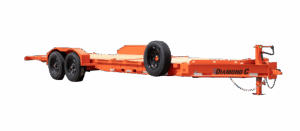
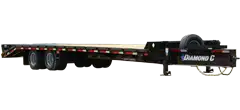
The same discipline applies to model names and options. Diamond C, for example, builds trailers in Mt. Pleasant, Texas, and has operated since 1985. Its current FMAX family is a gooseneck flatbed line with certified GVWR choices that vary by model and configuration from about 15,500 lb. to as high as 40,000 lb. Diamond C premium lines such as FMAX, HDT, LPT, LPX, WDT, and DEC use Lippert axles as standard. A dealer should identify the exact model, axle package, brake configuration, empty weight, and certification label rather than treating every trailer in a product family as interchangeable.
The brands Spencer Trailers carries, including Diamond C, H&H, Liberty, Legend, and Wells Cargo, operate within the broader dealer-manufacturer-supplier ecosystem that NATDA serves. That does not mean every brand, dealer, or employee participates in every NATDA program. It means the association provides a forum where dealership feedback, manufacturer information, component training, service practices, and business resources can meet. That communication loop is one of the ways dealers learn about current products instead of relying on old model descriptions or copied specifications.
What to Look For in a Dealer
NATDA membership is not a magic quality badge, a state license, or a substitute for checking the actual trailer. There are excellent dealers that are not members and there can be member dealers whose staff make mistakes. Membership is best viewed as one possible signal that a dealership values industry participation and has access to dealer-specific education and resources. The stronger evidence is how the dealer answers detailed questions and supports the customer after the sale.
A few practical questions worth asking any dealer:
- How long have you carried this brand, and which model-year changes should I know about? A dealer with experience selling Diamond C, Delco, or another brand should be able to explain current model identities, important option changes, service history, parts availability, and warranty procedures without confusing old and new specifications.
- Can you show me the certification label and walk me through GVWR, GAWR, empty weight, and payload on this exact trailer? The answer should be tied to the VIN-specific unit, not a generic website number. Ask whether dealer-installed options, spare tires, ramps, batteries, tarps, toolboxes, or hydraulic equipment affect the listed or actual empty weight.
- Can you verify every connection rating in my setup? A competent dealer should discuss the truck’s ratings, receiver or gooseneck hitch, ball, coupler, safety chains, breakaway system, electrical connector, brake controller, tires, wheels, and expected tongue or pin weight. No single component rating overrides a lower limit elsewhere in the combination.
- What is the process if I have a warranty or service issue? Good dealers explain who diagnoses the problem, what documentation and photographs may be required, whether the manufacturer must preauthorize repairs, how parts are ordered, what labor is covered, and which maintenance or wear items are excluded. The written manufacturer’s warranty controls, but the dealer’s experience can make the process far easier to navigate.
These questions test the dealership’s knowledge without requiring you to know anything about NATDA. They also reveal whether the dealer verifies facts or defaults to confident-sounding generalities. A professional answer may occasionally be, “I need to confirm that against the build sheet or manufacturer documentation.” That is better than an immediate answer that turns out to be wrong.
Networking and Market Access for Buyers
One underappreciated benefit of an active dealer network is access to information and inventory beyond the units physically parked on one lot. A dealer with established manufacturer, representative, transporter, and dealer relationships may be able to check production schedules, incoming allocations, available configurations, factory-order possibilities, or dealer-transfer options. That does not guarantee that every hard-to-find trailer can be located immediately, but it gives the buyer more options than a simple search of public listings.
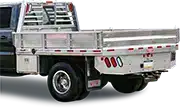
Looking for a specific 20-foot enclosed cargo trailer from Darkhorse Cargo, a particular United all-aluminum enclosed trailer, or an uncommon combination of height, axle package, color, doors, and interior options? A connected dealer can often determine whether the practical solution is an in-stock unit, an incoming trailer, a factory order, or a comparable configuration from another line. The same principle applies to truck beds from Zimmerman or Martin, where chassis fitment, cab-to-axle dimensions, material, hitch equipment, lighting, and installation details matter as much as the product name.
For buyers in and around Owen County, that kind of network access matters. Spencer, Indiana, is not a major metropolitan inventory hub, but a local dealership with strong manufacturer and industry relationships can still source specialized equipment and obtain accurate build information. Geographic size does not have to limit product knowledge or access when the dealer maintains active lines of communication.
The value of a good dealer is not limited to what is parked on the lot. It includes what the dealer can accurately identify, responsibly source, properly match, and support after the sale.
A Quick Reference: NATDA vs. Other Industry Groups
| Organization | Who It Represents | Primary Focus |
|---|---|---|
| NATDA | Trailer and truck-bed dealerships, with manufacturer and vendor participation across the light- and medium-duty trailer industry | Dealer education, technical and service training, the NATDA Trailer Show, publications, networking, and member-benefit programs |
| NTEA | Companies that manufacture, distribute, install, sell, and repair commercial vehicles, truck bodies, truck equipment, trailers, and accessories | Work-truck technical information, vehicle engineering and compliance resources, education, market data, member programs, and industry advocacy |
| NATM | Light- and medium-duty trailer manufacturers, suppliers, service providers, dealers, and tow-vehicle OEMs | Trailer safety, manufacturing compliance, education, advocacy, industry best practices, and its manufacturer Compliance Verification Program |
Each organization operates in a different lane, and none replaces NHTSA, FMCSA, a state motor-vehicle agency, or the manufacturer’s own certification responsibilities. NATDA is the group with the most direct focus on dealership performance and dealer education, which is why it is especially relevant to buyers trying to understand the professional environment behind a retail trailer sale.
What Counts for Buyers
You do not need to research trade associations before buying a trailer, and NATDA membership should never replace inspection of the trailer, the tow vehicle, the certification labels, the written warranty, and the purchase documents. Understanding NATDA does, however, help explain why two dealerships carrying the same brand can provide very different buying experiences. The difference often comes down to product knowledge, continuing education, service capability, manufacturer communication, documentation habits, and whether the dealership is willing to verify a technical answer before asking you to sign.
At Spencer Trailers, we select and support products through direct manufacturer relationships, hands-on familiarity, and ongoing attention to current model information. Whether you are considering a Diamond C FMAX gooseneck flatbed, a DEC deck-over equipment trailer, a Wells Cargo enclosed trailer, or a Liberty dump trailer for farm, landscaping, property-maintenance, or construction work, the recommendation should start with the load and the tow vehicle rather than a sales slogan. The exact trailer’s GVWR, actual empty weight, payload, axle and tire ratings, deck dimensions, ramps, brakes, coupler, suspension, and options all matter.
Browse our current inventory to see what is in stock, or reach out directly if you have a specific application in mind. Bring the year, make, model, cab and bed configuration of your truck, a photograph of its payload and certification labels, the weight and dimensions of the equipment or cargo, and a list of attachments you plan to carry. The right trailer is not automatically the one with the highest GVWR, the most axles, or the lowest advertised price. It is the unit whose certified ratings, usable payload, dimensions, loading system, braking equipment, hitch requirements, and service support fit your real job. That is the conversation a professional trailer dealer should be prepared to have.


