








You buy a cargo trailer, hitch it up, and start hauling for pay. The trailer has your logo, phone number, and a polished wrap, but the pickup doors are blank. At a roadside inspection, the officer points to the power unit: no registered motor-carrier name, no USDOT number, or markings that cannot be read from the required distance. That can produce an inspection violation, a citation, and a costly delay while the officer checks whether your registration, operating authority, insurance, driver credentials, and vehicle are otherwise compliant.
This is not a theoretical problem. Commercial motor vehicle marking requirements catch many small operators off guard, especially contractors, landscapers, equipment haulers, and new for-hire carriers. The most common misunderstanding is that lettering the trailer automatically satisfies the federal rule. Under the general FMCSA marking requirement, the legal name and USDOT number belong on both sides of the self-propelled commercial motor vehicle—the truck or tractor operating as the power unit. Lettering on the trailer may be useful advertising, but it normally does not replace compliant markings on the tow vehicle.
One firm reminder up front: federal and state marking rules change, and applicability depends on the vehicle, cargo, operating area, and type of business. Everything here reflects general federal guidance under FMCSA regulations and current Indiana guidance. Before you put a truck-and-trailer combination on the road for commercial use, verify current requirements directly with the FMCSA, Indiana Department of Revenue Motor Carrier Services, Indiana State Police Commercial Vehicle Enforcement, and the agencies in every state where you operate. Do not rely solely on any single source, including this one.
When Does Your Trailer Actually Require Lettering?
The first distinction is important: the federal motor-carrier identification rule is primarily a power-unit marking rule, not a blanket requirement to place the carrier’s USDOT number on every ordinary cargo, dump, equipment, flatbed, or gooseneck trailer. Every self-propelled commercial motor vehicle subject to the applicable FMCSA regulations must display the required carrier identification on both sides. A truck-and-trailer combination generally enters federal commercial motor vehicle territory when it is used in interstate commerce and has a gross vehicle weight rating, gross combination weight rating, gross vehicle weight, or gross combination weight of 10,001 pounds or more, whichever value is greater. Passenger capacity and placardable hazardous-material transportation can also trigger federal requirements regardless of the ordinary property-hauling weight calculation.
Interstate commerce means more than physically driving across a state line. A trip conducted entirely within Indiana can still be part of interstate commerce when the property being transported originated outside Indiana, is destined for another state, or is moving as part of a continuous interstate shipment. Conversely, towing a personally owned trailer for a genuinely non-business recreational trip is not automatically commercial transportation simply because the combination is heavy. Operations confined to one state may instead be governed by that state’s intrastate motor-carrier rules, and several states—including Indiana—require USDOT registration for at least some intrastate carriers.
Private carriers hauling their own tools, machinery, products, or materials can be subject to the same federal safety-registration and marking threshold as for-hire carriers when they operate in interstate commerce. A for-hire carrier may also need separate operating authority, insurance filings, Unified Carrier Registration, and other credentials, depending on what it transports and where it operates. For weight calculations, do not look only at the trailer’s empty scale weight. FMCSA’s combination-rating definition generally uses the greater applicable value, including a manufacturer-listed GCWR or the combined ratings or actual weights of the power unit and towed unit. Also remember that the 10,001-pound FMCSA safety threshold is not the Class A CDL threshold. A Class A CDL is generally implicated when the combination has a GCWR of 26,001 pounds or more and the towed vehicle has a GVWR greater than 10,000 pounds, subject to applicable exemptions.
The USDOT Number Requirement
The USDOT number is the identifier assigned to the motor carrier responsible for the operation. Under the general federal marking rule, the operating carrier’s legal name or registered trade name and USDOT number must appear on both sides of the self-propelled commercial motor vehicle. For a pickup towing an enclosed trailer, the required markings normally go on both sides of the pickup. For a road tractor pulling a semitrailer, they normally go on both sides of the tractor. Placing the number only on the trailer does not ordinarily satisfy that power-unit requirement. Separate provisions exist for intermodal equipment providers, driveaway operations, rented or leased power units, and certain state-regulated operations, so those arrangements deserve an operation-specific review.
As of 2026, FMCSA uses the Motus registration system for new USDOT registrations, operating-authority applications, updates, and related registration actions. There is no federal charge merely to obtain a USDOT number, although applications for operating authority and other registrations may involve fees and additional filings. Receiving a USDOT number does not automatically mean a for-hire carrier is authorized to begin every type of operation. When operating authority is required, the authority, insurance filings, process-agent designation, and other applicable registrations must be active before service begins. Carriers must also keep their USDOT information accurate and complete the required biennial updates.
Lettering Size: The Numbers That Actually Matter
Federal regulations do not establish a universal 2-inch minimum letter height for ordinary motor-carrier identification markings. The federal standard is performance-based. The required name and USDOT number must appear on both sides of the self-propelled commercial motor vehicle, contrast sharply with the background, and be readily legible during daylight hours from 50 feet while the vehicle is stationary. The markings must then be maintained so they continue meeting that standard. A decal can fail because it is too small, but it can also fail because the font is too thin, the colors lack contrast, the surface is dirty, or part of the information is hidden by equipment.
Two-inch, 3-inch, or 4-inch characters are common practical choices, but choosing a commonly used height does not by itself guarantee compliance. A narrow decorative font in 4-inch lettering may be harder to read than bold block lettering at a smaller nominal height. Use a simple font, adequate stroke width, sensible spacing, and a location that is not blocked by mirrors, steps, toolboxes, door seams, body trim, mud, or an attached trailer. Stand 50 feet away in daylight and confirm that both the carrier name and complete USDOT number are immediately readable. On a pickup, that may require larger or better-positioned lettering than a sign shop’s smallest standard door kit.
States may impose additional identification, permit-number, locality, or lettering requirements for intrastate carriers and specialized operations. Do not assume that an arbitrary letter height satisfies every jurisdiction, and do not assume that a state’s requirements apply only to tractor-trailers. A commercially operated pickup towing a trailer can be a regulated combination even when it looks like an ordinary contractor’s rig. Check the rules of the carrier’s base state and each state in which the combination will operate.
What Information Must Be Displayed
Federal commercial vehicle marking rules generally require two primary pieces of information on both sides of the self-propelled commercial motor vehicle:
- The legal name or a single trade name of the motor carrier. The displayed name must be the legal name or a single trade name associated with the carrier’s USDOT registration. If the business operates as “Smith Brothers Hauling LLC,” or under a registered trade name listed in the carrier record, use the corresponding name from that record. A marketing nickname that is not associated with the USDOT registration can create a mismatch during an inspection.
- The USDOT number, preceded by the letters “USDOT.” A compliant presentation reads “USDOT 1234567,” using the number actually assigned to the operating carrier. The complete number must be visible, correctly reproduced, and associated with the carrier operating the power unit.
An MC number identifies operating authority, but it is not one of the two standard markings required on the vehicle by the current federal motor-carrier identification rule. A carrier may display an MC number or other identifying information voluntarily when it is accurate and not misleading, but doing so does not replace the legal or registered trade name and the USDOT number. A city and state, telephone number, website address, logo, service description, and unit number are also generally optional under the federal marking rule. When the name of another person or company appears on the power unit, the operating carrier’s required identification may need to be preceded by the words “operated by” so responsibility for the vehicle is clear.
The required carrier identification must appear on both sides of the self-propelled commercial motor vehicle and be readable from 50 feet in daylight while the vehicle is stationary. A company logo and USDOT number placed only on the rear doors or sidewalls of an enclosed trailer normally do not cure blank or noncompliant pickup doors. Trailer branding can repeat the same information for visibility, but the required power-unit markings still need to stand on their own.
Permanent vs. Temporary Markings
FMCSA rules allow markings to be painted on the vehicle or displayed by a removable device, provided the device satisfies the identification, contrast, placement, legibility, and maintenance requirements. Properly made magnetic signs can therefore be acceptable under the general federal rule. The practical risk is that a magnet may be forgotten, placed where it cannot be read, stolen, damaged, covered with grime, or lost at highway speed. If the sign is absent during a regulated trip, the vehicle is not properly marked merely because a compliant magnet exists back at the shop. Rented and leased power units can also involve special marking and document provisions, particularly when the operating carrier differs from the vehicle owner.
Commercial-grade vinyl lettering is the most common choice for trucks used regularly in business. It is clean, weather-resistant, and easy to reproduce consistently across a fleet. Pricing varies with character size, material grade, colors, reflective options, design work, surface preparation, and professional installation, so a single nationwide price estimate is not reliable. Ask the sign shop for two matching power-unit sets and make sure the proof uses the exact name and USDOT number shown in the active carrier record. Additional lettering for the trailer can be ordered as branding, but it should be treated as an additional set rather than a substitute for the truck markings.
How This Applies to Common Trailer Types
Trailer type affects the combination’s weight rating, loading method, and practical branding surfaces, but it usually does not change the basic federal rule that the operating carrier’s identification belongs on the self-propelled commercial motor vehicle. Always use the actual certification labels and manufacturer ratings for the specific truck and trailer rather than relying on a model description in an advertisement.
Enclosed Cargo Trailers
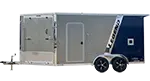
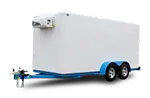
A tandem-axle 7×14 or 7×16 enclosed cargo trailer is commonly available with a 7,000-pound GVWR, although the exact rating depends on the manufacturer, axle package, tires, coupler, brakes, and ordered configuration. Pairing a 7,000-pound-GVWR trailer with a pickup carrying a GVWR in the 6,000- to 7,000-pound range produces a combination of ratings well above 10,001 pounds. The fact that the trailer is empty, or that the pickup and trailer individually fall below 10,001 pounds, does not automatically keep the combination outside the federal definition. Actual gross weights can also trigger applicability when they exceed the ratings used in the comparison.
A larger enclosed trailer rated at 9,990 pounds will push the combination beyond 10,001 pounds when paired with virtually any ordinary pickup suitable for towing it. When that combination is used in interstate commerce for a business, the operator should evaluate USDOT registration and the full set of applicable FMCSA requirements. The enclosed sidewalls are excellent for a company logo, telephone number, website, and service list, but the legal name and USDOT number must still be displayed correctly on both sides of the pickup or other power unit.
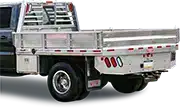
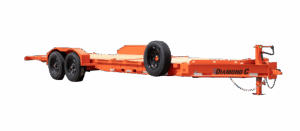
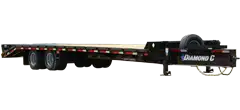
Flatbed and Equipment Trailers
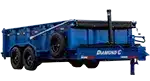
Flatbed and equipment-trailer combinations move beyond the 10,001-pound threshold quickly. For example, the current Diamond C FMAX210 is a 25,000-pound-GVWR Flatbed Max gooseneck offered in multiple lengths and equipped with two 10,000-pound Lippert axles. Even a more conventional 14,000-pound-GVWR bumper-pull equipment trailer, when combined with a suitable pickup, is comfortably above the federal weight threshold for an interstate commercial operation. The exact trailer model, axle rating, loaded weight, and tow vehicle still matter for payload, towing capacity, licensing, and other compliance questions, but there is no realistic argument that such a combination falls below 10,001 pounds.
Flatbeds and equipment trailers may have limited smooth panel area, but that is not a barrier to complying with the normal federal marking rule because the required identification goes on the truck. Optional branding can be added to a bulkhead, toolbox, fender, side plate, or other appropriate trailer surface without covering the VIN label, certification information, conspicuity material, lights, reflectors, safety warnings, or securement hardware. A fleet-lettering shop can design matching truck and trailer graphics while keeping the required power-unit information unmistakable.
Gooseneck and Heavy Haulers
Heavy gooseneck trailers make the distinction between FMCSA safety thresholds and CDL thresholds especially important. Diamond C’s FMAX gooseneck flatbed lineup ranges from approximately 15,500 pounds to as much as 40,000 pounds GVWR, depending on the specific FMAX model and configuration. A 25,900-pound or 40,000-pound-GVWR gooseneck combined with an appropriate truck is far beyond the 10,001-pound FMCSA threshold and may also enter Class A CDL, apportioned-registration, fuel-tax, operating-authority, medical-card, hours-of-service, and other regulatory territory depending on the vehicle and operation. The operating carrier’s required identification belongs on both sides of the truck or tractor. Additional lettering on the gooseneck, toolbox, or trailer frame is optional branding unless a separate rule specifically applies.
A Quick Reference Table
| Requirement | Federal Minimum | Notes |
|---|---|---|
| Letter height | No fixed inch measurement | Markings must contrast sharply and be readily legible from 50 feet in daylight while stationary |
| Company name | Required on both sides of the power unit | Use the legal name or a single trade name associated with the carrier’s USDOT registration |
| USDOT number | Required on both sides of the power unit | Must be preceded by “USDOT”; ordinary trailer lettering does not replace the power-unit markings |
| Weight threshold | 10,001 lb or more for covered interstate property operations | Compare GVWR, GCWR, GVW, and GCW as applicable; this is not the same as the Class A CDL threshold |
| Readability distance | 50 feet in daylight while stationary | Faded, peeling, dirty, hidden, or low-contrast markings can be noncompliant |
State Rules Add Another Layer
Federal rules govern covered interstate operations, while states can regulate intrastate carriers and impose additional registration or identification requirements. Indiana currently requires USDOT registration and markings for many interstate and intrastate commercial motor vehicles meeting its applicable criteria. Indiana guidance generally uses the 10,001-pound commercial motor vehicle threshold but also recognizes specific intrastate exemptions, including qualifying farm-plated combinations that do not cross state lines and certain private carriers hauling their own non-hazardous property below 26,000 pounds. An intrastate for-hire carrier operating below the ordinary USDOT threshold may instead need an Indiana identification number. Because the exemptions and state-number requirements depend on the operation, confirm the result with Indiana Department of Revenue Motor Carrier Services or Indiana State Police rather than assuming that “intrastate only” means unregulated.
If you regularly cross into Illinois, Ohio, Kentucky, Michigan, or other states, review each jurisdiction’s intrastate carrier rules, registration requirements, weigh-station instructions, permit rules, and enforcement guidance before the first trip. Correct federal markings on the power unit do not automatically satisfy every state registration or operating-authority obligation. At the same time, putting extra numbers on the trailer does not correct an inactive USDOT registration or missing authority. The carrier record, displayed identification, vehicle credentials, and actual operation all need to agree.
What Happens When You Get It Wrong
An inspector can record a violation when the required name or USDOT number is missing, incorrect, displayed only on the trailer, obscured, insufficiently contrasting, or unreadable from the required distance. The consequences can include a roadside citation, inspection documentation, administrative penalties, and substantial delay while the carrier’s identity and status are verified. There is no single universal dollar amount for every marking violation, and a marking defect is not automatically an out-of-service order in every inspection. However, the stop may reveal an inactive USDOT number, missing operating authority, missing insurance filings, an unqualified driver, brake defects, tire defects, or another condition that can place the driver or vehicle out of service.
Getting it right before leaving the yard is far less expensive than correcting it during a roadside inspection. Add the markings to the vehicle’s normal pre-trip walk-around: confirm that both sides are present, the displayed name still matches the carrier record, every digit is intact, the color contrast is strong, and mud, snow, straps, equipment, or body damage has not hidden the information.
Buying a Trailer with Commercial Use in Mind
If you are buying a trailer specifically for commercial hauling, evaluate the whole combination rather than treating the trailer as a stand-alone purchase. An enclosed cargo trailer from our current inventory may provide large flat sidewalls for professional branding, while a dump, flatbed, equipment, or gooseneck trailer may offer smaller areas for optional company graphics. In either case, reserve appropriate space on both sides of the tow vehicle for the operating carrier’s legal or registered trade name and USDOT number. A fleet sign shop can coordinate the truck and trailer design without confusing optional advertising with required identification.
Ask for the exact GVWR, unloaded vehicle weight, payload capacity, axle configuration, and certification label information for any trailer you are considering. Compare those figures with the tow vehicle’s GVWR, GCWR, payload rating, towing rating, hitch capacity, and actual loaded weight. If the applicable combination rating or weight is 10,001 pounds or more and the vehicle will be used in interstate commerce, evaluate USDOT registration and proper power-unit lettering before the first commercial trip. Use FMCSA’s current Motus system for registration actions, and do not assume that possession of a USDOT number alone activates any operating authority, insurance filing, state registration, or CDL privilege that the operation may require.
Have questions about which trailer makes sense for your commercial operation? Reach out to the team at Spencer Trailers. We work with contractors, landscapers, equipment owners, and small carriers and can help you compare trailer ratings, payload, loading systems, and tow-vehicle compatibility. We can explain the specifications shown on the trailer, but final legal and regulatory determinations should be confirmed with FMCSA, Indiana motor-carrier authorities, your licensing agency, and a qualified compliance professional familiar with your operation.
Reminder: This post provides general information and is not legal advice. FMCSA regulations, registration systems, enforcement policies, and state commercial vehicle rules are updated periodically. Verify current requirements with FMCSA (fmcsa.dot.gov), Indiana Department of Revenue Motor Carrier Services, Indiana State Police Commercial Vehicle Enforcement, and the appropriate agencies in every state where you operate. Any regulatory threshold or citation discussed here should be checked against the current law and the facts of your specific operation before operating commercially.


