








You back your loaded trailer down a steep grade and press the tow vehicle’s brake pedal. What happens next depends heavily on the braking system installed under the trailer. Surge brakes and electric brakes may both use familiar drum or disc hardware at the wheels, but they generate braking force in different ways, require different supporting equipment, and suit different kinds of towing.
Here’s the practical breakdown, without the runaround.
How Surge Brakes Work
A surge brake system is hydraulic and largely self-contained. When the tow vehicle slows, the trailer’s forward momentum compresses a sliding actuator built into the coupler. The actuator’s master cylinder pressurizes hydraulic fluid, which travels through brake lines to wheel cylinders in a drum-brake system or calipers in a disc-brake system. The resulting friction slows the trailer.
The actuator sits at the trailer tongue and must be rated for the trailer’s actual loaded weight and compatible with the type of brakes installed. Current marine-trailer systems are available from manufacturers such as Dexter/UFP, Demco, and Tie Down Engineering, with ratings and configurations that vary considerably. A tandem-axle boat trailer might use a properly rated surge actuator with hydraulic drum brakes or hydraulic disc brakes on the wheels required to be braked. The actuator, coupler, brake assemblies, tires, axles, and trailer certification rating must all be suitable for the load; the actuator rating alone does not increase the trailer’s GVWR.
Because the system reacts to compression at the coupler, braking generally increases as the trailer pushes harder against the tow vehicle. A gradual stop produces relatively light trailer braking, while stronger deceleration produces greater hydraulic pressure. The system still needs correct adjustment, properly functioning dampening components, sound hydraulic lines, uncontaminated fluid, and brakes that have been maintained according to the component manufacturers’ instructions.
Surge brakes do not require an electric-brake controller. However, many surge systems use an electrically operated reverse-lockout solenoid, so “self-contained” does not always mean that no electrical connection is needed beyond ordinary trailer lights. The correct connector depends on the trailer’s configuration.
How Electric Brakes Work
Conventional electric trailer drum brakes use an electromagnet inside each brake assembly. When the tow vehicle’s brake controller sends current through the brake-output circuit, the magnet contacts the rotating drum and moves an actuating lever. That lever expands the brake shoes against the drum. Braking strength is controlled through the tow vehicle’s controller and can be adjusted for trailer loading and road conditions.
A proportional controller measures tow-vehicle deceleration and varies trailer-brake output accordingly. Examples include the Tekonsha Prodigy P3 and CURT Echo family, although installation method, vehicle compatibility, axle capacity, smartphone requirements, and manual-control operation differ by controller version. Factory-integrated controllers can also coordinate braking through the tow vehicle’s onboard systems.
Electric brakes normally use a 7-way RV-style connector on equipment, cargo, dump, and utility trailers. Some specialized installations use other connector formats, but a standard 4-way flat connector does not provide a dedicated electric-brake output circuit. A properly wired system also needs dependable grounds, suitable wire gauge, protected junctions, and a functional breakaway system. Brake-controller output is variable rather than a simple constant 12-volt supply.
Most electric-brake controllers provide a manual control that applies the trailer brakes independently of the tow vehicle’s service brakes. That control is useful for a stationary function check and may help dampen the early stages of trailer sway when used carefully and in accordance with the controller and tow-vehicle instructions. It should not be treated as a cure for improper tongue weight, excessive speed, overloaded components, poor tire condition, or incorrect load placement. If a combination is already jackknifing, the priority is maintaining control and avoiding abrupt inputs, not experimenting with the controller.
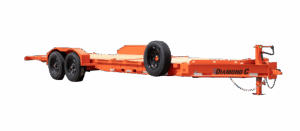
Electric brakes are widely used on cargo, equipment, dump, flatbed, and utility trailers. A current Diamond C LPX Low Profile Equipment Trailer in the 207 package, for example, has a 15,500 lb GVWR and two 7,000 lb Lippert axles with electric brakes. Higher-capacity LPX packages use different axle, tire, frame, and brake configurations, and current Diamond C specifications should be checked for the exact VIN and selected options. Diamond C uses Lippert axles on its premium trailer lines, including the LPX, and current brake equipment may include electric drums, available electric-over-hydraulic discs, and model-dependent anti-lock brake technology.
Surge Brakes: Pros and Cons
Advantages
- No electric-brake controller required. Braking is generated hydraulically by movement of the actuator. A trailer with an electric reverse-lockout solenoid still needs the appropriate reverse-light signal, commonly supplied through a 5-way flat or 7-way connector.
- Well suited to many boat-trailer applications. Properly selected hydraulic components avoid placing conventional electric-drum magnets inside repeatedly submerged brake assemblies. Hydraulic disc systems are especially common on larger and saltwater boat trailers because they are easier to inspect and rinse than enclosed drum assemblies.
- Compatible with different tow vehicles. Provided the tow vehicle has the correct hitch, capacity, lighting connection, and any required reverse-lockout circuit, the trailer does not depend on an installed electric-brake controller.
- Automatic response to trailer push. The system develops hydraulic pressure as the trailer compresses the actuator during deceleration, without requiring the driver to set controller output for each tow vehicle.
- Available with drum or disc brakes. Hydraulic drums can be economical, while hydraulic discs generally dissipate heat well and make visual inspection more straightforward. The actuator must be designed for the selected brake type because drum and disc systems can require different pressure and residual-valve arrangements.
Disadvantages
- No conventional in-cab manual override. A purely mechanical surge system does not let the driver command a separate, graduated trailer-brake application from a normal electric-brake controller.
- Hydraulic maintenance is essential. Fluid condition, leaks, flexible hoses, steel lines, fittings, master-cylinder seals, wheel cylinders or calipers, and the actuator’s sliding mechanism all require inspection. Opening the hydraulic system normally requires proper bleeding afterward.
- Saltwater still causes corrosion. Surge operation does not make a trailer corrosion-proof. Rotors, calipers, fasteners, brake lines, bearings, electrical connections, and the trailer frame should be built for the environment, rinsed with fresh water after saltwater exposure, and inspected frequently.
- Reversing provisions vary. Some hydraulic drum systems use free-backing brake assemblies. Many disc-brake installations use an electric reverse-lockout solenoid, while certain actuators provide a manual lockout procedure. The operator must know which arrangement is installed before backing uphill or down a ramp.
- Coupler movement affects operation. Corrosion, binding, incorrect lubrication, a damaged shock or dampener, seized brakes, or improper actuator installation can cause delayed, harsh, or ineffective braking.
- Brake balance is not adjustable from the cab. Conventional surge systems do not provide the convenient gain adjustments available with an electric controller. Correct sizing and mechanical condition therefore matter greatly.
Electric Brakes: Pros and Cons
Advantages
- Manual-control capability. The controller’s manual control can apply the trailer brakes independently for a pre-trip function check and, when used correctly, may help settle developing sway. The exact control may be a physical lever, button, remote, or app-based control, depending on the controller.
- Adjustable output. Gain can be set so the trailer contributes meaningful braking without locking its wheels during ordinary stops. Settings should be checked whenever trailer loading, road conditions, controller mode, or tow vehicle changes.
- Strong fit for working trailers. Electric drum brakes are common, widely serviceable, and well suited to cargo, utility, equipment, dump, and flatbed trailers that are not routinely submerged.
- Good tow-vehicle integration. Many late-model pickups offer factory-integrated trailer-brake controllers that work with the vehicle’s braking electronics. Compatibility must still be verified, particularly for electric-over-hydraulic systems.
- Straightforward diagnosis. A technician can test controller output, connector condition, breakaway operation, grounds, wiring resistance, magnet current, brake adjustment, and mechanical wear to isolate many common faults.
- Electric-over-hydraulic upgrade path. Heavy-duty trailers can use an in-cab electric controller to command a hydraulic actuator operating disc brakes. This provides driver-adjustable control while retaining hydraulic braking hardware at the trailer wheels.
Disadvantages
- Requires a compatible controller. Conventional electric brakes need a properly installed controller or a compatible factory-integrated system. Controller prices and installation costs vary, and inexpensive time-delayed controllers behave differently from proportional units.
- Wiring condition directly affects braking. Damaged conductors, weak grounds, corroded connectors, poor splices, undersized wire, or a faulty tow-vehicle output circuit can reduce or eliminate brake performance.
- Routine submersion is hard on components. Conventional electric drum assemblies are generally a less practical choice for boat trailers that enter the water frequently, especially in saltwater. Waterproof connections and disciplined maintenance reduce risk but do not eliminate the harsh environment.
- Magnets and drums are wear items. Magnet faces, drums, shoes, springs, adjusters, bearings, seals, and wiring should be inspected at the intervals specified by the axle or brake manufacturer. Service life depends on load, adjustment, heat, terrain, contamination, driving technique, and annual mileage; there is no reliable universal replacement-mileage figure.
- Controller setup matters. Excessive gain can cause wheel lockup and unnecessary wear, while insufficient gain makes the tow vehicle perform too much of the stopping work. Proper adjustment must be confirmed in a safe location.
Boat Trailers: Why Surge Usually Wins
Boat trailers operate in an environment that conventional electric drum brakes were not designed to enjoy. Repeated immersion can introduce water into connectors and brake assemblies, accelerate corrosion, contaminate friction surfaces, and damage grounds. Saltwater makes the problem more severe. That is why hydraulic surge brakes, particularly corrosion-resistant hydraulic disc systems, are common on modern boat trailers.
Surge brakes are not maintenance-free. After saltwater use, the trailer should be rinsed thoroughly with fresh water, including the brakes, frame, suspension, wheels, and accessible hardware. Bearings and seals should be inspected according to the trailer manufacturer’s schedule, and brake-fluid condition, hoses, lines, calipers, rotors, actuator travel, and breakaway mechanism should be checked regularly.
Reversing is an important design consideration. When a tow vehicle backs a trailer uphill or pushes it down a ramp, compression at the actuator can apply the trailer brakes. Free-backing hydraulic drums are designed to reduce this effect in reverse. Hydraulic disc systems commonly use a normally open reverse-lockout solenoid that blocks or redirects hydraulic pressure when energized by the tow vehicle’s reverse-light circuit. A 5-way flat or properly wired 7-way connector can supply that signal. A manual lockout, where provided, should be used only as directed and must be disengaged before normal travel.
Loaded boat-trailer weight varies too much to select brakes from boat length alone. The correct figure includes the boat, engine, batteries, fuel, trolling motor, water, gear, accessories, and the trailer itself. A 21-foot fishing boat combination might weigh substantially more or less than another boat of the same nominal length. The trailer should be weighed in ready-to-tow condition, and every component must remain within its rating.
For larger pontoons, fiberglass boats, and offshore rigs, the actuator must be compatible with the trailer’s actual loaded weight and braking hardware. The trailer’s certified GVWR, GAWR, tire ratings, coupler rating, safety equipment, and tow vehicle limits remain controlling. Installing a higher-rated actuator does not authorize loading beyond the lowest-rated component or the trailer manufacturer’s certification label.
If a boat trailer is used in saltwater, inspect and rinse the complete braking system regularly. Corrosion often develops gradually, and a brake system should never be assumed functional merely because the trailer felt normal during the previous trip.
Brake Controllers: What to Know Before You Buy
If you run conventional electric brakes or a compatible electric-over-hydraulic system, the controller is central to brake performance. The two broad controller categories are time-delayed and proportional, although product-specific features and factory-integrated systems create additional variations.
Time-delayed controllers begin sending brake output after the brake-light circuit is activated and increase or apply that output according to preset gain, timing, and aggressiveness settings. They are affordable and can work acceptably when properly adjusted, but they do not directly measure the severity of every stop. The same settings may feel too aggressive while creeping through town and too mild during a faster stop with a heavily loaded trailer.
Proportional controllers, including products such as the Tekonsha Prodigy P3 and compatible CURT Echo models, use motion sensing to relate trailer output to tow-vehicle deceleration. They generally produce smoother, more intuitive braking across changing traffic conditions. Wireless or app-supported products must be installed and operated according to their specific instructions; Bluetooth may provide the user interface, but the trailer’s braking response must not depend on an unsafe improvised setup.
Controller prices change frequently and may not include the vehicle-specific harness, mounting hardware, adapter, professional installation, 7-way conversion, battery charge circuit, or wiring repairs. Choose a controller by brake type, number of braked axles, tow-vehicle compatibility, electric-over-hydraulic compatibility when applicable, manual-control accessibility, and the manufacturer’s rated capacity—not by price alone.
Many late-model Ford, Ram, Chevrolet, and GMC pickups offer factory-integrated trailer-brake controllers on selected trims or option packages. Availability is not universal, even within the same model line, and it may vary by model year, powertrain, towing package, and trim. Confirm the truck’s actual equipment rather than assuming every heavy-duty pickup has a controller.
A factory-integrated controller may communicate with the truck’s stability-control and anti-lock-braking systems and display trailer output or connection status in the instrument panel. It still requires correct trailer wiring, compatible brakes, sound grounds, and proper gain selection. Owners of electric-over-hydraulic brakes should verify that the tow vehicle’s controller supports that mode.
Before every towing day, connect the trailer, inspect the plug and breakaway cable, verify that the controller recognizes the trailer, and test brake response at low speed in a safe area. Newly installed electric drum brakes may also require a manufacturer-specified burnishing procedure before they deliver full braking performance.
Comparison at a Glance
| Feature | Surge (Hydraulic) | Electric |
|---|---|---|
| Electric-brake controller needed | No | Yes, unless a compatible factory controller is installed |
| Primary operating principle | Coupler compression pressurizes hydraulic fluid | Controller varies current to brake magnets |
| Saltwater suitability | Generally better suited, especially with marine hydraulic discs | Conventional electric drums face significant corrosion risk |
| Manual override from cab | Not on a conventional mechanical surge system | Normally available through the controller |
| Driver-adjustable gain | No | Yes |
| Trailer electrical connection | Lights plus reverse-lockout circuit when equipped | Normally a properly wired 7-way connection |
| Brake hardware | Hydraulic drum or hydraulic disc | Usually electric drum; electric-over-hydraulic is a separate hybrid system |
| Weight capability | Depends on actuator, brakes, axles, tires, and certified trailer rating | Depends on controller, brakes, axles, tires, and certified trailer rating |
| Typical use case | Boat and marine trailers | Cargo, equipment, utility, dump, and flatbed trailers |
| Reverse provision | Configuration-dependent: free-backing brakes, electric lockout, or approved manual method | No surge-actuator lockout required |
| Breakaway operation | Mechanical cable or another approved hydraulic arrangement | Switch and charged onboard battery |
State Brake Requirements
Indiana Code IC 9-19-3-3 applies when a trailer or semitrailer has a gross weight of at least 3,000 lbs and is operated on a highway. The trailer must have brakes adequate to control its movement and to stop and hold it. Those brakes must be designed so the tow-vehicle driver can apply them from the cab, and they must apply automatically if the trailer accidentally separates from the tow vehicle.
The statute establishes the braking obligation at 3,000 lbs of actual gross weight; it should not be reduced to a casual statement that only trailers “over” 3,000 lbs are covered. A trailer at the threshold is included. Owners should also distinguish actual gross weight, GVWR, and axle ratings when evaluating a particular combination.
Do not assume Indiana’s basic threshold answers every equipment question. The number of wheels or axles that must be braked can depend on the trailer’s design, other applicable provisions, manufacturer certification, and whether federal commercial-motor-vehicle rules apply. On a trailer manufactured with brakes on both tandem axles, all installed brakes should remain connected and operational. Removing brakes or disconnecting one axle can reduce performance, violate the certified configuration, and create legal and insurance problems.
A functioning breakaway system is not merely an optional convenience on an Indiana trailer covered by IC 9-19-3-3. The brakes must be designed and connected to apply automatically upon accidental breakaway. Conventional electric-brake trailers normally accomplish this with a charged onboard battery, switch, pin, and cable. Surge systems can use a mechanical breakaway cable that strokes or latches the hydraulic actuator. The breakaway cable must be attached independently to a suitable point on the tow vehicle, not simply looped through a safety chain.
For interstate commercial operation, federal rules may also apply. Under 49 CFR 393.43, a trailer required to have brakes must have them apply automatically and immediately upon breakaway. Except for specified configurations, the required brakes must remain applied for at least 15 minutes. Commercial operators should evaluate the complete Federal Motor Carrier Safety Regulations rather than relying only on a consumer-oriented state threshold.
Brake laws differ among states, so a trailer that travels outside Indiana should be checked against the laws of every jurisdiction in which it will operate. Legal minimums also do not override the tow vehicle’s owner’s manual, hitch rating, trailer certification label, axle and tire ratings, or safe loading practices.
What We See at Spencer Trailers
For boat trailers, surge-actuated hydraulic brakes remain a practical and common choice. They eliminate conventional electric brake magnets at the submerged wheel assemblies and work with tow vehicles that do not have an electric-brake controller. Hydraulic disc systems are especially attractive for frequent ramp use, provided the owner rinses and services them consistently.
For cargo trailers, equipment haulers, utility trailers, dumps, and flatbeds from manufacturers such as Diamond C, H&H, and Liberty, electric brakes are the more common arrangement. They provide adjustable output, an in-cab manual control, broad service availability, and good compatibility with modern proportional and factory-integrated controllers.
Diamond C’s current premium equipment and work-trailer lines use Lippert axles as standard. Brake, axle, GVWR, suspension, tire, and anti-lock-brake configurations vary by model and package. An LPX, HDT, LPT, FMAX, WDT, or DEC should therefore be evaluated by its exact model, package, option sheet, and VIN rather than by a generic “14K” or “20K” label. Current Diamond C trailers may also offer electric-over-hydraulic disc brakes for buyers who need stronger heavy-duty braking performance and are using a compatible controller.
If you’re buying a new trailer and aren’t sure which system fits your situation, bring us the complete use case. We can walk through the trailer’s certified GVWR, expected loaded weight, axle and tire ratings, tow vehicle capacity, connector, controller compatibility, breakaway equipment, terrain, annual mileage, and whether the trailer will be launched in fresh or salt water. Once those facts are known, the appropriate system usually becomes clear.
Whichever system you choose, test it before entering traffic. Confirm that the coupler is latched, safety chains are crossed and secured, the breakaway cable is independently attached, the connector is fully seated, all lamps work, tires are properly inflated, the load is secured, and the brakes respond smoothly at low speed. No brake design can compensate for an overloaded trailer, inadequate tow vehicle, excessive speed, incorrect tongue weight, neglected tires, or poorly secured cargo.
Browse our current inventory at spencertrailers.com/all-inventory or contact us at (812) 829-0226. We’re at 291 West State Hwy 46, Spencer IN 47460. And if you want to see what’s moved through recently, the recently sold page gives a real-world picture of what buyers in this area are actually choosing.