









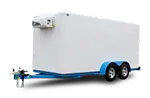


Picture your enclosed trailer sitting in a home-improvement store parking lot while you grab supplies. For the twenty minutes it is parked there, each broad side is a highly visible advertising surface facing drivers, contractors, homeowners, and foot traffic. If the trailer is plain white, it is doing only one job. If it carries your company name, service, phone number, website, and a clean design across its exterior panels, it can promote your business while you shop, travel between jobs, or park at a customer’s property.
Vinyl graphics and full wraps on enclosed trailers can be practical marketing investments for small businesses. They look professional, help customers recognize a company vehicle, and can provide repeated local exposure without a recurring media-placement charge. The value, however, depends on good design, suitable materials, professional installation, regular trailer use, and a surface that is compatible with pressure-sensitive wrap film.
Why Enclosed Trailers Are the Best Wrap Candidates
Not every trailer provides an equally useful wrapping surface. Open car haulers, equipment trailers, utility trailers, and flatbeds have rails, fenders, stake pockets, tie-downs, ramps, and open spaces that interrupt graphics and limit the available advertising area. Enclosed cargo trailers are different. A typical 8.5×24 enclosed trailer with approximately 7-foot exterior sidewalls provides about 336 square feet across its two main side panels before the rear doors, front sections, V-nose, upper radius, trim, and usable portions around fenders are counted. Exact wrap area must be measured from the individual trailer because body height, nose design, fender shape, doors, vents, seams, and trim vary by manufacturer and model.
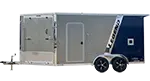
Current enclosed trailers from brands such as Wells Cargo, United Trailers, Legend Manufacturing, and Darkhorse Cargo commonly use finished aluminum exterior skin over steel or aluminum structural components, depending on the model. Smooth, properly bonded or securely fastened exterior panels can provide an excellent graphic surface. Bonded or screwless panels generally create a cleaner appearance, while riveted or screwed panels can also be wrapped successfully when the installer uses the correct conformable film and installation method.
The condition and finish of the surface matter more than the brand name alone. Exterior oxidation, loose paint, failing panel adhesive, deep scratches, silicone residue, wax, grease, chalking, and corrosion can interfere with adhesion. Roof vents, concession openings, escape doors, side doors, windows, stoneguard, exterior hinges, latches, and electrical inlets also reduce uninterrupted design space. A solid-side enclosed cargo trailer with sound, smooth panels is usually the simplest and most economical canvas.
A wrap must never cover required lamps, reflectors, license plates, conspicuity markings, VIN plates, federal certification labels, warning labels, vents, door hardware, or other safety-related equipment. A competent commercial installer will build those exclusions into the template before printing.
What Vinyl Wraps Actually Cost
Cost depends on trailer dimensions, actual printable square footage, film system, surface condition, design time, number of doors and rivets, wrap coverage, local labor rates, and whether the shop must remove and reinstall trim or hardware. The following are practical 2025-2026 planning ranges for professionally designed, printed, laminated, and installed commercial graphics. They are not fixed quotes, and unusually complex trailers or premium specialty films can cost more:
| Trailer Size | Partial Wrap (primary side coverage) | Full Commercial Wrap (sides, rear, and usable nose panels) |
|---|---|---|
| 6×12 enclosed | $1,000 to $1,800 | $2,000 to $3,500 |
| 7×16 enclosed | $1,500 to $2,600 | $3,000 to $5,000 |
| 8.5×24 enclosed | $2,500 to $4,000 | $4,500 to $7,500 |
| 8.5×28 enclosed | $3,000 to $4,800 | $5,500 to $9,000 |
In wrap-industry terminology, a “full wrap” does not always include the roof, underside, stoneguard, fenders, exposed frame, door jambs, or every piece of trim. Roof graphics are commonly quoted separately because horizontal surfaces receive more UV exposure, collect water and debris, and may have shorter expected service life. Ask the shop to identify every included and excluded panel in writing so two quotes can be compared fairly.
Some shops include design and production setup in the total price, while others charge separately. Custom commercial design may add several hundred dollars or more depending on the number of concepts, revisions, logo cleanup, photography, illustration, and template work. Do not treat design as an optional afterthought. The artwork must account for panel seams, rivets, V-nose geometry, fenders, stoneguard, vents, doors, hinges, handles, trim, lights, reflectors, and the safe placement of contact information. A flat rectangular design dropped onto a trailer photograph rarely produces a professional installed result.
For digitally printed commercial trailer wraps, ask for a cast print film and a compatible protective overlaminate from the same approved graphics system. Current examples include 3M Print Wrap Film IJ280 paired with an appropriate 3M wrap overlaminate, or Avery Dennison MPI 1105 wrapping film paired with a recommended Avery Dennison DOL overlaminate. Product selection should be based on the trailer’s panel material, rivets, curves, recesses, intended service period, and the manufacturer’s current technical bulletin.
Printed cast film is generally more conformable and dimensionally stable than economy calendered film, making it better suited to rivets, compound curves, long panels, and demanding commercial use. That does not mean every cast product carries a universal seven-, eight-, or ten-year warranty after printing and installation. Published durability and warranty coverage vary by film, ink, laminate, color, exposure angle, geographic region, substrate, printer certification, installation method, and maintenance. Vertical side graphics normally have better longevity than horizontal or near-horizontal surfaces.
The ROI Argument (and How to Think About It)
A professionally designed and installed full wrap for a 7×16 enclosed trailer may land around $3,500 to $5,500 after design, print, laminate, preparation, and installation, although local quotes can fall outside that range. Spread over a five-year planning period, that works out to roughly $58 to $92 per month. That calculation is a budgeting tool, not a promise that every film system or installer warranty lasts exactly five years.
Compare that figure with what your business currently spends on local search ads, social advertising, directory listings, sponsorships, mailers, yard signs, or print campaigns. Those channels can work well, but most require repeated spending to maintain exposure. A trailer wrap has a large initial cost and no separate monthly media fee, although it still requires cleaning, maintenance, insurance, and eventual removal or replacement.
Be cautious with widely repeated claims that every wrapped vehicle generates a fixed number of daily impressions. There is no single credible number that applies equally to a contractor’s trailer in Spencer, a delivery van in Indianapolis, and a fleet truck operating all day in a major metropolitan area. Exposure depends on miles driven, route, traffic volume, parking location, time of day, trailer orientation, visibility, weather, and how often the trailer is actually in public.
Even without an inflated daily-impression estimate, the local value is easy to understand. A contractor traveling between Owen County job sites, supply stores, restaurants, fuel stations, neighborhoods, and customer properties repeatedly puts the same brand in front of people who live within the service area. A trailer parked at a roofing, landscaping, plumbing, electrical, or remodeling project can also act as a temporary job-site sign, provided it is legally and safely parked.
Service businesses often receive the greatest benefit from trailer graphics: landscapers, HVAC contractors, plumbers, electricians, roofers, remodelers, construction crews, caterers, restoration companies, mobile detailers, flooring installers, and other businesses that travel to customer locations. The exposure compounds when the trailer is used several days per week and follows consistent routes through the same communities.
Track results rather than relying on generic industry claims. Use a memorable web address, a dedicated landing page, a trackable phone number, or a simple “How did you hear about us?” field. Record calls and leads attributed to the trailer. That gives you a business-specific return calculation instead of an impression estimate borrowed from a different market.
Design That Actually Works
The biggest mistake on trailer wraps is trying to turn every side into a brochure. Drivers and pedestrians usually have only a few seconds to identify the company, understand the service, and remember how to respond. The primary side design should communicate one clear idea before it supplies secondary details.
- Company name in a large, bold, highly legible typeface sized for the expected viewing distance
- One primary response method, such as a phone number or short website, with any secondary method kept visually subordinate
- One clear service category or benefit, such as “Residential Roofing,” “Commercial HVAC,” or “Landscape Design & Installation”
- A high-contrast color system that remains readable in daylight, shade, traffic, and busy parking-lot backgrounds
There is no universal six-inch lettering rule that works for every logo, font, speed, and viewing distance. Narrow scripts, thin strokes, all-cap italics, and low-contrast outlines require more space than bold block lettering. A wrap designer should test the layout at realistic scale and evaluate it from the distance at which another driver will see it. The company name and service should remain understandable without zooming in on a computer mockup.
The rear doors receive longer viewing time when the trailer is stopped at a traffic light, parked at a job, or traveling ahead of another vehicle. That makes the rear a better place for a complete phone number, short website, service list, license information when appropriate, and social or review messaging. A QR code can work on the rear when it is large, high contrast, surrounded by sufficient clear space, and intended to be scanned by a passenger or a person near a parked trailer. It should not be treated as the primary call to action on a side panel viewed at road speed.
Color matters, but contrast and hierarchy matter more than choosing the brightest possible palette. White trailers offer a neutral base for partial wraps and cut-vinyl graphics. Full printed wraps can use dark, light, or saturated backgrounds, provided the company name and contact information remain clearly separated from photographs and textures. A brand-consistent two- or three-color system often reads better than a design containing every available color.
Photographs should be selected carefully. A single high-resolution image of a finished project may strengthen the message, but several small photographs usually become visual clutter. Avoid placing important faces, text, logos, or phone-number digits directly over door gaps, fender openings, vertical seams, hinges, or latches. The most important information should sit within the broadest uninterrupted areas of the side and rear panels.
Durability in Real-World Conditions
Indiana weather puts real stress on trailer graphics. Sunlight, summer heat, freezing temperatures, moisture, road salt, fuel residue, airborne contaminants, tree sap, bugs, and repeated washing all affect film performance. A compatible protective overlaminate helps protect printed ink from abrasion, weathering, and UV exposure, but it does not make a wrap maintenance-free or permanently resistant to damage.
A few things that shorten wrap life:
- Pressure washing too close to seams and edges, using excessive pressure, or aiming the spray into an exposed film edge
- Allowing tree sap, bird droppings, bugs, tar, fuel, or other contaminants to remain on the surface
- Leaving winter road salt and grime on lower panels, fenders, door edges, and rear surfaces for extended periods
- Parking outdoors continuously without routine washing, especially when horizontal and angled surfaces receive direct sun
Hand washing with clean water, mild non-abrasive soap, and a soft cloth or sponge is the safest general approach. Rinse from the top down and dry with a clean microfiber towel or other non-abrasive material. Avoid harsh solvents, abrasive compounds, stiff brushes, and petroleum-based cleaners unless the film manufacturer specifically approves the product. Test any unfamiliar cleaner in a small, inconspicuous area first.
Pressure washing should be a last resort and must follow the specific film manufacturer’s instructions. As a general commercial-wrap precaution, use a wide spray pattern, keep the nozzle well away from edges, avoid excessive temperature and pressure, and direct the spray perpendicular to the graphic rather than under a seam. The installer should provide care instructions for the exact film and laminate used on your trailer.
Many businesses plan around approximately five years of useful service for well-maintained, vertically installed printed commercial graphics, but actual life may be shorter or longer. Southern-facing panels, roof sections, upper curves, lower road-spray areas, rear doors, hinges, handles, and fender edges often age or wear faster than broad vertical side panels. Manufacturer warranty periods and real-world appearance are not always the same thing.
The trailer may outlast several advertising designs. That can be an advantage: a worn or outdated wrap can be professionally removed and replaced when the company changes its logo, phone number, services, ownership, or branding. Removal should not be postponed indefinitely after the film reaches the end of its intended service life, because aged and brittle vinyl can require substantially more labor to remove.
One practical preparation step is to schedule graphics before a new trailer accumulates heavy road contamination, but “new” does not automatically mean “ready to wrap.” New panels may still carry manufacturing residue, wax, transport film adhesive, silicone, oil, polish, or dealer-applied protectants. The wrap shop must inspect, clean, and test the surface according to the film manufacturer’s requirements.
A used trailer needs an even closer inspection. Oxidized or chalking aluminum, peeling paint, loose exterior skin, silicone-sealed seams, corrosion, repairs, adhesive residue, and deep scratches may require correction before installation. Vinyl adheres to the existing finish, so weak paint or a failing coating can separate from the trailer during installation or future removal. Surface preparation should be itemized in the quote instead of assumed.
New Trailer or Used for a Wrap Project?
If you are buying a trailer with a wrap in mind, new is usually easier because the exterior condition, panel layout, and repair history are known. Browse the current enclosed trailer inventory at Spencer Trailers and compare body length, exterior height, V-nose shape, side-door placement, fenders, stoneguard, panel fasteners, vents, trim, and available blank side area. Smooth, sound aluminum exterior skin can wrap cleanly, while heavy texture, extensive exposed hardware, or complex openings increase design and installation time.
A United 7×16 V-Nose cargo configuration or a Wells Cargo Road Force 8.5×20 configuration can provide useful side and rear advertising space, depending on the selected doors, vents, trim, and options. Current United cargo offerings include 7-foot-wide tandem-axle lengths through 16 feet, while the Wells Cargo Road Force line includes 8.5-foot-wide cargo and auto-hauler-oriented configurations. Final dimensions and exterior details should always be verified from the actual trailer, VIN-specific build information, or manufacturer specifications before a graphic template is approved.
Sloped V-fronts, radius roof transitions, front corner trim, stoneguard, and upper caps require more installation skill than a flat side panel. Some front sections can be wrapped cleanly, while others are better handled with separate printed pieces or left in the original finish. Ask the installer to inspect the nose rather than assuming that every visible front surface is included in a standard full-wrap quote.
Used trailers can absolutely be wrapped, but the surface condition matters. Wrap film does not repair dents, hide buckled panels, fill deep scratches, or stop corrosion. Because the vinyl follows the shape of the substrate, dents and ripples may become more noticeable once a glossy graphic is installed. Repairing the body before wrapping usually produces a better result and protects the investment in printed material.
Also consider the trailer’s remaining service life. Spending several thousand dollars on graphics makes more sense when the roof, frame, floor, doors, coupler, running gear, exterior skin, and electrical system are worth keeping. A mechanically sound used trailer with clean panels can be an excellent branding platform; a neglected unit that needs major structural or exterior work should be repaired before graphic production begins.
Finding a Good Wrap Shop
Look for a shop that regularly designs, prints, laminates, installs, and removes commercial fleet graphics, box-truck wraps, and enclosed-trailer wraps. A business that mainly installs small decals or color-change film on passenger cars may not have the equipment, templates, staffing, lift access, scaffolding, or indoor bay needed for a 20- to 28-foot trailer. Indoor installation is especially valuable because it helps control dust, temperature, moisture, and wind.
Ask to see completed trailer projects, including close photographs around rivets, seams, door edges, hinges, fenders, and rear openings. A wide-angle portfolio image can hide poor trimming and edge work. When possible, inspect a wrap that has already been in service for a year or more, not only one photographed immediately after installation.
Request the exact product names for the print film, ink, and overlaminate. “Premium vinyl” is not a technical specification. Confirm that the film is approved for the trailer’s substrate and geometry and that the laminate is compatible with the printed film. If a shop claims manufacturer certification or preferred-installer status, ask which program and whether the person performing the installation currently holds it.
Get warranty terms in writing. The film manufacturer’s finished-graphics coverage, the printer’s production responsibility, and the installer’s workmanship warranty are separate matters. Coverage can vary by film system, panel orientation, exposure, substrate, location, and authorized production process. The written agreement should explain what happens if edges lift, rivet areas fail, panels discolor, ink fades prematurely, or a damaged section needs to be reprinted.
Also ask who owns the final artwork and whether you will receive editable production files. Businesses sometimes discover that they cannot reproduce their own design after changing wrap shops. The agreement should address design ownership, proof approval, color expectations, removal costs, repair pricing, and how future phone-number or service changes will be handled.
If you are local to Owen County or southwest Indiana, compare commercial wrap providers in Bloomington, Terre Haute, Indianapolis, and other nearby markets that routinely handle fleet-sized work. Travel can be worthwhile when the shop has the correct indoor space, materials, equipment, and trailer-specific experience. Choose on documented workmanship and process, not simply the lowest square-foot price.
Is It Right for Your Business?
A trailer wrap makes the most sense when:
- Your trailer travels to customer locations, supply stores, public parking areas, and visible job sites instead of remaining behind a warehouse
- You serve a defined geographic area where repeated exposure helps residents recognize and remember the business
- Your company depends on local customer acquisition, referrals, and neighborhood visibility rather than operating only as a national or online seller
- You already budget for local marketing and can keep the trailer’s design, contact information, and exterior condition current
If your enclosed trailer moves only between a private shop and a private yard, or remains parked where the public cannot see it, the advertising return drops significantly. The same is true when the graphics become dirty, damaged, unreadable, outdated, or inconsistent with the company’s other branding. A trailer wrap earns its keep through visibility, repetition, legibility, and professional presentation.
Before approving the project, calculate the full cost of design, surface preparation, printing, lamination, installation, future removal, and any body repairs. Then compare that investment with the trailer’s expected public use and your normal cost of acquiring a local customer. A wrap does not replace a good website, reviews, sales follow-up, or quality work, but it can reinforce all of them every time the trailer is on the road.
Ready to pick up the enclosed trailer that is going to carry your brand? Contact Spencer Trailers at (812) 829-0226 or stop by 291 West State Hwy 46 in Spencer, Indiana. We will help you compare current enclosed-trailer sizes, panel layouts, doors, exterior finishes, and usable graphic space so you can choose a trailer that works for your cargo and gives your wrap installer a strong canvas.


