













By the time Labor Day rolls around, your trailer has already put in a full summer of work. Maybe it hauled ATVs to the lake four or five times. Maybe it carried a load of brush, then lumber, then a mower, then another load of project materials. The tires have repeatedly heated up and cooled down. The brakes have worked in July and August heat. The wheel bearings have spent thousands of revolutions carrying the load while their grease, seals, hubs, and spindles dealt with heat, dust, water, and vibration.
And now, with one more big weekend ahead, most people hook up and go without a second thought.
That’s the difference between Labor Day and Memorial Day. In May, you’re preparing equipment that may have been sitting all winter, so you’re naturally cautious. By September, the trailer feels familiar and the checks get skipped. But familiar is not the same as ready, and a full summer of use gives you more to inspect than you had in May.
Your Tires Have Been Working All Summer
ST-rated trailer tires are designed specifically for free-rolling trailer axles, but they are still vulnerable to heat, underinflation, overloading, road impacts, UV exposure, and age. Tread depth is only one part of the inspection. A tire that looked fine in May may have developed a puncture, bulge, belt separation, weather cracking, irregular wear, damaged valve stem, or slow leak during the summer.
Pull the unloaded trailer into good light and inspect every tire, including the inward-facing sidewalls and the spare. Look for cuts, punctures, scrapes, bubbles, bulges, exposed cords, cracking, objects embedded in the tread, and uneven wear across the tread face. Check around the valve stem and where the tire meets the wheel. A bulge, exposed reinforcement, deep crack, visible separation, or repeated loss of pressure is a reason to remove the tire from service and have it evaluated by a qualified tire professional.
Check inflation when the tires are cold, which generally means the trailer has been parked for several hours or has traveled less than about a mile at moderate speed. Use the cold inflation pressure printed on the trailer’s certification or tire-information label and confirm that the installed tire size and load range match the trailer manufacturer’s requirements. Do not assume every Load Range D tire should be set to one universal pressure or every Load Range E tire to another. The correct pressure depends on the tire, wheel, axle rating, trailer configuration, and manufacturer’s specification.
Use an accurate gauge rather than judging inflation by appearance. Radial trailer tires can be substantially underinflated without looking flat. Underinflation increases sidewall flex and heat buildup, especially when the trailer is loaded and highway pavement is hot. Check the spare at the same time, reinstall valve caps, and investigate any tire that repeatedly loses pressure rather than topping it off before every trip. Do not bleed pressure from a hot tire to bring it back to the cold specification.
Age matters too, but there is not one universal five-year expiration rule for every trailer tire. Read the four-digit DOT date code, which identifies the week and year of manufacture, and follow the tire manufacturer’s and trailer manufacturer’s replacement guidance. NHTSA notes that some manufacturers recommend age-based replacement between six and ten years regardless of remaining tread. A tire manufactured in week 32 of 2019 is about seven years old by Labor Day 2026, placing it inside the age range where replacement is commonly recommended. For a heavily loaded highway trip, that tire deserves replacement or, at minimum, a professional inspection before departure.
Brakes After a Hot Summer
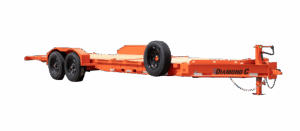
Electric drum brakes work hard when a trailer is loaded, traffic is heavy, and grades are involved. Whether you’re towing an H&H 7,000 lb tandem-axle tilt trailer or a Diamond C LPX equipment trailer, heat and mileage can expose worn shoes, glazed friction surfaces, damaged magnets, contaminated drums, poor adjustment, weak wiring connections, or an improperly calibrated brake controller. Current Diamond C LPX configurations range from approximately 14,900 or 15,500 lb at the lower end, depending on factory rating or derating, up to 24,000 lb, with Lippert axle packages matched to the selected configuration.
Perform a low-speed function check in a clear, level area before loading. With the trailer properly hitched, the electrical connector secured, the safety chains attached, and the breakaway cable clipped independently to the tow vehicle, roll forward slowly and apply the trailer brakes with the manual lever on the in-cab controller. You should feel definite, reasonably even braking from the trailer. Pulling to one side, intermittent engagement, unusually weak resistance, wheel lockup at a low controller setting, or no response at all calls for inspection and adjustment.
That parking-lot check only confirms that the system does something; it does not prove that every wheel is contributing correctly. Controller output on the display does not confirm that each magnet, shoe, drum, wire, ground connection, and hub assembly is healthy. Lippert’s axle guidance calls for periodic brake inspection, commonly annually or at the mileage interval specified for the axle, with more frequent attention under severe service. Inspection should include shoe condition and adjustment, magnet wear, drum condition, grease contamination, wiring, grounds, wheel seals, breakaway-switch operation, and breakaway-battery charge.
Avoid relying on generic claims that brake magnets last a fixed number of miles or that every repair costs the same amount. Wear varies with trailer weight, brake adjustment, controller settings, terrain, driving style, moisture, contamination, and component size. On many electric-drum systems, replacing a complete matched backing-plate assembly can be more practical than replacing one worn component, but the correct repair depends on the axle and brake specifications.
If your trailer has hydraulic surge brakes, inspect the actuator, coupler mechanism, master-cylinder fluid level, brake lines, flexible hoses, wheel cylinders or calipers, drums or rotors, and any signs of leakage or corrosion. Boat trailers require particular attention because repeated submersion can introduce water and accelerate corrosion. Rinse appropriate components after launch-ramp use, follow the actuator and axle manufacturers’ service schedules, and repair fluid leaks or sticking brakes before towing again.
The Last Project Haul of the Season
Labor Day is when people finish things. That deck project that’s been sitting since June gets its last material run. The demolition debris from the garage addition finally goes to the transfer station. The firewood gets split and hauled. Landscaping that has been planned since spring gets completed before cooler weather arrives.
A few things about end-of-season project loads catch people off guard.
Debris loads are deceptively heavy because volume does not tell you the weight. Broken concrete, brick, gravel, roofing, wet soil, and mixed demolition material can consume a trailer’s available payload long before the deck or dump body looks full. Never estimate payload by axle count or by how much space remains. Start with the trailer’s GVWR and subtract the trailer’s actual empty weight as equipped. The result is the maximum theoretical payload, and hitch load, axle ratings, tire capacities, wheel ratings, coupler ratings, and the tow vehicle’s limits may reduce what can be carried safely.
For example, a 3,500 lb GVWR utility trailer that actually weighs 1,300 lb empty has about 2,200 lb of payload before accessories or cargo are added. If another trailer with the same GVWR weighs 1,800 lb because of heavier construction, tall sides, a spare, a toolbox, and other equipment, only about 1,700 lb remains. The certification label and a public scale are more reliable than a brochure estimate, especially after ramps, sides, toolboxes, spare tires, winches, or flooring have been added.
A tandem-axle utility trailer is often a better fit for mowers, brush, lumber, and contained project material than a light single-axle trailer. The current Diamond C GTU, for example, is a 7,000 lb GVWR utility trailer with two 3,500 lb Lippert brake axles, an 83-inch bed, lengths from 14 to 20 feet, and a 4-inch channel frame. Liberty and Delco also offer tandem-axle utility configurations, with exact dimensions, empty weights, payloads, gate styles, and axle packages varying by unit.
Loose, dense debris is usually better matched to a properly rated dump trailer than an open equipment trailer. The Diamond C LPT Heavy Duty Low Profile Telescopic Dump is offered in GVWR packages from approximately 15,500 to 24,000 lb, with two 7,000 lb Lippert axles standard on the base package and heavier axle configurations available. It uses a telescopic hydraulic hoist and is built for dump work, but payload still depends on the selected GVWR, body dimensions, empty weight, axle package, tires, and installed options. Never load to the top of the sides without calculating or weighing the material.
Firewood is another load that is easy to underestimate. A standard cord occupies 128 cubic feet when properly stacked, but its weight varies widely by species and moisture content. Dry hardwood can weigh several thousand pounds per cord, while freshly cut oak can exceed 5,000 lb per cord. A full-size pickup loaded level with the top of a standard bed generally carries closer to one-half cord than two-thirds of a cord, and even that amount may exceed the truck’s available payload depending on the wood and vehicle.
A small single-axle utility trailer may be appropriate for a partial load of seasoned wood, but only when the actual weight stays within the trailer, tire, axle, hitch, and tow-vehicle limits. A tandem-axle utility with properly constructed stake sides provides more room and payload, but the sides only contain the wood; they do not replace proper securement. Balance the load according to the trailer manufacturer’s tongue-weight guidance, keep heavy material low and forward of the axle group without overloading the hitch, and use rated straps, a cargo net, or a tarp as appropriate.
Labor Day Traffic Is Different From the Other Two Holidays
Memorial Day often brings the first major recreational trips of the season. Independence Day traffic can be spread across several days and destinations. Labor Day frequently puts large numbers of boats, campers, utility trailers, and families on the road at the end of the same long weekend. Around southern and central Indiana, returning lake and campground traffic can make Sunday evening and Monday especially busy.
I-69 north of Bloomington, State Road 46, US-231, and routes leading away from Monroe Lake and other recreation areas can combine heavy traffic with drivers who are tired, distracted, unfamiliar with towing, or impatient to get home. Abrupt lane changes and short following gaps are more serious when your truck and trailer are carrying several thousand pounds of equipment or material.
There is no single accurate stopping-distance number for every 7,000 lb trailer at 60 mph. Total stopping distance changes with the truck, trailer, actual weight, brake type, brake adjustment, controller calibration, tire condition, road surface, grade, weather, speed, and driver reaction time. What does not change is that a loaded combination needs substantially more room than an unloaded passenger vehicle. Slow down before traffic compresses, leave a much larger following interval, avoid unnecessary lane changes, and do not let an impatient driver pressure you into towing faster than conditions allow.
Indiana law requires a trailer or semitrailer with a gross weight of at least 3,000 lb to have brakes adequate to control, stop, and hold the vehicle. The system must allow the driver to apply the brakes from the tow vehicle’s cab, and it must automatically apply the trailer brakes in an accidental breakaway. That means the breakaway switch, cable, battery, wiring, controller, and wheel brakes all need to be functional, not merely present.
Trailer brakes are not a spare system that matters only if the truck’s brakes fail. They are an essential part of the combined braking system. Before entering holiday traffic, verify controller operation and gain, check the breakaway battery, confirm the trailer connector is fully seated, and make sure the truck is operating within its tow rating, payload rating, rear-axle rating, hitch rating, and gross combined rating.
Bearings: The End-of-Season Honest Assessment
Summer use can be demanding on wheel bearings because heat, heavy loads, dust, long highway runs, water intrusion, and repeated launch-ramp submersion can all affect the grease, seals, cups, cones, spindles, and hubs. Labor Day is a good time to ask when the bearings were last inspected and serviced, but the answer should be compared with the axle manufacturer’s schedule rather than an arbitrary seasonal rule.
For many Lippert trailer axles under normal service, bearing inspection and grease replacement are called for annually or at the specified mileage interval, whichever comes first. Severe service, contamination, water exposure, unusual heat, or damaged seals can require much earlier attention. A trailer serviced correctly before the summer may not automatically be overdue in September, while a trailer with unknown history, leaking seals, loose wheels, discolored grease, or repeated water exposure should be inspected before another highway trip.
Bearing problems often provide warning signs, although they should never be ignored while waiting for a complete failure. Look for grease thrown onto the wheel or brake backing plate, a damaged dust cap, excessive wheel play, grinding or rumbling, uneven tire wear, a hot hub, or a wheel that does not rotate smoothly when safely lifted and supported. After the first portion of a trip, stop in a safe location and compare hub temperatures with a non-contact infrared thermometer. One hub running markedly hotter than the others deserves immediate investigation. Do not place your bare hand on a potentially overheated hub.
A failed bearing can damage the hub, spindle, brake assembly, tire, and wheel. In severe cases, the wheel can lock, loosen, or separate. Proper service means more than pumping grease through a lubrication fitting. The bearings, races, seals, spindle, hub, and brake area need to be inspected according to the manufacturer’s procedure, and the correct compatible grease must be used. Overfilling or forcing grease past a seal can contaminate electric brake shoes and reduce braking performance.
Boat-trailer bearings need extra attention because worn or damaged seals can admit water as the warm hub is submerged and cools. There is no reliable rule that a specific number of launch-ramp trips automatically requires repacking. Inspect according to the marine trailer and axle manufacturers’ schedules and service immediately if grease becomes milky, water is found inside the hub, a seal leaks, the hub runs hot, or corrosion is visible.
A Maintenance Checklist for End-of-Summer Towing
| System | What to Check | Action If Failed |
|---|---|---|
| Tires (all wheels) | Placard-specified cold PSI, tread and sidewall condition, valve stems, tire size and load range, DOT date, wheel condition, and spare | Correct inflation when cold; repair the leak or replace damaged, mismatched, overloaded, or age-expired tires according to manufacturer guidance |
| Electric brakes | Low-speed manual-controller test, adjustment, wiring, grounds, shoes, magnets, drums, breakaway switch, cable, and battery | Inspect and repair the complete system; replace worn or contaminated components and recalibrate the controller before towing |
| Wheel bearings | Service history, grease leakage, seal condition, wheel play, noise, smooth rotation, and relative hub temperature after an initial drive | Inspect, clean, repack, and adjust according to the axle manual; replace damaged bearings, races, seals, hubs, or spindles |
| Safety chains | Correct rating and length, secure attachment points, hook latches, stretched or cracked links, corrosion, and proper crossing beneath the tongue | Replace any damaged or underrated chain, hook, or attachment hardware; do not weld or temporarily repair a compromised chain |
| Coupler and ball | Correct ball size, coupler rating, complete latch engagement, retaining pin, lubrication, mounting hardware, hitch rating, and visible wear | Use the correct rated ball and hitch; adjust or replace worn components and tighten mounting hardware to specification |
| Running lights | Tail, brake, turn, marker, clearance, reverse, and license-plate lights as equipped, plus reflectors, connector pins, wiring, and grounds | Replace failed lamps or modules and repair damaged wiring, corroded connectors, or poor grounds before entering traffic |
| Deck and rails | Loose or rotted boards, damaged fasteners, cracked welds, bent rails, gate or ramp operation, stake pockets, and tie-down points | Repair or replace structural and securement components before loading; never rely on a damaged ring, rail, ramp, or gate |
When This Is the Trip That Reveals the Problem
Some people get to Labor Day and realize the trailer that handled early summer trips is now showing its age. A tire keeps losing air. One hub runs hotter than the others. Electric brakes barely contribute. The wiring fails whenever it rains. A deck board has softened and flexes under a tire. A coupler has excessive play, or the trailer no longer tracks correctly behind the truck.
That does not automatically mean the entire trailer is finished. Tires, bearings, brakes, wiring, decking, couplers, suspension components, and lights can often be repaired. The real question is whether the frame and major structure are sound, whether replacement parts are available, whether the trailer still has enough GVWR and payload for the work, and whether the repair cost makes sense compared with a correctly sized replacement.
Pricing has changed enough that old blanket claims such as a new 7,000 lb tandem utility costing less than a certain round number are no longer reliable. A basic utility trailer, an electric tilt trailer, a heavy equipment trailer, and a dump trailer occupy very different price ranges. Length, width, empty weight, axle capacity, brakes, tires, suspension, ramps, hydraulic equipment, flooring, paint or coating, warranty, and optional accessories can change the final price substantially. Live dealer inventory and a written quote are the appropriate sources for current pricing.
Capacity also needs to be compared correctly. The Diamond C GTU is a 7,000 lb tandem utility with dual 3,500 lb Lippert brake axles and a 4-inch channel frame. The LPX is a low-profile extreme-duty equipment trailer offered from approximately 14,900 or 15,500 lb through 24,000 lb depending on configuration. The LPT is a heavy-duty telescopic dump in the 15,500 to 24,000 lb range. These are different tools for different cargo, and the trailer with the highest GVWR is not automatically the right choice if the tow vehicle, hitch, licensing, loading method, or job does not match it.
Diamond C has built trailers in Mt. Pleasant, Texas since 1985. Current premium Diamond C lines sold by Spencer Trailers use Lippert axle packages and the DM Difference Maker multi-stage coating system, with exact axle ratings, brake systems, frame designs, ramps, tires, and other features determined by the model and selected GVWR package.
When moving into a heavier trailer, check more than the truck’s advertised maximum tow rating. Confirm the truck’s payload, receiver or gooseneck rating, rear-axle rating, tire capacities, gross vehicle weight rating, and gross combined weight rating. For operations that require a CDL, a Class A threshold is generally reached when the combination’s GCWR or actual gross combination weight is at least 26,001 lb and the towed unit has a GVWR or actual gross weight greater than 10,000 lb. A trailer over 10,000 lb does not by itself create the standard Class A threshold when the combination remains below 26,001 lb, although commercial-use rules, exemptions, and other requirements still need to be evaluated for the specific operation.
If the trailer you own is the constraint on what you can move and when, it’s worth comparing the repair estimate with a properly specified replacement. You can see current stock at Spencer Trailers’ full inventory. The dealership at 291 West State Hwy 46 in Spencer carries Diamond C, H&H, Liberty, Delco, Darkhorse Cargo, Wells Cargo, and other current trailer and truck-bed brands in a wide range of sizes, capacities, and configurations.
Not sure what you need? Call (812) 829-0226 before the weekend. Have the cargo type, estimated cargo weight, equipment dimensions, tow-vehicle year and configuration, hitch type, and expected trip conditions available. Determining the necessary GVWR, payload, deck size, axle package, loading system, and brake setup takes only a few minutes when the right information is on hand. Limping an undersized or badly worn trailer through one more season can cost far more when a roadside failure damages the trailer, tow vehicle, cargo, or someone else’s property.
Labor Day weekend closes out the busiest part of the hauling season for many recreational and property-maintenance owners, but it should not close out attention to safety. Send the summer off with tires, brakes, bearings, lights, hitch equipment, securement, and capacity you can trust, or use the weekend as the point when you finally move into a trailer that fits the work you actually do. Either way, get there and back without a story about what went wrong on the shoulder of the highway. Reach out if you have questions before you go.


