









You’ve got 48,000 pounds of excavator sitting at a job site in Bloomington and a customer waiting in Anderson. That is a commercial heavy-haul move, not a pickup-and-gooseneck job. Your loaded combination measures 14’2″ high, but a standard GPS app routes you toward a county-road bridge posted at 13’6″. By the time you reach the structure, your legal route, delivery window, and entire day may be gone.
Central Indiana has one of the strongest interstate networks in the Midwest, but heavy equipment hauling follows a different set of rules than ordinary pickup-truck travel. The right corridor is only the beginning. You also need an approved route when a permit is required, verified bridge clearances, current construction information, accurate axle weights, proper cargo securement, and a trailer whose actual payload rating matches the machine.
The Four Corridors That Matter Most
If you’re moving heavy equipment anywhere in central Indiana, you’re likely to use some combination of I-65, I-69, I-70, and I-465. Each corridor serves a different purpose, and none should be treated as automatically clear for an oversize or overweight load.
I-70 is the main east-west corridor through central Indiana. It runs from the Illinois state line through Indianapolis and continues toward Ohio, making it a practical route for equipment moving between western Indiana, Indianapolis-area construction sites, and destinations east of the city. Interstate geometry is generally more suitable for long commercial combinations than county roads, but temporary lane restrictions, bridge work, crashes, and permit-specific detours can still change the legal route. Check current restrictions before departure instead of assuming yesterday’s route is still available.
I-65 carries major north-south commercial traffic through Indianapolis, connecting the region with Louisville to the south and Lafayette and northwest Indiana to the north. It is commonly used for equipment moving between central Indiana contractors, agricultural operations, and southern Indiana job sites. The highest-risk part of the trip is often not I-65 itself but the transition from the interstate to a state route, city street, or county road with tighter turns, lower structures, posted bridge limits, or restricted truck access.
I-69 now plays a much larger role in central Indiana hauling. The completed southwest corridor links Evansville, Bloomington, Martinsville, and the southwest side of Indianapolis, while the northeast leg serves Fishers, Pendleton, Anderson, Muncie-area connections, and Fort Wayne. A Bloomington-to-Anderson trip can use I-69 north to I-465 and then continue on the northeast leg of I-69. That is a major improvement over older surface-road routing, but permit holders must still follow the exact route printed on the permit rather than choosing an interchange based only on convenience.
I-465 is Indianapolis’s outer loop and the primary connector among I-65, I-69, I-70, and I-74. It can keep a legal-size commercial combination out of downtown streets, but it is not automatically the best choice for every permitted load. Interchange construction, lane shifts, ramp widths, ramp curvature, and temporary bridge restrictions can affect long, tall, or wide combinations. For an oversize or overweight move, the permitted route and current INDOT restrictions take priority over a driver’s preferred side of the loop.
What Makes a Route Legal vs. Just Driveable
Being able to physically drive a road and being legally authorized to haul on it are two different things. Indiana’s general maximum dimensions include the vehicle and its load. The standard legal width is 8’6″, and the standard legal height is 13’6″. Length is more complicated than a single 53-foot limit. A single self-propelled vehicle is generally limited to 40 feet, and a conventional two-vehicle combination is generally limited to 60 feet overall. In a qualifying truck-tractor and semitrailer combination, the semitrailer and its load may be up to 53 feet, with different overall-length rules applying to designated combinations and highways. Pickup-and-trailer operators should not assume that the 53-foot semitrailer rule automatically applies to their entire combination.
The familiar 80,000-pound figure is also not a blanket allowance. Legal weight is subject to axle limits, axle spacing, tire and wheel limits, the bridge formula, registered weight, and any lower posted restriction. The usual maximums include 20,000 pounds on a single axle and 34,000 pounds on a tandem axle, but a combination can be under 80,000 pounds gross and still be illegal because too much weight is concentrated on one axle group. A posted bridge or highway limit can be lower than the otherwise applicable statewide maximum.
Most Indiana oversize and overweight permits are administered by the Indiana Department of Revenue’s Motor Carrier Services division under Indiana law and INDOT routing requirements. A permit is generally used for a nondivisible load that exceeds a legal dimension, gross-weight limit, axle limit, or bridge-formula allowance. The permit does not increase the manufacturer’s GVWR, GAWR, tire rating, wheel rating, coupler rating, hitch rating, or tow-vehicle rating. It authorizes travel under stated highway conditions; it does not make an overloaded trailer safe or legal.
The current Indiana OSOW permitting system allows carriers to enter the vehicle, load dimensions, axle information, origin, and destination. A load that fits a pre-approved route may be processed quickly, while a custom route, unusual axle configuration, superload, or route requiring bridge analysis can require manual review. Apply early enough to correct a rejected route or supply additional axle and vehicle information.
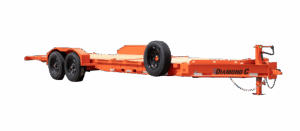
Here’s where it matters practically. A Diamond C FMAX212 rated at 25,900 pounds GVWR is not a trailer with a 25,900-pound payload. GVWR is the maximum loaded trailer weight, including the trailer itself, the machine, attachments, chains, tools, spare tires, and other cargo. The usable payload is found by subtracting the trailer’s actual empty weight as equipped from its GVWR, and the final load is still limited by the axles, tires, coupler, truck, hitch, and weight distribution. A 48,000-pound excavator exceeds even a 40,000-pound trailer GVWR before the trailer’s own weight is added, so that machine requires a properly rated commercial tractor and heavy-haul trailer rather than a pickup-towed equipment trailer.
Licensing is a separate calculation from permitting. A Class A CDL is generally triggered when the combination has a GCWR of 26,001 pounds or more and the towed unit has a GVWR over 10,000 pounds, subject to applicable statutory exemptions. The 26,001-pound threshold applies to the combination, not to the trailer by itself. A load can require a CDL without requiring an oversize permit, and a dimensionally oversize load can require a permit even when its gross weight is below 26,001 pounds.
Low Bridges and Weight-Restricted Roads: Where Haulers Get Caught
The interstates themselves are not immune to restrictions, but the risk usually increases after the haul leaves the interstate system. State routes, county roads, city streets, work-zone detours, railroad underpasses, and privately maintained access roads can introduce lower clearances, weaker structures, sharper turns, and narrower usable pavement.
Indiana has thousands of state- and locally maintained bridges, and responsibility is divided among INDOT, counties, cities, towns, and other public agencies. An Indiana state OSOW permit does not authorize travel on county roads or city streets. If the approved state route ends at a local road, the carrier must contact the agency that controls that road and obtain any separate approval or local permit that agency requires. The same applies to a locally posted bridge, even when the load has already been approved for the nearby state highway.
There is no single statewide February-to-April road-ban schedule that can be applied to every Indiana county. County commissioners and local highway authorities may post temporary or permanent weight restrictions based on pavement conditions, bridge capacity, construction, drainage problems, or seasonal freeze-and-thaw damage. The dates, affected roads, and allowable weights can vary by county and year. For a final delivery in Owen, Morgan, Monroe, Brown, or another central Indiana county, call the county highway department and verify the exact road names, bridge numbers, load weight, and travel date.
INDOT’s road restriction and bridge information includes links to current closures, 511 traffic information, posted bridge data, and the state’s digital bridge-clearance map. Clearance can differ by direction, lane, or structure, so check the record for the direction of travel rather than relying on a single number shown near an interchange. Construction overlays, resurfacing, snow or ice buildup, and temporary traffic shifts are additional reasons to maintain clearance margin.
Do not wait until the load reaches 14 feet to begin checking structures. Anything above Indiana’s legal height of 13’6″ requires an oversize permit, and the route must clear the load at its measured transport height. Under Indiana’s general permit provisions, an escort is required when a permitted vehicle exceeds 14’6″ in height, and a height-pole or height-stick escort must travel in front of a load over that threshold. Escort requirements can also be triggered by width or length.
Specific ramp advice also has a short shelf life. Work zones and interchange configurations around I-465, I-65, I-69, and I-70 can change repeatedly during a construction season. A ramp that handled a wide load last month may have narrowed lanes, concrete barriers, or a permit restriction today. Use the approved permit route, check 511 before departure, review every condition printed on the permit, and contact Motor Carrier Services when the route produced by the system appears incompatible with the load.
Choosing the Right Trailer for the Route
Route planning starts with the trailer and tow vehicle. A 40-foot gooseneck behaves differently on an interchange ramp than a 20-foot bumper-pull equipment trailer, but handling is only one concern. The trailer must have enough actual payload for the machine, enough deck length for correct weight placement, a suitable loading angle, adequate tie-down locations, compatible hitch equipment, properly rated tires and wheels, and an axle configuration that keeps every axle group legal.
A few options that come up often for Indiana equipment and construction work include:
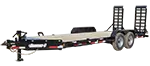
- Diamond C LPX low-profile equipment trailer configurations currently span approximately 15,500 to 24,000 pounds GVWR, with bumper-pull lengths from 16 to 30 feet. Current builds use Lippert axles, with axle count and rating determined by the selected GVWR package. The between-fender, low-profile deck can help control loaded height for compact excavators, skid steers, mini track loaders, and similar equipment that fits the trailer’s measured payload and deck dimensions. MAX Ramps and the X-Ramp system are available on qualifying configurations.
- Diamond C HDT hydraulically dampened tilt trailer is available in approximately 15,500- to 24,000-pound GVWR configurations and lengths from 16 to 28 feet. It uses a gravity-fed, hydraulically dampened tilt bed rather than conventional rear loading ramps. Current HDT builds use Lippert axles, with tandem or triple-axle packages available depending on the ordered rating. It is a strong option when a low loading angle and simplified loading process matter, provided the machine’s track length, concentrated loading, and actual weight are compatible with the selected build.
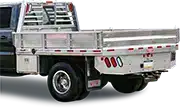
- Diamond C FMAX Flatbed Max gooseneck models range from the 15,500-pound-GVWR FMAX207 through heavier FMAX208, FMAX210, FMAX212, FMAX307, FMAX310, FMAX312, and FMAX216 configurations, with selected FMAX312 and FMAX216 builds reaching 40,000 pounds GVWR. Available deck lengths vary by model and can extend to 44 feet. The 102-inch deck-over layout provides a full-width platform and substantial length, but the deck sits above the tires and will generally produce a taller loaded height than a low-profile between-fender equipment trailer. Loading choices can include MAX Ramps, XDR Ramps, a hydraulic dovetail, or a straight deck, depending on the model and build.
- Diamond C LPT heavy-duty telescopic dump trailer is intended for dense material, demolition debris, soil, aggregate, and other dump applications. Current configurations span approximately 15,500 to 24,000 pounds GVWR in 12-, 14-, and 16-foot body lengths and use a telescopic hoist with Lippert axle packages appropriate to the selected rating. Material density must be calculated before loading because a dump body can reach its legal payload long before it looks full.
- A commercial lowboy or purpose-built heavy-haul trailer is the appropriate category for equipment that exceeds pickup-towed trailer ratings. A 48,000-pound excavator normally requires a properly rated tractor, heavy-haul trailer, adequate axle groups, commercial insurance and registration, a qualified driver, and route planning based on the complete loaded combination. A 40,000-pound trailer GVWR does not provide room for a 48,000-pound machine because the trailer’s own weight is part of that rating.
Current Diamond C premium configurations in these lines use Lippert axles, not a substituted axle brand, and are finished with the DM Difference Maker multi-stage coating process. Exact axle ratings, suspension, brakes, tires, wheels, frame construction, curb weight, deck dimensions, and payload vary by model and ordered options, so the VIN label and final build sheet are the controlling references for a specific trailer.
Deck height matters more than many buyers realize. A machine that measures 10 feet from the ground to its highest transport point will measure approximately 12’6″ when placed on a 30-inch-high deck, before allowing for any measurement uncertainty. A fixed ROPS, cab, exhaust stack, folded boom, attachment, beacon, or other upper component can become the highest point. Calculate the expected height before loading, then physically measure the loaded combination on level ground. Do not use the equipment brochure height alone if the machine has different tires, tracks, attachments, or cab equipment.
Cargo securement is just as important as route clearance. Federal rules for heavy equipment weighing 10,000 pounds or more require restraint against forward, rearward, lateral, and vertical movement with at least four tie-downs. Buckets, booms, blades, hydraulic shovels, and other accessory equipment must be lowered and secured, and articulated equipment must be restrained against articulation. Tie-down working-load limits, anchor-point ratings, chain condition, and the machine manufacturer’s approved securement points all matter.
Indiana also requires brakes on trailers over 3,000 pounds GVWR. For a heavy equipment setup, verify operation of the electric-over-hydraulic or electric brake system, in-cab controller, breakaway system, battery, lights, safety chains, and coupler before every trip. A legally rated trailer with an inoperative brake or breakaway system is not ready for the road.
A Practical Routing Framework
Before every heavy haul in central Indiana, run through this sequence:
- Confirm the machine’s actual transport weight and dimensions. Include attachments, counterweights, fuel, fluids, buckets, forks, blades, spare parts, chains, binders, and anything else carried on the trailer. Record the trailer’s actual empty weight and calculate the complete loaded trailer and combination weight.
- Measure loaded height, width, overall length, rear overhang, axle spacings, and axle weights. Compare those figures with Indiana’s legal limits, the tow vehicle’s ratings, the trailer GVWR and GAWR, tire and wheel ratings, hitch rating, registered weight, CDL requirements, and cargo-securement rules.
- If the load exceeds a state legal dimension or weight limit, apply through the Indiana DOR Motor Carrier Services OSOW system. Enter the axle configuration and dimensions accurately and follow the route and conditions printed on the issued permit. Do not substitute a consumer GPS route for the authorized route.
- For any county road, city street, town street, or private access road, contact the controlling agency or property owner. A state permit does not authorize local-road travel, and the local agency may require a separate permit, route inspection, bridge review, traffic control plan, or proof of insurance.
- Check INDOT’s current restrictions, 511 information, bridge-clearance map, weather, wind, and every local road notice shortly before departure. Do not rely on a fixed seasonal calendar or a route used on a previous job.
- Confirm the permitted travel window. Indiana does not prohibit every permitted load from moving after sunset. Under the general provisions, certain loads up to 110 feet long, 10 feet wide, legal height, and under 200,000 pounds may receive continuous travel. Larger dimensions have daylight, weekday, or restricted-hour requirements, and holiday restrictions apply to many permits. The conditions printed on the individual permit control the move.
Before rolling, make sure the driver has the permit and required general or special provisions in paper or electronic form. Install the required oversize-load signs, flags, lamps, and escort vehicles when applicable. Indiana’s general provisions also restrict permitted movement during hazardous road or traffic conditions, when visibility is less than 500 feet, or when wind exceeds 25 miles per hour. Open scales must be entered when required, and a permitted vehicle cannot use a closed or posted structure simply because it appears physically passable.
None of this takes as long as recovering from a bridge strike, an axle-weight citation, a voided permit, or a roadside out-of-service order. Some routine permits can be issued through a pre-approved route, while other applications require bridge engineering or manual review. Build permit time into the dispatch schedule instead of promising the customer a departure time before the route is approved.
Spencer Trailers and Indiana Haulers
We’re in Spencer, in Owen County west of Bloomington, with customers regularly traveling through Monroe, Morgan, Brown, Greene, Clay, Putnam, and Marion counties. We work with contractors moving compact construction equipment toward Indianapolis, agricultural customers hauling machinery between rural properties, and crews carrying material between the southern Indiana limestone region and central Indiana job sites. The interstate portion is usually straightforward; the last few miles on local roads are where careful trailer selection and route verification matter most.
If you’re buying a trailer and your main use case is equipment hauling on Indiana highways, the conversation about payload, deck height, deck width, loading style, overall length, axle configuration, brakes, hitch weight, and tow-vehicle capacity isn’t optional. The wrong trailer can create an overload before the machine ever leaves the yard. A trailer with a high GVWR may still have insufficient payload after its curb weight is deducted, and a full-width deck-over may create more loaded height than a lower between-fender deck.
Browse our current inventory and compare the actual VIN-label ratings and build specifications, or reach out directly with the equipment model, operating weight, attachments, overall dimensions, pickup specifications, and usual route. We’ll help you narrow the choices to trailers that fit the load instead of selecting one from a model name or advertised GVWR alone.
What equipment are you hauling, what does it weigh with every attachment installed, and where does your route leave the state highway system? Those answers determine the trailer, tow vehicle, licensing, securement, local approval, and permit process that apply to the job.


