













You’re loaded up and ready to roll. The trailer is hitched, the cargo is secured, and the truck is warmed up. Then it hits you: is this rig actually legal on Indiana roads? If you’ve ever added up a heavy haul and still felt uncertain about axle weights, bridge postings, permits, or the last few miles to a job site, this post is for you.
Indiana weight limits apply throughout the public-road system, but the legal number for a particular trip is not determined by one statewide maximum alone. Actual axle weights, axle spacing, total gross weight, tire capacity, manufacturer ratings, posted bridge limits, temporary restrictions, and permit routing can all matter at the same time. Exceed one applicable limit and you may face civil penalties, an out-of-service order, permit cancellation, load adjustment, or a required route change. Here’s a practical breakdown of how the rules work.
Indiana’s Standard Axle and Gross Weight Limits
Indiana incorporates the federal bridge formula into its state weight law. For an ordinary legal-weight move without an overweight permit, the baseline limits under Indiana Code are:
- Single axle: 20,000 lbs maximum, subject to the tire-width limitation
- Tandem axle group: 34,000 lbs maximum for the group, with no individual axle in the group exceeding 20,000 lbs
- Overall gross vehicle weight: 80,000 lbs maximum, subject to the bridge formula, axle limits, tire limits, and any lower posted restriction
Those numbers are ceilings, not automatic allowances. Indiana also limits wheel loading to 800 lbs per inch of tire width measured between the rim flanges. A vehicle can therefore be under 80,000 lbs overall and still be illegal because one axle, one tandem group, one tire, or one bridge is overloaded. Local authorities may impose lower limits on roads and bridges under their jurisdiction, and INDOT may restrict state-system roads when conditions require it. If a bridge is posted for 15 tons, that posted limit controls unless the authority responsible for that bridge has specifically authorized the movement.
Indiana’s bridge formula calculates the allowable weight on groups of two or more consecutive axles by considering both the number of axles and the distance between the outermost axles in the group. The purpose is to prevent too much weight from being concentrated over a short section of pavement or bridge. Indiana defines a tandem axle group as two or more axles spaced more than 40 inches and less than 96 inches apart. That tandem group remains subject to the 34,000-lb group limit even when each axle is individually rated for more.
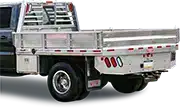
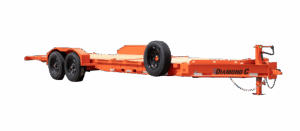
Greater spacing between axles can improve the bridge-formula result for certain axle groups, but spacing does not increase a trailer’s certified GVWR, GAWR, tire capacity, coupler rating, or payload rating. Axles spaced outside the statutory tandem definition may be evaluated as separate axles, but the 20,000-lb individual-axle limit and bridge formula still apply. So if you’re running a gooseneck or heavy-duty flatbed, use the actual center-to-center axle measurements and scale weights rather than assuming that a spread configuration automatically authorizes more cargo. A Diamond C or H&H trailer with a longer wheelbase may produce a different bridge-formula calculation than a shorter configuration, but every component rating and roadway limit still has to be satisfied.
Oversize and Overweight Permits
When a vehicle or nondivisible load exceeds Indiana’s ordinary legal dimensions or weight limits, the required permit must be obtained before the move begins. Most state-system oversize and overweight permits are issued by the Indiana Department of Revenue Motor Carrier Services Division under rules and routing requirements established with INDOT. Ordinary overweight permits are generally intended for nondivisible loads that cannot reasonably be separated or reduced to legal weight. Divisible cargo normally must be reduced to legal limits unless it qualifies for a specific statutory or commodity-permit program.
Single-Trip Permits
A single-trip permit authorizes the vehicle, load, axle configuration, dimensions, weight, travel period, and route shown on the permit. Indiana single-trip permits commonly provide a limited validity period in which the authorized trip must occur, but they do not create permission to make unlimited trips during that period. The operator must follow the approved route, travel times, markings, speed restrictions, escort requirements, and other permit provisions. A different fuel stop, detour, origin, destination, tractor, axle spacing, or load weight may require an approved amendment or a new permit before the change is made. Violating a permit condition can void the permit.
Annual Permits
Indiana offers annual and 90-day permit categories for certain repeated movements, including qualifying oversize vehicles and specialized commodity operations. An annual permit is not a blanket authorization to operate at any dimension, weight, or location in the state. The vehicle must remain within the dimensions, legal-weight limits, routes, commodities, and operating conditions stated for that permit category. Some annual permits authorize oversize travel only at legal axle and gross weights, while overweight operations may require a different permit. Operators should compare the exact permit terms with the equipment and loads they plan to move rather than assuming that an annual permit covers every job.
Superload Permits
For the Indiana State Police superload-escort process, a vehicle and load enters superload territory when it exceeds 17 feet in width, 15 feet in height, 110 feet in length, or 108,000 lbs in gross weight. Crossing any one of those thresholds can trigger the superload process. The carrier first obtains the appropriate permit through Indiana DOR and then coordinates the required agreement and escort arrangements with the Indiana State Police Commercial Vehicle Enforcement Division. Depending on the route and load, bridge review, traffic slowdowns, utility clearance work, route surveys, additional pilot vehicles, or other traffic-control measures may also be required.
Superloads do not automatically move overnight. Indiana permit provisions assign operating windows according to the load’s dimensions, weight, route, and traffic impact. Some permitted loads may travel continuously, some are restricted to daylight hours, and the largest loads may be limited to specified weekday periods. If you’re hauling wide construction equipment, a modular structure, or a heavy industrial component, do not commit to a delivery time until DOR routing and any required ISP escort have been confirmed.
What Triggers a Permit
Indiana’s general maximum legal width is 8 feet 6 inches, and its general maximum legal height is 13 feet 6 inches. Length depends on the vehicle configuration. A two-vehicle combination such as a pickup and trailer is generally limited to 60 feet overall, including the load, unless a statutory exception applies. For a truck-tractor and semitrailer combination, the semitrailer unit is generally limited to 53 feet; that is a semitrailer-length limit, not a 53-foot overall limit for the entire tractor-trailer combination. A single vehicle is generally limited to 40 feet. Certain combinations, vehicle types, and specialized operations have separate rules, so the exact configuration matters.
An otherwise legal 102-inch-wide equipment trailer becomes oversize if a bucket, attachment, tire, or other part of the load increases the overall loaded width beyond 8 feet 6 inches. For example, a skid steer attachment that brings the loaded width to 9 feet requires oversize authorization even when the truck and trailer are well below 80,000 lbs. Width is measured across the vehicle and load, not merely across the trailer deck. Height must likewise be measured from the road surface to the highest point of the loaded combination.
Verify current permit thresholds, permit availability, fees, routes, escort rules, travel windows, and load-divisibility requirements directly with Indiana DOR Motor Carrier Services at in.gov/dor/motor-carrier-services/oversizeoverweight-osw/ before beginning an oversize or overweight move. Permit conditions and active route restrictions can change, and general guidance is not a substitute for the permit issued for your specific vehicle and load.
Seasonal Frost Laws and Spring Weight Restrictions
Indiana does not operate under one automatic statewide frost-law calendar that reduces every road’s axle limits on the same dates each spring. Instead, Indiana law allows local authorities to impose temporary weight restrictions on roads under their jurisdiction when deterioration, rain, snow, freeze-thaw conditions, or other climatic conditions could seriously damage the roadway. A local temporary restriction under IC 9-20-1-3 may remain in effect for a total of up to 90 days in a year, and it must be posted before it can be enforced. INDOT has similar authority over highways in the state system and must also provide notice through roadway signs.
The practical result is that seasonal restrictions vary by jurisdiction. One county may establish a gross vehicle weight limit for a set period, another may restrict particular axle loads or commercial vehicles, and a neighboring county may have no temporary restriction at all. Do not assume that Indiana automatically reduces a 20,000-lb axle limit by a fixed percentage. The enforceable limit is the limit stated in the applicable ordinance, executive order, permit, or posted sign for that road.
Who Manages Frost Laws
INDOT controls restrictions on highways in the state system, while counties, cities, and towns control roads under their own jurisdiction. That means a load may be legal on an interstate or state route but prohibited on a posted county road immediately after turning off the state highway. The reverse can also occur when a state-system bridge or construction zone has a lower temporary limit than the surrounding local roads.
Some counties publish seasonal restrictions, heavy-haul requirements, truck routes, and permit forms through their highway departments or county commissioners. Others rely primarily on roadside postings or require operators to call for current information. Before using county or municipal roads during winter or the spring thaw, check the complete route with the applicable highway departments and review current INDOT restrictions through 511IN. A state permit does not authorize travel across a locally controlled segment, and a local authority may require a separate permit, route approval, bond, or proof of insurance.
Exemptions During Frost Laws
There is no blanket exemption that makes every agricultural, construction, utility, or time-sensitive load immune from a posted seasonal restriction. Indiana law contains narrow exemptions for certain operations, and local ordinances may create additional exceptions or local permitting procedures. For example, a qualifying implement of agriculture used in farming operations may be treated differently from a pickup and equipment trailer carrying ordinary divisible cargo. Confirm any exemption with the authority that controls the road, obtain written authorization when required, and comply with any route, time, axle, bonding, or notification conditions attached to it.
What This Means for Your Trailer Setup
The trailer you choose affects axle loading, tongue or pin weight, overall combination weight, maneuverability, and the bridge-formula calculation. It does not replace the need to verify the truck, hitch, trailer, tires, cargo, and route as one complete system. GVWR is the manufacturer’s maximum rated weight for the trailer; it is not the trailer’s payload capacity and is not permission to operate at that weight on every public road.
| Trailer Type | GVWR Range | Axle Config | Indiana Relevance |
|---|---|---|---|
| Diamond C GST single-axle telescopic dump | 6,000 lbs | Single 6,000-lb Lippert drop axle with electric brake | Indiana’s brake statute applies to trailers at least 3,000 lbs gross weight; truck, hitch, tire, and posted-road limits still control |
| Diamond C GTU tandem-axle utility | 7,000 lbs | Dual 3,500-lb Lippert brake axles on a 4-inch channel frame | Loaded trailer remains subject to tandem-group, component, and local posted limits; payload equals GVWR minus actual empty weight |
| Diamond C LPX, HDT, or LPT | 15,500–24,000 lbs | Tandem or tri-axle Lippert configurations depending on model and GVWR package | Scale the truck and trailer axle groups carefully; heavier combinations may also trigger commercial-vehicle and Class A CDL requirements |
| Diamond C FMAX gooseneck flatbed | Approximately 15,500–40,000 lbs by model and package | Tandem or triple Lippert axle configurations with single-wheel, dual-wheel, or super-single running gear depending on model | Truck GCWR, hitch and pin capacity, axle spacing, individual axle weights, tires, bridge formula, and route must all be legal; some loaded moves may require permits |
If you’re loading equipment that puts the rig anywhere near a truck, trailer, axle, tire, or roadway limit, weigh it before you roll. A proper scale ticket should show the steer, drive, and trailer axle groups. Remember that gooseneck pin weight and bumper-pull tongue weight are carried by the tow vehicle, so adding only the trailer-axle reading does not give you the trailer’s complete gross weight. Cargo, fuel, passengers, tools, chains, ramps, spare tires, and accessories all count. Also remember that a trailer with a GVWR above 10,000 lbs does not by itself trigger a Class A CDL. For a typical commercial combination, the Class A threshold is a GCWR or actual GCW of at least 26,001 lbs together with a towed unit rated or weighing more than 10,000 lbs, subject to applicable exemptions and specialized rules.
Common Mistakes Indiana Haulers Make
Skipping the county-road and bridge check is one of the most common mistakes. A DOR permit for state-maintained roads does not cover county roads or city streets. Another mistake is looking only at total gross weight. You can be below 80,000 lbs and still violate the bridge formula, exceed a 34,000-lb tandem limit, overload an individual axle, exceed a tire’s capacity, or cross a posted bridge that has a much lower limit. Registration weight and permit weight also do not authorize operation beyond the truck, trailer, axle, tire, coupler, or hitch manufacturer’s ratings.
Operators also confuse GVWR with actual weight and payload. A 24,000-lb-GVWR trailer cannot carry 24,000 lbs of cargo because the trailer’s own empty weight is part of its GVW. During a temporary local restriction, the rules are not limited to tractor-trailers. A pickup towing a tandem-axle equipment trailer, dump trailer, or gooseneck can exceed a posted gross or axle limit. Conversely, being under a roadway limit does not make an overloaded trailer safe or legal. The manufacturer ratings and roadway limits are separate requirements, and the rig must comply with both.
Permits Don’t Make It Legal Everywhere
One thing that catches operators is treating an Indiana DOR MCS permit as statewide clearance. The permit applies to the approved state-system route and does not apply to county roads or city streets. Indiana’s general permit provisions also exclude roads or bridges that are closed, posted for lower gross-load limits, or physically unable to clear the permitted height or width. If you leave the route for fuel, food, repairs, parking, or to avoid congestion, the off-route movement is not automatically authorized. Request an amendment or revised route before making a change whenever the permitting system allows it.
This matters most during the first and last miles of a trip. A properly permitted load can travel hundreds of miles on major highways and still lack authorization for the final township road, city street, subdivision entrance, or private job-site approach. Route planning should therefore start at the loading point and end at the exact unloading point, including every local segment, bridge, railroad crossing, overhead line, turn, and fuel stop.
Where to Get Real Answers
For state-route restrictions, closures, bridge information, and construction conditions, use INDOT and 511IN. For state-system oversize and overweight permits, contact Indiana DOR Motor Carrier Services. For a county road, city street, or locally maintained bridge, contact the highway department or public-works authority that controls that segment. The Indiana Toll Road has its own operating and permit requirements, so do not assume that a state permit automatically answers every toll-road question.
If you’re unsure whether your truck, trailer, and load are legal for a planned route, a certified scale ticket is inexpensive protection. Weigh the combination in its actual travel condition, with the cargo secured, fuel tanks filled to the expected level, the driver and passengers aboard, and normal tools and equipment loaded. Compare every scale reading with the truck’s GVWR and GAWR, the trailer’s GVWR and axle ratings, the hitch and coupler ratings, the tire load limits, the bridge formula, and any posted route restriction. Knowing the numbers before departure is far better than discovering an overload during a roadside inspection.
Buying the right trailer for the work you perform matters too. If you’re regularly hauling equipment, materials, or commercial loads on Indiana roads, trailer GVWR, empty weight, axle count, axle spacing, deck dimensions, hitch type, braking system, and loading method should all be part of the buying decision. Diamond C’s current heavy-duty lines use Lippert axles, with configurations ranging from the 6,000-lb single-axle GST and 7,000-lb GTU to LPX, HDT, LPT, and FMAX models built for substantially heavier work. Talk to the team at Spencer Trailers about what you haul, the truck you use, and the roads you regularly travel. We can help you compare trailer ratings and configurations, but final route legality must be verified with the government authority responsible for the road. Browse current inventory to see which specifications fit your operating needs.
What routes are you running, and are axle weights, posted bridges, overall length, or local road restrictions creating the biggest challenge for your current rig?


