













You’ve got a load to move. You’re leaving Spencer, Indiana, heading west on US-40 or I-70, and somewhere around Terre Haute you cross into Illinois. Simple enough, right? Not always. Indiana and Illinois share a border and a lot of road, but they do not apply every towing, size, registration, and commercial-vehicle rule in exactly the same way. Legal axle weights, highway classifications, speed limits for heavier trucks, oversize-permit conditions, and commercial credentials can all change what is allowed once you cross the state line.
This post covers what you need to know at the practical level. Rules, permit manuals, posted bridge limits, and designated truck routes can change, so always verify current requirements with the Indiana Department of Transportation (INDOT) at in.gov/indot, Indiana Department of Revenue Motor Carrier Services at in.gov/dor, and the Illinois Department of Transportation (IDOT) at idot.illinois.gov before your trip. Treat this as a solid starting framework, not a substitute for checking the agencies responsible for the roads and vehicle combination you will actually use.
Weight Limits: Where Indiana and Illinois Part Ways
Both states use federal-style axle and bridge-weight principles on major truck routes, but the legal number is not determined by gross weight alone. The actual weight on each axle, the distance between axles, tire ratings, axle ratings, the vehicle’s registered weight, posted bridge limits, and the classification of the road can all reduce what you may legally carry.
On Indiana Interstate and National Network routes, the familiar maximums for a properly configured legal-weight combination are generally 80,000 pounds gross, 20,000 pounds on a single axle, and 34,000 pounds on a tandem axle, subject to the federal bridge formula and other equipment limitations. Those figures are ceilings, not automatic allowances. A shorter combination may not qualify for 80,000 pounds under the bridge formula, and a truck, trailer, tire, wheel, hitch, coupler, or axle rating may establish a lower limit. Posted bridges and locally controlled roads can also carry substantially lower limits.
Illinois likewise permits gross weights up to 80,000 pounds when the axle count, axle spacing, bridge formula, registration, and route allow it. Illinois divides highways into Class I, Class II, Class III, and non-designated routes, and those classifications affect legal dimensions, access, and the movement of larger vehicles. There is not a reliable blanket rule that every non-Interstate Illinois route is limited to one lower statewide gross-weight figure. The controlling limit may instead come from the bridge formula, a posted structure, a local road restriction, the vehicle’s registration, or the ratings of the truck and trailer.
For pickup-and-trailer haulers, the 80,000-pound ceiling is rarely the first restriction that matters. You need to know the truck’s actual steer- and drive-axle weights, the weight carried by the trailer axles, and the total actual combination weight. Tongue or gooseneck weight transfers part of the trailer’s loaded weight to the tow vehicle, so adding the trailer axle ratings does not tell you the trailer’s total allowable weight or payload. The only dependable way to confirm a loaded combination is to use a certified scale and compare the scale ticket with the truck’s GVWR, front and rear GAWRs, GCWR, tire ratings, hitch or ball rating, trailer GVWR, trailer GAWRs, and registered weights.
Do not assume that seasonal restrictions operate through one statewide “spring thaw” calendar in either state. Indiana, Illinois, counties, townships, cities, and other road authorities can post temporary or permanent restrictions on particular roads and bridges. A route that is legal on I-70 may not remain legal after you turn onto a county road leading to a farm, quarry, construction site, or equipment yard. Check INDOT’s traveler information, IDOT route information, posted signs, and the local agency responsible for the first and last miles of the trip.
Speed Laws With a Trailer Attached
Indiana does not impose one universal lower speed limit on every passenger vehicle merely because a trailer is attached. A light-duty towing combination may ordinarily follow the posted limit, but the type and declared weight of the tow vehicle still matter. Indiana generally allows up to 70 mph on rural Interstate highways outside urbanized areas, while a vehicle other than a bus with a declared gross weight over 26,000 pounds is generally limited to 65 mph on those roads. Other controlled-access highways may be posted at 65 mph, qualifying divided highways may be posted at 60 mph, and the general maximum on many other highways is 55 mph unless a different limit is posted.
Illinois also does not use a single statewide “trailer speed limit,” but it has important location- and vehicle-class distinctions. Rural Interstate limits are commonly 70 mph. However, vehicles classified as trucks over four tons are generally subject to lower limits in Cook, DuPage, Kane, Lake, McHenry, and Will counties: typically 60 mph on Interstates and 55 mph on non-Interstate freeways or expressways unless signs establish another limit. Outside those counties, a heavier truck may generally travel up to 70 mph on an Interstate and 65 mph on a non-Interstate freeway where those limits are authorized and posted. Conventional highways are commonly limited to 55 mph or less.
The practical rule is to read the signs and know how the tow vehicle is classified, rather than assuming that one speed applies to every pickup, commercial truck, or towing combination. Tire speed ratings, trailer-manufacturer recommendations, load security, crosswinds, traffic, braking distance, and the tow vehicle’s stability may require a speed well below the legal maximum.
Both states permit enforcement when a driver is traveling too fast for actual conditions, even if the vehicle is below the posted limit. Rain, ice, wind, construction zones, reduced visibility, congested traffic, a high center of gravity, and a load that can shift all justify slowing down. A posted speed limit is a maximum under favorable conditions, not a promise that a loaded trailer will remain stable or stop safely at that speed.
Reciprocity: Does Your Indiana Registration Work in Illinois?
For most Indiana residents making a temporary trip with a properly titled, registered, and plated private trailer, Illinois generally recognizes the Indiana registration. If you’re pulling a trailer you bought at Spencer Trailers for personal hauling, farm activity, a move, or work that does not place the vehicle into a different commercial-registration category, you normally do not purchase a second ordinary Illinois trailer registration merely to cross the border.
That recognition is based on nonresident registration and reciprocity rules. It is not the same thing as the International Registration Plan. The IRP is an apportioned-registration program for qualifying commercial vehicles operating in multiple jurisdictions; it is not the reason an ordinary privately owned Indiana trailer plate is accepted during a temporary trip into Illinois. In certain apportioned commercial operations, Illinois trailer-plate or “ST” registration requirements can apply, so carriers should verify their specific fleet credentials with the Illinois Secretary of State rather than assuming a standard Indiana trailer plate covers every commercial use.
Commercial operation can add several separate requirements. An interstate commercial motor vehicle may require a USDOT number based on its weight rating, actual weight, passenger capacity, or hazardous-material use. IRP and IFTA generally apply to qualifying commercial power units operating in more than one jurisdiction, commonly when the vehicle exceeds 26,000 pounds or has three or more axles; IFTA applies to the fuel-using power unit, not simply to the trailer. For-hire operations may also require federal operating authority, Unified Carrier Registration, insurance filings, and shipping documents. Whether those rules apply depends on how the vehicle is used, not merely whether the owner is being paid for the cargo.
CDL rules are another separate issue. A Class A CDL is generally implicated when the combination’s GCWR or actual gross combination weight is 26,001 pounds or more and the towed unit has a GVWR or actual gross weight of more than 10,000 pounds, subject to applicable exemptions. The 26,001-pound threshold refers to the combination, not to the trailer by itself. Farm, recreational, military, emergency, and other exemptions are limited and should be verified before relying on them, particularly when crossing state lines or hauling in furtherance of a business.
Indiana generally requires a newly acquired vehicle or trailer to be titled and registered within 45 days to avoid the administrative late penalty. That 45-day deadline is not permission to operate an unregistered trailer on public roads for 45 days. Before leaving for Illinois, make sure the trailer displays a valid plate or properly issued temporary permit and that you are carrying the registration, purchase paperwork when relevant, proof of insurance for the tow vehicle, and all required commercial credentials.
Oversize and Overweight Permits
This is where careful route planning becomes especially important. A permit issued by one state does not authorize movement in the other state, and a state permit generally does not grant authority over county, township, municipal, or privately controlled roads.
Indiana requires an oversize or overweight permit when a vehicle or load exceeds the legal dimensions or weights for the route. The normal legal width is generally 8 feet 6 inches, and the normal legal height is generally 13 feet 6 inches. Legal length depends on the configuration, including whether the combination is a truck and trailer, semitractor and semitrailer, or another vehicle type. Do not apply one semitrailer-length number to every pickup-and-gooseneck combination.
Indiana oversize and overweight permits are administered through Indiana Department of Revenue Motor Carrier Services under INDOT’s route and operating rules. Permits are configuration- and route-specific, and approval depends on axle weights, axle spacing, dimensions, bridge capacity, construction restrictions, and the roads requested. A routine permit is not an automatic authorization to travel at any size or weight. Indiana generally requires an escort when a permitted movement exceeds 12 feet 4 inches in width, 110 feet in length, or 14 feet 6 inches in height, with additional escort and height-clearance requirements possible as dimensions increase. The issued permit and current Indiana permit manual control.
Permitted Indiana movements can also be subject to reduced speed, lighting, signage, weather, holiday, and travel-hour conditions. For example, larger permitted vehicles may be limited to no more than 55 mph, and movement may be prohibited during hazardous weather, inadequate visibility, or excessive wind. Some permits allow broader travel windows than others, so never rely on a general statement that every oversize load is either daylight-only or eligible for continuous travel.
Illinois requires an IDOT permit when a vehicle or nondivisible load exceeds legal size or weight on highways under IDOT jurisdiction. The ordinary legal width is 8 feet 6 inches, and the ordinary legal height is 13 feet 6 inches. Length is determined by the vehicle configuration and highway classification. On non-designated highways, many combinations other than a standard semitractor-semitrailer are limited to 60 feet overall, while Class I and Class II rules differ. A blanket 65-foot rule is therefore not accurate for every pickup, gooseneck, fifth-wheel, or commercial combination.
Illinois permit applications are handled through IDOT’s Illinois Transportation Automated Permits system. IDOT reviews the requested route and may impose specific limits for travel hours, holidays, weather, speed, warning signs, flags, lighting, and escort vehicles. Escort thresholds vary by the width, height, length, route, and permit type, so the instructions printed on the permit take priority over any general rule of thumb.
Both states generally reserve oversize and overweight permits for loads that cannot reasonably be reduced to legal dimensions or weights. A permit is not ordinarily a way to carry extra divisible material simply because the trailer has room for it. Equipment attachments, buckets, booms, counterweights, and other removable components may need to be repositioned or removed when doing so can make the load legal.
If you’re hauling a modular building section, wide farm implement, large piece of construction equipment, or another nondivisible load, measure it after loading. Width is measured across the widest part of the vehicle and load, and height is measured from the road surface to the highest point. Obtain a permit from each state before departure, confirm every route segment, and contact the appropriate local road authority for any county, township, or city streets that are not covered by the state permits.
Trailer Equipment Requirements
Trailers used in interstate commerce may be subject to federal motor-carrier equipment rules in addition to state traffic laws. Private trailers must still comply with the operating laws of each state. At a minimum, the trailer needs functioning tail lamps, stop lamps, turn signals, reflectors, a license-plate lamp, and any required clearance, identification, and side-marker lamps for its width, length, and model year. Inspect the seven-way connector, wiring, grounds, lenses, conspicuity material, and breakaway battery before leaving Indiana.
Trailer brakes are where the details differ. Indiana requires a trailer or semitrailer with a gross weight of at least 3,000 pounds to have brakes adequate to control, stop, and hold it, operable by the driver of the towing vehicle, with automatic application if the trailer breaks away. Illinois requires driver-operable brakes on a trailer or semitrailer with a gross weight of more than 3,000 pounds. In Illinois, a trailer over 3,000 pounds but under 5,001 pounds may have brakes on at least one wheel on each side; trailers at the heavier level are generally required to have service brakes on all wheels. Illinois requires automatic breakaway application for a towed vehicle over 5,000 pounds.
Most modern tandem-axle equipment, dump, and gooseneck trailers are built with brakes on all applicable wheels, but that does not guarantee that the system is road-ready. Test brake-controller output, manual override, magnet or hydraulic operation, adjustment, drums or rotors, wiring, fluid where applicable, and the breakaway switch. Attach the breakaway cable independently to a secure point on the tow vehicle rather than looping it around the hitch ball or attaching it only to a safety chain.
Safety chains or equivalent safety devices are required for applicable trailer connections in both states. Indiana calls for suitable safety devices positioned on each side of the connection, while Illinois generally requires two chains or cables of sufficient strength to prevent separation. Crossing chains beneath a bumper-pull tongue is a widely recommended practice because it can help support the tongue after a coupler failure, but the chains still need correct ratings, secure attachment points, enough slack for turning, and sufficient ground clearance. They should not be twisted merely to shorten them.
Cargo securement deserves the same attention as the hitch. Use properly rated chains, binders, straps, anchor points, edge protection, and equipment restraints. The aggregate working-load limit and the number and placement of tiedowns must be adequate for the cargo. Articulating equipment should have movement restrained, attachments should be lowered or secured, and loose tools, ramps, blocks, and debris should be contained before entering either state’s highway system.
A Practical Checklist Before You Cross
- Plan the complete route, including the non-Interstate roads at both ends, and identify whether each Illinois segment is Class I, Class II, Class III, non-designated, state-maintained, or locally controlled.
- Obtain a certified scale ticket when the load is close to a limit. Check steer, drive, trailer-axle, trailer gross, and total combination weights rather than relying on an estimate.
- Compare the scale weights with the truck’s GVWR, GAWRs, GCWR, tire and wheel ratings, receiver or gooseneck rating, trailer GVWR, trailer GAWRs, coupler rating, and registered weight.
- Measure the loaded rig. A vehicle or load over 8 feet 6 inches wide or 13 feet 6 inches high normally requires permit review, and legal length must be checked for the particular vehicle configuration and road class.
- Apply separately for Indiana and Illinois permits when required. Obtain additional authorization for county, township, municipal, or other roads not covered by the state permits.
- Confirm that the load is eligible for permitting and cannot reasonably be reduced to legal dimensions or weights by repositioning or removing components.
- Read every permit condition, including the approved route, movement dates, travel hours, speed, signs, flags, lighting, escorts, holiday restrictions, and weather limitations.
- Verify that the trailer’s lights, brakes, brake controller, breakaway switch and battery, coupler, safety chains, tires, wheel fasteners, bearings, ramps, doors, and cargo securement are ready for the trip.
- Carry the truck and trailer registrations, proof of insurance, permits, scale ticket, shipping documents, and any required USDOT, IRP, IFTA, UCR, operating-authority, or CDL credentials in the cab.
- Do not treat Indiana’s 45-day titling and registration deadline as permission to tow an unplated trailer. Use a valid plate or properly issued temporary permit before entering Illinois.
- Check INDOT, Indiana Department of Revenue Motor Carrier Services, IDOT, Illinois 511, and the relevant local road agencies for current construction, closures, posted bridge limits, and temporary restrictions.
Always verify current requirements directly with INDOT (in.gov/indot), Indiana Department of Revenue Motor Carrier Services (in.gov/dor), and IDOT (idot.illinois.gov) before your trip. Regulations, permit manuals, highway classifications, posted limits, and approved routes can change, and permit requirements are specific to the vehicle, load, dimensions, axle spacing, and roads being used. This post is a general orientation, not legal or compliance advice.
What This Means When You’re Buying a Trailer
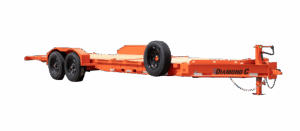
If you’re shopping for a trailer that will regularly cross the Indiana-Illinois state line, the configuration decisions you make at purchase time matter. A nominal 8.5-foot-wide enclosed cargo trailer is normally 102 inches wide, which places it at the standard 8-foot-6-inch legal-width limit rather than automatically over it. Confirm the manufacturer’s actual overall width, however, and make sure cargo, temporary racks, or other non-exempt items do not project beyond the legal envelope. A Diamond C flatbed with a 102-inch-wide deck is likewise at the ordinary legal-width limit, so the way the load is positioned can determine whether a permit is required.
Deck width is only one part of the decision. Overall trailer length, loaded height, empty weight, GVWR, axle spacing, tire capacity, coupler type, ramp arrangement, and the truck’s available rear-axle and towing capacity all affect interstate usability. A low-profile equipment trailer may help reduce loaded height, while a deck-over design can provide a wider usable deck but place the equipment higher. Neither design is automatically better for every route or machine.
Axle ratings also need to be interpreted correctly. Two 7,000-pound axles provide 14,000 pounds of combined axle capacity; they do not provide 14,000 pounds of payload. Payload is generally the trailer’s certified GVWR minus its actual empty weight, and the usable figure may be reduced by options, cargo placement, tires, wheels, the coupler, the frame, or the tow vehicle. On a gooseneck, part of the loaded trailer weight is carried as pin weight by the truck, which is why a properly engineered trailer’s GVWR does not always equal the simple sum of its axle ratings.
For example, the Diamond C FMAX207 is a current Flatbed Max gooseneck configuration with a 15,500-pound GVWR, a 102-inch deck, and tandem 7,000-pound Lippert axles. Heavier FMAX models extend through higher GVWR classes for commercial and heavy-equipment work. Diamond C’s current FMAX family includes the FMAX207, FMAX208, FMAX210, FMAX212, FMAX216, FMAX307, FMAX310, and FMAX312, with GVWRs ranging from approximately 15,500 pounds to as much as 40,000 pounds depending on the model and selected configuration.
Diamond C also offers the LPX Low Profile Extreme-Duty Equipment Trailer and HDT Hydraulically Dampened Tilt Trailer in configurations generally ranging from 15,500 to 24,000 pounds GVWR. The LPT Heavy Duty Telescopic Dump is available in the same general GVWR range for dump applications. Current Diamond C premium lines, including FMAX, HDT, LPT, LPX, WDT, and DEC, use Lippert axles as standard equipment. Available loading systems vary by model and can include MAX Ramps, XDR Ramps, and the X-Ramp system, so choose the arrangement based on the equipment’s approach angle, ground clearance, tire size, and operating weight.
Construction quality matters when the trailer will see regular interstate work. Diamond C trailers are built in Mt. Pleasant, Texas, where the company has operated since 1985, and current models use the DM Difference Maker multi-stage coating process. Even with a premium trailer, the final legal carrying capacity remains the lowest applicable rating in the complete truck-trailer system. Never increase payload merely because the deck has unused space or the tow vehicle can pull the load forward.
Spencer Trailers carries Diamond C, Liberty, Delco, Darkhorse Cargo, H&H, Legend, Wells Cargo, and other makes as inventory changes. If you’re not sure what configuration fits your load, tow vehicle, CDL status, and regular routes, call us at (812) 829-0226 or reach out through our contact page. We can help you compare deck width, GVWR, axle configuration, ramps, brakes, empty weight, hitch requirements, and realistic payload before you select a utility or equipment trailer.
The border is just a line on the map. But the rules, route classifications, equipment requirements, and permit conditions on either side of it are real. Know your ratings, weigh and measure the loaded rig, verify the route, and have the required documents before you load up.


