







You’re shopping for a dump or equipment trailer and CAM Superline keeps coming up. Maybe a friend runs one on an excavation site, or you spotted one at an auction. The name sounds solid enough, but a name does not tell you how much payload the trailer can legally carry, how the hoist is built, or whether the frame and running gear match your workload. Here is the straight answer on whether current CAM Superline trailers hold up, who they are built for, and where they fit compared with other working-trailer brands on the market.
Who Makes CAM Superline?
CAM Superline is a trailer brand within Novae LLC, with CAM operations based in Waynesboro, Pennsylvania. The manufacturer describes its current trailers as engineered and assembled in the United States. CAM focuses heavily on steel working trailers, including dump trailers, equipment trailers, tilt trailers, utility trailers, deckovers, and heavier commercial hauling configurations. Domestic production and a broad dealer network can make warranty communication and replacement-part sourcing more practical than with an unsupported trailer assembled from difficult-to-identify imported components.
CAM is not a small custom shop with only a few models. Its current lineup stretches from utility trailers with GVWRs starting around 2,990 pounds to heavy deckover configurations rated far beyond the typical pickup-truck market. Standard utility trailers are offered through approximately 9,900 pounds GVWR, with a separate 14,000-pound tube-top utility line. Current dump families range from homeowner-size models around 5,000 pounds GVWR to heavy dual-telescopic configurations reaching approximately 17,600 pounds. Equipment, tilt, and deckover families extend from conventional 7,000- to 17,600-pound trailers into heavier commercial models rated at 22,000 pounds and above. That range is one of CAM’s genuine strengths, but buyers still need to compare the exact model, axle rating, empty weight, payload, coupler, brakes, tires, and hitch requirements rather than evaluating the brand name alone.
The Dump Trailer Lineup
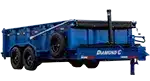
This is where CAM Superline receives much of its attention, and the current dump lineup is broader than a single 14,000-pound contractor model. CAM offers homeowner dumps in approximately the 5,000- to 7,000-pound GVWR range, standard-duty low-profile dumps from about 7,000 to 11,100 pounds, a 9,900-pound deckover dump, heavy-duty dumps from approximately 12,000 to 16,000 pounds, and dual-telescopic heavy-duty models reaching approximately 17,600 pounds. The correct choice depends on the material being hauled, the trailer’s empty weight, the required payload, the tow vehicle, and whether the buyer needs a bumper-pull or gooseneck configuration.
Contractors and landscapers commonly compare 7-foot-class dump bodies in 12-, 14-, and 16-foot lengths. Current CAM heavy-duty dumps in this category are available with GVWRs commonly ranging from 12,000 to 16,000 pounds. Depending on the selected configuration, CAM offers either a scissor hoist or telescopic hoist. Its heavier dual-telescopic dump line uses two telescopic cylinders and is offered in bumper-pull and gooseneck versions. That distinction matters because a buyer should not assume that every 7×14 CAM dump has the same hoist, frame, axle capacity, battery system, or legal payload.
A few specifics worth knowing:
- Current heavy-duty dump specifications include a reinforced tube main frame, structural-channel crossmembers, and a smooth steel floor. Conventional heavy-duty models commonly use a 10-gauge floor, while heavier dual-telescopic configurations use a 7-gauge floor. Floor thickness is important, but it does not eliminate the need to distribute concentrated loads properly and avoid dropping concrete, rock, or machinery attachments into the bed from excessive height.
- Hoist design varies by model. CAM offers power-up and gravity-down scissor and telescopic systems on its heavy-duty dumps, while its heavier dump family uses dual telescopic cylinders. Pump, battery, hose, cylinder, and pivot-point service should be handled according to the manufacturer’s procedures. A hydraulic cylinder is replaceable, but that does not mean an unsupported field replacement is safe while the bed is raised.
- Current heavy-duty dump models use a triple-acting rear gate that can function as a spreader gate, barn doors, or a pickup-style tailgate. Tarp systems, loading ramps, wireless controls, stabilizer legs, hydraulic jacks, and heavier floor packages may be standard on certain configurations or available as options. Buyers should verify the build sheet instead of assuming that every trailer on a dealer’s lot has the same equipment.
Pricing on a current CAM dump trailer is higher than the bargain-level numbers sometimes repeated in older online articles. Recent advertised pricing for a conventional 7×14 14,000-pound CAM dump has generally appeared in the low-to-mid teens, depending on the model year, hoist, tarp, axle package, tires, ramps, and dealer location. Heavier dual-telescopic, gooseneck, 8,000-pound-axle, or extensively optioned versions can reach the upper teens or more. CAM does not have one universal retail price for every configuration, so compare an itemized buyer’s order that identifies the exact GVWR, empty weight, payload, hoist, axle ratings, options, freight, tax, title, registration, and dealer fees. In Indiana, dealer documentation charges are regulated, but they are still separate from the advertised trailer price and should be shown clearly before purchase.
Equipment and Flatbed Trailers
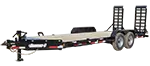
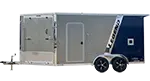
CAM’s equipment lineup covers more than a generic low-profile trailer. Current families include angle-frame equipment trailers, channel-frame equipment trailers, full-width equipment trailers, super-ramp configurations, hydraulic-cushioned tilt trailers, extra-wide tilt trailers, deckover tilts, conventional deckovers, and heavier commercial equipment trailers. Conventional equipment models cover much of the 7,000- to 17,600-pound GVWR market, while heavier equipment and tilt families reach approximately 22,000 pounds. This gives buyers options for skid steers, compact excavators, tractors, lifts, attachments, and other machinery, provided the equipment’s actual operating weight fits within the trailer’s calculated payload.
Current angle-frame and channel-frame equipment trailers use structural-steel frames, pressure-treated pine decks, LED lighting, sealed wiring, multiple tie-down points, and quick-release loading ramps on many configurations. Depending on the family, available ratings extend from lighter 7,000-pound trailers into 15,400- and 17,600-pound models. Tilt trailers use an adjustable hydraulic cushion cylinder to control deck movement on applicable models, while heavier powered configurations have their own hydraulic systems. A tilt deck can simplify loading low-clearance equipment, but the deck angle, breakover point, traction, wet-deck behavior, and equipment weight distribution still need to be evaluated before purchase.
The 10,000- to 17,600-pound class is where many owner-operators and smaller contractors shop, and CAM competes with PJ Trailers, Big Tex, and H&H Trailers in that space. H&H, which we carry here at Spencer Trailers, is a direct comparison worth making. Buyers should compare more than the number printed on the VIN label. A trailer with a 14,000-pound GVWR does not provide a 14,000-pound payload because the trailer’s own empty weight must be subtracted. The tow vehicle’s receiver or gooseneck rating, gross combined weight rating, axle ratings, tire ratings, brake controller, and allowable tongue or pin weight must also support the combination.
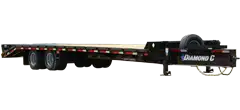
CAM also offers a substantial deckover lineup. Current general-duty deckovers are available around 11,000 pounds GVWR, standard-duty versions extend through approximately 17,600 pounds, and heavy-duty deckovers reach roughly 22,500 to 25,900 pounds. The heaviest deckover family extends from approximately 26,450 pounds to 65,000 pounds GVWR, depending on axle, brake, frame, and hitch configuration. Deckovers provide an approximately 102-inch-wide platform above the wheels, which is useful for pallets, wide equipment, attachments, and side loading. They are not automatically lower than a low-profile equipment trailer, however. The higher deck height and loading angle must be considered, especially with compact tracked machines or equipment that has limited ground clearance. Bumper-pull, pintle, and gooseneck availability also varies by model and capacity.
Utility Trailers: Nothing Flashy, Just Functional
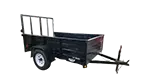
CAM’s utility and landscape trailers are the most straightforward part of the lineup. Current models include single- and tandem-axle steel trailers with pressure-treated pine decks, spring-assisted rear landscape gates, LED lighting, stake pockets, spare-tire provisions, and common landscaping options. The standard utility family currently covers approximately 2,990 to 9,900 pounds GVWR, while the separate tube-top utility line reaches 14,000 pounds. A 7×14 tandem utility rated at 7,000 pounds, using two 3,500-pound axles, remains a practical size for mowers, compact tractors, landscape equipment, household material, and general property-maintenance work.
These trailers do not need unnecessary electronic features. They need a square frame, consistent weld penetration, a gate that can be raised safely, dependable lights, properly adjusted brakes where required, and enough payload for the load. Rather than relying on generalized owner reports about weld quality, inspect the actual trailer. Look at the tongue-to-frame connection, suspension hangers, crossmembers, gate hinges, coupler mounting, ramp-gate supports, wiring routes, and finish coverage. Also check whether the gate’s rated capacity is sufficient for the mower or machine being loaded. A heavy zero-turn mower, compact tractor, or attachment can exceed the safe capacity of a light landscape gate even when the trailer itself has enough payload.
Build Quality: Honest Assessment
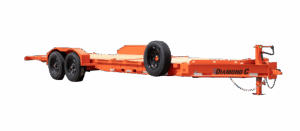
CAM Superline occupies a broad work-trailer segment rather than one narrow premium category. Some models are straightforward landscaping trailers, while the heavier dump and deckover lines use much more substantial frames, floors, axles, and hydraulic systems. It is therefore more accurate to judge the specific CAM family than to label every CAM trailer as either entry-level or premium. If you want premium engineering, model-specific loading systems, and a more extensive finish package, compare CAM with Diamond C and higher-spec configurations from PJ. Diamond C’s premium FMAX, HDT, LPT, LPX, WDT, and DEC lines use Lippert axles as standard, and Diamond C applies its DM Difference Maker multi-stage coating process. Depending on the model, Diamond C also offers purpose-built loading systems such as MAX Ramps, XDR Ramps, and the X-Ramp. Those details can justify a higher price for buyers who will use the trailer heavily.
Key positives:
- CAM publishes model-specific frame, floor, crossmember, axle, and hoist information rather than applying one construction claim to its entire lineup. Heavy-duty dumps use reinforced tube frames and structural-channel crossmembers, while commercial deckovers move into deeper I-beam and pierced-beam construction as ratings increase.
- Current steel models use an industrial-grade polymer finish rather than relying on a basic exposed-primer paint system. Many current trailers also include LED lighting and sealed or protected wiring. Any steel trailer can still chip and corrode, so exposed metal should be cleaned and touched up promptly, especially after winter road-salt exposure.
- Brakes, bearings, hubs, tires, hydraulic components, couplers, jacks, and suspension parts are serviceable through trailer dealers and qualified repair shops. However, the exact axle and component manufacturer can vary by model or production period, so replacement parts should be ordered using the VIN, axle tag, component label, and current CAM parts information rather than by guessing a brand.
Areas to watch:
- LED lighting is standard on many current models, but used trailers may have older fixtures, spliced wiring, damaged grounds, or corroded connectors. Test every light, the seven-way plug, electric brakes, brake controller response, and breakaway system before towing. A working breakaway battery is a safety component, not an optional convenience.
- On a used dump or powered trailer, inspect the battery, charging system, pump, reservoir, hoses, fittings, cylinder seals, pins, bushings, safety support, and wiring. Cycle the system from fully lowered to fully raised while following safe operating procedures. Slow movement, leaking fittings, damaged hoses, bent pivots, an overheated motor, or a bed that drifts downward can indicate required service.
- Pressure-treated wood decking is replaceable, but it remains a wear item. Inspect for rot, splitting, loose fasteners, chemical damage, and crushing under equipment tracks. On dump trailers, examine the steel floor for severe dents, ripples, cracked welds, corrosion, and evidence of repeated overloading. Also check tires, bearings, suspension hardware, brake linings, coupler wear, and frame alignment.
CAM Superline vs. H&H Trailers
This comparison comes up frequently because CAM and H&H operate in overlapping categories and are both brands within Novae LLC. The product lines remain distinct: CAM is based in Waynesboro, Pennsylvania, while H&H is based in Clarinda, Iowa. We carry H&H at Spencer Trailers, so here is a practical side-by-side based on the current lineups rather than outdated maximum ratings:
| Feature | CAM Superline | H&H Trailers |
|---|---|---|
| Manufacturing base | Waynesboro, Pennsylvania; engineered and assembled in the USA | Clarinda, Iowa; USA-built trailer lineup |
| Dump trailer GVWR range | Approximately 5,000 to 17,600 lb., depending on family | Approximately 2,900 to 22,000 lb., depending on family |
| Equipment trailer options | Broad selection from conventional equipment and tilt trailers through heavy commercial deckovers | Strong equipment, tilt, full-width, and low-profile deckover selection |
| Heavy deckover capacity | Commercial models extend to approximately 65,000 lb. GVWR | Dual-tandem and hydraulic-tail models extend into approximately the 25,900- to 32,000-lb. range |
| Utility trailer finish | Steel construction with industrial-grade polymer finish; treated-pine decks on applicable models | Steel utility models plus multiple all-aluminum utility choices |
| Dump hoist choices | Scissor, telescopic, and dual-telescopic systems, depending on model | Conventional and telescopic dump configurations, including heavier TOPLINE models |
| Parts availability | Dealer-supported service components; confirm exact parts with VIN and component tags | Dealer-supported service components; confirm exact parts with VIN and component tags |
| Limited warranty | Three-year limited trailer warranty, with separate component-provider terms and exclusions | Three-year limited frame and component coverage, with separate supplier terms and exclusions |
| Price tier | Dealer-priced; spans general-purpose through commercial-heavy equipment | Dealer-priced; spans homeowner, contractor, and heavier commercial categories |
H&H’s all-aluminum utility trailers are a genuine differentiator when empty weight, corrosion resistance, and towing efficiency matter. CAM’s current utility lineup is centered on steel construction and does not offer an equivalent broad all-aluminum utility family. For steel dump, equipment, tilt, and deckover trailers, the comparison depends on the exact models. Look at payload after empty weight, frame construction, deck or floor material, hoist type, loading system, axle and brake ratings, warranty administration, local parts support, and the dealer’s ability to service the trailer after the sale.
A Quick Q&A
Q: Is CAM Superline a good first trailer for a contractor starting out?
It can be, provided the trailer is matched to the work rather than purchased solely by GVWR. A 10,000- to 14,000-pound equipment or dump trailer gives many contractors useful capacity without moving immediately into a dual-tandem commercial unit. Calculate payload by subtracting the trailer’s empty weight from its GVWR, then include attachments, buckets, fuel, tools, chains, and material in the load calculation. Confirm that the tow vehicle, hitch, receiver or gooseneck ball, tires, axles, and brake controller are rated for the resulting combination.
Q: How does the warranty hold up?
CAM’s current limited warranty provides three years of coverage against qualifying defects in materials and workmanship for the original registered consumer owner, subject to the written exclusions and claim procedures. Separate terms may apply to axles, suspension, tires, hydraulic pumps, cylinders, and other supplier-manufactured components. Wear items and maintenance items such as brake components, bearings, tires, batteries, lumber, finish damage, and damage caused by overloading, misuse, corrosion, or improper maintenance are not automatically covered. Register the trailer promptly and keep the purchase agreement, VIN, service records, and photographs.
Q: Should I buy CAM used?
A used CAM can be a practical purchase, but its condition matters more than the badge. Inspect the dump floor or equipment deck, hydraulic system, axle tags, tires and date codes, brakes, bearings, suspension hangers, frame alignment, coupler, jack, ramps, gate hinges, safety chains, breakaway switch, wiring, and weld areas around the tongue and suspension. Compare the VIN label with the actual axle and tire ratings. Signs of bent crossmembers, uneven tire wear, cracked finish around welds, distorted fenders, a twisted tongue, or a bed that does not sit square can indicate overloading or collision damage.
Q: Does a 14,000-pound trailer automatically require a CDL in Indiana?
No. The standard Class A CDL threshold is based on the combination, not the trailer rating by itself. It generally applies when the combination has a GCWR or combined weight of 26,001 pounds or more and the towed unit has a GVWR or actual weight greater than 10,000 pounds. A trailer rated above 10,000 pounds does not by itself establish that the full combination reaches 26,001 pounds. Commercial use, actual weights, vehicle ratings, hazardous materials, passenger transportation, interstate operation, and other exemptions or requirements can affect licensing and compliance, so confirm the rules that apply to your operation.
Q: What Indiana brake and registration rules should buyers remember?
Indiana requires brakes on trailers with a GVWR over 3,000 pounds. The tow vehicle also needs a compatible brake controller when the trailer uses electric brakes, and all braking and breakaway equipment must be maintained in working condition. A newly acquired trailer should be titled and registered within Indiana’s 45-day penalty-free window. Keep the properly assigned title or manufacturer’s certificate of origin, bill of sale, identification information, and any required tax documents together so the transaction can be processed without delay.
Q: Can a business deduct the cost of a new trailer?
A qualifying trailer used in a business may be eligible for depreciation deductions. Federal legislation restored 100% bonus depreciation for qualifying property acquired and placed in service after January 19, 2025. Eligibility depends on factors such as business use, acquisition date, placed-in-service date, tax basis, ownership, financing, and any elections made on the return. That does not make every trailer purchase an automatic full write-off, so discuss the transaction with a qualified tax professional before relying on a deduction in the purchase decision.
Q: Do you carry CAM Superline at Spencer Trailers?
We carry H&H, Diamond C, Liberty, and other brands in similar and overlapping categories. If you’re comparing CAM to what we stock, browse our current inventory and we can walk you through direct comparisons on the floor. Bring the CAM model information, GVWR, empty weight, axle ratings, hoist type, options, and quoted out-the-door price so the comparison is based on equivalent equipment.
The Verdict
CAM Superline earns a legitimate place in the working-trailer market. It is a U.S.-assembled brand with a broad range of utility, dump, equipment, tilt, and deckover trailers. Its heavy-duty dump models offer real scissor and telescopic hoist choices, while its dual-telescopic line provides heavier contractor configurations. Its equipment and deckover families extend far beyond the typical 7,000- or 14,000-pound bumper-pull trailer, giving the brand a useful path from property-maintenance work to commercial hauling.
But “worth it” depends on the exact configuration and the price being compared. A current CAM 7×14 dump should not be evaluated against an old advertised price for a lighter or differently equipped trailer. Compare the actual floor gauge, frame, crossmembers, empty weight, payload, hoist, axle ratings, tire capacity, brakes, tarp, ramps, battery, charger, jack, warranty, freight, and out-the-door cost. Two trailers with the same nominal GVWR can have meaningfully different payloads and equipment.
If you’re comparing CAM with a premium Diamond C, the additional Diamond C cost may buy model-specific engineering, a more involved coating system, Lippert axles on its premium lines, and loading solutions designed around the trailer’s intended work. If you’re comparing CAM with an H&H, the decision may come down to the exact dump or equipment configuration, whether an aluminum utility trailer is important, local inventory, and dealer support. CAM can still be the right purchase when its specifications match the load and the price reflects the equipment included.
So the real question is what you’re hauling, how often you’re hauling it, how much legal payload you need, and whether your truck is properly rated for the combination. If you want to talk through that in person, reach out to the team at Spencer Trailers or stop by 291 West State Hwy 46 in Spencer. Bring the weight of your machine or material, the tow vehicle’s door-jamb and towing information, and any competing trailer quote. We can help compare the numbers instead of relying on a badge or sales claim.
And if you’re not sure yet, check what’s on the lot right now. Sometimes the right trailer is already sitting there waiting for a decision.


