


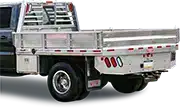





If you haul equipment, tow livestock trailers, carry building materials, or work from the truck every day, a conventional pickup box can eventually become limiting. Modern factory beds are available with useful tie-downs, lighting, and, on properly equipped trucks, factory gooseneck or fifth-wheel preparation. A purpose-built flatbed still offers advantages that a pickup box cannot match: a wide open deck, easier side loading, stake pockets and rub rails, integrated towing hardware, and storage that can be reached without climbing over a tailgate. The practical question is not whether a factory bed is usable. It is whether a flatbed would make the truck safer, faster, and better suited to the work you actually do.
Zimmerman Truck Bodies manufactures light- and medium-duty truck bodies in Cantril, Iowa. Its current lineup includes the steel 3000XL Series, the aluminum-and-steel 6000XL Series, the storage-focused aluminum Ranch Master, the Platinum Aluminum body, and several service and contractor configurations. Spencer Truck Beds carries Zimmerman steel and aluminum beds here in Spencer, Indiana, with applications for selected Ford, Ram, Chevrolet, and GMC pickups and cab-and-chassis trucks. Because fitment varies by truck year, model, rear-wheel configuration, and frame dimensions, each available bed should be matched to a specific vehicle rather than purchased by width or length alone.
Steel vs. Aluminum: Pick a Side
Zimmerman builds truck bodies using both steel and aluminum, but the decision involves more than the initial price. You need to consider the deck material, supporting frame, expected impacts and abrasion, exposure to road salt or fertilizer, repair options in your area, installed body weight, storage package, and how much payload remains after the conversion. An aluminum-deck body can be lighter than a similarly equipped steel body, but the difference must be verified using the actual specifications for the exact size and configuration being installed.
Zimmerman’s 3000XL is the company’s conventional steel flatbed. Current specifications call for a 1/8-inch steel treadplate deck, welded headache rack, double 4-inch steel channel frame, heavy-wall steel channel around the perimeter, rub rail, stake pockets, LED lighting, sealed wiring harness, rear access steps, and integrated towing equipment. Steel is a practical choice when the deck will regularly see concentrated impacts, sliding steel equipment, pallets, scrap, masonry supplies, or other abrasive loads. Damaged coatings should be repaired promptly because exposed steel can rust, but steel fabrication and welding services are widely available when a working body eventually needs repair. Zimmerman does not publish one universal weight for every 3000XL size and option package, so buyers should request the actual body weight instead of planning around a generic estimate.
The 6000XL uses a 3/16-inch aluminum treadplate deck and heavy-wall aluminum perimeter channel, but it is not an entirely aluminum structure. Zimmerman supports the deck with a double 4-inch steel channel frame, retaining a substantial steel foundation for the hitch and body mounting system. The Ranch Master also combines an aluminum deck and compartments with a steel supporting structure. These bodies resist the red rust that forms on an exposed steel deck, although the steel frame, fasteners, mounting points, and areas where dissimilar metals meet still require inspection and maintenance. Aluminum can preserve more available payload in some installations, but Zimmerman does not claim that every aluminum configuration is a fixed percentage lighter than its steel equivalent. Any fuel-economy difference will also depend on the truck, route, load, tires, gearing, and driving conditions rather than the bed material alone.
Neither material is universally better. A buyer who routinely drags heavy steel objects across the deck may prefer the 3000XL, while someone working around moisture, road salt, livestock operations, or agricultural chemicals may value an aluminum deck and body panels. The best comparison uses the exact installed price, actual body weight, storage configuration, hitch package, and maintenance requirements of the beds that fit your truck.
Flatbed Configuration and Dimensions
Zimmerman offers more dimensional variety than a simple short-bed or long-bed label suggests. Spencer’s current 3000XL and 6000XL inventory includes 84-inch and 97-inch widths, while the Ranch Master is offered at 94 inches wide. Zimmerman lists 84-, 102-, 109-, 114-, 136-, and 144-inch lengths for the 3000XL and 6000XL families, depending on the truck application. Ranch Master sizes include 94 by 84, 94 by 102, 94 by 109, and 94 by 114 inches. An 84-inch-wide deck easily accommodates the 48-inch width of common sheet goods, but an 84-inch-long deck does not provide full-length support for an eight-foot sheet. A 102-inch or longer deck is more suitable when regularly carrying 4-by-8 material entirely within the deck footprint. Every load still needs appropriate securement, regardless of whether it fits inside the deck edges.
There is no universal rule that assigns one Zimmerman length to every short-bed pickup, long-bed pickup, or dual-rear-wheel truck. Current Spencer inventory shows that beds with the same nominal dimensions can be intended for different generations of Ford, Ram, Chevrolet, or GMC trucks because frame width, wheel position, body mounts, fuel-fill location, and chassis design change between applications. Cab-to-axle measurement is especially important on cab-and-chassis trucks, but installers must also confirm pickup-box length, single- or dual-rear-wheel configuration, frame-rail spacing, axle clearance, tire clearance, cab clearance, fuel and DEF routing, exhaust location, and rear overhang. The team at Spencer Truck Beds can help verify the correct body before you commit to a particular length or width.
Gooseneck Hitch Integration
Towing integration is one of the strongest reasons to choose a Zimmerman work body, although it is worth recognizing that many newer pickups can also be ordered with capable factory gooseneck or fifth-wheel preparation. The advantage of a Zimmerman flatbed is that the hitch, deck opening, trailer connection, body frame, and rear receiver are planned as one truck-body package rather than assembled from unrelated components after installation.
Current 3000XL, 6000XL, and Ranch Master specifications include a 30,000-pound-rated B&W Turnoverball gooseneck hitch integrated with the body frame. They also include a 20,000-pound-rated weld-in rear receiver, with 2-inch or 2.5-inch receiver configurations depending on the build, plus a seven-way round trailer connector and sealed wiring harness. Zimmerman offers a recessed gooseneck opening with a door on applicable builds, and a compatible B&W Companion fifth-wheel setup is listed as an option for buyers who need a fifth-wheel connection. A gooseneck ball and a fifth-wheel hitch are different coupling systems, so the correct approved hitch or adapter must be selected for the trailer. Cab-to-trailer clearance and turning clearance must also be checked, particularly on trucks with shorter cab-to-axle dimensions.
The 30,000-pound gooseneck rating and 20,000-pound rear-receiver rating are ratings for those hitch components and the listed body configuration. They do not automatically give the completed truck the same towing capacity. Actual allowable trailer weight is limited by the lowest applicable rating among the truck’s GVWR, rear GAWR, GCWR, manufacturer towing limit, tires, wheels, suspension, hitch, ball or ball mount, trailer coupler, safety equipment, and loaded axle weights. Gooseneck pin weight also consumes truck payload and is usually concentrated heavily on the rear axle. Before towing a large equipment, dump, or livestock trailer, verify the completed truck’s scale weights and the towing information for its exact VIN and configuration.
Toolboxes and Storage
Toolbox equipment depends heavily on the Zimmerman body selected. The open-deck 3000XL and 6000XL can be ordered with front or rear underbody aluminum toolboxes in several sizes. The Ranch Master is a more storage-oriented package with two front side-hinged aluminum treadplate compartments, two rear underbody compartments, side skirts, and two headache-rack-mounted LED floodlights. Zimmerman also lists smooth toolbox doors, adjustable shelves, and pull-out drawers as available Ranch Master upgrades. The Platinum Aluminum body includes front and rear underbody storage along with 6-inch fold-down sides and a 6-inch tailboard.
Side-access and underbody boxes can make a major difference on a working truck. Chains, binders, straps, hand tools, hydraulic fittings, fencing tools, and trailer accessories can be reached from ground level instead of being stored loose on the deck or inside the cab. The best arrangement depends on how the truck is used. A contractor may prioritize drawers and divided compartments, while a farm truck may need open space for chains, hitch parts, recovery equipment, and bulky tools.
Toolbox material is not determined solely by whether the deck is steel or aluminum. Zimmerman lists aluminum underbody toolbox options for both the steel 3000XL and the aluminum-deck 6000XL, while the Ranch Master uses aluminum treadplate compartments as part of its standard storage package. Do not rely on a generic depth estimate when checking whether a saw, jack, chain set, or power tool case will fit. Ask for the compartment’s actual internal dimensions, door-opening dimensions, shelf layout, and load rating. Remember that tools, drawers, shelves, chains, and permanently carried equipment all add to the completed truck’s weight and reduce remaining payload.
What Zimmerman Compares To
Zimmerman is commonly cross-shopped against established work-truck-body manufacturers such as CM Truck Beds and Norstar. Those companies also offer flatbeds, skirted bodies, service bodies, storage packages, and integrated towing systems, but materials and standard equipment differ from one model to another. A useful comparison should place specific models side by side rather than assuming that every bed from one manufacturer is equivalent to every bed from another. Compare deck thickness, frame construction, hitch ratings, receiver size, storage volume, lighting, wiring, included mounting hardware, finish, warranty terms, installed weight, and the final installed price.
Zimmerman’s strongest argument is the amount of useful equipment included in its core flatbeds. The steel 3000XL combines a 1/8-inch treadplate deck with a double 4-inch steel channel frame. The 6000XL uses a 3/16-inch aluminum deck over a double 4-inch steel channel frame. Both include the B&W gooseneck hitch, rated rear receiver, rub rail, stake pockets, rear steps, LED lighting, seven-way connection, and sealed wiring harness. Buyers who need integrated storage can move to the Ranch Master rather than adding a collection of unrelated aftermarket boxes. These are practical specifications that can be evaluated before purchase and inspected after installation.
Current advertised pricing is higher than the broad figures often quoted for generic flatbeds. At the time of this review, Spencer’s listed Zimmerman inventory starts around the mid-$4,000 range for selected 3000XL steel beds. Depending on dimensions and fitment, listed 3000XL prices extend into the mid-$5,000 range, while 6000XL aluminum-deck beds run from roughly $5,000 to about $7,900. Ranch Master bodies with integrated storage are advertised from approximately $10,500 to $12,900. Inventory, options, credit-card charges, installation labor, taxes, and pricing can change, so the relevant number is the complete installed quote for the body that fits your truck.
Installation and What to Expect
Replacing a pickup box or completing a cab-and-chassis truck requires proper lifting equipment and application-specific installation knowledge. A truck body is too large and awkward to handle safely with a few people lifting by hand. The installer must remove the original body without damaging the truck, position the replacement body correctly, install the specified mounting brackets and fasteners, maintain clearance around the axle and suspension, and correctly route the fuel filler, DEF filler, exhaust, wiring, trailer connector, license-plate light, mudflaps, and other equipment. Newer trucks may also require careful integration of the rear camera, parking sensors, blind-spot components, trailer electronics, or other factory systems. Frame drilling, welding, or modification should only be performed when permitted by the applicable truck and body-manufacturer instructions.
Spencer Truck Beds handles installation and can identify the stock units intended for particular truck generations. Many current 3000XL and 6000XL listings specify that mounting brackets, a wiring harness, and mudflaps are included with the bed, but buyers should confirm exactly what is included with the individual stock number and what installation labor or additional parts are required. After the body, toolboxes, hitch equipment, and normal permanent gear are installed, obtaining certified front-axle, rear-axle, and total truck weights is the most reliable way to understand the truck’s remaining payload. It is also worth confirming that the fuel and DEF fills are accessible, the trailer plugs work, the lights are correctly positioned, and the gooseneck opening provides adequate trailer clearance before the truck returns to regular service.
A Few Things Worth Checking Before You Buy
- Confirm the truck’s full application information, including model year, make, model, pickup or cab-and-chassis configuration, single or dual rear wheels, original box length, wheelbase, cab-to-axle measurement, frame width, fuel type, and fuel and DEF fill locations. Cab-to-axle is critical, but it is not the only measurement that determines whether a bed fits.
- Read the GVWR and front and rear GAWR values on the truck’s certification label, then determine the completed truck’s actual scale weight. Removing the original pickup box offsets part of the replacement body’s weight, so simply subtracting an estimated bed weight from the original payload sticker does not produce a dependable final payload figure. The completed truck, occupants, cargo, tools, trailer pin weight, and accessories must remain within GVWR, GAWR, tire, and wheel limits.
- Select the towing configuration before ordering. Confirm whether you need a gooseneck ball, recessed hitch door, rear receiver, fifth-wheel system, or a combination of those features. Do not assume that a later hitch conversion will be inexpensive, structurally approved, or compatible with the existing body and trailer-clearance requirements.
- Plan toolbox access around the work you actually perform. Check door swing, internal dimensions, shelf position, drawer clearance, exhaust heat, tire clearance, and whether a loaded trailer will obstruct any compartment. Also account for the weight of the tools and equipment that will remain in the truck every day.
- Verify all required road lighting after installation. Federal requirements distinguish trucks that are less than 80 inches wide from trucks that are 80 inches or more in overall width. Most Zimmerman flatbeds discussed here are at least 84 inches wide, so the completed vehicle may require applicable clearance lamps, identification lamps, side-marker lamps, reflectors, stop and turn lamps, and license-plate lighting in compliant positions. Required lamps must remain visible and unobstructed by the body, toolboxes, hitch equipment, or cargo.
Who These Beds Are Actually For
Zimmerman flatbeds make the most sense for buyers who need a truck body to perform measurable work. That includes farmers towing livestock or equipment trailers, fencing crews carrying posts and tools, contractors moving sheet goods and job-site materials, equipment operators pulling gooseneck trailers, and service businesses that need secure ground-level storage. The 3000XL works well for buyers who want a straightforward steel work deck, while the 6000XL provides an aluminum deck and perimeter over a steel channel foundation. The Ranch Master is aimed at users who need towing capability and a substantial integrated toolbox package on the same body.
A flatbed can also improve the appearance of a work truck, but appearance should not be the only buying criterion. Body width, installed weight, rear-axle load, trailer clearance, storage access, camera and sensor compatibility, deck height, corrosion maintenance, and hitch requirements all have a direct effect on daily use. The headache rack, rub rails, stake pockets, receiver, lighting, and toolboxes are not decorative details. Each one should match the loads, trailers, and tools the truck will handle.
Spencer Truck Beds keeps Zimmerman inventory available for buyers in Owen County and the surrounding region, including steel 3000XL beds, aluminum-deck 6000XL beds, Ranch Master bodies, and service-body configurations. You can browse what is currently in inventory online, or call (812) 829-0226 to discuss your truck’s year, model, wheel configuration, measurements, towing needs, storage requirements, and installation quote before making the trip. A truck bed is a long-term purchase, and the correct application matters just as much as the material or price. Confirming the fit, installed weight, hitch system, lighting, and final capacities before installation is the best way to get a body that works correctly from the first day.


