










You’ve got a real number in your head, somewhere south of $10,000, and you want a trailer that will not embarrass you at the job site or leave you stranded on the shoulder of I-70. The good news is that this price bracket still has legitimate working trailers in it. Depending on the category, roughly $2,500 to $9,900 can buy a well-built utility trailer, compact dump trailer, equipment hauler, tilt trailer, or enclosed cargo trailer with useful capacity and serviceable components.
But “under $10,000” needs a little discipline in 2026. A manufacturer’s base MSRP is not always the final selling price, and upgrades such as a tarp, spare tire, taller sides, premium wheels, extra tie-downs, higher-capacity axles, ramps, delivery, taxes, title, and registration can push a build over the line. Large 14,000-lb. dump trailers and premium heavy-equipment trailers also generally sit above this budget now. The brands below earn their place because each still offers specific current models or configurations that can realistically land below $10,000 without pretending that every trailer in the lineup qualifies.
1. H&H Trailers
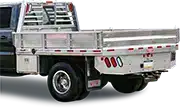
H&H builds in Clarinda, Iowa, and its Midwest roots make sense for Indiana owners who expect a trailer to handle equipment, landscaping material, road salt, wet weather, and regular job-site use. The company offers everything from light single-axle utilities to commercial dump and equipment trailers, but the strongest sub-$10k opportunities are its utility, compact dump, car-hauler, and lower-GVWR tilt configurations.
For dump buyers, pay close attention to the exact H&H series rather than shopping by bed length alone. The current Utility Dump lineup runs from 62 to 76 inches wide, 8 to 12 feet long, and 5,000 to 9,990 lbs. GVWR. Those compact models are built for landscaping, property maintenance, light construction, mulch, brush, debris, and similar work. H&H’s larger Telescopic I-Beam dumps are 83 inches wide, 12 to 16 feet long, and rated from 14,000 to 16,000 lbs. GVWR, while the TOPLINE telescopic range reaches 15,400 to 22,000 lbs. Those heavier dumps are serious commercial equipment, but buyers should expect them to cost more than the sub-$10k trailers discussed here. Hoist design also varies by series: H&H uses telescopic hoists on its current Telescopic I-Beam models, so a generic claim that every H&H dump includes the same lift system is not accurate.
H&H’s open equipment and utility offerings may be an even better fit for this budget. The Heavy Duty Rail Side Utility is 82 inches wide, available from 14 to 24 feet, and rated at 9,900 lbs. GVWR with tandem 5,200-lb. axles. H&H also offers rail-side, solid-side, car-hauler, and single-axle gravity-tilt configurations across the 2,990- to 9,900-lb. range. As one current real-world example, Spencer Trailers has listed a 2026 H&H EX 82-by-20-foot electric/hydraulic tilt with a 9,900-lb. GVWR, dual 5,200-lb. axles, a 6-inch channel frame, treated decking, a spare, rub rails, stake pockets, and tie-downs for $8,700. That is the kind of honest working specification that makes H&H competitive below $10,000. As always, compare the exact axle, brake, gate, ramp, spare, deck, charger, and coating package rather than assuming two similarly sized trailers are equipped alike.
2. Diamond C Trailers
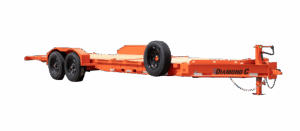
Diamond C is built in Mt. Pleasant, Texas, and has been manufacturing trailers in the United States since 1985. The company is best known for premium lines such as the FMAX goosenecks, LPT dumps, LPX equipment trailers, HDT hydraulic tilts, WDT dumps, and DEC deck-over equipment trailers. Those are legitimate heavy-duty products, but most start above this article’s budget. The Diamond C models that make sense below $10,000 are the PSA and GTU utility trailers and, when the final configuration stays close to base pricing, the GST and GDT telescopic dumps.
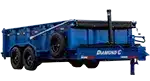
The GST is Diamond C’s current Single Axle Telescopic Dump. It has a 6,000-lb. GVWR, an 8-foot-long by 60-inch-wide bed, a 6,000-lb. Lippert drop axle, a three-stage telescopic cylinder, and a 45-degree dump angle. Its current base MSRP is approximately $8,068. The GDT is the General Duty Telescopic Dump, with a 7,000-lb. GVWR, a 10-foot bed, 60- or 77-inch width choices, a three-stage telescopic hoist, and two 3,500-lb. Lippert axles. Its current base MSRP is approximately $8,989. These are the Diamond C dump trailers that belong in a realistic under-$10k discussion. Taller sides, upgraded tires, premium wheels, ramps, power accessories, or other options can move the final price higher, so buyers should price the complete build rather than budgeting from the base figure alone.
Utility buyers have more breathing room. The PSA starts around a $3,736 base MSRP and is available in 10- to 14-foot lengths, 77- or 83-inch widths, and ratings from 2,990 to 6,000 lbs. depending on axle selection. It uses a 4-inch engineered channel frame and Diamond C’s DM Difference Maker multi-stage coating system. The GTU starts around $6,791, carries a 7,000-lb. GVWR, uses two 3,500-lb. Lippert brake axles, provides an 83-inch-wide bed in 14- to 20-foot lengths, and is built on a 4-inch channel frame. Current Spencer inventory has placed basic PSA models in the mid-$3,000s, while current GTU examples remain comfortably below $10,000 in many configurations. Loading equipment varies by model and build; where applicable, Diamond C’s real loading systems include MAX Ramps, XDR Ramps, and the X-Ramp. A tarp or ramp package should never be assumed standard unless it appears on that trailer’s build sheet.
We carry Diamond C here at Spencer Trailers because the brand gives buyers several distinct steps between a basic utility trailer and a premium commercial hauler. The important part is choosing the correct step. A PSA or GTU can be a smart sub-$10k purchase. A GST or carefully optioned GDT can put telescopic dump capability in the same budget. An LPT, LPX, HDT, DEC, or FMAX is a different class of investment and should be evaluated on payload, duty cycle, truck compatibility, and long-term earning potential rather than forced into an unrealistic price comparison.
3. Delco Trailers
Delco is another Texas manufacturer, but its current production facility is in Brookston, Texas. The company started in 2006 and moved into its large purpose-built Brookston manufacturing facility in 2023. Delco now produces dumps, utilities, equipment trailers, flatbeds, enclosed trailers, livestock trailers, and specialty models, with a wide range of configurations for working owners.
The most relevant Delco dump below $10,000 is the D1 7K bumper-pull series. The 8-foot D108 currently carries a manufacturer MSRP of about $7,731 and uses a 5-inch channel frame, a 6-inch I-beam tongue, one 7,000-lb. electric-brake axle, an 18-inch-sided 10-gauge engineered dump body, a hydraulic cylinder lift, a three-way spreader gate, and slide-in ramps. The 10-foot D110 has a current MSRP of about $8,729 and changes to two 3,500-lb. electric-brake axles while retaining the same basic 7,000-lb. GVWR class. A pull-back tarp system is part of the current D1 specification. Delco’s 12K and 14K D2 and D3 dumps are heavier commercial trailers, and current base pricing generally places them above $10,000. For example, the 12-foot D3 starts at roughly $12,033 before options.
Delco’s utility and equipment models offer even more value. The 83-inch-wide U3 single-axle utility begins in the mid-$2,000s, although its base specification is intentionally simple: treated pine flooring, angle-frame construction, an idler axle, and no standard rear gate, ramps, or spare. The 77-inch-wide U5 tandem utilities start in the mid-$3,000s and use two 3,500-lb. axles, a 4-inch channel tongue, angle crossmembers on 24-inch centers, and treated pine decking. Equipment-oriented Delco models add heavier channel or I-beam frames, closer crossmember spacing, rub rails, and slide-in ramps while still offering several configurations below $10,000. Buyers should compare the complete order because adding gates, ramps, brakes, a spare, upgraded tires, tie-downs, or a heavier jack can materially change the price.
Delco’s finish process is another real reason to look closely at the brand. The company describes a six-stage process that includes blasting, washing, oven drying, a zinc-rich Sherwin-Williams powder primer, a powder topcoat, and a final cure. That is more useful information than a vague claim that a trailer is simply “painted” or “powder coated.” Still, coating quality does not eliminate maintenance. Indiana owners should wash road salt from the frame, repair chips before corrosion spreads, keep drain paths open, and inspect hidden areas around the tongue, crossmembers, suspension hangers, and fenders.
4. Liberty Trailers
Liberty earns a spot on this list specifically for open utility, car-hauler, and equipment-trailer buyers. Liberty manufactures in Fillmore, Indiana, so the brand is a natural fit for customers who want a locally built working trailer with straightforward construction and easily understood specifications. Its heavy dump and flatbed lines extend far beyond $10,000, but its single-axle and tandem-axle open trailers offer plenty of useful choices below the limit.
Liberty’s current single-axle utility range includes 2,990-lb. GVWR trailers in 60-, 72-, 78-, and 83-inch widths and lengths from 8 to 14 feet. That 2,990-lb. rating is especially common for homeowners, lawn crews, side-by-side owners, and buyers whose tow vehicles do not need a larger tandem trailer. Current Spencer listings for basic 2026 Liberty single-axle utilities have generally landed around the upper-$2,000s to low-$3,000s depending on width, length, gate, spare, and other equipment. Typical specifications include a channel-steel chassis, treated wood flooring, LED lighting, a rear ramp gate, radial tires, and a powder-coated finish, but buyers should verify every item on the stock sheet.
For more capacity, Liberty offers an 83-inch-wide 7,000-lb. tandem utility in 14-, 16-, 18-, and 20-foot lengths, plus a 9,990-lb. tandem range from 16 to 24 feet. A current 83-by-16-foot 7K Liberty utility specification includes two 3,500-lb. axles, electric brakes, a 4-inch channel chassis, an adjustable 2-5/16-inch coupler, a treated wood deck, a reinforced 48-inch rear gate, a mounted spare, LED lights, and powder coating. Spencer has also listed a 2026 Liberty 83-by-20-foot 7K car hauler with a 4-inch channel frame, dual 3,500-lb. brake axles, slide-out ramps, removable fenders, treated decking, and a 4,780-lb. calculated payload for $4,900. That is strong practical value for a lawn tractor, compact equipment, recreational vehicles, or automotive hauling when the load fits the trailer’s actual payload and deck dimensions.
Remember that 7,000 lbs. GVWR is not the same as 7,000 lbs. of payload. Payload is the trailer’s GVWR minus its empty weight, and tongue weight transferred to the truck still counts against the tow vehicle’s payload and axle ratings. A load that weighs 5,500 lbs. may be legal on one 7K trailer and overweight on another if the second trailer has a heavier curb weight. Liberty’s simple product structure makes those calculations easier, but the calculation still has to be done.
5. Wells Cargo
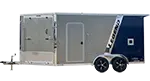
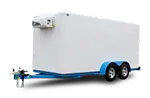
Wells Cargo has been building enclosed trailers since 1954 and remains one of the longest-established names in the cargo-trailer market. The brand makes sense for contractors, mobile service businesses, event operators, maintenance crews, and owners who need weather protection and security rather than an open deck. In today’s market, the FastTrac and FastTrac Deluxe lines provide the clearest route to a new Wells Cargo below $10,000. Road Force is a higher-feature steel-frame line, and larger tandem Road Force configurations can exceed the budget.
Current 2026 dealer examples place a 6-by-12-foot FastTrac Deluxe with a 2,990-lb. GVWR at roughly $4,600 to $6,100 depending on height, doors, ramp, finish, and regional pricing. Tandem 7-by-16-foot FastTrac Deluxe trailers with a 7,000-lb. GVWR have appeared around $7,700 to the upper-$9,000s. That makes the FastTrac family a realistic sub-$10k enclosed choice. A 7-by-16-foot Road Force, by comparison, can now list above $11,000 once equipped, so buyers should not assume that every Wells Cargo model of a familiar size still fits this price bracket.
What you are paying for is a structured cargo body, not an aluminum frame. Current Road Force and FastTrac specifications use steel framing. Road Force promotes closely spaced tubular-steel construction, a one-piece aluminum roof, LED lighting, flow-through vents, durable flooring, and bonded .080-inch aluminum-composite exterior panels on current configurations. FastTrac specifications vary by width and axle package, with single-axle models commonly carrying 2,990-lb. GVWR ratings and tandem models stepping to 7,000 or 9,900 lbs. Exact wall, roof, floor, crossmember, brake, ramp-door, and side-door specifications should be checked on the individual unit because options and regional packages can change both curb weight and payload.
That curb-weight check matters. An enclosed trailer’s interior height, ramp door, extra roof bows, thicker flooring, finished walls, cabinets, electrical package, spare tire, and added tie-down track all consume payload. Do not buy an enclosed trailer by exterior dimensions alone. Add up the tools, shelving, machines, parts, liquids, batteries, generators, and supplies you plan to carry, then leave a sensible margin below the trailer, axle, tire, hitch, and tow-vehicle limits.
How to Think About This Price Bracket
The honest difference between a $5,000 trailer and a $9,000 trailer is not always visible in a four-line advertisement. It may show up in frame section and material weight, crossmember shape and spacing, tongue construction, axle capacity, brake equipment, hub serviceability, tire load range, coupler and jack ratings, ramp design, wiring protection, deck retention, tarp equipment, powder-coat preparation, warranty coverage, and the availability of replacement parts. Lippert and other established axle suppliers all make components in multiple capacities and configurations, so the brand name alone is not enough. The axle rating, hub type, brake setup, suspension, wheel and tire capacity, and total trailer certification must work as one system.
Price comparisons also need to use the same definition of “equipped.” A base utility trailer may not include a rear gate, ramps, spare tire, brake upgrade, adjustable coupler, toolbox, premium wheels, or extra tie-downs. A dump may include a telescopic cylinder but price the tarp, ramps, charger, wireless remote, or taller sides separately. A cargo trailer may advertise the shell price before a ramp door, side door, added height, finished walls, or electrical package. Ask for the stock number or complete build sheet and compare the final selling price of trailers equipped for the same job.
| Brand | Best Category | Approx. Price Range | Notable Spec |
|---|---|---|---|
| H&H | Utility / Compact Dump / Tilt | $4,000 – $9,900 | Utility dumps up to 9,990-lb. GVWR and sub-$10k equipment tilts |
| Diamond C | Utility / Compact Dump | $3,300 – $9,900 | Lippert axles and DM Difference Maker coating |
| Delco | Utility / Equipment / Compact Dump | $2,300 – $9,900 | Six-stage Sherwin-Williams powder-coat process |
| Liberty | Utility / Car Hauler / Equipment | $2,700 – $9,900 | Indiana-built open trailers with clear GVWR choices |
| Wells Cargo | Cargo / Enclosed | $4,000 – $9,900 | Steel-frame FastTrac and Road Force construction |
Those prices are planning ranges, not guaranteed quotes. Configuration, freight, market conditions, financing products, taxes, title, registration, and dealer-installed accessories can change the total. Indiana’s Auto Dealer Services Division currently states that it will not take enforcement action on a documentation preparation fee at or below $261.72 as of July 1, 2026. The state’s guidance also says the documentation fee must be included in the advertised sale price, disclosed in writing, and shown as a separate line item on the bill of sale. Buyers should still request an itemized out-the-door figure before signing.
Indiana towing law matters just as much as the purchase price. Under IC 9-19-3-3, a trailer or semitrailer with a gross weight of at least 3,000 lbs. must have brakes adequate to control, stop, and hold the trailer. The brakes must be operable from the tow vehicle’s cab and must apply automatically if the trailer breaks away. Indiana law also generally requires service brakes on all wheels of a new trailer sold in the state unless the trailer is under 3,000 lbs. That is why many light utility trailers carry a 2,990-lb. GVWR and why a brake controller, charged breakaway battery, correct seven-way connection, and functioning brakes are essential on larger trailers.
A trailer above 10,000 lbs. does not automatically require a CDL by itself. For a commercial combination to fall into federal Class A territory, the gross combination weight rating or actual gross combination weight must be 26,001 lbs. or more, and the towed unit must have a GVWR or actual gross weight greater than 10,000 lbs., using the applicable greater values. FMCSA specifically states that a combination below 26,001 lbs. does not require a CDL solely because the trailer is rated above 10,000 lbs. Hazardous-material, passenger, commercial-use, farm, military, emergency, recreational, and strictly non-business situations can involve additional rules or exemptions, so owners should verify their exact use instead of relying on a salesperson’s shorthand.
After purchase, an Indiana resident generally has 45 days to apply for the title and register a newly acquired, previously unregistered trailer before administrative penalties apply. Do not leave the manufacturer’s certificate of origin, title paperwork, bill of sale, lien information, or registration documents sitting in the glovebox until the next hauling season.
Business buyers should also know that federal bonus depreciation changed again. The One Big Beautiful Bill Act restored a 100% special depreciation allowance for certain qualified property acquired and placed in service after January 19, 2025. A trailer used in a qualifying business may be eligible, but the deduction is not a universal rebate and should not be promised as “free money.” Business-use percentage, acquisition date, placed-in-service date, tax basis, financing, related-party rules, elections, depreciation recapture, Section 179 interaction, and the buyer’s tax situation can all affect the result. Confirm eligibility with a qualified tax professional before purchasing based on an expected deduction.
A Quick Note on Matching Brand to Job
If you are maintaining properties, hauling brush, moving mulch, or doing light construction, compare the H&H Utility Dump, Diamond C GST or GDT, and Delco D1. If you are moving mowers, compact tractors, side-by-sides, cars, or palletized material, H&H, Diamond C, Delco, and Liberty all have strong open-deck choices below $10,000. For repeated daily loads of dirt, gravel, demolition debris, skid steers, or heavier equipment, be honest about the duty cycle: a properly configured 14K-or-higher dump or equipment trailer will usually cost more than this article’s limit, and buying too little trailer is more expensive than increasing the original budget.
If you are hauling tools, running a mobile service business, transporting event equipment, or carrying anything that needs to stay clean, dry, and locked


