







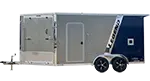
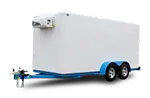
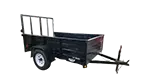

When a flood rolls through Owen County or a windstorm drops trees across three townships, the clock starts immediately. Pumping crews need their pumps on-site within hours. Generator teams have to stage power where the grid went dark. Debris haulers need dump trailers ready to run back-to-back loads. The bottleneck often is not the equipment itself. It is the trailer that was not ready, was not properly rated, was not maintained, or was not matched to the tow vehicle and the actual loaded weight.
Disaster-recovery hauling is a specific category with specific demands. Loads are dense, awkward, frequently wet or muddy, and moved under time pressure. Trailer GVWR, payload, axle ratings, tire capacities, hitch ratings, truck payload, and combined weight ratings all matter. The certification labels on the trailer and tow vehicle, equipment transport weights, and scale tickets should guide the decision rather than an estimate based only on trailer length or truck size. Here is how to think through the right trailer for each mission.
Pumps and Flood-Control Equipment
Portable pumps used in flood response vary widely in weight. A small engine-driven trash pump may weigh only a few hundred pounds before hoses, fittings, fuel, and accessories are added. Industrial dry-prime pump packages are much heavier. Depending on the enclosure, engine, fuel capacity, trailer, and installed options, a packaged 4-inch flood-control pump can weigh roughly 2,000 to more than 3,000 pounds wet, while many packaged 6-inch units weigh approximately 3,100 to 3,700 pounds or more. The pump manufacturer’s transport or wet weight should always be checked before choosing a trailer.
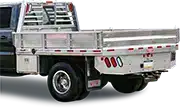
For compact pumps, hose, and hand tools, a light utility trailer may handle the job cleanly. A current H&H 82-inch-by-14-foot single-axle Rail Side Utility configuration has a published 2,990 lb GVWR, a base curb weight of approximately 1,210 pounds, and a calculated base payload of about 1,780 pounds before optional equipment is added. That is appropriate for genuinely light pump packages, not for a multi-thousand-pound industrial pump skid.
For a larger pump, several smaller pumps, or a complete hose-and-accessory package, an H&H tandem-axle Rail Side Utility in the same general size can provide substantially more capacity. A 7,000 lb GVWR configuration has a published base curb weight of approximately 1,610 pounds and a calculated base payload of about 5,390 pounds. Actual payload must be calculated from the completed trailer’s certified GVWR and its real empty weight, especially when toolboxes, spare tires, expanded-metal sides, upgraded ramps, or other options have been installed.
Tie-down placement matters because pump frames do not always provide convenient or symmetrical securement points. Use only manufacturer-approved lifting or transport points, and select chains, binders, or straps with clearly marked working-load limits. Cross-securement may control lateral movement, but every connection must be positioned so it cannot slide across an edge, contact a hot exhaust component, or be cut by the pump frame. Hose reels, suction hose, discharge hose, fuel containers, and loose fittings also need independent restraint.
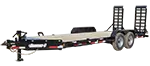
For large skid-mounted pump packages or multi-pump staging loads, step up to a purpose-built equipment trailer. The Diamond C LPX Low Profile Extreme Duty Equipment Trailer is currently offered in configurations ranging from approximately 15,500 to 24,000 lb GVWR, with deck lengths from 16 to 30 feet and bed widths generally ranging from 80 to 82 inches between the fenders. The base LPX uses tandem 7,000 lb LIPPERT axles, with higher-capacity axle configurations available for appropriately rated models.
The LPX’s low-profile layout and equipment-oriented loading systems are important when forklifts or cranes may not be available. Depending on trailer length and configuration, loading choices include extra-wide flip-knee ramps, MAX Ramps, and eligible X-Ramp and maximum-width packages. Select the ramp system by checking the pump skid’s ground clearance, wheel or track spacing, concentrated loading, and required approach angle. Do not assume that a trailer’s total payload rating means every point on the deck or every ramp can safely carry the same concentrated load.
Flood-control equipment should be transported drained and contained whenever practical. Cap hose connections, secure fuel and hydraulic caps, and use appropriate containment for equipment that may drip contaminated water, oil, or fuel. Wet equipment can also add more weight than expected, so a scale check is worthwhile when a pump package includes full fuel tanks, water-filled hose, sound enclosures, or mounted accessories.
Generator Hauling: Weight Is Deceptive
Portable generators often look manageable until the actual transport specification is checked. Generator output alone does not predict weight because enclosure type, fuel capacity, engine platform, sound attenuation, emissions equipment, and trailer configuration all make a significant difference.
For perspective, a current Multiquip DCA25-class generator rated around 20 kW prime power weighs approximately 2,100 pounds wet as a generator package and roughly 2,600 pounds when configured with its matching transport trailer. A DCA70-class unit rated around 56 kW prime power is approximately 4,200 pounds wet before a separate transport-trailer weight is considered. A DCA125-class generator rated around 100 kW prime power is approximately 6,700 pounds wet as a generator package and can exceed 8,400 pounds when supplied on its transport trailer. Exact weights vary by model year, tank, trailer, and options, so use the current data plate and manufacturer specification for the exact unit being moved.
Many towable generators already have a purpose-built highway transport chassis. Those units should normally be towed as designed rather than placed on another trailer unless the manufacturer provides an approved loading and securement procedure. Equipment trailers are more commonly used for skid-mounted generator modules, generators removed from a dedicated chassis, or combined staging loads that include cable ramps, distribution panels, light towers, fuel-system components, and other support equipment.
Two skid-mounted 20 kW generator packages can exceed 4,000 pounds before cable, distribution equipment, fuel, toolboxes, and containment materials are added. Two generator modules in the 50- to 60-kW class can exceed 8,000 pounds before accessories. That is why a trailer should be selected from a complete load plan rather than from the generator’s advertised output.
For these heavier staging loads, the Diamond C LPX provides a more appropriate starting point than a light utility trailer. Current LPX configurations start around 15,500 lb GVWR and use LIPPERT axles, with higher-GVWR and higher-capacity axle packages available. Standard equipment-oriented securement features include multiple 5/8-inch D-rings, a rub rail, stake pockets, and pipe spools. The trailer’s actual payload remains its certified GVWR minus the completed trailer’s real empty weight, not the sum of the axle ratings and not the number printed in a generic advertisement.
Place the heaviest generator where the completed trailer will maintain proper tongue weight without overloading the hitch, truck receiver, rear axle, tires, or truck payload rating. Heavy components should not be concentrated behind the trailer axles simply to make the tongue feel lighter. Insufficient tongue weight can contribute to instability, while excessive tongue or gooseneck pin weight can overload the tow vehicle even when the trailer itself remains below GVWR.
Generator hauling also demands close attention to trailer wiring, brake components, connectors, and the breakaway system. Indiana requires adequate trailer brakes when the trailer reaches the applicable gross-weight threshold, and heavy tandem equipment trailers should have functioning brakes at all braked wheels, a charged breakaway battery, and a compatible in-cab controller. Conduct a manual brake-controller test at low speed before entering traffic.
Wet weather does not make flooded roads safe. Never drive through moving water or water of unknown depth merely because the truck and trailer are capable of carrying disaster equipment. Water can hide a washed-out roadbed, displace a trailer, contaminate wheel bearings and brakes, or disable electrical connectors. Use routes cleared by the responsible authorities, and inspect the trailer after exposure to deep standing water, mud, or contaminated debris.
Debris Removal: Dump Trailers Do the Work
Tree debris, flood-damaged contents, torn roofing, and demolition material all favor a dump trailer. Unloading a flatbed or utility trailer by hand on repeated runs quickly exhausts a crew and keeps the tow vehicle tied up. A properly selected hydraulic dump trailer allows the operator to unload from a controlled position, but cycle time varies with the hydraulic system, battery condition, fluid temperature, bed angle, and load distribution. There is no reliable universal cycle-time figure that applies to every dump trailer and every load.
Diamond C currently offers several real dump-trailer categories for different levels of cleanup work. The GST Single Axle Telescopic Dump is a compact 6,000 lb GVWR trailer intended for lighter loads. The GDT General Duty Telescopic Dump is available at 7,000 lb GVWR with tandem 3,500 lb LIPPERT axles. The MDT Medium Duty Telescopic Dump occupies the next step for users who need more capability without moving immediately to the heaviest low-profile dump line.
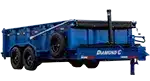
For dense debris and contractor-scale response work, the Diamond C LPT Heavy Duty Low Profile Telescopic Dump is the appropriate premium line. Current LPT configurations range from approximately 15,500 to 24,000 lb GVWR, with 12-, 14-, and 16-foot body lengths and bed widths generally ranging from 81 to 82 inches. Base models use tandem 7,000 lb LIPPERT axles, while selected higher-capacity configurations are available with triple 7,000 lb, tandem 8,000 lb, or tandem 10,000 lb axle packages.
The LPT uses a three-stage telescopic cylinder and is designed for an approximately 45-degree dump angle. Current configurations use a high-flow KTI hydraulic system that Diamond C describes as operating faster than its previous standard pump. Actual raise and lower times still depend on battery charge, ambient temperature, load position, hydraulic-fluid condition, and the specific trailer configuration.
Low-profile dump construction helps crews load by hand and allows compact equipment to reach over the side more easily. Even so, dense material can use up the trailer’s legal payload long before the body looks full. Wet lumber, soil, shingles, broken concrete, saturated drywall, and waterlogged household contents can be far heavier than brush or loose household debris. Trailer volume is not a substitute for a scale weight.
For bulkier commercial debris, a 16-foot LPT can provide additional body volume, while the Diamond C DOD Deck Over Dump offers a wider deck-over body for applications that benefit from approximately 96 inches of bed width. Current DOD configurations are available in the heavy-duty range, generally from approximately 15,500 to 23,000 lb GVWR depending on configuration. The wider body improves volume and loading access, but it does not remove the need to calculate payload, truck pin or tongue weight, tire capacity, and combined operating weight.
A few practical notes on dump trailers for disaster work:
- Dump bodies and tailgates should not be treated as watertight containers. Inspect the gate, hinges, latches, hold-back hardware, tarp, and body before loading. Use a suitable liner, tarp, or separate containment method for fine, wet, or leaking material, and do not transport free liquids in a standard dump trailer.
- Start every response period with a fully charged hydraulic battery and inspect the pump, remote, wiring, grounds, hoses, fittings, cylinder mounts, and fluid level. Follow the manufacturer’s approved procedure if the bed will not lower. Never crawl beneath or work under a raised dump body unless it has been emptied and secured with the manufacturer-specified mechanical body support.
- Tandem or triple axles distribute weight among more tires, but they do not make saturated soil safe. A heavily loaded dump trailer can sink, rut a lawn, lose traction, or become unstable on a soft shoulder. Use firm routes, appropriate ground protection, and a spotter where visibility or soil conditions are uncertain.
Debris should also be separated according to the requirements of the cleanup project and disposal facility. Fuel containers, propane cylinders, batteries, asbestos-containing materials, chemicals, medical waste, and other regulated materials should not be mixed casually into a general debris load. Confirm acceptance rules before leaving the site so the trailer is not rejected at the disposal point.
Equipment Trailers for Skid Steers and Mini Excavators
Skid steers are central to disaster cleanup. They handle debris piles, move material around staging areas, clear access routes, and load dump trailers or trucks faster than a hand crew. Getting the machine to the site and back safely requires a trailer with enough real payload, suitable deck dimensions, properly rated loading equipment, and secure tie-down locations.
Current midsize skid steers frequently weigh close to 7,000 pounds at published operating weight. Examples include machines in the range of approximately 6,850 pounds for a Bobcat S64-class loader, approximately 6,970 pounds for a Case SR210B-class loader, and approximately 7,150 pounds for a John Deere 320 P-Tier-class loader. Larger current skid steers can exceed 8,500 pounds before a specialized attachment is considered.
Operating-weight definitions differ among manufacturers. Some published operating weights already include normal fluids, a standard bucket, and an operator allowance. Adding those items again can double-count part of the load. Conversely, a forestry package, high-flow hydraulic package, steel tracks, mulching head, grapple, breaker, large bucket, or other attachment can add hundreds or thousands of pounds. Use the machine’s transport weight for its exact configuration, or weigh the machine with the attachment and fuel level that will be carried.
A trailer should not be approved for a skid steer merely because it has two 7,000 lb axles. The trailer’s certification-label GVWR governs, and the usable payload equals GVWR minus the completed trailer’s actual empty weight. A nominal 14,000 lb equipment trailer may have enough payload for some 7,000 lb machines, but the result depends on the trailer’s own weight and everything else carried. A current Diamond C LPX Low Profile Extreme Duty Equipment Trailer, beginning at approximately 15,500 lb GVWR, provides a more practical starting point when a response team needs working margin for a bucket, grapple, chains, fuel, cribbing, and other equipment.
The LPX is offered with approximately 80- to 82-inch bed width between the fenders, depending on configuration. Standard loading arrangements include equipment ramps and a dovetail selected for the trailer’s length and capacity. Available MAX Ramps provide a wider spring-assisted loading surface and a longer self-cleaning dovetail on eligible configurations. The X-Ramp and maximum-width package are available on eligible LPX configurations for users who need a broad loading surface and drive-over-fender capability. Ramp rating, track position, machine ground clearance, and concentrated load must all be checked before loading.
Mini excavators in the 8,000- to 10,000-pound class require even more careful planning. Include the bucket, hydraulic thumb, coupler, blade, counterweight, fuel, and any extra attachment in the load calculation. Verify track width, overall transport width, counterweight clearance, tail swing, machine height, and deck length. The excavator should be positioned so that the trailer maintains proper tongue weight while all tracks, blades, buckets, and counterweights remain fully supported and legally contained.
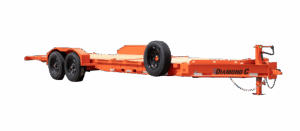
For machines that benefit from loading without conventional ramps, the Diamond C HDT Low Profile Hydraulically Dampened Tilt Equipment Trailer is another current option. HDT configurations range from approximately 15,500 to 24,000 lb GVWR and use LIPPERT axles. The standard hydraulic dampening system controls deck movement during loading and unloading. Depending on configuration, powered-tilt and Pro Tilt options are available for operators who want powered operation or the ability to select between gravity and powered tilt behavior.
Tilt and ramp systems reduce the loading angle, but they do not replace proper technique. Load on firm, level ground whenever possible, keep bystanders clear, align the tracks or tires before climbing the deck, and avoid steering sharply while the machine is on a narrow ramp or partially supported by the trailer. Follow the trailer and machine manufacturers’ loading procedures.
Commercial operators subject to federal cargo-securement rules should also account for the requirements of 49 CFR Part 393. Heavy vehicles, equipment, and machinery weighing 10,000 pounds or more generally require a minimum of four properly rated tie-downs attached near the front and rear. Articulated components and accessories must be lowered and restrained as required. Lighter machines remain subject to the general securement rules, and four-point securement is a sound operating practice whenever the machine provides approved attachment points.
Use chains, binders, and attachment points with legible working-load limits, protect securement equipment from sharp edges, and recheck the load after the first few miles. The bucket, blade, boom, or grapple should not be relied upon as the only means of restraining the machine.
Rapid Deployment: What That Actually Means for Trailers
Rapid deployment in disaster response means the trailer is inspected, appropriately pre-loaded, and ready to connect without searching for missing straps, adapters, pins, or electrical components. A response team may set a target such as rolling within 15 minutes of a callout, but that speed must come from preparation rather than skipped inspections.
A few features and practices that support genuine rapid deployment:
- Gooseneck vs. bumper pull. Gooseneck trailers can provide better stability and load distribution for heavy staging loads, but they are not automatically appropriate simply because a trailer exceeds a particular GVWR. The truck must have an approved in-bed hitch, sufficient payload, adequate rear-axle and tire ratings, and enough capacity for the loaded pin weight. The Diamond C FMAX Flatbed Max line includes real gooseneck flatbed configurations from approximately 15,500 lb GVWR to as much as 40,000 lb on selected models. The FMAX207 begins around 15,500 lb GVWR, uses a 102-inch-wide deck, and is equipped with tandem 7,000 lb LIPPERT axles. Heavier FMAX models use correspondingly heavier frame, suspension, axle, tire, brake, and hitch configurations.
- Tie-down inventory. Keep inspected chains, binders, straps, edge protection, wheel chocks, flags, and warning devices in a secure trailer-mounted storage location. Separate damaged equipment immediately so it cannot be used during a hurried nighttime callout. Record working-load limits and make sure the inventory matches the heaviest equipment assigned to that trailer.
- LED lighting and sealed wiring. Current Diamond C premium trailers use all-LED lighting with waterproof, rubber-mounted lamps and sealed wiring-harness construction. These systems reduce routine bulb maintenance and improve durability, but plugs, junctions, grounds, lenses, and wiring still require inspection after mud, impact, corrosion, or deep-water exposure.
- Brake controller and breakaway readiness. A properly installed and calibrated proportional brake controller helps the trailer contribute smoothly to braking. Test brake response before entering traffic, confirm the breakaway battery is charged, inspect the switch cable, and verify that the trailer plug cannot drag or pull loose. A dashboard gain setting that worked for an empty trailer may be inappropriate for a fully loaded one.
Pre-deployment maintenance should also include tire-pressure checks while the tires are cold, lug-nut inspection, verification of wheel-bearing service intervals, hitch and coupler inspection, safety-chain attachment, jack operation, spare-tire condition, and confirmation that every registration and insurance document required for the operation is current.
Diamond C trailers are built in Mt. Pleasant, Texas, where the company was founded in 1985. Current premium models use the DM Difference Maker multi-stage coating system, which includes steel preparation, a multi-stage wash process, primer, topcoat, and controlled curing. The coating system improves corrosion resistance and finish durability, but disaster-response trailers should still be washed after exposure to salt, contaminated floodwater, mud, chemicals, or corrosive debris. Paint and coating do not make wheel bearings, brakes, electrical connectors, or hydraulic components maintenance-free.
Matching Tow Vehicle to the Load
| Load Type | Typical Trailer GVWR Range | Tow-Vehicle Starting Point |
|---|---|---|
| Single compact pump, tools, or small generator package | 2,990 to 7,000 lb | Properly equipped half-ton truck or heavier, after checking payload, receiver, tongue-weight, axle, tire, and tow ratings |
| Multiple pump skids, generator modules, or medium dump load | 7,000 to 15,500 lb | Properly equipped 3/4-ton or 1-ton truck, selected from the completed load and the truck’s certified ratings |
| Skid steer, compact track loader, or mini excavator | 15,500 to 20,000 lb | Typically a properly configured 1-ton truck; dual rear wheels or a heavier truck may be required by tongue or pin weight |
| Heavy equipment or full gooseneck staging load | 20,000 to 40,000 lb | Properly rated 1-ton dual-rear-wheel, medium-duty, or commercial truck matched to pin weight, GCWR, axles, tires, hitch, and brakes |
The categories above are starting points, not blanket approvals. Two trucks with the same badge can have very different payload, rear-axle, hitch, and combined-weight ratings because of engine, cab, bed, axle ratio, suspension, wheel, and option differences. The door-jamb certification labels, owner’s manual, manufacturer towing guide, and installed hitch label must all be checked.
Trailer GVWR is the maximum permitted loaded weight of the trailer, not its payload. Payload is calculated by subtracting the completed trailer’s actual empty weight from its certified GVWR. The weight transferred to the truck through the bumper-pull tongue or gooseneck coupler remains part of the trailer’s loaded weight while also consuming the truck’s payload and affecting its rear-axle and tire loads.
Do not use axle capacity alone to calculate a higher trailer rating. A trailer with tandem 7,000 lb axles may have a GVWR above, equal to, or below 14,000 pounds depending on the manufacturer’s engineered rating and the amount of weight designed to transfer to the tow vehicle. The certification label is controlling, and the frame, coupler, safety chains, tires, wheels, suspension, brakes, and other components must remain within their individual ratings.
For an unfamiliar response load, obtain separate scale readings for the truck’s steer axle, drive axle, and trailer axles. Compare those readings with the truck GVWR, front and rear GAWR, tire ratings, trailer GVWR, trailer axle ratings, and GCWR. A combination can be below its total GCWR and still overload the truck’s rear axle or tires.
Indiana law requires a trailer or semitrailer with a gross weight of at least 3,000 pounds to have brakes adequate to control, stop, and hold the trailer. The brakes must be controllable from the tow vehicle, and the required breakaway system must apply the trailer brakes automatically if the trailer separates. Verify the equipment installed on the specific trailer rather than assuming that every used or rental trailer has functional brakes on every required wheel.
A trailer over 10,000 lb GVWR does not, by itself, automatically require a Class A commercial driver’s license. The usual federal and Indiana Class A threshold is a combination with a GCWR or qualifying gross combination weight of 26,001 pounds or more when the towed vehicle has a GVWR or qualifying gross weight greater than 10,000 pounds. Passenger, hazardous-material, farm, emergency-response, and other exemptions or endorsements can change the result, so organizations should have their licensing and commercial-use requirements reviewed for the exact truck, trailer, cargo, route, and operation.
Indiana generally provides a 45-day period for completing the required title and registration process after acquiring a trailer. That administrative window should not be treated as permission to operate without the plate, interim registration, permit, insurance, or documentation otherwise required for the trip. Complete the paperwork promptly so a response trailer is not sidelined when it is needed.
Operating near the top of a tow vehicle’s ratings on compromised roads, at night, in wind, or with an unfamiliar load is different from towing the same combination on a dry local route. Build in working margin, reduce speed, increase following distance, and use a truck that remains within every applicable rating after passengers, fuel, tools, hitch hardware, and bed cargo are included.
A Note on Trailer Inventory for Response Teams
Fire departments, county emergency-management offices, utilities, restoration contractors, tree services, and larger contractors operating in rural Indiana often ask what a practical disaster-response trailer fleet looks like. There is no single answer, but a versatile starting point is:
- One 15,500 to 20,000 lb GVWR Diamond C LPX or HDT equipment trailer for a skid steer, compact track loader, or appropriately sized mini excavator
- One Diamond C MDT for moderate cleanup loads or an LPT in the 15,500 to 24,000 lb GVWR range for dense debris and contractor-scale dump work
- One 7,000 lb GVWR Diamond C GTU Premium Tandem Axle Utility or comparable H&H tandem utility trailer for pumps, hose, tools, and smaller generator packages
The GTU is a true 7,000 lb GVWR bumper-pull utility trailer built on a 4-inch channel frame with tandem 3,500 lb axles. As with every trailer, available payload is the certified GVWR minus the completed trailer’s actual empty weight. A 7,000 lb utility trailer is useful for support equipment, but it should not be substituted for an LPX or HDT when the assigned machine exceeds its payload or deck capabilities.
Three trailers provide three distinct capabilities. The equipment trailer can carry skid-mounted generators or other machinery when dimensions and securement permit. The dump trailer can move debris efficiently. The utility trailer can remain staged with pumps, hose, traffic-control equipment, hand tools, or power-distribution accessories. Purpose-specific assignments reduce setup time, prevent repeated unloading, and simplify training and inspection.
Every response trailer should have an assigned load plan showing expected cargo weight, placement, tie-down points, required securement equipment, normal tongue or pin weight, compatible tow vehicles, required driver qualifications, and pre-trip inspection steps. Photographing the approved loaded configuration can help crews reproduce it under pressure, but the photograph does not replace a scale ticket or inspection when equipment changes.
Spencer Trailers stocks Diamond C, H&H, and Liberty trailers in configurations that can support this type of fleet. Inventory specifications vary by model year, length, axle package, tires, ramps, body options, and ordered GVWR, so compare the certification label and build sheet on the actual trailer rather than relying on a general model description. Walk the lot, measure the equipment, examine the ramp system, and compare deck height, bed width, tie-down access, body construction, and hitch requirements hands-on.
Browse current inventory at Spencer Trailers or call us at (812) 829-0226 to talk through the right configuration for your specific loads. Bring the equipment model numbers, attachments, transport weights, tow-vehicle certification information, and expected cargo list. If the real loaded weight is unknown, we can help work through the calculation before you buy. Getting the trailer, tow vehicle, hitch, and securement plan right before the next callout is far less expensive than discovering a mismatch during an emergency.


