






A generator or compressor sitting in the back of a pickup sounds simple until you are dealing with a 3,500 lb diesel-powered machine with its own steel base, fuel tank, battery, cooling system, and exhaust assembly. At that point, you are not simply putting another tool in the truck bed. You are making real decisions about trailer payload, concentrated deck loads, tongue weight, tow-vehicle ratings, cargo securement, brakes, registration, and commercial-vehicle compliance. Get those decisions wrong and you can end up with an overloaded axle, an unstable combination, a damaged machine, a roadside violation, or a unit that moves across the deck when you brake on an Indiana county road.
This covers the full picture: factory-built towable units versus deck-mounted equipment, how to determine real transport weight, which utility and equipment trailers fit the job, how fuel-containing machinery is treated during highway transportation, and how to secure the equipment so it stays in place from Spencer to the job site. The machine’s current data plate, operator’s manual, transport instructions, and configuration-specific specification sheet always control over a general published weight or an older brochure.
Towable Unit vs. Deck-Mounted: Pick the Right Category First
These two categories may look similar from across a job site, but they place very different demands on the tow vehicle and trailer.
Towable generators and compressors are built on their own running gear. Current examples include small Atlas Copco XAS-series compressors, Sullivan-Palatek D185-series compressors, Cat XQ mobile generator sets, and Bobcat portable generators equipped with highway-capable undercarriages. Depending on the exact package, the machine may use a ball coupler or an adjustable lunette ring for a pintle hitch. It may also have its own axle, tires, safety chains, lighting, brakes, and breakaway system.
Do not assume every wheeled job-site machine is ready for unrestricted highway towing. Some undercarriages are intended only for low-speed movement around a work site, while others are sold with optional highway lighting, brakes, tires, hitches, and certification labels. Before towing one on a public road, verify the VIN or certification label, maximum towing speed, tire ratings, brake equipment, coupler rating, lighting package, safety-chain attachment, and registration status.
Deck-mounted units are generators, compressors, light towers, pumps, or similar machines carried as cargo on a separate trailer. The equipment may be a factory skid-mounted package, a support-mounted compressor, or a mobile unit being delivered on a flatbed instead of being pulled on its own running gear. In this arrangement, the hauling trailer supports the entire machine and must have enough usable payload, deck space, frame capacity, axle capacity, tire capacity, and rated securement points for the job.
A contractor may carry a skid-mounted generator on a Diamond C utility or equipment trailer for temporary jobs. A rental company may transport a compressor on a flatbed to avoid adding mileage to the compressor’s tires and wheel bearings. A generator may also be permanently or semi-permanently installed on a trailer, but that installation should be attached to structural crossmembers or a properly designed subframe rather than relying on wood decking alone.
The distinction matters because the full gross weight of a factory-towable machine is still part of the towing combination. The truck’s receiver and rear axle primarily carry the machine’s tongue weight, but the truck’s engine, transmission, chassis, brakes, tires, and GCWR must account for the entire towed weight. A roughly 2,200 lb serviced Sullivan-Palatek D185-series compressor does not place all 2,200 lb on the truck’s rear axle, but the truck still has to accelerate, control, and stop that entire machine.
A deck-mounted 3,000 lb compressor, by comparison, adds its full weight to the cargo trailer. Its position also changes the trailer’s axle loading and tongue weight. Placing it too far rearward can produce inadequate tongue weight and sway. Placing it too far forward can overload the hitch, receiver, truck rear axle, or truck payload rating even when the trailer remains below GVWR.
Running the Numbers: Weight Is the Starting Point
Before selecting a trailer, find the actual transport weight of the exact machine. Do not rely on a model family name or an advertised “dry weight” without checking what that number includes. Manufacturers may publish dry, shipping, serviced, wet, operating, support-mounted, or trailer-mounted weights, and those terms are not interchangeable.
Operating or transport weight can include engine oil, coolant, hydraulic fluid, compressor oil, starting batteries, onboard accessories, trailer running gear, and some or all of the fuel capacity. Add any hoses, cables, distribution panels, spare tires, external fuel connections, fire extinguishers, tools, wheel chocks, and other equipment that will travel with the machine. A large diesel tank can add several hundred pounds when filled.
A few manufacturer-published figures illustrate how much configurations can differ:
- Atlas Copco XAS 188 CD T4F portable compressor: approximately 1,900 lbs wet and ready to operate in the published trailer-mounted configuration
- Sullivan-Palatek D185PKR portable compressor: approximately 2,200 lbs serviced, with a 30-gallon fuel tank
- Generac MLTS-K LED light tower: approximately 1,389 to 1,445 lbs operating weight, depending on the power-export configuration
- Cat XQ60 generator without a trailer: approximately 3,137 lbs with oil and coolant and approximately 3,710 lbs with fuel, oil, and coolant in the applicable configuration
- Cat XQ60 generator with its factory electric-brake trailer: approximately 3,607 lbs with oil and coolant and approximately 4,180 lbs with fuel, oil, and coolant in the applicable configuration
Those figures are benchmarks, not substitutes for the serial-number-specific data sheet. Generator families can change engines, fuel capacities, enclosures, electrical packages, trailers, and emissions equipment between revisions. A current machine carrying the same general model name may not weigh the same as an earlier rental-fleet version.
If you are loading a deck-mounted unit, add the equipment’s transport weight to the trailer’s actual empty weight. Payload is calculated by subtracting the trailer’s as-equipped empty weight from its GVWR. The empty weight must include installed ramps, spare tires, toolboxes, winches, batteries, hydraulic components, upgraded flooring, and any other options on that particular trailer.
For example, a 7,000 lb GVWR tandem utility trailer weighing 2,000 lbs as equipped has a theoretical payload of 5,000 lbs. That does not automatically mean every 5,000 lb generator is a safe load. You must also stay within each axle’s GAWR, every tire and wheel rating, the trailer manufacturer’s point-load limits, the hitch rating, the truck’s rear-axle rating, and the tow vehicle’s payload and GCWR.
Concentrated weight deserves special attention. Four narrow generator feet can place far more stress on a small area than a wheeled vehicle of the same total weight. The floor, crossmembers, main frame, and mounting system must distribute those loads. Steel spreader plates or a properly engineered skid can help distribute the machine’s weight, but the trailer manufacturer should approve any permanent structural installation.
The best confirmation is a scale ticket with the complete combination loaded as it will travel. Obtain individual steer-axle, drive-axle, and trailer-axle weights where possible. Compare those numbers with the truck’s GVWR and rear GAWR, the trailer’s GVWR and GAWR, the tire ratings, and the combination rating. A trailer can be below GVWR while the truck’s rear axle or one trailer axle is already overloaded.
Which Trailer Actually Fits the Job
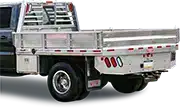
For deck-mounted generators and compressors, a utility, equipment, tilt, deck-over, or gooseneck flatbed trailer may be appropriate. The right platform depends on the machine’s weight, dimensions, center of gravity, loading method, mounting-foot spacing, and how frequently the load changes.
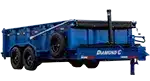
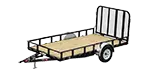
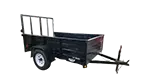
Utility trailers work best for smaller machines when the trailer has enough payload and a solid deck. H&H Rail Side Utility trailers are offered in multiple widths, lengths, axle arrangements, and GVWR packages, including tandem configurations rated at 7,000 lbs. The Diamond C GTU is an 83-inch-wide tandem-axle utility available in 14- to 20-foot lengths with a 7,000 lb GVWR, two 3,500 lb Lippert brake axles, a 4-inch channel frame, treated-lumber flooring, and the DM Difference Maker coating system.
A 7,000 lb utility trailer can be a practical platform for a compressor or generator in the roughly 2,000 to 3,000 lb class, provided the actual trailer tare leaves enough payload and the equipment fits between the rails. Side rails can make forklift loading difficult, so confirm fork access and machine dimensions before choosing a rail-side trailer. A pallet jack is not a substitute for a suitable forklift, crane, winch, or properly rated loading system, especially when the trailer is not positioned at dock height.
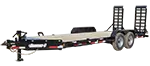
Equipment trailers are the better starting point for larger generators, compressors, and support equipment. The Diamond C LPX low-profile equipment trailer is offered in bumper-pull configurations from 16 to 30 feet, with GVWR packages beginning around 14,900 or 15,500 lbs and extending to 24,000 lbs. Standard heavy-duty configurations use Lippert axles, with axle packages selected according to the trailer’s GVWR. The low deck and available loading systems make the LPX useful when a machine must be winched or driven onto the trailer.
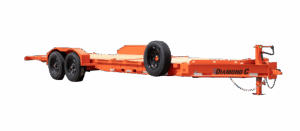
The Diamond C HDT hydraulically dampened tilt equipment trailer covers a similar heavy-duty range, with 15,500 to 24,000 lb GVWR configurations, 16- to 28-foot lengths, and Lippert axle packages. Its tilt deck removes the need to handle separate loading ramps and can be useful for wheeled compressors, light towers, and other mobile machines. A tilt trailer still requires the machine to fit the deck, clear the transition angle, and produce acceptable tongue weight when positioned for transport.
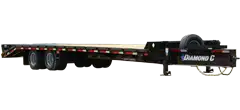
For wider skids, side loading, or loads that need a full 102-inch deck, a deck-over equipment trailer such as the Diamond C DEC may be more appropriate. For still heavier equipment or longer working platforms, the FMAX flatbed gooseneck family provides higher GVWR choices and a 102-inch deck. The FMAX line includes configurations from 15,500 lbs through 40,000 lbs, depending on the exact model, axle package, brake system, and rating.
For most utility and light equipment work, Spencer Trailers carries H&H and Diamond C in both classes. The correct choice is not simply the trailer with the highest published rating. A low-profile bumper-pull may be easier to load, while a deck-over or FMAX gooseneck may provide more deck width, more payload, and better stability for a larger machine.
Avoid relying on expanded metal or light mesh as the primary support for a generator or compressor. Mounting feet need solid, flat support over structural members. Treated wood or steel flooring can work when the floor, crossmember spacing, and frame are rated for the load, but flooring material alone does not establish point-load capacity. A heavy skid should bear over supported areas rather than between widely spaced crossmembers.
Also consider what happens when the machine operates on the trailer. Cooling-air inlets, radiator discharge, exhaust outlets, control doors, cable connections, and service panels need clearance. The trailer must be level and stabilized during operation, and the equipment manufacturer’s grounding, ventilation, fire-clearance, and exhaust instructions still apply. Never transport a light tower with its mast raised or accessories left in an operating position.
Securing the Load: Four Points, No Shortcuts
A generator or compressor sitting on a trailer deck does not stay there by gravity, friction, or its own weight. It must be restrained against forward, rearward, lateral, and vertical movement. Short local trips are not an exception. Emergency braking, potholes, railroad crossings, sharp turns, and evasive maneuvers can apply forces far beyond what the machine experiences while parked.
For commercial carriers subject to FMCSA cargo-securement rules, the aggregate Working Load Limit must be at least one-half the weight of the article or group of articles being secured. A 4,000 lb generator therefore needs at least 2,000 lbs of aggregate WLL. The calculation is more detailed than simply adding the numbers printed on four straps. A direct tiedown running from a trailer anchor to an attachment point on the cargo generally contributes one-half of its rated WLL to the aggregate calculation, while a tiedown passing from one side of the trailer over, through, or around the cargo to the opposite side can contribute its full WLL.
The legally required number of tiedowns for general cargo depends on the article’s length, weight, orientation, and whether it is blocked against forward movement. There is not a universal two-tiedown rule for every machine. Heavy wheeled or tracked machinery weighing 10,000 lbs or more is subject to the specialized rule requiring at least four tiedowns positioned as close as practicable to the front and rear or attached to manufacturer-designed mounting points.
For generators and compressors below that threshold, four properly arranged direct tiedowns are still a strong real-world practice. One at each corner gives independent control in every direction and makes it easier to maintain restraint if one component loosens. The system must be arranged so the machine cannot slide, rotate, bounce, or tip.
Use manufacturer-designated transport tie-down points. Do not assume a lifting eye is automatically approved for tiedown loading, and do not assume a forklift pocket can be used as a chain attachment. Lifting points are designed for forces in a particular direction and may not be rated for angled transport loads. Check the operator’s manual, labels, or manufacturer documentation.
Strapping across engine covers, exhaust components, radiator guards, control panels, doors, fuel tanks, hoses, wiring, or plastic enclosures is not acceptable securement. It can damage the equipment while providing little resistance to movement. Tiedowns should connect the machine’s structural base or approved transport lugs to rated trailer anchors.
A few specifics on securement equipment:
- Select synthetic web straps by the WLL printed on the identification tag, not by strap width alone; two straps of the same width can have different ratings
- Use edge protection anywhere webbing can contact a sharp frame, skid, bracket, or abrasive surface
- Grade 70 transport chain is appropriate for many steel-framed machines; common rated examples include approximately 4,700 lbs WLL for 5/16-inch chain and 6,600 lbs WLL for 3/8-inch chain, but the chain, hooks, binders, and tags must confirm the actual rating
- The weakest component controls the securement system, including the trailer anchor, chain, strap, hook, connector, binder, and equipment attachment point
- Wheel chocks are useful supplemental restraint for equipment with wheels, but chocks do not replace the required tiedowns
- Secure or remove loose doors, tow bars, hose reels, cables, jack handles, control covers, and accessories that could move during transport
Inspect tiedowns shortly after beginning the trip and periodically afterward. Wood decking can compress, tires can settle, suspension can move, and straps can lose tension. Commercial drivers should follow all applicable en-route inspection requirements, while every operator should stop safely and recheck the load after the first few miles.
For semi-permanently mounted equipment, a properly engineered bolted or welded installation can provide better consistency than removable straps, but bolts through wood flooring alone are not enough. The mounting system should transfer loads into steel crossmembers or a structural subframe and should use hardware, backing plates, locking methods, torque specifications, vibration isolation, and corrosion protection approved for the application. The installation must also preserve the trailer’s structural integrity, service access, ventilation, and correct tongue weight.
Fuel: The Part Nobody Reads Until There’s a Problem
Generators and compressors commonly contain diesel fuel, gasoline, propane, batteries, lubricants, coolant, and sometimes other regulated materials. The transport rules depend on whether the machinery is being towed on its own running gear, carried as cargo, transported by highway or another mode, and whether separate fuel containers or tanks are also being carried.
Under 49 CFR 173.220, internal-combustion machinery carried as cargo is subject to specific preparation requirements when it contains liquid or gaseous fuel. Although the general rule addresses draining flammable liquid fuel, the highway modal exception permits more than 500 mL of flammable liquid fuel to remain in the machine’s tank when transported by motor vehicle, provided the fuel tank is securely closed. That means a gasoline-powered machine does not automatically have to be transported with an almost empty tank on the highway, but the cap, tank, lines, and valves must be secure and leak-free.
Follow the equipment manufacturer’s transport instructions for the proper fuel level. Do not overfill the tank, and leave the required expansion space. Confirm that the cap seals, vents and rollover valves function correctly and that no fuel is collecting in the containment pan or leaking from the drain, filter, hoses, or fittings. Shut the engine down before transport and close any manufacturer-specified fuel supply or auxiliary-tank valves.
- Gasoline units: secure the fuel system, leave appropriate expansion space, eliminate leaks, and follow the manufacturer’s transport procedure
- Diesel units: secure the cap and valves, inspect the tank and lines, use the specified fuel, and account for the weight of the fuel in payload calculations
- Propane or other flammable-gas units: securely close the fuel-tank and fuel-system valves and follow the applicable cylinder, tank, mounting, and transport requirements
The rules for fuel contained in the machine do not automatically cover separate gasoline cans, diesel transfer tanks, propane cylinders, auxiliary tanks, or fuel totes carried on the same trailer. Those items can trigger different packaging, marking, shipping-paper, placarding, training, and operational requirements depending on the material, package size, quantity, use, and available exemptions. Do not determine placarding requirements from tank capacity alone.
Inspect the starting battery as well. It should be securely installed, protected from movement and physical damage, and protected against short circuits at exposed terminals. If the manufacturer calls for a battery disconnect during transport, use it. Do not disconnect or alter emissions, control, or safety equipment contrary to the machine’s instructions.
Exhaust systems, turbochargers, aftertreatment components, and engine compartments can remain hot long after shutdown. Let the unit cool before loading or securing it. Synthetic straps can be damaged by heat, and fuel, oil, dry vegetation, or debris contacting a hot exhaust creates a serious fire hazard.
Towing a Factory-Built Towable Unit
If you are towing an Atlas Copco XAS-series compressor, Sullivan-Palatek D185-series compressor, Cat mobile generator, Bobcat portable generator, or similar unit on its own axle, the process may appear simpler because no separate cargo trailer is involved. The machine still needs a complete highway-towing inspection.
Start by confirming that the undercarriage is approved for the intended road speed. Inspect the certification label, axle, tires, wheels, wheel fasteners, bearings, fenders, suspension, lights, brakes, breakaway equipment, chains, jack, and tow bar. Job-site equipment may sit outdoors for months between trips, allowing tire weathering, bearing corrosion, connector damage, animal damage to wiring, or brake deterioration to go unnoticed.
Match the hitch exactly. Many towable compressors use an adjustable lunette ring and pintle hitch, while ball-coupler packages may use a 2-inch or 2-5/16-inch ball. Read the markings on the coupler and ball instead of judging by appearance. A 2-inch ball can appear to latch inside a 2-5/16-inch coupler but can separate under load. The hitch, ball or pintle, receiver, drawbar, fasteners, and safety chains must all be rated for the machine’s actual gross weight.
Check the electrical connector before every trip. A machine without brakes may have a four-way lighting connection, while brake-equipped packages commonly use a seven-way connector. Test the tail lights, brake lights, turn signals, clearance lights, electric brakes, brake-controller response, breakaway switch, and breakaway battery. Do not assume a connector is wired correctly simply because it fits the truck.
Indiana requires a trailer or semitrailer with a gross weight of at least 3,000 lbs, when operated on a highway, to have brakes adequate to control, stop, and hold the trailer. The driver must be able to apply the brakes from the towing vehicle’s cab, and the brakes must apply automatically if the trailer accidentally breaks away. For an electric-brake or electric-over-hydraulic system, use a compatible, properly adjusted brake controller and test the breakaway system before departure.
Measure tongue weight rather than guessing. Portable equipment can have unusual weight distribution because the engine, compressor element, generator head, fuel tank, battery, and aftertreatment system are positioned for service access rather than conventional cargo loading. The machine manufacturer may specify a tongue-weight range or provide an adjustable drawbar. Stay within the tow vehicle’s receiver rating, rear GAWR, tire capacity, payload rating, and maximum trailer rating.
A visibly squatting truck is a warning to stop and verify the ratings and actual weights. A weight-distribution hitch is not an automatic cure and may be incompatible with a pintle connection, adjustable equipment tow bar, surge-brake system, or machine manufacturer’s instructions. Use one only when the tow vehicle, receiver, hitch, and equipment manufacturers approve the combination.
Cross the safety chains beneath a ball coupler when the equipment and hitch arrangement allow it, leaving enough slack for full turns but not enough for the chains to drag. Attach them only to the tow vehicle’s designated receiver loops, not to the removable ball mount. With a pintle or specialized tow bar, follow the equipment manufacturer’s prescribed chain routing while ensuring the chains can retain the tongue if the primary connection fails.
Newly acquired, unregistered vehicles and trailers generally must be titled and registered in Indiana within 45 days of purchase or acquisition to avoid the administrative penalty. A factory towable unit should have the required ownership documents, identification, registration, and plate before routine public-road use. Confirm the treatment of specialized mobile equipment with the Indiana BMV when the documentation is unclear.
CDL requirements are based on the complete combination, not the trailer by itself. A Class A CDL is generally required when the combination has a GCWR or actual gross combination weight of at least 26,001 lbs, whichever standard applies, and the towed unit has a GVWR or actual gross weight over 10,000 lbs. A trailer rated over 10,000 lbs does not by itself trigger a Class A CDL when the complete combination remains below 26,001 lbs. Hazardous-material, passenger, farm, recreational, intrastate, and other rules or exemptions can change the result.
A non-CDL combination can still be a regulated commercial motor vehicle. Business transportation in interstate commerce can bring FMCSA requirements into play at a combination rating or actual weight of 10,001 lbs or more, depending on the operation and applicable exceptions. Vehicle markings, inspection records, driver qualification, medical certification, hours-of-service, and cargo-securement requirements should be reviewed separately from the CDL question.
A Practical Comparison: Trailer Options by Load Size
The table below is a starting point for deck-mounted equipment. It is not a promise that every machine in a listed weight range will fit. Subtract the specific trailer’s equipped empty weight from GVWR, verify concentrated-load support and dimensions, and confirm the tow vehicle’s ratings before choosing a configuration.
| Unit Weight Range | Trailer Type | Example Model | GVWR |
|---|---|---|---|
| Under 3,000 lbs | Tandem-axle utility | Diamond C GTU | 7,000 lbs |
| 3,000 to 7,000 lbs | Low-profile equipment | Diamond C LPX | Approximately 14,900/15,500 to 24,000 lbs by configuration |
| 7,000 to 14,000 lbs | Heavy equipment or tilt | Diamond C LPX, LPX-GN, or HDT | 15,500 to 24,000 lbs by model and package |
| Over 14,000 lbs | Gooseneck flatbed | Diamond C FMAX210, FMAX212, or FMAX216 | 25,000 lbs, 25,900 lbs, or up to 40,000 lbs by model |
A unit near the upper end of any row normally requires one of the higher GVWR packages because trailer tare must also be included. For example, a 14,000 lb skid cannot be placed on a 15,500 lb trailer that weighs several thousand pounds empty. The selected trailer must have enough net payload after accounting for its deck length, axle package, loading system, spare tires, toolboxes, flooring, and other options.
Pre-Trip Checklist
- Confirm the machine’s current transport or operating weight, including fuel, fluids, batteries, accessories, cables, hoses, and tools
- Verify that the trailer’s available payload covers the machine and all other cargo without exceeding GVWR, GAWR, tire ratings, wheel ratings, or point-load limits
- Confirm that the tow vehicle’s towing capacity, GCWR, GVWR, rear GAWR, tire capacity, receiver rating, and available payload cover the fully loaded combination and tongue weight
- Position the machine to produce the trailer manufacturer’s recommended tongue weight and verify the result with a suitable scale
- Inspect straps, chains, hooks, binders, anchors, and edge protectors for cuts, abrasion, corrosion, stretched links, bent hardware, unreadable tags, and damaged stitching
- Use manufacturer-designated transport tie-down points rather than body panels, lifting eyes, hoses, controls, exhaust parts, or unapproved forklift pockets
- Confirm that aggregate WLL and the number and arrangement of tiedowns satisfy the applicable securement rules
- Secure wheels, tow bars, doors, covers, hose reels, cables, jack handles, and other parts that could move during transport
- Inspect the fuel tank, cap, vents, valves, lines, filters, and containment area for leakage; follow the manufacturer’s transport procedure
- Shut the unit down, allow hot exhaust and aftertreatment components to cool, lower any mast, and place all accessories in their transport positions
- Set the battery disconnect, fuel shutoff, control lockout, or other transport controls when required by the equipment manufacturer
- Latch and pin the coupler or pintle connection, attach the breakaway cable independently, route the safety chains correctly, and raise the tongue jack fully
- Inspect trailer tires, wheel fasteners, bearings, suspension, fenders, license plate, registration, reflectors, and required conspicuity equipment
- Test brake lights, turn signals, running lights, clearance lights, reverse lights when equipped, trailer brakes, brake-controller operation, and the breakaway system
- For trailers meeting Indiana’s brake threshold, confirm that the cab-operated braking system and automatic breakaway application are functional before entering the highway
- Reinspect the machine and securement shortly after departure and at appropriate intervals during the trip
Where to Get the Right Trailer for the Job
If you haul generators or compressors regularly, the right trailer is not the least expensive one that can theoretically hold the machine. You need the correct usable payload, deck height, bed width, loading angle, axle package, tire capacity, frame support, and tie-down layout. You also need enough reserve capacity for fuel, cables, hoses, distribution equipment, toolboxes, spare tires, and the accessories that eventually get added to a working trailer.
For a changing rental or contractor fleet, flexible tie-down placement and a low loading angle may matter more than a permanent mounting system. For a dedicated generator installation, structural mounting, vibration control, cooling clearance, cable access, fuel service, grounding, and operating stability may be more important than ramp design. A forklift-loaded skid may work best on a straight deck, while a wheeled compressor may be quicker to handle on an HDT tilt or an LPX equipped with the appropriate ramp system.
Diamond C has built trailers in Mt. Pleasant, Texas, since 1985. Current heavy-duty LPX, HDT, and FMAX configurations use Lippert axle packages selected for their respective ratings, and Diamond C finishes its trailers with the multi-stage DM Difference Maker coating system. Specifications can change by model year, GVWR package, length, loading system, and dealer order, so the VIN label and final build sheet should be reviewed before matching a trailer to a machine.
Browse current inventory at Spencer Trailers and you will find H&H and Diamond C utility, equipment, tilt, deck-over, and gooseneck trailers in configurations suited to this work. Bring the machine’s current data sheet, dimensions, mounting-foot spacing, operating weight, loading method, and tow-vehicle information. Call (812) 829-0226 or visit the team at 291 West State Hwy 46 in Spencer to compare the complete setup rather than shopping from GVWR alone.
What is the heaviest unit you are moving, what does it weigh with fuel, and how often does the configuration change between jobs? Those answers determine whether a tandem utility trailer with a solid deck is enough, whether an LPX or HDT provides the right loading setup, or whether a deck-over or FMAX gooseneck is the safer long-term platform. Get in touch and work through the weight, dimensions, securement points, and tow-vehicle ratings before you are standing in a parking lot wondering why the load does not sit correctly on the trailer you already bought.


