












You’ve got a 28-foot cabin cruiser and a reservation at a lake four hours away. The truck has the horsepower, the receiver and ball mount appear to be rated, and you’ve towed smaller rigs before. Easy, right? Not quite. Boats over 25 feet operate in a different category from routine bass-boat runs, and gaps in preparation tend to show up at the worst possible moments: a roadside enforcement stop, a steep or narrow ramp, a failed wheel bearing, or a backing attempt with limited visibility and a crowd waiting.
Spencer Trailers doesn’t build boat trailers, and neither does Diamond C. But we see plenty of customers who tow large boats and ask us about gross vehicle weight ratings, payload, axle capacity, braking systems, and what actually matters when you’re moving something that long. Here’s the straight-talk version.
The Weight Problem Is Bigger Than It Looks
A boat’s advertised dry weight is only the starting point. Depending on the manufacturer, that number may exclude fuel, freshwater, batteries, anchors, electronics, air-conditioning equipment, generators, aftermarket accessories, personal gear, and sometimes engines or other major options. Published dry weights for boats in the 25-to-32-foot range vary dramatically, from roughly 5,000 pounds for lighter designs to well over 10,000 pounds for heavily equipped cruisers.
Gasoline weighs approximately 6.1 pounds per gallon, so a 100-gallon fuel load adds about 610 pounds. Freshwater weighs approximately 8.3 pounds per gallon. Add batteries, coolers, anchors, dock lines, tools, fishing equipment, safety gear, canvas, and the trailer itself, and a combination that looked manageable on a brochure can become a 12,000-pound or heavier loaded trailer. Drain bilges, livewells, and onboard water systems when appropriate rather than treating carried water as an acceptable part of the load.
The trailer’s GVWR includes the weight of the trailer and everything loaded on it. It is not the amount of boat the trailer can carry. Payload capacity is calculated by subtracting the trailer’s actual empty weight from its GVWR, and optional equipment such as a spare tire, additional bunks, a heavier winch, upgraded wheels, or a larger brake system can change that empty weight. The only reliable way to know the road-ready weight is to load the boat exactly as it will travel and weigh the complete rig on a certified scale.
Record the total trailer weight, the weight carried by the trailer axles, and the tongue weight. None may exceed the applicable rating. Check the trailer’s GVWR, each gross axle weight rating, tire and wheel capacities, coupler or actuator rating, safety-chain rating, hitch-ball rating, ball-mount rating, and the tow vehicle’s receiver limits. The lowest-rated component controls the combination.
Treat GVWR as a hard ceiling rather than a target. Preserving a practical reserve below the maximum is wise, but a generic percentage cannot replace actual scale weights. The necessary margin depends on the trailer, tire reserve, route, equipment, and the amount of fuel or gear that may be added during the trip. Uneven loading can also overload one axle or one side even when the total trailer weight remains below GVWR.
On the tow-vehicle side, the advertised maximum tow rating is not the same as available payload. Tongue weight, passengers, tools, coolers, bed cargo, aftermarket accessories, and the hitch itself all count against the truck’s payload. Check the Tire and Loading Information label on the driver’s door jamb, the vehicle’s GVWR and rear-axle rating, the receiver’s ratings, and the owner’s manual for the exact engine, axle ratio, cab, bed, and drivetrain configuration.
Boat-trailer tongue-weight recommendations are manufacturer-specific. Depending on the trailer, construction, and brake actuator, the specified range may be approximately 5 to 10 percent, 7 to 10 percent, or as high as 7 to 12 percent of actual loaded trailer weight. Follow the boat-trailer and actuator manufacturers’ instructions rather than relying on one universal percentage. If a 10,000-pound trailer is supposed to carry 7 to 10 percent on the hitch, that is 700 to 1,000 pounds of tongue weight before passengers or cargo are added to the truck.
A three-quarter-ton or one-ton truck may provide more payload, rear-axle capacity, braking capability, cooling capacity, and receiver capacity than a similarly equipped half-ton, but the badge alone proves nothing. Verify the ratings of the specific truck. A combination can remain below the published tow rating while exceeding payload, rear-axle, receiver, tire, or combined-weight limits.
Permits: Know Before You Go
Most states use 8 feet 6 inches, or 102 inches, as the standard maximum width before an oversize permit is required. Many boats longer than 25 feet have a beam wider than that, especially once rub rails, guide posts, brackets, fenders, or other fixed equipment are considered. Measure the actual loaded transport width rather than relying only on the boat’s advertised beam.
Height matters just as much as width. Hardtops, radar arches, antennas, outriggers, towers, shrink-wrap frames, and equipment mounted on a cradle can push the loaded height higher than expected. Indiana’s standard permit threshold is 13 feet 6 inches in height and 8 feet 6 inches in width. A legal maximum does not guarantee clearance under every bridge, utility line, tree limb, marina entrance, or local structure, so the route still has to be checked.
Overall length is measured from the foremost point of the tow vehicle to the rearmost point of the trailer or load, subject to each state’s rules for excluded safety equipment and permitted overhang. A 28-foot boat does not produce a 28-foot trailer combination. Add the trailer tongue, outboard or drive projection, swim platform, bow pulpit, and the tow vehicle, and the complete rig can approach or exceed 60 feet.
Indiana’s length rules are more nuanced than one blanket limit for every recreational boat combination. Indiana Code 9-20-9-1 generally limits a combination of two coupled vehicles, including the load, to 60 feet, but expressly excludes combinations especially constructed to transport boats. Separate provisions apply to combinations involving additional vehicles and specialized commercial transporters. That boat-transport exception does not eliminate width, height, overhang, weight, route, equipment, or local-road requirements. Confirm the classification of your exact rig with Indiana Department of Revenue Motor Carrier Services before traveling.
Illinois, Ohio, Michigan, Kentucky, and other states along a multistate route have their own dimensional limits, permit systems, operating hours, holiday restrictions, signage requirements, escort rules, and fee schedules. An Indiana permit does not authorize movement in another state, and a state-issued permit may not cover county roads, city streets, toll facilities, or privately controlled approaches. Check every jurisdiction before leaving the driveway.
Permit conditions control how and when an oversize boat may travel. Depending on the state, route, and dimensions, the permit may require daylight movement, restricted travel during commuter hours, flags, warning signs, amber lights, escort vehicles, or specific approved roads. Do not assume that every load slightly wider than 8 feet 6 inches receives the same conditions or that a permit guarantees unrestricted nighttime travel.
Measure the complete loaded rig after the boat is secured. Include the widest and highest fixed components, the rearmost point of the engine or drive, the trailer’s guide posts, and anything mounted temporarily for transport. Folding or removing an antenna may solve a height problem, but removable equipment must be properly secured and must not create another overhang or load-securement issue.
Driver licensing is separate from oversize permitting. A trailer with a GVWR over 10,000 pounds does not, by itself, establish the federal Class A CDL threshold. For a combination operated as a commercial motor vehicle, the Class A threshold is a GCWR of 26,001 pounds or more when the towed vehicle has a GVWR greater than 10,000 pounds. Personal recreational operation may be treated differently from commercial transportation, so confirm the applicable license class with the Indiana BMV and any destination state when the combination approaches those ratings.
If the trailer was recently purchased, do not confuse title and registration timing with an oversize permit. Indiana generally allows 45 days after acquisition to complete registration and payment before the administrative late-registration penalty applies. The trailer still needs valid authority to operate during that period, such as a properly issued interim plate when applicable.
Bunk Trailers vs. Roller Trailers
This is one of the most important decisions for a large boat because it affects hull support, launch and retrieval technique, ramp depth, tongue weight, and long-term trailer fit. Neither design is automatically correct based only on boat length or hull material.
Bunk Trailers
Bunk trailers support the hull on carpeted, composite, or other low-friction boards positioned lengthwise beneath approved structural areas. Properly fitted bunks spread the load across a relatively broad surface and can provide stable support for fiberglass, aluminum, deep-V, stepped, and performance hulls. The bunk angle, spacing, length, height, and position must match the boat rather than merely looking close enough while the trailer is empty.
Bunk trailers usually require more submersion than comparable roller designs before the hull begins to float. The exact depth depends on ramp angle, trailer geometry, hull shape, bunk height, water level, and where the axles sit. Do not use a universal axle-depth measurement. Follow the trailer manufacturer’s launching procedure and determine the correct position cautiously at each ramp.
Retrieval should be controlled with a properly rated winch, bow eye, winch strap or cable, and a separate bow safety connection. Do not rely on momentum to force the hull onto the bunks. Power loading may be prohibited at a ramp and can erode the material beyond the end of the concrete slab. Where power loading is allowed, use only the minimum thrust necessary and follow marina and manufacturer instructions.
Bunk material also needs inspection. Worn carpet, exposed fasteners, distorted brackets, rotten wood, loose mounting hardware, or grit embedded in the covering can damage the hull. Bunks that do not contact the hull evenly may create concentrated loads even though the trailer is technically the correct length and capacity.
Roller Trailers
Roller trailers support the hull with multiple keel, wobble, or side rollers. Reduced friction can make launching and retrieval easier on shallow ramps, especially where the boat must move before the trailer is deeply submerged. That does not guarantee that the wheel hubs or brakes will remain out of the water. Ramp angle and trailer geometry may still require substantial immersion.
Roller placement is critical. Each assembly has to support appropriate areas of the hull without concentrating excessive pressure on unsupported panels, strakes, steps, transducers, or fittings. Incorrectly positioned, seized, cracked, or missing rollers can damage fiberglass or aluminum. A roller trailer that was adjusted for one hull should not be assumed to fit another boat simply because the overall length is similar.
A low-friction roller setup also means the boat may move unexpectedly when the bow connection is released. Keep the winch line and bow safety connection secured until the trailer is correctly positioned and the operator is ready to launch. Never stand directly behind the boat on the ramp.
Hull shape alone does not decide between bunks and rollers. Both systems can be engineered for V-hulls, aluminum boats, and other designs. The correct choice is the trailer configuration approved for the specific hull, loaded weight, center of gravity, engine arrangement, and launch conditions. For a large cruiser, proper fit and support are more important than choosing whichever style appears easier at the ramp.
Backing Down the Ramp
Here’s where reputation gets made or lost in public, but protecting the truck, boat, trailer, and people around the ramp matters more than looking fast.
A 30-foot trailer behind a full-size truck behaves differently from a 20-foot setup. The longer wheelbase between the coupler and trailer axles slows the initial response to steering input, but the rear of the boat also swings through a wide arc. Once the trailer is substantially out of line, correcting it requires more distance than many ramps provide. Two practical rules for long trailers at ramps:
- Set your hand low on the steering wheel. Move your hand in the direction you want the trailer to travel. Use small inputs, pause long enough to see the response, and pull forward to reset before the angle becomes severe. A controlled pull-up is safer than trying to rescue a bad approach beside a dock, retaining wall, or parked vehicle.
- Use a spotter whenever visibility is limited. Agree on hand signals or use reliable radios before moving. The spotter should remain where the driver can see them, stay clear of the trailer’s path and swing area, and never stand directly behind the rig or between the tow vehicle and trailer. If the driver loses sight of the spotter, stop immediately.
Back at walking speed and keep the rig as straight as practical on the steep portion of the ramp. Algae, mud, gravel, sand, fuel, and worn concrete can reduce traction. Stay within the marked launch lane rather than trying to find an improvised path along the edge. Four-wheel-drive low range may provide smoother low-speed control on an equipped truck, but use it only as directed by the vehicle manufacturer and remember that four-wheel drive does not increase braking traction.
Before leaving the driver’s seat, fully apply the parking brake, place the transmission in the manufacturer-recommended position, and use wheel chocks when conditions call for them. Do not depend on the transmission parking pawl to hold a heavy combination on a steep, wet ramp. Keep unnecessary passengers and bystanders out of the launch area.
Check the ramp before committing. Look for posted weight or length restrictions, lane width, crosswind, current, water level, overhead obstructions, a sharp break in slope, and the location where the concrete ends. Ask marina or park staff whether the ramp can accommodate a boat and trailer of your size. Avoid walking into unfamiliar water to probe for depth because submerged drop-offs, broken concrete, hooks, glass, and algae can make that dangerous.
Back only far enough to launch or retrieve the boat correctly. Submerging the trailer farther than necessary can allow the stern to drift sideways, reduce control, and place the trailer wheels near the end of the ramp. Before pulling out, verify that the bow is seated correctly, the winch and bow safety connection are attached, transom straps are installed, the engine or drive is in the proper transport position, and no line is trailing from the boat.
Trailer Hardware Worth Checking Before Every Long Haul
| Component | What to Check | Interval |
|---|---|---|
| Tires and wheels | Cold pressure from the VIN label, load range, tread, sidewall cracking, uneven wear, valve stems, wheel damage, and lug-nut torque | Before each trip; re-torque after wheel service as directed by the manufacturer |
| Wheel bearings and hubs | Seal leakage, looseness, abnormal noise, water contamination, lubrication condition, and unusual hub temperature during stops | Inspect before and during trips; service on the hub manufacturer’s schedule and more often under severe marine use |
| Brake system and actuator | Hydraulic-fluid level and condition, leaks, hoses, lines, calipers or drums, actuator travel, electrical connections, and reverse-lockout operation | Functional check before each trip; complete inspection and service at least as often as the manufacturer specifies |
| Breakaway system | Cable condition, attachment to an independent tow-vehicle point, battery charge where applicable, switch movement, and automatic brake application | Before each trip |
| Winch and tie-downs | Winch strap or cable, bow eye, separate bow safety connection, transom straps, hooks, stitching, corrosion, UV damage, and ratchet operation | Before each trip and again after the first stop |
| Coupler, hitch ball, and safety chains | Exact stamped ball-size match, component capacities, coupler latch engagement, safety pin, chain condition, crossed-chain routing where required, and adequate turning clearance | Before each trip and at fuel or rest stops |
| Bunks, rollers, and frame | Correct hull contact, loose brackets, exposed fasteners, worn coverings, cracked or seized rollers, corrosion, damaged welds, and missing hardware | Visual check at every launch; detailed inspection each season |
| Lights and wiring | Tail, brake, turn, side-marker, clearance, license-plate, and reverse functions; sealed connectors, grounds, cable protection, and seven-way plug condition | Before each trip and after launching |
Indiana requires a trailer or semitrailer with a gross weight of at least 3,000 pounds to have brakes adequate to control, stop, and hold the vehicle. The brakes must be applied through the towing vehicle’s operation and must activate automatically if the trailer breaks away. A boat trailer in this size range should have its entire brake system inspected as a system rather than assuming that an intact-looking actuator means every axle is braking correctly.
Large boat trailers may use hydraulic surge brakes or electric-over-hydraulic disc brakes. Either system has components that can deteriorate from immersion, corrosion, inactivity, contaminated fluid, damaged wiring, or seized calipers. After saltwater use, rinse the trailer, brakes, frame, and running gear with fresh water as directed by the manufacturer. Test braking in a controlled area before beginning a long highway trip.
Submersible LED trailer lights are more resistant to water than older incandescent assemblies, but the lamp housing is only one part of the circuit. Connectors, grounds, splices, junction boxes, and damaged wire insulation remain common failure points. Use marine-suitable sealed connections, protect wiring from abrasion, and test every lighting function before entering traffic. Follow the trailer manufacturer’s instructions about whether the electrical connector should remain attached or be disconnected during launching.
A Quick Word on Weight Distribution Hitches
A boat trailer with surge brakes does not automatically require a standard ball mount, and it does not automatically rule out a weight-distribution hitch. Some surge-brake actuators and weight-distribution systems are designed to work together, while other combinations or add-on sway-control devices can restrict the actuator’s necessary telescoping movement and interfere with braking.
Before installing one, obtain approval from the tow-vehicle manufacturer, receiver-hitch manufacturer, boat-trailer manufacturer, brake-actuator manufacturer, and weight-distribution-hitch manufacturer. The system must be rated for the actual loaded trailer and tongue weight, must fit the trailer’s tongue geometry, and must allow the surge actuator to operate freely. Never add a friction-style sway-control device unless it is specifically approved for that actuator and trailer.
A weight-distribution hitch can redistribute part of the hitch load across the tow vehicle and trailer axles, but it cannot increase the truck’s GVWR, rear-axle rating, receiver rating, GCWR, tire capacity, or maximum trailer rating. Air springs and other suspension-leveling products may reduce visible sag, but they also do not restore overloaded capacity. A truck that looks level can still be over its ratings.
If the tow vehicle is noticeably nose-high, steering feels light, or the rear axle is overloaded, stop and verify scale weights. Do not fix an incorrect tongue-weight condition by randomly moving heavy equipment inside the boat. The boat’s position, winch stand, bunks, axle group, and engine arrangement determine trailer balance. Significant adjustment should be performed by a qualified boat-trailer dealer that can preserve proper hull support while bringing tongue weight into the manufacturer’s range.
A Note on Trailers We Do Sell
While Spencer Trailers doesn’t stock dedicated boat trailers, customers occasionally need to transport personal watercraft, rowing shells, small hulls, or other marine equipment over land on a professionally designed cradle. In limited cases, something in our current trailer inventory may fit that non-standard job.
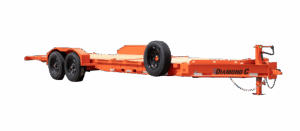
Diamond C’s LPX is a low-profile extreme-duty equipment trailer, while the HDT is a low-profile hydraulically dampened tilt equipment trailer. Current configurations are offered in GVWR packages from approximately 15,500 to 24,000 pounds, depending on the model and options. They are equipment trailers, not launchable boat trailers, and they are not designed to be backed into the water as a substitute for a galvanized or aluminum marine trailer.
Any marine load carried on an LPX, HDT, or another equipment trailer needs an engineered cradle that supports the hull at approved points, remains securely attached to the deck, and keeps the complete load within the trailer’s GVWR, axle ratings, tire capacities, deck dimensions, tie-down ratings, and center-of-gravity limits. The loaded width and height must also remain legal or be properly permitted. Call us at (812) 829-0226 and describe the hull, actual loaded weight, cradle, dimensions, and intended use. We’ll tell you honestly whether we have something appropriate or whether you need a dedicated marine-trailer specialist.
If you’re in the market for a proper boat trailer for a 25-plus-foot vessel, start with the boat manufacturer or the dealer that sold the boat. They can identify the hull’s approved support locations, center of gravity, loaded capacity, engine allowance, and the bunk or roller arrangement engineered for that model. The correct trailer also needs enough capacity for the trailer itself, fuel, water, batteries, installed options, and normal equipment. That match matters more than finding the lowest purchase price on a big rig.
Got a specific weight or permit question for a route through Owen County or across state lines? Reach out to the team at Spencer Trailers and we’ll give you a straight answer or point you to the appropriate manufacturer, BMV office, or state permitting agency. Final legal authority comes from the agencies governing the route, but we’d rather help you identify the right questions before you leave the driveway than see you sort them out on the side of the highway.


