


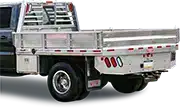
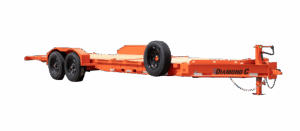


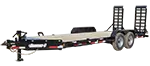





You finally found a used Kubota L3301 three counties over. Good price, good condition. Now comes the part nobody warned you about: getting it home safely. Compact tractors look manageable until you add up the tractor, loader, bucket, ballast, backhoe, implements, fuel, and the trailer itself. A typical 7×14 utility trailer may not have enough payload capacity, usable deck length, ramp capacity, brakes, or properly rated tie-down points for the job.
Kubota’s L Series includes several generations and configurations. The L3301 is part of the earlier Standard L01 family, while current Standard L models use designations such as L2502, L3302, L3902, and L4802. An L3301 weighs approximately 2,734 lbs in four-wheel-drive gear-drive form and about 2,778 lbs with hydrostatic transmission, before adding a loader, bucket, ballast, or implement. The Kubota LA525 loader itself weighs approximately 805 lbs, and the selected bucket, quick-attach components, mounting hardware, loaded rear tires, wheel weights, or ballast box add more. A BH77 backhoe package can add roughly 1,000 lbs or more once the backhoe, subframe, and bucket are included. Larger L Series and Grand L tractors, especially cab models, are heavier before any attachments are installed.
That means an L3301 equipped with a loader and backhoe can approach or exceed 5,000 lbs depending on the exact configuration. Add loaded tires, pallet forks, a mower, a box blade, or another implement, and the transport weight can climb toward 6,000 lbs surprisingly quickly. The first job is knowing exactly what you are loading rather than relying on the tractor’s advertised base weight. Check the operator’s manuals and equipment identification plates, then use a certified scale whenever possible.
Picking the Right Trailer for an L Series
A trailer’s GVWR is not the same thing as its cargo capacity. Payload is calculated by subtracting the trailer’s actual empty weight, including installed options, spare tires, toolboxes, ramps, batteries, winches, and other equipment, from its GVWR. A 7,000 lb GVWR trailer that weighs 2,000 lbs empty has only about 5,000 lbs of theoretical payload before considering how that weight is distributed across the axles, tires, coupler, and hitch.
There is no universal law requiring a trailer’s GVWR to be 20–25% higher than the cargo weight, but having meaningful reserve capacity is a sensible purchasing practice. At an absolute minimum, the trailer’s available payload must exceed the tractor’s complete transport weight, and the trailer’s axles, tires, wheels, ramps, deck, coupler, safety chains, brakes, and tie-down anchors must all be rated for the load. The tow vehicle, receiver, ball mount, hitch ball, and brake controller must also be rated for the resulting combination.
For a bare L3301 weighing approximately 2,734–2,778 lbs, some properly equipped 7,000 lb tandem-axle trailers may have enough payload, but the margin can disappear after adding a loader, bucket, ballast, and trailer accessories. A 9,990 or 10,000 lb GVWR equipment trailer is often a more practical starting point for a smaller L Series tractor with a loader. For an L4701, L4802, larger Grand L, or any tractor carrying a backhoe and additional implements, a 14,000–15,500 lb class equipment trailer commonly provides more usable payload and more capable running gear. The correct choice still depends on the trailer’s actual empty weight and the tractor’s scaled transport weight.
Deck length matters just as much as weight capacity. An L3301 has a wheelbase of approximately 63 inches, while larger L Series and Grand L tractors extend into the low-to-mid-70-inch wheelbase range. Wheelbase alone does not tell you how much trailer you need. A loader bucket projects well ahead of the front axle, and a backhoe, rotary cutter, box blade, or other three-point implement can extend several feet behind the tractor. A 16-foot deck may work for a bare compact tractor, but an 18- or 20-foot deck is usually easier to balance with a loader installed. Loader-and-backhoe combinations may require 20–22 feet or more, depending on the attachment positions and the trailer’s axle location. Measure the tractor from its forwardmost attachment to its rearmost secured component before selecting a deck length.
At Spencer Trailers, we carry equipment trailers from Diamond C, H&H, and Liberty that are built for compact equipment hauling. The current Diamond C LPX Low-Profile Equipment Trailer line is available in multiple lengths and configurations, with GVWR ratings ranging from approximately 15,500 to 24,000 lbs. The LPX207 configuration uses tandem 7,000 lb Lippert axles and a 15,500 lb GVWR. Depending on the package, LPX trailers can be equipped with heavy-duty flip-knee ramps, MAX Ramps, or an X-Ramp system. Their low-profile design, dovetail options, engineered frame construction, electric brakes, and DM Difference Maker multi-stage coating make them well suited to frequent equipment use.
An H&H 82-inch Gravity Tilt Equipment Trailer is another configuration worth considering. Current gravity-tilt models are available in 14,000 and 16,000 lb GVWR classes, depending on the selected package. A tilt deck removes the need to position separate loading ramps, although you still need to verify the approach angle, breakover clearance, deck capacity, axle placement, and tongue weight for your particular tractor. Browse our current trailer inventory to see which lengths, axle packages, ramp systems, and GVWR ratings are currently in stock.
Ramp Angle: The Problem Nobody Talks About
This is where a lot of tractor hauls go wrong, sometimes literally. The limiting clearance may be under the tractor’s front axle, drawbar, three-point hitch, loader mounting crossmember, backhoe subframe, mower deck, or rear attachment. A steep ramp can also create a severe breakover point where the ramps meet the trailer deck.
As a simplified example, a trailer deck 30 inches above the ground with straight 60-inch ramps creates a theoretical angle of about 30 degrees before accounting for a dovetail, ramp feet, suspension movement, or uneven terrain. That can be steep enough for a loader frame, drawbar, backhoe subframe, or rear implement to contact the ramp or deck transition. It also causes the tractor’s center of gravity to shift more abruptly while loading.
Many compact tractors load more comfortably when the effective approach angle is in the high teens or lower, but there is no single safe angle for every configuration. Tire size, wheelbase, attachment clearance, ramp spacing, ground slope, and the location of the trailer’s breakover point all matter. With a 24-inch deck height, a straight seven-foot ramp produces an angle of roughly 16–17 degrees, while an eight-foot ramp is closer to 14–15 degrees. A dovetail or tilt deck can reduce the effective breakover angle further.
A low-profile trailer such as the Diamond C LPX uses a lower-loading design and can be paired with a dovetail and longer ramp system. The actual deck height varies with axle, tire, suspension, and trailer configuration, so measure the particular trailer rather than relying on a general number from an advertisement. Some axle or tire options can raise the deck several inches and materially change the approach angle.
Load on firm, level ground whenever possible. Carry the loader bucket low and level while moving, but high enough that it does not dig into the ramps or ground. Move slowly, avoid sudden steering or braking, and use a spotter who remains clearly outside the tractor’s travel path. Once the tractor is positioned, lower the loader bucket flat onto the deck. Retract the backhoe stabilizers and boom into their transport positions, lower the bucket, and secure any attachment that could move independently. Never travel with hydraulic components raised solely because hydraulic pressure appears to hold them in place.
Weight Distribution on the Deck
The familiar “60/40 rule” is not a reliable way to position a compact tractor. What matters on a bumper-pull trailer is the measured tongue weight, the load carried by each trailer axle, and the load transferred to the tow vehicle’s receiver, rear axle, and tires. As a general starting range, many conventional bumper-pull trailers are designed to carry approximately 10–15% of their actual loaded trailer weight on the hitch. The trailer manufacturer and tow-vehicle owner’s manual should control if they specify a different range.
Remember that tongue-weight percentage is based on the entire loaded trailer, not just the tractor. If the trailer, tractor, attachments, chains, spare tire, and accessories weigh 8,000 lbs together, a 10–15% target would place approximately 800–1,200 lbs on the hitch. That tongue weight also counts against the tow vehicle’s payload capacity, along with the driver, passengers, cargo, fuel, tools, and the weight of the hitch hardware.
An L Series tractor with a front-end loader is usually front-heavy, but attachment combinations can change the balance dramatically. A backhoe adds substantial weight behind the rear axle, while loaded tires or a rear implement move the center of gravity differently. Do not assume the tractor belongs in a certain spot based only on where its front axle sits relative to the trailer axles. Move the tractor forward or backward in small increments, lower all attachments, and measure the resulting tongue weight. A tongue-weight scale, portable wheel scales, or a certified public scale is much more dependable than judging the trailer by how level it looks.
If you are using a Diamond C tandem-axle equipment trailer, both axles must remain within their rated loads, and the tires and wheels must also remain within their individual capacities. Tandem axles improve load support and stability, but they do not correct poor positioning. Too little tongue weight can cause trailer sway. Too much tongue weight can overload the receiver, rear axle, suspension, or tires of the tow vehicle while unloading the truck’s front axle and reducing steering control.
Tie-Down Points and Strap Selection
A Kubota L Series tractor may not have four obvious transport anchors, and suitable points can vary by model and installed equipment. Start with the tractor and attachment operator’s manuals. Use manufacturer-designated towing or tie-down points whenever they are provided. Otherwise, use substantial structural locations that the manufacturer permits for securement and that cannot damage steering, braking, hydraulic, electrical, or driveline components.
At the front, use rated tie-down eyes or approved structural frame or axle locations. Do not attach to steering rods, hydraulic cylinders, hoses, sheet metal, plastic guards, the loader bucket’s cutting edge, or an unapproved portion of the loader arms. A hole, loop, or bracket is not automatically a rated tie-down point simply because a hook fits through it.
At the rear, use designated tie-down provisions or approved structural points on the tractor’s frame or axle assembly. Do not assume that three-point hitch lift arms, stabilizers, top-link brackets, drawbar supports, or backhoe controls are suitable anchors. Three-point components are designed to carry implements through a particular load path and may move, bend, or release when loaded in an unintended direction. Use them only when the Kubota manual specifically identifies them as transport-securement points.
Four independent tiedowns, one controlling each corner of the tractor, are a strong baseline for compact equipment even when a particular personal-use trip is not governed by federal commercial cargo rules. The tiedowns should restrain forward, rearward, and lateral movement. They do not always need to form a perfect visual X, but they should pull in opposing directions and remain clear of tires, sharp edges, hot components, and moving parts.
Grade 70 transport chain with properly matched binders is commonly preferred for tractors because it resists cutting and abrasion. Rated synthetic ratchet straps may also be suitable when their manufacturer permits equipment securement, the straps are protected from sharp edges, and they cannot contact hot exhaust or hydraulic components. A 2-inch strap with a 3,333 lb working load limit is a common heavy-duty size, but the correct securement system is not determined by strap width alone.
Under federal commercial cargo-securement rules, the aggregate working load limit of the tiedown system, calculated using the applicable regulatory method, must equal at least one-half of the secured cargo’s weight. Every tiedown is limited by its weakest component, including the strap or chain, hooks, binder, attachment hardware, and trailer anchor. Four high-capacity chains connected to low-rated stake pockets do not create a high-capacity securement system.
The tractor and its attachments must also be considered separately. Lower the loader bucket and backhoe bucket to the deck and secure them against movement when required. A mower, box blade, pallet forks, ballast box, or other implement must be locked into its transport position and restrained if it can pivot, bounce, unfold, or shift independently. Do not rely on the tractor’s parking brake, transmission, hydraulics, or three-point hitch alone to hold the machine during a panic stop or collision.
Tow Vehicle Requirements
This is where people make expensive mistakes. A half-ton pickup may advertise a high maximum tow rating, but that number applies only to specific cab, bed, engine, axle-ratio, drivetrain, wheel, tire, and towing-package combinations. The truck may reach its payload, receiver, rear-axle, or tire limit long before reaching the advertised maximum trailer weight. A heavy equipment trailer can place more than 1,000 lbs of tongue weight on the truck before passengers, tools, or other cargo are added.
For an L4701, L4802, larger Grand L, or any L Series carrying a loader, backhoe, and additional implements, a properly configured three-quarter-ton or one-ton pickup is often the more appropriate choice. That does not mean every Ford F-250, Ram 2500, Chevrolet Silverado 2500HD, or GMC Sierra 2500HD can tow every equipment trailer. Check the specific truck’s certification labels, payload sticker, owner’s manual, towing guide, GCWR, receiver rating, rear gross axle weight rating, and tire capacities. Gasoline and diesel trucks can both be suitable when properly rated; engine size by itself does not establish legal or safe towing capacity.
Indiana law requires trailers with a GVWR over 3,000 lbs to have brakes. For a tandem-axle equipment trailer, verify that the service brakes, breakaway switch, breakaway battery, wiring, connector, and in-cab brake controller are all functional before loading. The controller should be adjusted for the actual load so that the trailer assists the truck without locking its wheels or pushing the tow vehicle during braking. If you are not familiar with brake-controller setup, call us at (812) 829-0226 before you hook up.
CDL requirements are based on the rated combination, not solely on the trailer’s GVWR. Under the general Indiana and federal Class A commercial threshold, the combination must have a GCWR of 26,001 lbs or more and the towed trailer must have a GVWR over 10,000 lbs. A 14,000 lb equipment trailer does not automatically trigger a Class A CDL when the combined rating remains below 26,001 lbs, but pairing that trailer with a higher-GVWR truck may cross the threshold. Commercial use, farm exemptions, personal use, interstate travel, and the actual vehicle ratings can affect which rules apply, so verify your particular operation rather than relying on a salesperson’s verbal estimate.
If you purchase a trailer that is not already properly registered to you, Indiana generally provides a 45-day window to complete the title and registration process without the late administrative penalty. That window does not eliminate the need to carry the purchase documents or obtain any permit required for lawful operation before permanent registration is issued.
A Quick Pre-Haul Checklist
- Confirm the tractor’s complete transport weight, including the loader, bucket, backhoe, subframe, loaded tires, wheel weights, ballast, fuel, and every implement being carried; use a certified scale whenever possible
- Calculate usable trailer payload by subtracting the trailer’s actual empty weight and installed options from its GVWR, then verify the axle, tire, wheel, coupler, ramp, deck, and anchor ratings on the trailer’s certification labels
- Measure the tractor’s full transport length and width, check the ramp and deck capacities, and confirm that the approach and breakover angles clear the loader frame, drawbar, backhoe subframe, and rear implement
- Set trailer-tire pressure cold according to the trailer manufacturer’s certification label or tire-loading instructions, and inspect every tire for cracking, damage, uneven wear, correct load range, and adequate tread
- Inspect wheel bearings, hubs, suspension, lug nuts, and wheel torque using the trailer manufacturer’s specifications; carry a properly inflated spare and the tools needed to change it
- Use four independent, properly rated tiedowns in opposing directions, verify that every hook and trailer anchor is compatible, and ensure the aggregate working load limit is sufficient for the equipment
- Test the trailer brakes, brake controller, seven-way connector, breakaway switch, and charged breakaway battery before entering traffic
- Verify the hitch receiver, ball mount, hitch ball, coupler, latch, locking pin, jack, safety chains, and breakaway cable are correctly rated and connected; attach the breakaway cable independently from the safety chains
- Confirm that all running lights, brake lights, turn signals, reflectors, license plate, registration documents, and any required permit are present and functional
- Inspect the tractor for fuel, coolant, engine-oil, and hydraulic leaks; close all caps securely and carry enough fuel to load, unload, and reposition the tractor safely rather than intentionally running the tank nearly empty
- Lower and secure the loader and backhoe, retract stabilizers, lock or restrain every implement, set the parking brake, place the transmission in the manufacturer’s recommended transport position, shut off the engine, and remove the key
What About Removing the Loader First?
It is a legitimate question. Kubota LA Series loaders are designed for relatively quick removal on compatible tractors when the procedure is performed on a firm, level surface using the loader’s parking stands and the steps in the operator’s manual. The LA525 loader used on many L3301 tractors weighs approximately 805 lbs before accounting for the selected bucket and some installed components. Removing the loader and bucket can therefore make a meaningful difference in cargo weight, overall length, visibility, ramp clearance, and weight distribution.
Loader removal is not something to improvise at a seller’s farm. You need level ground, the correct stands, properly functioning hydraulic connections, all required pins, enough space to back the tractor away, and a safe plan for transporting or storing the detached loader. The loader itself would still need to be loaded and independently secured if it is traveling with you. Removing it may also change how much ballast the tractor needs for safe operation during loading.
If you are picking up a tractor that is not yours, the seller cannot demonstrate the correct removal procedure, or there is no suitable place to support the loader frame, haul the tractor with the loader installed. Account for the complete weight and length when choosing the trailer, keep the bucket low during loading, and lower and secure it on the deck before travel. Do not compromise on trailer payload, tow-vehicle ratings, ramp clearance, tongue weight, or tie-down points simply to avoid making a second trip.
Trailer Options at Spencer Trailers
If you are shopping for a trailer specifically for compact tractor hauling, a few configurations come up regularly at our lot in Spencer. Exact curb weight, payload, axle package, tire rating, ramp system, and deck layout can change with options, so always verify the certification label and build sheet for the individual trailer rather than relying only on the model-family description.
| Trailer | GVWR | Deck Length | Best For |
|---|---|---|---|
| H&H 82×20 Gravity Tilt Equipment Trailer | 14,000 or 16,000 lb, by configuration | 20 ft | Operators who prefer tilt-deck loading for compatible L Series tractors; verify payload, breakover clearance, axle placement, and tongue weight |
| Diamond C LPX207 Low-Profile Equipment Trailer | 15,500 lb | 20 ft | L3301, L4701, L4802, and similar tractors with loaders or backhoes when the actual scaled weight and dimensions fit the selected build |
| Liberty LE 83×20 Equipment Trailer | 9,990 or 14,000 lb, by configuration | 20 ft | Lighter L Series combinations on the 9,990 lb version or heavier attachment packages on the 14,000 lb version after verifying actual payload |
The current Diamond C LPX207 is a 15,500 lb GVWR bumper-pull equipment trailer with tandem 7,000 lb Lippert axles. Available configurations may include a dovetail, heavy-duty flip-knee ramps, MAX Ramps, or other compatible loading systems. Longer and higher-GVWR LPX configurations are available for operators who regularly carry larger equipment. Because ramp packages, winches, spare tires, hydraulic jacks, toolboxes, and other options add empty weight, the payload shown on the individual VIN and certification labels should always be used for the final calculation.
Liberty equipment trailers may be stocked in both 9,990 and 14,000 lb GVWR configurations. Those ratings are not interchangeable. The 9,990 lb version can be a useful fit for lighter compact-tractor combinations when its payload is sufficient, while the 14,000 lb version provides heavier axles and additional capacity for loaders, backhoes, ballast, or implements. H&H gravity-tilt trailers provide another loading approach, but the tilt system does not replace the need to calculate payload, tongue weight, and attachment clearance.
Stock changes constantly. Check our full inventory or stop by 291 West State Hwy 46, Spencer, IN 47460 to see what is available. Our team can compare deck lengths, usable payload, axle and tire ratings, ramp capacities, tilt angles, brake systems, tie-down anchors, and hitch requirements against the specifications of your actual tractor and attachments.
Ready to get the right trailer before your next equipment move? Reach out to us and we will point you toward the right configuration. The worst time to discover that your trailer lacks the payload, deck space, ramp capacity, or braking system for your tractor is when you are already at the seller’s farm.


