







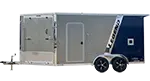
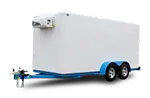
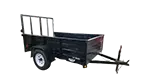

You’ve got a 25HP Kubota or a Case IH Farmall 35A or 35C sitting in the barn and a job waiting two counties over. Renting a flatbed is not worth it. Hiring a hauler for a compact machine feels like overkill. So you back your utility or equipment trailer up and start loading. And that is usually where things go wrong, because compact tractors have several quirks that make them more difficult to haul than their horsepower rating or physical size suggests.
The good news: none of those quirks are difficult to manage once you understand them. You need an accurate transport weight, enough usable trailer payload, a safe loading angle, correct tongue weight, and a securement plan that accounts for the tractor and every attached implement. Here’s what actually matters.
Know What You’re Working With
Horsepower is a poor way to estimate transport weight. Tractors in the 25-40HP range include lightweight sub-compacts as well as substantially heavier compact utility tractors. A Kubota BX2380, for example, has a published tractor weight of about 1,443 pounds with ROPS before adding its LA344 or LA344S front loader, bucket, mower deck, ballast, loaded tires, or rear implement. A John Deere 3025E open-station tractor is roughly 2,600 pounds before its loader and attachments. A Mahindra 2638 HST is approximately 3,130 pounds before its loader, and the matched loader package adds close to another 1,000 pounds. A cab, backhoe, liquid tire ballast, wheel weights, pallet forks, rotary cutter, box blade, or tiller can push a transport-ready compact tractor well past 4,000 pounds.
That weight range matters when you’re choosing a trailer. A tandem-axle trailer with two 3,500-pound axles may have a 7,000-pound GVWR, but 7,000 pounds is not its cargo capacity. You must subtract the trailer’s actual empty weight, including installed ramps, spare tire, toolbox, winch, and other options. An equipment trailer that weighs 2,100 pounds has about 4,900 pounds of theoretical payload before accounting for any manufacturer-specific limits. That may be enough for a lightweight tractor package, but it can become tight once you add a loader, rear implement, ballast, fuel, chains, and tools. For heavier compact tractors or owners who regularly carry multiple implements, a 9,890- or 9,900-pound trailer provides more useful margin. Diamond C’s TUT, LPX, and HDT models and current H&H car-hauler and equipment configurations provide several capacity and loading-style choices. The only reliable way to confirm your setup is to total every component or take the loaded combination across a certified scale.
Front-End Loader: Bucket on the Deck
This is one of the most common mistakes people make. They load the tractor with the bucket unnecessarily high because it keeps the cutting edge away from the ramps and improves forward clearance during the transition. Once the tractor is on the trailer, however, leaving the loader elevated raises the machine’s center of gravity, increases overall height, places unnecessary stress on the loader hydraulics, and gives the bucket room to move if hydraulic pressure bleeds off. The bucket should also be empty. Dirt, gravel, firewood, or tools carried loose in the bucket add weight and create an additional unsecured load.
Drive onto the trailer with the bucket only as high as necessary for ramp clearance and visibility. After positioning the tractor, lower the loader until the bucket is fully supported by the trailer deck. Curl it into a stable position, shut off the engine, set the parking brake, remove the key, and move the hydraulic control through its positions to relieve trapped pressure as directed by the tractor’s operator’s manual. If you want to protect a wood deck or powder-coated surface, use a rubber mat or a secured sacrificial board that cannot slide or become loose cargo. Do not depend on a small unsecured piece of plywood remaining under the bucket during highway travel.
A bucket resting on the deck is not a tie-down, and hydraulic float is not a mechanical transport lock. If the loader or attachment can articulate, detach, swing, or bounce, use the manufacturer’s locking provisions and secure the attachment as necessary. Commercial cargo-securement rules allow accessory equipment on machinery under 10,000 pounds to be restrained with locking pins or similar devices when those devices prevent movement, but the loader still must not be able to shift in a way that destabilizes the tractor or damages another tie-down.
3-Point Hitch: All the Way Down
Whatever is mounted on the 3-point hitch should normally be lowered into a stable, supported transport position before you finish securing the load. That includes a finish mower, box blade, tiller, rear blade, ballast box, landscape rake, or rotary cutter. Turn off the PTO, stop the engine, remove the key, and relieve hydraulic pressure after the implement is supported. Leaving a heavy implement suspended solely by the tractor’s hydraulic system allows it to settle or drop as pressure bleeds off, and a sudden change in implement position can alter load balance or damage a strap, chain, deck board, light, or ramp.
Lowering the implement also reduces the rear attachment’s height and limits movement, but contact with the deck does not automatically make it secure. An implement that can pivot on the hitch, swing sideways, open, unfold, or detach should receive its own rated restraint or manufacturer-approved locking device. Check that the implement is not resting on a hydraulic hose, PTO shaft, gearbox guard, tail wheel, or other component that was not designed to support the machine during transport.
If an attachment cannot sit safely on the trailer, remove it or transport it in the position specified by its manufacturer. A post-hole digger, for example, should not travel upright and unsupported with the auger extending above or behind the tractor. Long rotary cutters and rear blades also affect deck-length requirements, rear overhang, and tractor placement. Measure the entire tractor-and-implement package before buying or loading the trailer rather than relying on the tractor’s wheelbase alone.
ROPS Height: Check Before You Load
Compact-tractor rollover protective structures vary considerably. Some tractors have a folding two-post ROPS, some have a fixed ROPS, and cab tractors use an integrated protective structure. Folding capability should never be assumed simply because the tractor is modern or under 40 horsepower. Consult the operator’s manual and measure from the ground to the actual highest point, which may be the ROPS, cab roof, beacon, exhaust, canopy, mirror, or raised attachment.
Remember that the tractor’s published overall height is measured while the tractor is on the ground. You must add the trailer’s loaded deck height. An 82-inch-high tractor placed on a trailer with a 24-inch deck has a total loaded height of approximately 106 inches, or 8 feet 10 inches. Indiana’s general maximum vehicle height is 13 feet 6 inches, but being below the legal maximum does not guarantee clearance under every posted bridge, covered bridge, parking structure, shed entrance, tree limb, utility line on private property, or other obstruction. Route clearance remains the driver’s responsibility, and dips, road crowns, ramps, and uneven entrances can temporarily change the highest point of the load.
Where clearance allows, load and unload with the ROPS locked in its upright operating position so the manufacturer’s rollover protection remains available while the tractor is moving on the ramps. If the ROPS must be folded for highway transport, fold it only according to the operator’s manual and secure it with the original pins, retainers, knobs, or latches. Do not substitute a loose bungee cord. Raise and lock the ROPS again before operating the tractor whenever clearance permits, and follow the manufacturer’s instructions regarding seat-belt use in each ROPS position.
Tie-Down Points: Use Approved Structural Locations
Compact tractors do not all use the same tie-down points. Some have factory transport provisions, while others require securement around approved structural components. Start with the tractor and loader operator’s manuals. Suitable locations may include designated brackets, substantial frame members, approved portions of the front structure, rear drawbar support, or axle housings when the manufacturer identifies them as acceptable. Do not assume that every visible casting, hole, bracket, or frame opening can accept transport-chain loads. Avoid sharp edges, hydraulic lines, wiring, brake linkages, and areas where a chain or strap can crush or bend a component.
For a compact tractor, four independent tiedowns arranged to restrain the machine forward, rearward, laterally, and vertically are a conservative and easily inspected setup: two at the front and two at the rear. The tiedowns should oppose one another and run to rated trailer anchor points without contacting tires, hoses, steering parts, or sheet metal. They do not have to form an exact 45-degree angle, but they need enough fore-and-aft and side angle to prevent movement in every direction. Set the parking brake and place the transmission in park or the manufacturer-recommended transport position, but remember that the transmission, parking brake, wheel chocks, and bucket are not substitutes for tiedowns.
Use transport chain and binders or synthetic-web ratchet straps with clearly identified working load limits. Grade 70 transport chain is often preferred around equipment because it tolerates abrasion and contact with robust structural points, while properly rated web straps can work when they are protected from cutting, heat, and sharp edges. Under the federal commercial cargo-securement formula, the aggregate working load limit must equal at least one-half of the secured article’s weight. A direct tiedown running from the trailer to the tractor contributes one-half of its marked working load limit to that calculation. Four direct tiedowns rated at 3,333 pounds each therefore provide an aggregate working load limit of 6,666 pounds, not 13,332 pounds. The lowest-rated part of the assembly controls, including the chain, strap, hook, binder, tractor attachment point, D-ring, stake pocket, and trailer anchor structure.
Do not strap to:
- The loader arms, curl cylinder, lift cylinder, hydraulic hoses, or quick-attach handle unless the tractor or loader manufacturer specifically designates a transport point there
- The 3-point lower links, top link, stabilizers, or PTO guard, which were not designed to serve as general-purpose highway tie-down anchors
- The ROPS, canopy, seat frame, steps, fenders, floorboard, grille guard, or sheet-metal bodywork unless a marked manufacturer-approved point is provided
- The steering cylinder, tie rod, brake linkage, front-wheel-drive shaft, hydraulic filter, wiring harness, or any component that can bend, leak, or interfere with steering and braking
If the tractor has front suitcase weights, wheel weights, a ballast box, or another removable counterweight, confirm that every weight is positively pinned or latched. Loose or partially engaged ballast can separate from the tractor even when the tractor itself remains secured. Keep required ballast installed if the manufacturer calls for it, but do not use a removable weight or weight bracket as a tie-down anchor unless it is specifically rated for that purpose.
Trailer Selection for This Job
A 7,000-pound tandem-axle trailer is not automatically too small for a 3,500-pound tractor, but you have to calculate payload rather than compare tractor weight directly with GVWR. For example, the current H&H 82-inch-by-18-foot steel car hauler in its 7,000-pound configuration has a published curb weight of about 2,140 pounds, leaving approximately 4,860 pounds before options or additional cargo. A 3,500-pound transport-ready tractor would leave roughly 1,360 pounds for implements, ballast, chains, tools, and other cargo. That can be workable, but the margin disappears quickly if the 3,500-pound figure did not include the loader, loaded tires, rear attachment, or fuel. A higher-GVWR trailer is usually the better long-term purchase when the tractor’s configuration changes from job to job.
A few current trailer configurations that can work well for compact tractors in this weight class are:
| Trailer | GVWR | Deck Length | Best For |
|---|---|---|---|
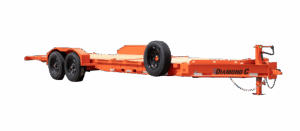
| Diamond C TUT utility trailer (83″ x 20″) | 9,890 lb | 20 ft | Sub-compact or compact tractor packages that fit between the rails and work with the selected tractor-gate or ramp configuration |
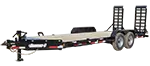
| H&H steel car hauler 10K (82″ x 18″) | 9,900 lb | 18 ft | Compact tractor, loader, and moderate rear implement; published curb weight is approximately 2,400 lb before options |
| Diamond C LPX207 equipment trailer (82″ x 20″) | 15,500 lb | 20 ft | Heavier 35-40HP tractors, loaded tires, larger implements, or owners who want substantial payload and equipment-hauling reserve |
Loading angle matters as much as deck length. Compare the tractor’s approach angle, departure angle, ground clearance, wheelbase, mower-deck clearance, and the transition where the ramps meet the trailer deck. A short-wheelbase sub-compact can high-center at the ramp-to-deck breakover even when its tires climb the ramps easily. The current H&H car hauler uses a 2-foot steel treadplate dovetail with slide-in ramps, while the Diamond C LPX offers dovetail and ramp choices that include spring-assisted MAX Ramps. Compatible max-width LPX configurations can also be equipped with the X-Ramp system. For operators who want to avoid handling separate ramps, the Diamond C HDT is a hydraulically dampened full-bed tilt trailer available from 15,500 to 24,000 pounds GVWR. Current LPX and HDT 207 packages use two 7,000-pound Lippert axles as standard, and Diamond C finishes these trailers with its DM Difference Maker multi-stage coating system at its Mt. Pleasant, Texas, manufacturing operation.
A Quick Pre-Trip Checklist
- Confirm the tractor’s actual transport weight, including loader, bucket, fuel, liquid ballast, wheel weights, mower deck, rear implement, tools, and loose accessories
- Lower the front bucket onto the deck, empty it, place it in a stable position, shut off the engine, and relieve hydraulic pressure according to the operator’s manual
- Lower the 3-point implement into a supported position and secure any attachment that can pivot, swing, unfold, detach, or move independently
- Measure total loaded height, lock the ROPS in the selected transport position, and verify clearance along the entire route
- Install four correctly angled tiedowns at manufacturer-approved structural points and verify the working load limit of every chain, strap, hook, binder, and anchor
- Set the parking brake, place the transmission in the recommended transport position, shut off the engine, remove the key, and close or latch all panels
- Verify that the coupler, hitch ball, ball mount, receiver, hitch pin, tow vehicle, and trailer are rated for the actual gross trailer weight and tongue weight
- Cross the safety chains under a bumper-pull coupler, connect the breakaway cable independently to the tow vehicle, raise the jack fully, and confirm that the coupler latch is pinned
- Test the running lights, brake lights, turn signals, electric trailer brakes, brake controller, breakaway battery, and breakaway switch before entering the road
- Check trailer-tire condition and cold inflation pressure, inspect wheel-lug torque and bearings as required, and stop after the first few miles to recheck the load and tiedown tension
One more thing that gets skipped is the tractor’s fuel and ballast. Compact tractors commonly carry roughly 6-10 gallons of diesel, which can add approximately 40-75 pounds depending on tank size and fuel level. That is rarely the largest variable, but it still counts. Liquid-filled tires, by comparison, can add hundreds of pounds to the tractor, and published base weights frequently exclude that ballast. Use the weight of the tractor as it is actually equipped on hauling day, not the lightest number shown in a sales brochure.
What Tow Vehicle Do You Need?
Start with the actual gross trailer weight. A 3,500-pound tractor package on a 2,400-pound trailer is already about 5,900 pounds before chains, tools, spare parts, or another implement. A heavier tractor-and-implement package can put the trailer near 7,000 pounds quickly. The tow vehicle must remain within its maximum trailer rating, GCWR, GVWR, rear GAWR, tire ratings, payload capacity, receiver rating, and permitted tongue weight. A properly configured half-ton pickup may be rated to tow a trailer in this range, but available payload and rear-axle capacity often become limiting before the advertised maximum tow rating. A properly equipped three-quarter-ton pickup generally provides more payload, braking, suspension, receiver, and axle margin, but the badge on the fender does not replace the ratings on the specific truck’s labels and towing guide.
For a conventional bumper-pull equipment trailer, target approximately 10-15% of the actual gross trailer weight on the hitch unless the trailer or tow-vehicle manufacturer specifies otherwise. A 6,900-pound loaded trailer would therefore commonly need about 690-1,035 pounds of tongue weight. That entire amount counts against the truck’s payload along with passengers, cargo, accessories, and the hitch itself. Move the tractor gradually to achieve correct balance and confirm it with a tongue-weight scale or certified axle weights; do not assume that parking the front tires at a certain board or placing the bucket against the bulkhead produces the right result. Receiver classes and 2-inch versus 2.5-inch openings do not guarantee a specific rating, so check the labels on the receiver, ball mount, and ball. For commercial operation, a Class A CDL is generally triggered when the combination GCWR is 26,001 pounds or more and the towed unit has a GVWR over 10,000 pounds. A trailer exceeding 10,000 pounds does not trigger that Class A threshold by itself. Separate commercial-motor-vehicle requirements can apply below the CDL threshold depending on how and where the equipment is being transported.
Ready to Haul?
If you’re in the market for a trailer that actually fits your compact tractor, come see what’s available in Spencer Trailers’ current inventory. We carry Diamond C, H&H, and Liberty trailers in utility, car-hauler, equipment, low-profile, and tilt configurations, with inventory changing as trailers arrive and sell. We can help you compare the tractor’s true transport weight with trailer payload, deck width, ramp geometry, axle configuration, brake equipment, tongue weight, and the ratings of your tow vehicle. In Indiana, a trailer with a gross weight of at least 3,000 pounds must have brakes capable of being applied from the tow vehicle and an automatic breakaway function, so the brake controller and breakaway system are part of the trailer match, not optional details to address later. Not sure which specification to pick? Give us a call at (812) 829-0226 or stop by the lot at 291 West State Hwy 46 in Spencer. We’d rather help you select the right trailer before the load than after something goes sideways on the highway.
What’s the heaviest thing you’ve hauled on a utility or equipment trailer? If it was a tractor with a loader, loaded tires, and a box blade hanging off the back, you probably learned that the tractor’s brochure weight tells only part of the story. Current trailers offer better choices in low-profile frames, dovetails, tilt beds, ramp storage, MAX Ramps, and other loading systems, but capacity and equipment cannot correct a poorly balanced or loosely secured load. Weigh the complete setup, load for proper tongue weight, use rated structural tie-down points, and recheck every connection after the first few miles and at each fuel or rest stop.


