







You pull into the cut site at dawn and the ground is soft. Your forestry machine has a transport weight of more than 40,000 pounds, the chip container is already full, and the dump truck is still an hour away. If you arrived with a trailer that was only marginally rated for the load, this is the moment you regret it. Forestry and logging do not leave room for close-enough trailer choices. The terrain is severe, the cargo is heavy, and a bad match between the truck, trailer, loading system, and machine can mean damaged frames, overloaded tires, failed brakes, or an out-of-service order before you reach the highway.
Here is a practical guide to the trailers that fit forestry and logging work, broken down by application. Always base the final decision on the machine’s actual transport weight and dimensions, the trailer’s certified GVWR and empty weight, the tow vehicle’s ratings, and the legal limits on every road in the planned route.
Moving Skidders and Feller-Bunchers: Heavy Equipment Goosenecks
Modern full-size forestry machines are substantially heavier than many buyers expect. A current John Deere 648L-III grapple skidder has an operating weight of approximately 42,512 pounds. A Tigercat 625H six-wheel skidder is approximately 50,600 pounds and about 131 inches wide. Depending on the carrier, boom, guarding, tracks, tires, fuel, and cutting or bunching attachment, a feller-buncher can weigh 50,000 to more than 70,000 pounds. Those machines are beyond the payload capacity of a pickup-style bumper-pull trailer and, in many cases, beyond the capacity of even the heaviest Diamond C FMAX gooseneck configuration.
Full-size skidders and feller-bunchers normally require a commercial tractor paired with a purpose-built lowboy, detachable gooseneck, or similarly rated heavy-haul trailer. The trailer must have enough payload after its own empty weight is deducted from GVWR, and the complete combination must comply with axle, bridge, width, height, and route restrictions. A trailer advertised with a 40,000-pound GVWR cannot carry a 40,000-pound machine because the trailer’s own weight is included in that rating.
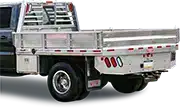
For lighter forestry machines, support equipment, compact loaders, mulchers, tractors, attachments, and service equipment, a Diamond C FMAX flatbed gooseneck can be an appropriate choice when correctly configured. Current FMAX models range from approximately 15,500 pounds to 40,000 pounds GVWR. At the upper end, the FMAX312 is rated at 30,000 pounds with an available 40,000-pound package, uses three 12,000-pound Lippert axles, and is offered in deck lengths from 25 to 44 feet. Published trailer weights range from approximately 8,330 to 13,080 pounds depending on length and equipment, leaving a nominal payload of roughly 26,920 to 31,670 pounds when configured and certified at 40,000 pounds GVWR. The VIN certification label and the trailer’s actual scale weight remain the controlling numbers.
The tandem-dual FMAX216 is also available in 25,900-, 30,000-, and properly equipped 40,000-pound GVWR configurations. Axle, brake, tire, coupler, frame, and neck specifications change with the selected package, so buyers should never assume that two trailers carrying the same model name have the same capacity. Diamond C’s current premium heavy-duty lines use Lippert axles as standard equipment.
Key specs to match to your equipment:
- Deck length and geometry: Use the manufacturer’s transport dimensions for the exact machine and attachment. The entire machine must fit without unsafe overhang, concentrated loading outside the supported deck structure, or interference between the boom, blade, arch, grapple, tires, and gooseneck. Many skidders are also wider than the ordinary 102-inch highway limit, so deck width, outriggers, permits, and route clearance must be addressed before purchase.
- Axle, tire, and brake capacity: Match the certified GVWR and expected axle loads rather than choosing an axle rating in isolation. FMAX configurations use different Lippert axle packages, including tandem and triple-axle arrangements. Tire load ratings, wheel ratings, suspension, brakes, coupler, frame, and safety equipment must all support the load. The lowest-rated component limits the usable capacity.
- Loading system: Select a factory loading system that suits the machine’s tire or track contact pattern. Diamond C options include MAX Ramps, XDR Ramps, and hydraulic dovetail systems on applicable FMAX configurations. XDR Ramps are designed for concentrated equipment loading and include support knees, while MAX Ramps provide a wide loading surface. Use the manufacturer’s stated rating for the exact ramp package rather than estimating capacity from plate thickness.
- Tie-down points: Federal cargo-securement rules require heavy equipment weighing 10,000 pounds or more to be restrained with at least four properly positioned tiedowns, with additional securement when needed. The aggregate working load limit of the securement system must be at least one-half of the cargo weight, and the chains, binders, hooks, anchor points, and attachment methods are limited by their weakest component. Use the machine manufacturer’s designated securement points whenever provided.
Include every attachment and operating item in the transport calculation. A grapple, shear, mulching head, winch, blade, guarding package, tire chains, fuel, fluids, spare parts, and tools can change both total weight and axle distribution. Articulated components, booms, blades, buckets, grapples, and other accessories must also be lowered, restrained, or otherwise secured so they cannot move independently during transport. For a machine anywhere near the trailer’s nominal payload, obtain an equipped weight from the manufacturer and confirm the completed combination on certified scales.
Hauling Chips: Dump Trailers for Chip Vans and Wood Waste
Wood-chip hauling is often a volume-driven job, but moisture, species, particle size, bark, dirt, stone, and compaction can turn a seemingly light load into an overweight one. Clean, dry chips may be relatively light, while wet chips mixed with bark and soil can be substantially denser. Do not rely on one universal pounds-per-cubic-foot figure. Establish a conservative loading procedure and weigh the first several representative loads before deciding where the safe fill line should be.
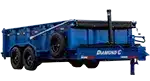
For smaller-scale forestry, firewood, brush, bark, and chip operations, the current Diamond C LPT heavy-duty low-profile telescopic dump is available in 12-, 14-, and 16-foot lengths with GVWR packages ranging from approximately 15,500 to 24,000 pounds. It uses a multi-stage telescopic hoist, provides a 45-degree dump angle, and comes with dual 7,000-pound Lippert axles in its base package, with higher-capacity tandem or triple-axle packages available. Published empty weights range from approximately 4,440 to 6,930 pounds, so usable payload varies significantly by length, GVWR package, body thickness, side height, tarp, ramps, hydraulic jack, and other options.
The H&H Industrial Dump Trailer is another relevant comparison for forestry debris. Current configurations include approximately 83-inch-wide bodies in 12- to 16-foot lengths, 14,000- and 16,000-pound GVWR packages, hydraulic scissor hoists, integrated loading ramps, and a one-piece 10-gauge steel floor. Depending on the exact configuration, a 14,000-pound model generally has a nominal payload in the range of roughly 9,500 to 10,000 pounds before additional options or carried equipment are considered.
What separates a suitable forestry dump trailer from a poor match is not only the hoist. Floor construction, side height, gate design, tarp coverage, rear stabilization, hydraulic capacity, battery condition, and payload all matter. The standard Diamond C LPT body uses 10-gauge steel, with a heavier 7-gauge body option available for demanding applications. Diamond C trailers receive the DM Difference Maker multi-stage coating system, but no coating makes a working dump body maintenance-free. Wet bark, leaf matter, mud, and chips should not be left packed against the floor and corners for extended periods. Clean the body, allow it to dry, inspect high-wear areas, and repair coating damage before corrosion spreads.
Questions to Ask Before You Buy a Dump Trailer for Chip Hauling
What is the trailer’s actual empty weight in the configuration I am buying? What payload remains after the tarp, side extensions, ramps, spare tire, hydraulic jack, and tools are installed? What is the usable cubic volume at the selected side height? Is the hoist telescopic or scissor-style, what is the rated dump angle, and will the tailgate work with chips, bark, brush, and firewood? Does the truck’s hitch, payload rating, rear axle rating, brake controller, and maximum trailer rating support the fully loaded trailer?
A current Diamond C LPT uses a telescopic hoist and a published 45-degree dump angle, while the current H&H Industrial Dump uses a scissor-hoist arrangement. Either design can work when properly engineered for the trailer. Wet chips may bridge against tall sides or stick to the floor regardless of cylinder type. Dump only on firm, level ground, keep people clear of the body and rear gate, use rear stabilizers when specified, and never use hydraulic pressure to force out a frozen, obstructed, or badly unbalanced load. A fitted tarp is also important because loose chips and bark can leave the trailer during highway travel.
Dedicated Log Trailers: Bunks, Stakes, and GVWR
If you are pulling logs to a mill, you are in a different category from ordinary equipment transport. Purpose-built log trailers use engineered bunks, stakes, frames, and securement systems that contain the load while allowing the trailer to operate on uneven roads. Stake pockets on a flatbed are not automatically rated to withstand the lateral force created by a shifting stack of logs. Any removable bunk system must be designed, fabricated, attached, and rated for the intended load.
For farm-scale and small woodlot operations, a properly configured gooseneck can carry cordwood, short logs, or limited sawlog loads when the weight and securement system remain within the trailer’s ratings. A cord of green hardwood commonly weighs roughly 4,000 to 5,500 pounds depending on species, moisture, bark, and how the wood is stacked. Two or three cords can therefore consume the payload of a pickup-towed trailer much faster than the apparent volume suggests.
Commercial log hauling is a separate heavy-truck application. Tractor-semitrailer combinations are often designed around the ordinary 80,000-pound gross legal limit on interstate and Indiana routes, but total gross weight is only one part of compliance. Axle limits, axle-group limits, the federal bridge formula, tire ratings, trailer configuration, route restrictions, and posted bridge limits can control even when the gross combination weight is below 80,000 pounds.
For smaller-scale work, a Diamond C FMAX flatbed in the 20- to 24-foot range may serve as the foundation for a professionally engineered removable bunk system, provided the modification is approved for the trailer and does not reduce structural integrity or interfere with tires, lights, brakes, wiring, or loading equipment. As one example, a 30,000-pound FMAX310 can provide a nominal payload of approximately 18,000 to 22,000 pounds depending on deck length, options, and actual empty weight. Bunks, stakes, chains, binders, toolboxes, and other additions reduce that remaining payload, and actual axle weights must still be verified.
A few things most first-time log trailer buyers miss:
- Bunk spacing: Spacing must suit the length and arrangement of the logs. Under federal log-securement rules, outside bottom logs must be supported and contained by the bunks or stakes, and each outside log generally needs contact with at least two bunks, bolsters, stakes, or standards. Short pulpwood and irregular logs may require a different trailer and bunk arrangement from long sawlogs.
- Stake strength: Stakes must be engineered for lateral loading and tall enough to contain the stack. The center of the highest outside log must remain below the top of the supporting stakes or standards. Steel stakes and their attachment points should be professionally designed rather than improvised from unrated tubing, lumber, or light stake-pocket accessories.
- Tire clearance and load placement: Confirm clearance between bunks, stakes, chains, logs, fenders, and tires throughout suspension travel. Position the load so the trailer, individual axles, tires, truck rear axle, and hitch remain within their ratings. A trailer can be under GVWR and still have an overloaded axle or tire because the logs were placed too far forward or rearward.
Logs also have commodity-specific securement requirements beyond the general cargo rules. Solidly pack the load, prevent rolling or shifting, use properly rated tiedowns, and secure the load in the manner required for the log length, stack, and trailer type. A flatbed that safely carries a tractor is not automatically a compliant log trailer simply because removable stakes have been added.
GVWR, Payload, and the Numbers That Actually Matter
GVWR is the maximum certified loaded weight of the trailer, including the trailer itself, cargo, attachments, spare tires, chains, tools, and permanently or temporarily installed accessories. Payload is the trailer’s GVWR minus its actual empty weight. Neither number replaces GAWR, tire capacity, wheel capacity, coupler rating, hitch rating, or the tow vehicle’s limits. The usable capacity of the combination is governed by the lowest applicable rating and by how the load is distributed.
| Application | Typical GVWR Range | Typical Payload | Common Configuration |
|---|---|---|---|
| ATV / compact tractor / smaller skid steer | 7,000-15,500 lb | Approximately 4,500-12,000 lb | Tandem utility or equipment trailer |
| Lighter forestry machine or support equipment | 24,000-40,000 lb | Approximately 15,500-31,500 lb | Tandem- or tri-axle FMAX gooseneck |
| Full-size skidder / feller-buncher | Load-specific commercial rating, commonly above 60,000 lb | Approximately 42,000-70,000+ lb | Commercial lowboy or detachable gooseneck |
| Chip / bark / debris dump | 9,890-24,000 lb | Approximately 4,000-17,000 lb | Tandem- or tri-axle dump trailer |
| Log hauling (small-scale cordwood or short logs) | 15,500-30,000 lb | Approximately 11,000-22,000 lb | Gooseneck flatbed with engineered bunks |
These payload figures are planning ranges, not guarantees. Trailer length, axle package, tires, ramps, hydraulic equipment, deck material, toolboxes, bunks, spare tires, and other options can change empty weight by thousands of pounds. Use the certification label for GVWR and GAWR, then obtain the actual empty and loaded axle weights from a certified scale.
For Indiana operators, 80,000 pounds is generally the ordinary maximum gross combination weight before an overweight permit is required, but the federal bridge formula and individual axle limits may require a lower weight. Indiana also requires an oversize or overweight permit when a vehicle or load exceeds applicable limits, including 8 feet 6 inches in width, 13 feet 6 inches in height, 80,000 pounds gross weight, or legal axle and bridge-formula limits. A skidder that is 127 to 131 inches wide is already oversize even when the weight is legal. Non-divisible machinery permits are route-specific, and local bridge postings or road restrictions can still affect access to a cut site.
Indiana law requires a trailer or semitrailer with a gross weight of at least 3,000 pounds to have brakes adequate to control, stop, and hold it. The driver must be able to apply those brakes from the tow vehicle’s cab, and the system must automatically apply the trailer brakes during an accidental breakaway. New trailers at and above that threshold are generally required to have service brakes on all wheels.
For commercial operation, a Class A CDL is generally triggered when the combination has a GCWR or actual gross combination weight of 26,001 pounds or more and the towed unit has a GVWR or actual gross weight of more than 10,000 pounds. The 26,001-pound threshold applies to the combination, not to the trailer by itself. Other federal or state motor-carrier rules can apply at lower weights depending on interstate commerce, business use, hazardous materials, passenger transport, and vehicle configuration.
Indiana buyers should also complete title and registration requirements within the state’s 45-day window. Do not assume that a temporary permit, dealer paperwork, or the absence of a license plate extends the legal period for titling and registering the trailer.
Matching Your Tow Vehicle to Your Trailer
A trailer’s maximum capacity is useful only when the tow vehicle can legally and safely control the loaded combination. The best-equipped current 250/2500-series pickups generally reach the low-20,000-pound range for fifth-wheel or gooseneck towing, while many cab, engine, axle-ratio, wheelbase, bed, and trim combinations are rated substantially lower. A trailer in the 25,900- to 30,000-pound class will usually require a properly configured 350/3500-series truck, often with dual rear wheels, or a commercial chassis. Using the full capacity of a 40,000-pound trailer requires a truck specifically rated for that loaded trailer weight; many conventional one-ton pickups are not.
Do not check only the advertised maximum tow rating. Verify the exact truck’s GCWR, GVWR, rear GAWR, tire ratings, payload label, maximum gooseneck or fifth-wheel trailer weight, and allowable hitch or pin weight. Gooseneck pin weight is carried by the truck and can overload the rear axle or tires before the truck reaches its advertised trailer limit. Fuel, occupants, tools, auxiliary tanks, service bodies, and cargo in the truck reduce available payload.
The hitch and coupler matter too. Ratings for 2-5/16-inch balls, 3-inch balls, couplers, mounting hardware, safety chains, and under-bed hitch structures vary. Do not assume that every ball of the same diameter has the same capacity. Diamond C’s 40,000-pound FMAX package uses equipment specified for that higher rating, including the appropriate heavy-duty coupler package. The lowest rating among the truck, receiver or under-bed structure, ball, coupler, safety chains, trailer, tires, and axles is the binding limit.
Brake compatibility also needs attention. Depending on the model and package, current Diamond C trailers may use electric drum brakes or electric-over-hydraulic disc brakes. The truck’s brake controller must support the installed system. Diamond C has also introduced Lippert anti-lock braking technology across applicable heavy-duty models, with ABS standard on current configurations using 8,000-pound-and-larger axle packages and available on certain 7,000-pound-axle configurations. Confirm the exact build sheet rather than assuming the brake equipment from the trailer’s model name alone.
What We Stock and What We Can Order
At Spencer Trailers, we keep Diamond C goosenecks, equipment trailers, and dump trailers in stock, with access to current Diamond C models such as the FMAX flatbed gooseneck, LPX extreme-duty equipment trailer, HDT hydraulically dampened tilt trailer, DEC equipment trailer, LPT telescopic dump, DOD deck-over dump, and MDT medium-duty dump. We also carry H&H dump and utility trailers. Inventory changes, and forestry-specific features such as engineered log bunks, unusual deck lengths, heavy axle packages, specialized loading systems, or commercial securement arrangements may require a factory order or work by a qualified fabricator.
Diamond C has built trailers in Mt. Pleasant, Texas, since 1985. Its current premium heavy-duty lines use Lippert axles as standard equipment and receive the DM Difference Maker multi-stage coating system. Those are meaningful construction details, but the correct model and package still depend on the actual load. An FMAX207, FMAX210, FMAX216, and FMAX312 are not interchangeable simply because all are FMAX goosenecks; their GVWR, axle packages, empty weights, deck lengths, brakes, tires, couplers, and available loading systems differ.
The honest answer is that many logging outfits start shopping after one bad experience with an undersized trailer. A damaged neck, overloaded axle, failed tire, overheated brake system, or roadside citation can cost more than buying the properly rated configuration in the first place. Choose for the heaviest machine or material load you regularly transport, then confirm that the trailer still has sufficient payload after every installed option is counted. If the heaviest machine is a current full-size skidder or feller-buncher, the correct recommendation may be a commercial lowboy rather than a pickup-towed trailer.
For qualifying business purchases, eligible depreciable property placed in service after January 19, 2025, may qualify for 100% federal bonus depreciation under current law. Eligibility, business-use percentage, financing, Section 179 interaction, and state tax treatment depend on the purchaser’s circumstances, so have a qualified tax professional review the transaction instead of treating the trailer’s purchase price as an automatic deduction.
Browse our current gooseneck and equipment trailer inventory at spencertrailers.com/all-inventory, or check what has moved through recently at our recently sold page to get a sense of what’s moving in this area. If you want to talk through a specific machine weight and application, reach out to us directly. What’s the heaviest thing on your cut site right now?


